
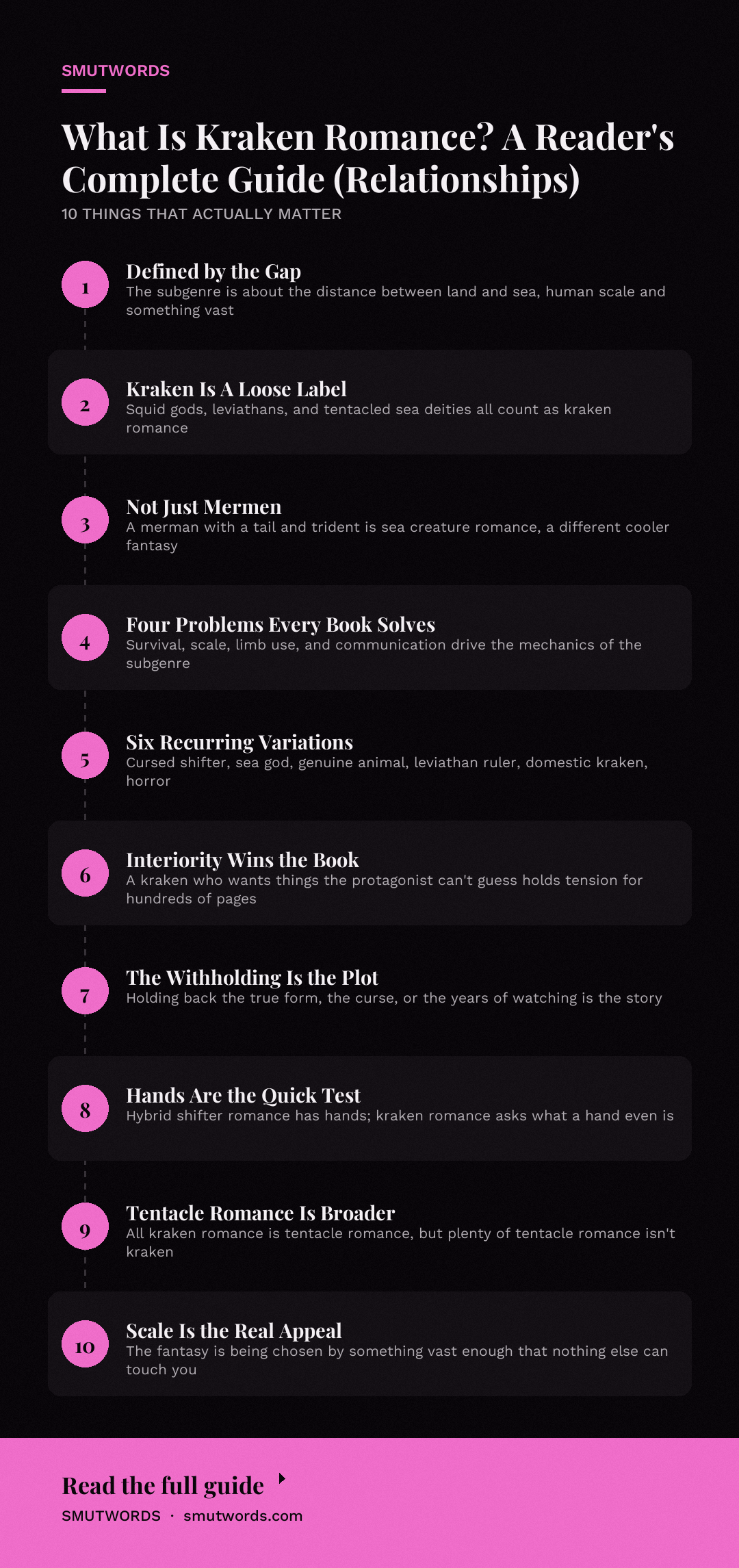
Kraken romance is a subgenre of monster romance in which one partner is a kraken, a colossal cephalopod of myth and deep water, and the love story has to account for the fact that one half of the couple lives in the abyss and the other mostly doesn't. The kraken might be a curse-marked shapeshifter, a bound sea god, a genuinely enormous animal with a mind, or something older than either.
What defines the category is the gap: land and sea, human scale and something you cannot see the end of. Readers come for the tentacles and stay for the problem of loving a thing the size of a weather system.
What Kraken Romance Actually Means
The word kraken comes from Old Norse kraki, a term for a twisted or stunted tree, applied by Scandinavian sailors to a sea beast said to drag ships down whole. The creature entered English through eighteenth-century natural history writing as a real animal somebody claimed to have measured. Erotica inherited that ambiguity. A kraken love interest is always slightly impossible, and the books know it.
What counts as kraken romance is looser than readers assume. The love interest does not have to be a literal kraken. Enormous octopuses, squid gods, deep-sea leviathans, and sea deities with tentacled true forms all read as kraken romance to the audience that buys it. What matters is the iconography: multiple limbs built for grasping, a body optimized for crushing pressure, eyes that evolved somewhere sunlight never reached.
What does not count is a merman with a temper. Tail, lungs, maybe a trident. That is sea creature romance in a different key, and the fantasy runs cooler.
The kraken version has weight to it. The creature is not scaled up to be sexy; it is scaled up to be frightening, and then the book makes it tender anyway.
Common misconceptions worth clearing up:
- That it's always noncon or horror-adjacent. Plenty of kraken romance is cozy, slow, and deeply consensual. The tentacles are a body part, not a warning label.
- That the kraken is always male. Kraken heroines, kraken love interests with no gender at all, and human protagonists of every gender all show up regularly.
- That tentacle sex is the whole point. It is often a big point. It is rarely the only point.
- That the creature is monstrous and stays monstrous. Most of the shelf uses shapeshifting to let the kraken appear human when convenient, which changes the emotional math entirely.
- That it's a niche with no history. Sea-monster seduction is one of the oldest motifs in speculative fiction, and erotica has been borrowing it for decades.
There's a real kinship here with alien romance. Both ask the reader to fall for something anatomically incompatible and culturally unreachable. The kraken version just sets the incompatibility underwater instead of in orbit.
Where Kraken Romance Comes From
The honest history of kraken romance as a publishing category is short and recent, and it runs through a much older history of sea monsters in literature. Separating the two matters, because a lot of what gets written about this subgenre pads the timeline with mythology and skips the part where the books actually started selling.
Tentacled seduction shows up in Victorian and pulp-era adventure fiction as menace, not romance. The giant squid in Jules Verne is an obstacle. Lovecraft's cephalopod gods are objects of dread. For most of the twentieth century, the tentacle in Anglophone fiction signals violation, madness, or both.
Japanese erotic art and manga developed a parallel tradition of tentacle imagery starting in the postwar decades, and that tradition fed into Western internet culture in the 1990s and 2000s, where it became shorthand for extreme fantasy.
What turned the kraken into a romantic lead was the monster romance boom of the 2010s and 2020s. Once paranormal romance readers proved willing to buy books about demons, minotaurs, and orcs, authors and small presses started working through the monster catalog alphabetically. Sea creatures were an obvious next stop. The kraken had name recognition, a built-in visual, and a body plan that solved the anatomy problem in interesting ways.
The evolution since then has been mostly in how the creature is characterized. Early kraken romance leaned hard on captivity and threat, borrowing the abduction structure from alien abduction romance: taken, kept, claimed.
The current shelf is warmer. Kraken love interests now frequently run kitchens, guard shipwrecks, run salvage operations, or rule drowned kingdoms with an anxious kind of care. The threat is still there. It just isn't aimed at the protagonist.
A second shift: the ocean itself became a character. Recent kraken romance spends real page time on cold water, bioluminescence, pressure, and silence. That atmosphere is doing marketing work. Readers who want a book that feels like drowning in a good way know exactly which cover to pick up, which is why the subgenre has stayed legible even as it sprawls.
How It Shows Up in Erotica
On the page, kraken romance has a set of recurring mechanical problems to solve, and the books that work are the ones that solve them with confidence.
The survival problem. Humans drown. Every kraken romance has to deal with this within the first fifty pages. The usual fixes are a magical adaptation (the kraken marks the human, breathes for them, or alters them), a shapeshifting love interest who can meet on land, or a setting that's already underwater for everyone.
The fix the author picks determines the whole tone of the book. Adaptation magic tends toward the mythic. Shapeshifting tends toward the domestic. A fully submerged setting tends toward the strange.
The scale problem. A kraken at full size cannot hold a normal conversation, fit through a door, or share a bed. Authors handle this with size-shifting, with true-form reveals saved for climactic moments, and with careful staging where the creature stays partly submerged. The best versions let the size difference matter emotionally rather than just physically, which puts kraken romance in conversation with size difference romance.
The limb problem. Tentacles are the commercial engine of the subgenre and also its craft challenge. Strong scenes establish early what the limbs can do, give each one a distinct role, and use them for things besides sex. A kraken that holds a cup, catches a falling protagonist, and turns a page before it ever holds a person is a kraken the reader trusts with everything else.
The communication problem. Many kraken love interests don't speak. They use pressure, color, bioluminescent patterns, or a mind-link the author has to establish.
This is where the subgenre overlaps with soulbond conventions, and it's the biggest single differentiator between a kraken romance that lands and one that doesn't. If the reader can't tell what the creature wants, the romance stalls.
Common variations authors actually use:
Enjoyed this? Get a free book.
Join the list and we will send a complete free story straight to your inbox, plus new releases every week after that. No credit card, no catch.
- The cursed shifter. A person bound into a kraken form, usually by a god, a rival, or their own past. Romance resolves the curse or accepts it permanently.
- The sea god in true form. The love interest is a deity whose humanoid body is the mask. Tentacles are what's underneath.
- The genuine animal with a mind. Fully nonhuman, no shapeshifting, communication solved through magic or instinct. Rarer and harder to write.
- The leviathan ruler. Kraken as monarch of a drowned court, protagonist as diplomat, prisoner, or bride. This one borrows heavily from territorial shifter trope territory.
- The domestic kraken. Cozy setting, tentacles helping with chores, low external conflict. A growing slice of the market.
- The horror romance. The creature stays genuinely frightening and the book doesn't apologize. Related to hybrid shifter romance in how it handles a body that's more than one thing.
What separates a strong kraken romance from a flat one usually comes down to two things: whether the creature has interiority, and whether the ocean is a setting or a problem.
Books where the kraken wants things the protagonist can't guess, and where the water is actively working against the couple, hold tension for hundreds of pages. Books where the kraken is a hot guy with extra arms who happens to live near a beach run out of gas by chapter eight.
There's also a craft question about restraint. The reveal of the full form is the biggest card in the deck, and playing it early kills the back half. Strong kraken romance holds something back, whether that's the true size, the real reason for the curse, or the fact that the creature has been watching the protagonist for years before chapter one. The withholding is the plot.
For readers who like the specific texture of a fantasy creature with nonhuman anatomy and a lot of logistical friction around the sex, there's overlap with plenty of adjacent kinks.
The piercing fetish crowd, for example, tends to appreciate the same questions about what goes where and how it feels; our comprehensive guide to piercing fetish covers that ground. Kraken romance readers also tend to be monster romance readers generally, which means they tolerate a lot of strange anatomy and expect the author to handle it on the page rather than cutting away.
Kraken Romance vs Hybrid Shifter Romance
These two get confused because both involve a love interest whose body is not entirely one species, and both get shelved under monster romance. The distinction is where the nonhuman part sits on the spectrum between two recognizable forms and something else entirely.
Hybrid shifter romance typically involves a character who shifts between a human body and a single animal body, sometimes with a blended in-between state. Wolf, bear, big cat, occasionally something stranger. The creature half is still a mammal the reader recognizes.
Kraken romance breaks that. There is no blended state that reads as halfway between human and kraken, because the kraken isn't a scaled-up version of a person. It's a different phylum.
Books in this subgenre have to invent their own vocabulary for the in-between, and that invention is most of the fun. It's also why kraken romance tends to attract readers who are bored of wolf packs and are looking for something with more distance from the human.
If you're sorting between the two on a storefront, the quick test is the hands. Hybrid shifter romance always has hands. Kraken romance is asking what a hand even is.
Frequently Asked Questions
Is kraken romance the same as tentacle romance?
Not exactly. Tentacle romance is a broader tag that covers any erotica where tentacle anatomy drives the scene, including science fiction, alien settings, and purely humanoid characters with extra limbs.
Kraken romance is the subset where the love interest is specifically a sea creature of the kraken type, with the ocean setting and the deep-water mythology that come attached. Most kraken romance is tentacle romance. Plenty of tentacle romance is not kraken romance.
Do kraken romance books always involve shapeshifting?
No, but a majority do. Shapeshifting solves the practical problem of letting the kraken and the human share a bed, a meal, and a conversation.
Some books skip it and keep the couple physically separated for most of the story, meeting at the waterline and solving intimacy through magic instead. Both approaches work. The shapeshifting ones sell better.
Is kraken romance always dark?
No. The subgenre splits roughly into three tones: dark and horror-adjacent, romantic with real threat and a happy ending, and fully cozy with low stakes and domestic scenes. The cozy corner has grown fast in the last few years. If you want a kraken that helps with the dishes, that book exists and there are several of them.
What's the appeal for readers who aren't into monster anatomy?
The scale. Kraken romance sells a fantasy of being chosen by something vast, ancient, and powerful enough that nothing else in the world can touch you.
The tentacles are a feature, but the emotional core is the same as any romance where one partner is dangerous and the danger is aimed elsewhere. It's also adjacent to the abduction-romance fantasy of being taken somewhere no one can follow. Readers who like angel romance for the same reason often end up here.
How explicit do kraken romance books usually get?
Very. The subgenre runs from steamy to fully explicit, and the majority sits at the explicit end because the anatomy is part of the sales pitch. Readers who want the sex on the page will find it. There's also a small but real corner of closed-door kraken romance for people who want the myth and the mood without the mechanics.
Where should someone start if they've never read one?
Pick by tone rather than by creature. If you want warmth, look for covers with soft lighting and a single tentacle curling near a human hand. If you want the horror-romance version, look for deep blues, storm imagery, and a title that mentions drowning, abyss, or teeth. The cover art in this subgenre is unusually honest about what's inside.
Final Thoughts
Kraken romance works because it takes the oldest fear in the human catalog, being pulled under by something you can't see, and rewrites it as being wanted. The best books in the subgenre don't soften the creature. They change what the creature is for.
If you want one place to start, look for a book that keeps its kraken silent for the first hundred pages and makes you wait for the voice. That restraint is usually the sign of an author who understands what the subgenre is for.
Genre readers who like the same slow burn of revelation in other fantasy pairings, particularly the ones with real cultural distance between partners, tend to like elf romance for the same reasons. Start there if you want to trace the family tree before you go back to the water.







Loading comments…