
Childhood friends to lovers is the romance trope where two people who grew up together, shared a sandbox or a school bus or a bedroom wall, finally stop pretending the friendship is the whole story. The slow burn starts early, sometimes decades before page one.
What makes the childhood friends to lovers arc so reliable is the intimacy already sitting there: inside jokes, family history, the way she knows how he takes his coffee and he knows which songs she skips.
Converting that into romance takes very little convincing and enormous courage. That gap is the tension the trope runs on.
What Childhood Friends to Lovers Actually Means
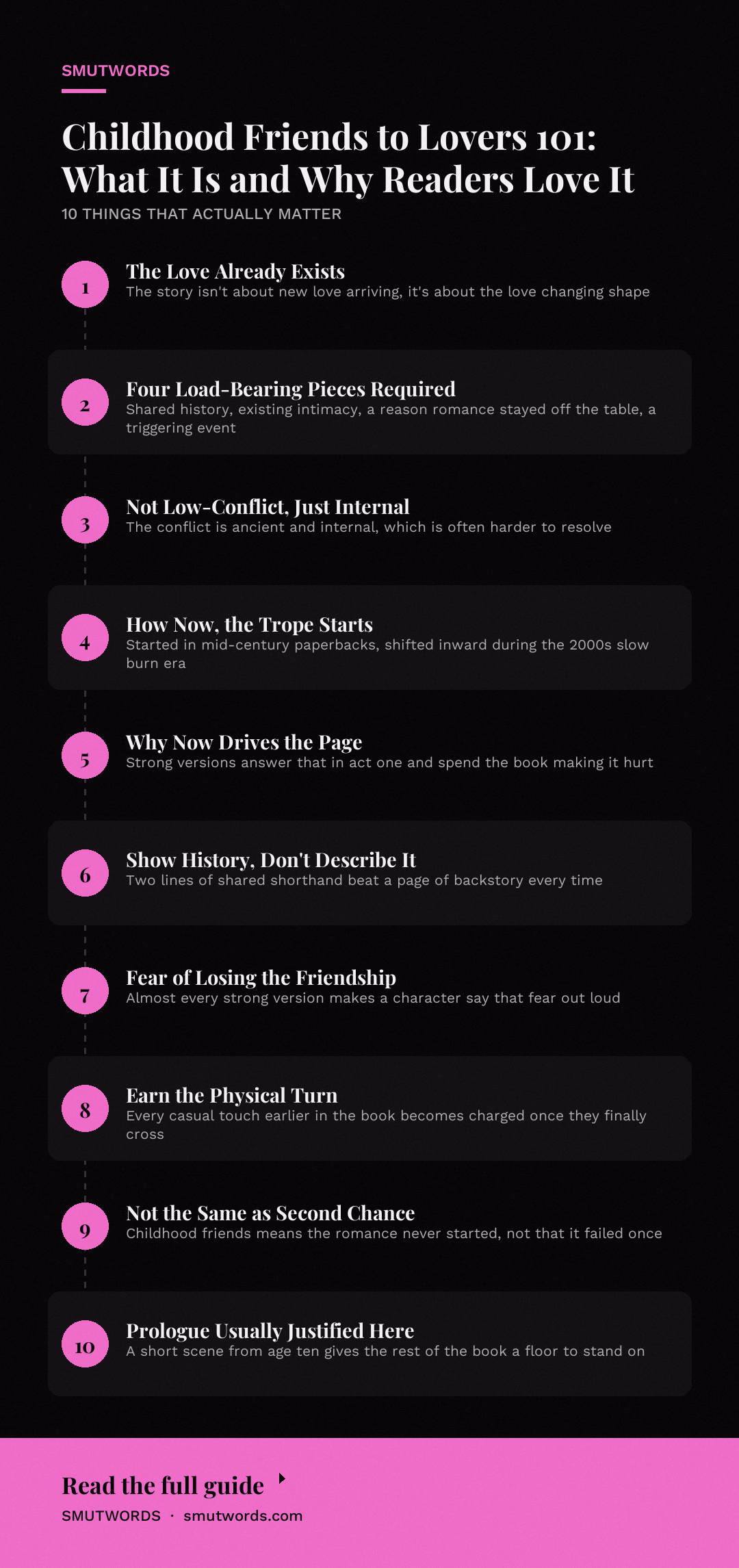
The term describes a specific architecture of romance, not just proximity. Two characters share a formative past, and that past creates both the foundation and the obstacle. They already love each other. The story is about the love changing shape.
Not every long friendship qualifies. A childhood friends to lovers romance needs a few load-bearing pieces:
- A shared history that predates the story. The reader should feel the years even if they are delivered in flashback or offhand reference. Ten years of friendship hits differently than ten months.
- An existing emotional intimacy. The characters already tell each other things. The shift is about the nature of the closeness, not its arrival.
- A reason the romance stayed off the table. Fear of losing the friendship, a bad timing window, a family complication, an unspoken rule. Without friction, the transition has no weight.
- A triggering event. A wedding, a funeral, a return to the hometown, a drunken confession, a divorce. Something cracks the status quo open.
The name itself is plain and descriptive, which suits a trope whose appeal is plain and descriptive. This is not the genre's flashiest category. It might be its most emotionally grounded one.
What Does Not Count
If two characters met once as children and reconnected as adults, that is closer to second chance romance with a childhood prologue. If they were neighbors for one summer at age nine and barely spoke, the shared history is too thin to carry the trope. The distinction matters because readers searching for childhood friends to lovers are looking for a specific feeling: the vertigo of seeing someone familiar turn into someone wanted.
A frequent misconception is that this trope is low-conflict. It is not. The conflict is internal and ancient rather than external and fresh, which is often harder to resolve.
You cannot fix a decade of unspoken wanting with a grand gesture in the final chapter. You have to dismantle it brick by brick.
Another misconception is that the couple must be the same age. They don't. A four-year gap means the older character remembers the younger one as a kid, which adds a guilt layer some authors mine deliberately. A twelve-year gap usually pushes the story out of this trope entirely and into a different dynamic.
Where Childhood Friends to Lovers Comes From
The trope's roots in published romance run deep and are tangled with the broader friends to lovers category, which has been a staple of the genre since mass-market paperback romance took hold in the mid-twentieth century. The childhood version is the deepest cut of that category, because it carries the most accumulated history and therefore the most emotional debt.
In the 1980s and 1990s category romance era, the childhood friends to lovers setup usually arrived with a strong external force: a marriage of convenience, a ranch to save, a family promise. The shared past was backstory. The plot was business. You can still see that DNA in contemporary western romance, where small towns make long histories unavoidable.
The 2000s and 2010s shifted the weight inward. As romance publishing grew more interested in interiority and slow burn, the childhood friendship became the plot rather than the setup. The obstacle was no longer a ranch. It was the terrifying possibility of ruining something irreplaceable.
Indie publishing accelerated the change. Digital-first authors writing for Kindle Unlimited discovered that readers would happily follow a childhood friends to lovers novel across 400 pages of barely-there physical contact, provided the emotional tension never sagged. That discovery reshaped pacing conventions across the entire genre.
Contemporary publishing has pushed the trope into new territory. Queer romance has been especially fertile ground, partly because the childhood friendship can double as a coming-of-age story, and the years of unspoken feeling map onto the years before coming out.
The trope also now runs comfortably alongside darker material: a childhood friend who returns from military service slots into soldier romance, and a reconnection after years apart can carry the same weight as marriage in trouble if the pair married young and grew wrong.
What has stayed constant across four decades is the core promise. The reader knows these two people belong together before either character admits it. Every page is a countdown.
How It Shows Up in Erotica
On the page, childhood friends to lovers lives and dies by the same question: why now? A strong version answers that in the first act and spends the rest of the book making the answer hurt.
The most common structural choice is the return. One character comes back to the town, the neighborhood, the family house.
The reunion scene does the work of establishing history fast, usually through behavior rather than exposition. She still steals his fries. He still calls her by a nickname nobody else uses.
The second common structure is the threshold, where the pair has been circling each other for the whole book and one night tips it. These stories are almost entirely slow burn, and the payoff scene has to deliver on hundreds of pages of restraint. Most authors know to make the first kiss carry more voltage than the sex.
Common Variations Authors Use
The trope has developed a reliable family of sub-shapes. Each one solves the "why now" problem differently, and each one makes different demands on the writer:
Enjoyed this? Get a free book.
Join the list and we will send a complete free story straight to your inbox, plus new releases every week after that. No credit card, no catch.
- Best friends to lovers. The closest sibling of the trope. One character has usually been in love for years while the other is oblivious, which makes the reveal scene the emotional centerpiece.
- Childhood crush gone adult. The unrequited version. One party has been quietly wanting since age fourteen, and the story is about the other one catching up.
- Sibling's best friend. Adds a loyalty complication. The romance risks damaging a third relationship, usually a brother who is protective or worse.
- Second chance childhood friends. They tried once, it failed, they find each other again. This variant borrows heavily from redemption arc romance, because one or both parties need to earn the second attempt.
- Friends to enemies to lovers. A rift pushes them apart, usually a betrayal or a misunderstanding, and they rebuild with an edge.
- Small town rediscovery. Neither left, both stayed, and the tension is that everyone in town has been waiting for this for years.
- Childhood pen pals or long distance. The intimacy survives on letters or texts, sometimes with a long gap, which makes the eventual meeting physical in a way that hits harder.
Authors frequently combine the trope with parenting complications. A secret baby reveal lands differently when the father is the guy who taught the mother to ride a bike, because the reader has already spent chapters trusting him.
What Makes a Strong Version Work
The best childhood friends to lovers stories do specific things on the page, and those things are learnable:
- They show the history instead of describing it. Two lines of dialogue in a shared shorthand do more than a page of backstory. A character who instinctively reaches for the other's hand before crossing a street tells the reader everything.
- They give the characters separate lives. The friendship works best when both people are complete adults with jobs, friends, and past relationships. Codependency is a different trope.
- They address the fear directly. The strongest versions let a character say out loud that losing the friendship would be worse than never having the romance. That line is the engine of the book.
- They earn the physical turn. When the couple finally touches, every prior scene of casual contact becomes retroactively charged. The hand on the back. The head on the shoulder. The borrowed hoodie.
- They let the community react. Families, siblings, and old friends have opinions, and those opinions create pressure the couple has to resist or fold to.
Weak versions fail in predictable ways. The characters have no reason to be apart other than author-imposed delay. The history is asserted rather than felt. The obstacle dissolved two chapters before the breakup, and the third act feels like filler.
You can usually spot a flat version by page fifty. If the two leads are already acting like a couple with the labels removed and nothing is at stake, the book has spent its best material early.
There is also a craft question about heat level. Some childhood friends to lovers novels are tender and slow, and others push into explicit territory while keeping the emotional architecture intact. A reader who wants the second kind is usually looking for the same thing the first kind provides: recognition, history, and the specific thrill of a familiar body becoming unfamiliar.
In that sense it shares common ground with kinks built on long-term familiarity and accumulated detail, the way a smoking fetish story depends on repetition and ritual more than novelty, or the way D/s protocols build intensity through structure rather than surprise. The trope rewards writers who understand that intimacy compounds.
One more craft note worth stating plainly: this trope is one of the few where a prologue is almost always justified. A short scene from age ten, or a single childhood memory rendered clean, gives the rest of the book a floor to stand on. Do not skip it because prologues are unfashionable in some writing advice circles. The advice is about bad prologues, not about this trope.
Childhood Friends to Lovers vs Second Chance Romance
These two get confused constantly, and the confusion is understandable, because they overlap. The difference is where the relationship broke.
Childhood friends to lovers means the romance never started. The friendship ran for years without crossing the line, and the story is about crossing it for the first time.
Second chance romance means the couple already tried, and the story is about the second attempt after failure. The emotional question is different. One is what if we ruin this. The other is what if we ruin this again.
Plenty of books are both. Childhood friends who dated briefly at nineteen, blew up, and reconnect at thirty. When that happens, the childhood friendship usually supplies the texture and the second chance supplies the plot.
If you are searching for one and find the other, you are probably still going to be happy, but the pacing conventions differ. Second chance stories often open with the couple already estranged, while childhood friends stories typically open with the friendship intact and thriving.
The easiest test: in the first chapter, are they still friends? If yes, you are reading childhood friends to lovers.
Frequently Asked Questions
Is childhood friends to lovers the same as friends to lovers?
Friends to lovers is the broader category and includes adults who met last year. Childhood friends to lovers is a subset that requires a shared formative history. The childhood version carries more accumulated weight, which is why the transition to romance tends to feel more inevitable and more terrifying at the same time.
Why is it so popular in romance novels?
It delivers trust, familiarity, and long-term emotional investment without asking the reader to believe in instant chemistry. The relationship is already built. The book is about the change, not the meeting, and readers get to enjoy both the security of the friendship and the thrill of it shifting into something sexual and romantic.
Can childhood friends to lovers work as a standalone or does it need a series?
It works perfectly well as a standalone, especially in small town settings where the surrounding community gets sketched in a single book. Series work well when the friend group has multiple couples to pair off, since the reader already knows the world. Neither approach is superior, but series versions tend to spend less time on worldbuilding.
What is the most common conflict in these stories?
Fear of losing the friendship. Almost every strong version of the trope makes one or both characters voice the specific worry that a failed romance would cost them the relationship they already have. Authors who skip that fear end up with a book that feels low-stakes.
Does childhood friends to lovers have to be a slow burn?
Not strictly, but the pacing almost always benefits from it. Because the emotional foundation is already in place, a fast physical turn can feel unearned unless the author renders the internal shift with care. Most successful versions pace the physical relationship slower than the emotional one.
Is sibling's best friend the same trope?
It is a variation. The shared history is usually there, but the complicating factor is a third party whose loyalty is on the line. A sibling's best friend story can be a childhood friends to lovers novel, or it can be a near-miss if the two characters barely knew each other growing up.
Can this trope work outside contemporary romance?
Yes. Historical romance uses it constantly, and so does paranormal and fantasy, especially in stories that span decades or involve long-lived characters. The only requirement is that the shared history be believable given the world's rules, which is harder in settings where children are separated by class or geography.
Final Thoughts
Childhood friends to lovers rewards readers who want a romance built on foundations instead of fireworks. It rewards writers who understand that the most charged moment in these books is almost never the first kiss. It is the moment one character realizes the person across the table has been the answer the entire time. If you want to see the trope executed with the kind of patience it demands, the list below has ranked picks worth your weekend.








Loading comments…