Most readers search "cuckold breeding vs cuckold pregnancy" because a review used the two terms like they're interchangeable, then a blurb used one of them to promise something the other one doesn't deliver. They aren't the same thing, and the difference matters before you buy.
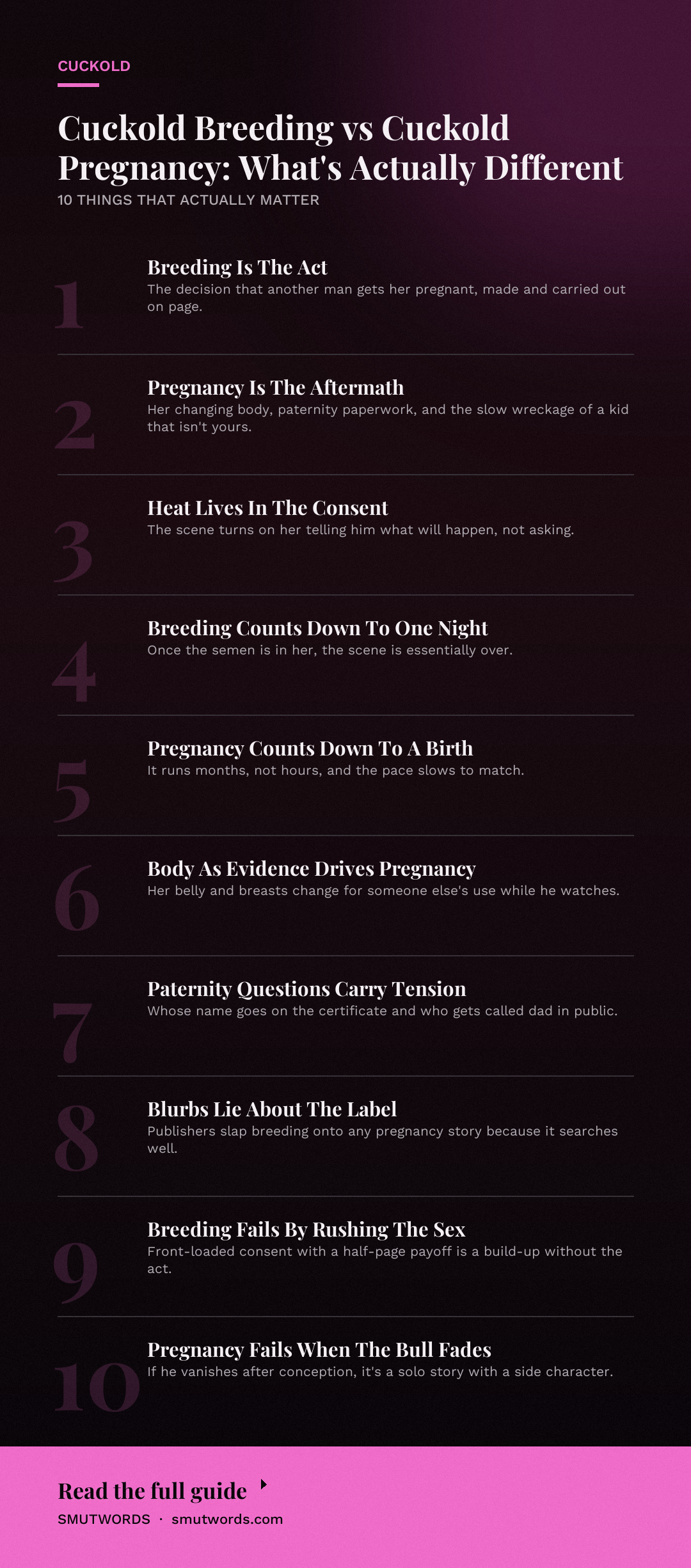
Cuckold breeding is about the act: the decision that another man will get your wife pregnant, made and carried out on page. Cuckold pregnancy is about what's left once it takes: her changing body, the paperwork of paternity, the slow domestic wreckage of a kid that isn't yours. One is a scene. The other is a situation.
Confuse them and you'll download a breeding story expecting nine months of belly and get forty pages of raw, filthy conception instead, or the reverse. So here's the actual split, what each one is good at, and where each one usually fumbles the fantasy.
What cuckold breeding actually means
Breeding is a verb. A breeding story is built around the moment the order gets given: she's going to let him finish inside her, no protection, no pulling out, and the husband either watches or gets told about it after. The heat lives in the consent, because it takes two people agreeing that his swimmers are welcome, plus a third person quietly accepting his role in the room.
That's why so many breeding scenes stall right at the bedroom door. The wife says yes to the bull, the bull says he's clean, and then a chapter of hand-wringing about whether this is "really" the right call. Or the production handles it and the scene rushes straight to penetration while the husband stands there like a coat rack.
The beats a good breeding scene needs
- The conversation beforehand where she tells her husband what's going to happen to her, not asks. The power is in the telling.
- The countdown: pulling out of a planned withdrawal, the condom coming off, the "don't stop" that ends the option.
- Her choice of position with the husband in the room. Doggy or from behind so he sees everything. Or she looks him in the eye while the other man finishes, because that's the cruelest version and often the best one.
- Aftercare that isn't really aftercare: she's dripping and glowing and her husband is allowed to clean her up while she tells him how it felt.
Notice how none of those beats require anyone to get pregnant. The breeding kink is the deliberate no-pulling-out, the "we want his baby," the risk she's brave enough to take. The actual conception is the door closing behind it, not the room.
What cuckold pregnancy means on the page
Pregnancy starts months after the sex. It's the term for stories built on the consequence: a wife who's visibly carrying another man's child, a husband who has to explain the timeline to relatives, an ultrasound appointment he attends as the third wheel while the bull gets a photo of the scan sent to his phone. The tension comes from a body that keeps changing and a set of documents that don't.
Three things reliably drive a pregnancy storyline, and none of them are the sex act itself:
- The body as evidence. Her belly grows. Her breasts change for someone else's use. Her husband watches and has opinions about all of it, and those opinions are usually a mess.
- Paternity questions. Whose name goes on the birth certificate. Who gets called "dad" in public and who doesn't. Whether the husband's family finds out and how.
- The relationship rearrangement. The bull becomes a fixture: money, visitation, decisions, a role in the house that was never negotiated before the positive test.
Plenty of pregnancy-focused erotica is slower, more character-driven, and spends as much time on a doctor's appointment as on a single sex scene. If what you want is the emotional slow burn of a husband coming to terms with a nursery he isn't technically needed in, that's your shelf.
If you want heat, you'll be bored. Both are legitimate. They're just not answering the same question.
Cuckold breeding vs cuckold pregnancy: the real difference
The cleanest way to tell them apart is to ask where the story's clock starts and what it's counting down to.
Cuckold breeding counts down to a single event: the night she conceives, or the week it might happen. Everything on the page points forward to one decisive act, and once the semen is in her, the scene is essentially over. Story length runs short, often under 15,000 words, and the pacing is fast, dirty, and single-minded.
Cuckold pregnancy starts after that night and counts down to a birth, a name on a form, or a confrontation that forces the arrangement out into the open. It's a chapter of months, not hours, and the pace slows accordingly. Structure tends toward novella length or full novels, with multiple sex scenes broken up by conversations that exist to move the pregnancy plot, not to get anyone off.
There's a third shape you'll find labeled both ways, and it's the sneaky one: a breeding scene that stretches for the full pregnancy, with the husband narrating every month. Those work when the writer treats the conception as a hook and the pregnancy as the actual story, with weeks of belly growth, a shower scene, and one big reveal at the end.
Enjoyed this? Get a free book.
Join the list and we will send a complete free story straight to your inbox, plus new releases every week after that. No credit card, no catch.
They fail when the writer thinks the conception scene is the whole appeal and the pregnancy is just "and then she got bigger." A good rule of thumb: breeding is the first ten pages; pregnancy is the next two hundred.
How to tell which one a book actually delivers
Blurbs are useless for this. Authors and publishers toss "breeding" onto any pregnancy story because it's a strong search term, and readers get burned. Read the sample instead and look for these tells.
Signs you're reading a breeding story
- Most of the sample takes place in real time, over one night or one weekend.
- The husband is physically present for the sex, watching and reacting.
- The words "come inside me," "fill me up," or "put a baby in me" show up in the first sex scene.
- If there's an epilogue with a baby, it's a page, not a quarter of the book.
Signs you're reading a pregnancy story
- The sample opens with a positive test, a missed period, or a conversation about the fact that it happened.
- Multiple scenes take place away from sex: a dinner, a doctor's office, an argument in a car.
- The bull has a name and a schedule, and he's not going anywhere.
- The husband's feelings about being a father to someone else's child get actual page time, not just a dry grunt.
If you're new to the husband-watching dynamic behind all this, the cuckold glossary entry covers the role basics, and a few key terms come up again and again in the breeding corner of the catalog: breeding kink for the deliberate conception angle, and hotwife for the wife who plays with permission while her husband watches. Those three glossary pages will save you more money than any review if you're trying to find the exact flavor you want.
Where each trope tends to fall apart
Breeding stories fail in one specific way: they front-load the consent and then rush the sex. If the sample exhausts the negotiation scene and the actual act gets half a page, you've been sold a build-up without the payoff. The other common failure is the "clean bill of health" conversation that lasts four paragraphs and kills the scene dead. It's a courtesies check, not foreplay.
Pregnancy stories fail differently. The most common mistake is treating the pregnancy itself as the entire conflict: "she's pregnant, now what?" without giving the husband a real emotional arc beyond vague discomfort.
Good versions give him a job, a family, a reputation, something concrete to lose. The second failure is a birth scene that arrives without warning and eats thirty pages. And a third, sneakier one: the bull fades out right after the conception, which makes the pregnancy feel like a solo story with a side character rather than the three-person arrangement you paid for.
If your taste runs to the softer end of that arrangement, the group marriage glossary entry is worth a look, since it covers the "more than one man, more than one role in the house" setup that some pregnancy plots land on by the final chapter.
Which one to buy, based on what you're actually after
If you want a fast, dirty read with heavy heat and a single scorching scene, go breeding. If you want a story with emotional fallout, slow body changes, and a husband slowly rearranging his life around a kid who isn't his, go pregnancy. Most readers end up wanting both eventually, just not on the same night.
Cuckold breeding tends to get bought by readers looking for one long, raw scene, which is why it's so common in short-story collections. Cuckold pregnancy is usually a novella or novel purchase, and readers tend to re-read their favorites rather than hunt for new ones, because the specific arrangement of characters matters more than the plot. Neither is nobler than the other. They're just different purchases, and knowing which one the blurb is actually promising you is the whole trick.
One last thing worth saying out loud, since the search volume on this topic keeps climbing: women read both. So do men who've never been in the room and have no plans to be. The fantasy doesn't require lived experience to land, and a lot of the best-reviewed stories in this corner of the catalog are written for readers who like the dynamic precisely because it's a fantasy and not a lifestyle.
Pick the flavor that hits you tonight and don't overthink the label.
Final Thoughts
Start with breeding kink if you want the act, and save the slower, paternity-driven stuff for a weekend when you're in the mood for a messier emotional arc.
Once you've picked your lane, that glossary page is the cheapest way to find out whether a blurb is using "breeding" honestly or just slapping the word onto a pregnancy story it doesn't fit. Read the sample, check which clues show up, and buy the one that actually gives you what you came for.



Loading comments…