
Search "best JOI books" and you get three kinds of results: generic lists that clearly haven't read the books, dead forums from 2014, and one person's very specific Google Doc. What you rarely get is someone who's actually sorted the breath play end of the shelf from the rest of it. That's what this is.
Jerk-off instruction fiction has a specific appeal when it's done well. Breath play layered on top raises the stakes in ways most JOI titles don't even attempt.
The overlap matters because they're two different reader demands. JOI readers want pacing, escalation, and an instruction voice that holds the scene together. Breath play readers want a controlled loss, written with enough craft that the page can hold the tension.
Put them together and you get something harder to write than either alone, which is why so many attempts fall flat. Here's what's actually worth your time.
Why Breath Play and JOI Work Together
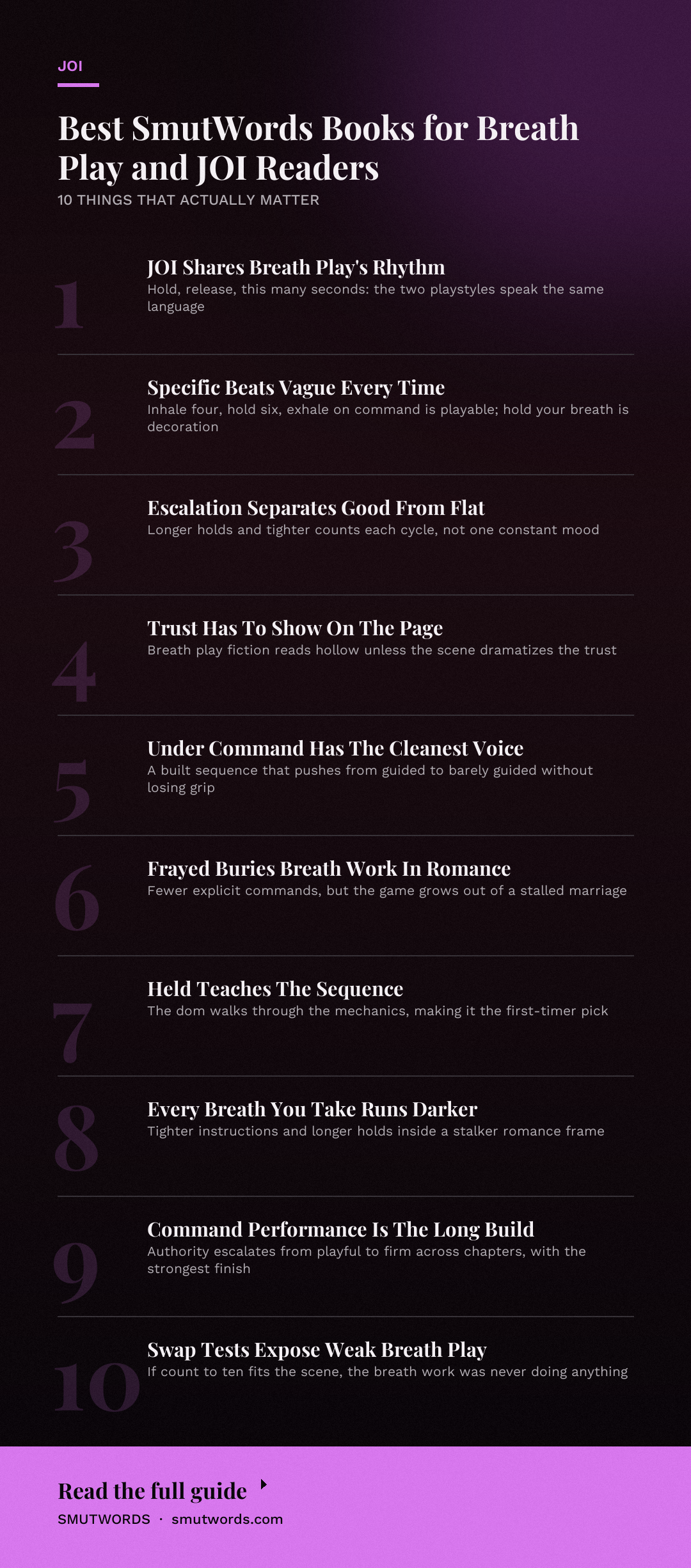
Jerk-off instructions already borrow the structure of breath play: breath in, hold, release. The rhythm of "hold it," "this many seconds," "don't let go" is a whole language shared between the two. A writer who understands breath work has a built-in pacing tool for JOI scenes. A writer who understands JOI has a built-in way to feed a reader through a breath play scene without it collapsing into abstraction.
The failure mode is obvious if you've read enough of these. Too many titles treat "breathe, hold, release" as the entire breath play element and then move on to a generic stroke count. Reader gets a minute of atmospheric danger and then nothing. Good breath play JOI keeps the pressure running under the whole scene, so each instruction lands with something real riding on it.
What separates a good breath play JOI title from a bad one
- Specific instructions. "Hold your breath" is not the same as "inhale for four, hold for six, exhale on the next command." The second is playable. The first is decoration.
- An actual instruction voice. The dom's pattern should sound like one person with a method, not a list of prompts you could shuffle like flashcards.
- Escalation. Each cycle should increase the stakes: longer holds, tighter counts, more riding on whether you hold. Flat intensity is the most common problem in breath play JOI, because writers mistake a constant mood for progression.
- A willing partner in each scene. Breath play is about trust, and the fiction has to actually dramatize that trust or the whole thing reads hollow.
If you want to understand how the mechanics are built from the writer's side, the walkthrough in How to Write a JOI Game: Pacing, Choices, and Escalation That Actually Works covers the escalation problem specifically.
The 5 Best JOI Books for Breath Play Readers
Five titles that actually earn the description. Each maps to a slightly different reader. Some lean heavier into instruction mechanics, some build the breath work into the romantic tension first and let the game follow. None of them treat the two as decoration.
1. Under Command: the cleanest instruction voice
If you want to know what a controlled breath play scene reads like when the writer clearly built it before writing any dialogue, start here. The dom runs a specific sequence: breath count, stroke sequence, hold, release. There's a rhythm to it that changes as the scene escalates, and the scene pushes from "guided" into "barely guided" without losing its grip on the reader.
The breath play writing is genuinely good: nothing purple, nothing that reads like a yoga class, just clear instructions that land with weight. The romance holds up too, which matters if you read for plot as well as play. Strong pick for a reader who wants the game to mean something.
2. Frayed: a slower version of the same craft
Frayed takes a different tack. The breath work is woven through the couple's relationship from the beginning, so by the time the JOI scene shows up, it's a natural escalation of what they've already been building. Most of the early book is marriage in trouble territory, with the game as the point where a stalled dynamic gets forced open.
The instruction sequences in Frayed are less mechanical than Under Command, more conversational, and the breath holds are longer and less obviously staged. The trade-off is fewer explicit commands per scene. If you're searching for a pure instruction-book experience, it doesn't scratch that itch. If you want breath play embedded in a whole relationship, it's the better pick.
3. Held: the one for anyone who's never tried breath play before
This is what I'd point a first-timer to, and the reason isn't the plot. The instructions are genuinely instructive: the book explains what's happening on the page in a way that models the rhythm for someone who hasn't done breath work before. The dom explicitly teaches the sequence, which gives the reader a feel for how the play works even if it's all new.
The first-timer JOI walkthrough pairs well with this one because the book does the same work: it slows down and lets the reader settle into the mechanics. The romantic plot is simpler than the other two, so don't go here if you want a long build. But for a reader who wants to understand both the breath play and the JOI structure while actually enjoying a book, Held earns its spot.
4. Every Breath You Take: the moodier, darker option
The tone in this one runs darker than the rest of this list, and the breath play reflects it: the instructions get tighter, the holds longer, the reward sharper on the far side. The book leans into a stalker romance structure, with the game as a way for the love interest to push proximity and hold.
Worth trying if you like the atmospheric end of breath play JOI and want the danger on the page. Skip it if you want your breath play gentle and warm. The tone is not for everyone, but for readers who like a scene with teeth, Every Breath You Take delivers the held-breath-to-release sequence better than anything else on this shelf.
Enjoyed this? Get a free book.
Join the list and we will send a complete free story straight to your inbox, plus new releases every week after that. No credit card, no catch.
5. Command Performance: the interconnected JOI title
Where a lot of JOI fiction is single-scene, Command Performance is the full arc: a longer book with more room for the game to develop across chapters. The breath play escalates in a way that makes actual narrative sense, with the dom's authority building from playful to firm over the course of the story. If you want the long version of an interactive JOI game translated to long-form fiction, this is what to read.
The trade-off is that the middle third sags if you're here purely for the breath play. But the ending pays off the buildup better than any shorter title on this list, and the final scene is the strongest example of breath play JOI on the shelf.
How These Books Map to Reader Types
There's no single "best JOI book" for breath play readers. Sort yourself by what you actually want. The differences matter more than the ranking.
If you want instruction-heavy JOI with breath play as the backbone
Start with Under Command. It's the cleanest example of a JOI sequence structured around breath work, and if the pacing clicks for you, Command Performance is the long-form version. These two share DNA. The reader who loves one usually loves both.
If you want the breath play blended into the whole relationship
Frayed and Every Breath You Take do this. Frayed for slow burn and marriage trouble tension; Every Breath You Take for darker, stalker-leaning atmosphere. Neither title treats breath play as a scavenger hunt for scenes you have to find past the plot.
If you're new to either breath play or JOI
Held is the obvious starting point. It's also worth skimming the breath play JOI guide first if you haven't read the playstyle before, since it covers the rhythm assumptions and the safety basics that good books assume you already understand. Most of the books on this list get the physicality right. Held is the one that actually teaches the sequence rather than assuming you know it.
What Breath Play in JOI Fiction Actually Does Well
The better titles on this list share a willingness to slow down and dramatize the command itself. A breath play JOI scene lives or dies on whether each instruction carries visible weight. When a writer rushes the sequence, it reads as a list of prompts. When a writer stretches the beat between the hold and the release, it reads as play.
There's also a trust problem to solve. Breath play is a high-trust playstyle in a way that other JOI scenes aren't, and the fiction has to earn that trust or the breath work becomes empty signaling.
Held, Frayed, and Command Performance each solve the problem differently, but all three make the trust visible in the prose. Every Breath You Take makes the trust the central tension. Under Command makes it the reward.
None of these books treat the breath play as one interesting scene at chapter three and then forget it. That's the bar. If a title puts breath play on the cover, it should be running underneath every scene.
Signs the breath play in a JOI book is underdeveloped
- The breath instructions could be swapped for "count to ten" without changing the scene.
- Every breath play moment happens in a single chapter, and the rest is normal JOI.
- The dom gives instructions but never builds on them; every scene is the same hold length.
- The romance plot would work the same if the breath play were deleted.
- The safety conversation gets skipped entirely, which tells you the writer was never going to write the physicality honestly.
These aren't dealbreakers for everyone. Plenty of readers are happy with a light dusting of breath play over a mostly generic JOI narrative. But if you searched "best JOI books" hoping to find breath play treated seriously, the difference between a title that hits these points and one that doesn't is the difference between a reread and a refund.
Beyond These Five: Related Shelves Worth Knowing
Some readers who land on breath play JOI actually want a heavier power dynamic than ordinary instruction scenes can offer. That's where a full total power exchange reading list beats any JOI-specific roundup. The instruction voice in those books runs similar, and the breath play sequences are usually longer and more conditioned. If the dom's closeness in Command Performance is what pulled you in, the TPE shelf is where to go next.
Readers who like their JOI fiction with more plot scaffolding also drift toward the heavier trope end, and some of those books double as breath play reads even without the label. The JOI game for women roundup has a few titles with breath work, some of them with thriller plotting on top, which makes them a stealth pick if you didn't think to look there.
Most of these crossovers won't put "breath play JOI" on the cover. That doesn't mean they don't belong on your shelf if the mechanics are solid. Half the point of a reader's shelf is that the taxonomy gets porous over time, once you know the writing patterns to look for.
Final Thoughts
Start with Under Command if you want to test whether breath play JOI is your thing at all. It has the cleanest instruction voice on this list and the most efficient sequence, so if the rhythm doesn't land, the rest of the roundup probably won't either. If it does, Held and Command Performance are the next two to pick up: one for the gentle on-ramp, one for the long-form build.


Loading comments…