
Total power exchange (TPE) is a consensual arrangement in which one partner hands over authority over most or all of their life to another, and the other agrees to hold it. It goes past weekend scenes and specific fetishes into the whole shape of a shared daily existence: who decides what the submissive eats, wears, does with their hours, spends, and answers to.
In erotica, TPE is a staple engine for 24/7 rule-based stories where protocols, ritual, and total devotion drive the emotional plot. The appeal sits in the extremity of the surrender and the trust required to make it real.
What Total Power Exchange Actually Means
The phrase itself is a construction of the modern kink community, built to describe an arrangement that had outgrown the vocabulary of "Dominant and submissive." A standard D/s relationship might structure scenes, or a bedroom-only protocol, or a particular ritual around service. Total power exchange claims the entire clock.
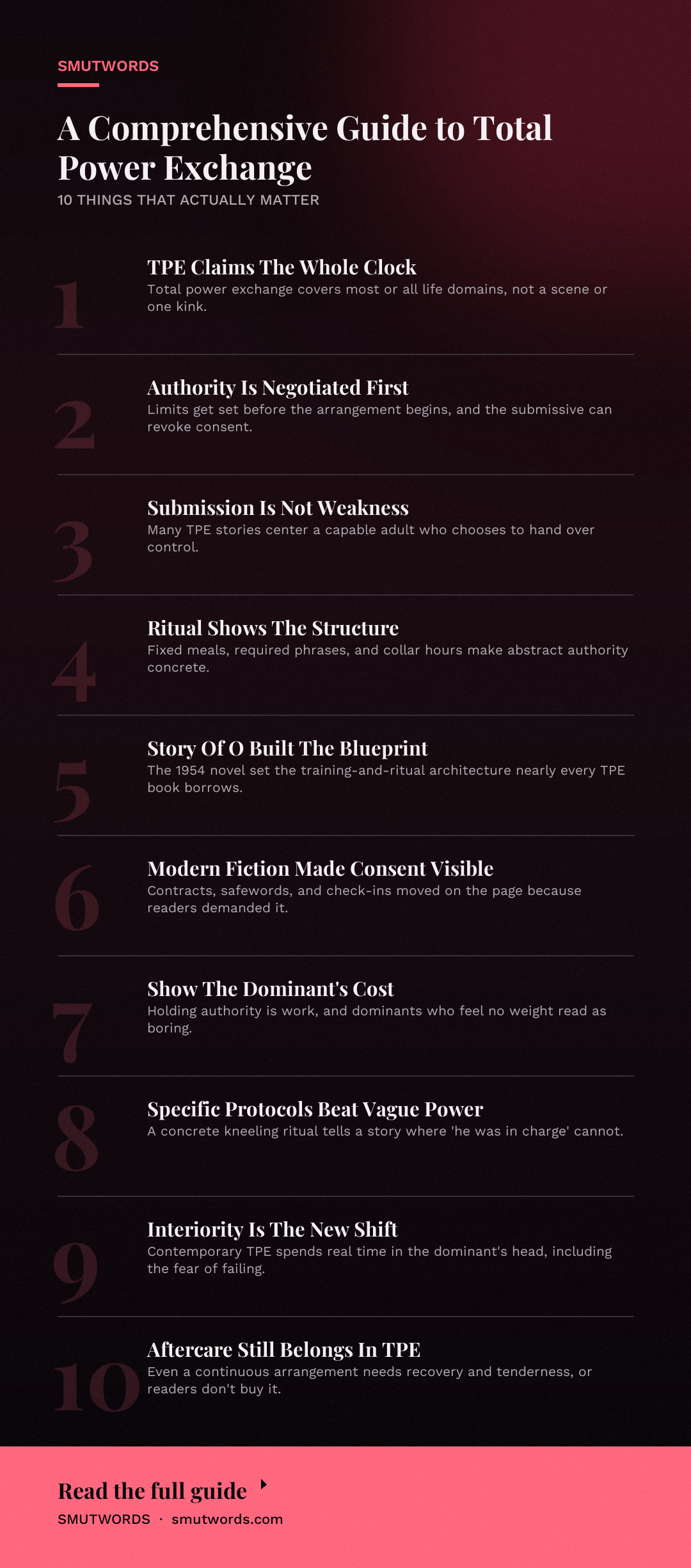
In practical terms, TPE means the dominant partner holds decision-making authority across the submissive's public and private life. Work, money, friendships, wardrobe, schedule, diet, sexual access, and personal habits can all fall inside the dominant's scope. The submissive agrees to obey within whatever limits have been explicitly reserved, and the two negotiate what those limits are before any of it begins.
Common misconceptions deserve clearing up. TPE does not mean the dominant can do anything at all. It does not mean the submissive has no rights, no voice, or no ability to stop.
And it does not require the submissive to be weak, passive, or damaged. Many TPE stories hinge on exactly the opposite: a competent, capable adult who chooses to give up control because the giving itself is the point.
What counts as genuine TPE versus something adjacent comes down to scope, duration, and consent architecture. A weekend of strict protocol is extended scene play. A live-in arrangement with a fixed set of rules around one or two domains is high-protocol D/s. TPE claims most or all domains, indefinitely, with the submissive retaining the standing right to withdraw consent and renegotiate.
In fiction, TPE is often rendered through ritual and repetition. Meals served at fixed times. A specific phrase required before the submissive may speak. A collar that must be worn during particular hours.
These details do the narrative work of showing a structure the reader can feel, because abstract authority is difficult to dramatize and concrete protocol is not.
Where Total Power Exchange Comes From
TPE as a named concept emerged from kink communities in the 1990s and early 2000s, alongside the broader codification of "safe, sane, and consensual" language and the rise of online forums where practitioners compared notes. The term was created to distinguish full-time arrangements from play-only ones. It was a clarifying label, and it stuck.
Erotic fiction, however, was writing the arrangement long before anyone named it. The 1954 novel Story of O is the obvious ancestor: a woman is taken to a chateau, trained in submission, and gradually hands over control of her body, her presentation, and her life. The novel's influence on the genre is nearly total. Almost every contemporary TPE book borrows its architecture of training, ritual, and escalating surrender.
Pulp erotica of the 1960s through the 1980s ran on a similar engine, though usually without the consent framing that modern readers expect. Those books treated total domination as a fantasy of capture. Later publishing, particularly from the 2000s onward, shifted the framing decisively toward consensual arrangement.
The bigger change came with the contemporary romance boom. Post-2010, TPE stories migrated from niche erotica into mainstream romance publishing, often rebranded as "arranged," "contract," or "billionaire" romance.
The consent architecture became explicit on the page because readers demanded it. Contracts signed, safe words established, check-ins scheduled. Where older erotica treated the arrangement as something imposed, modern TPE fiction treats it as something built.
The most recent shift is toward interiority. Contemporary TPE stories spend as much time in the dominant's head as the submissive's, exploring the weight of holding so much authority and the fear of getting it wrong. The genre has gotten more honest about how much work the arrangement requires.
How It Shows Up in Erotica
A TPE scene on the page does something no other kink configuration does quite as efficiently. It converts ordinary domestic moments into charged ones. Breakfast becomes a test of protocol. A text message becomes a command.
The dominant's arrival home becomes a hinge for the whole chapter. Authors who understand this generate enormous tension from small domestic beats.
The strongest TPE writing tends to share a handful of structural choices. Here's what separates a vivid version from a flat one:
- Specific protocols over vague authority. "He was in charge" is a statement. "She knelt by the door for ten minutes each evening when she heard his key in the lock, and last Tuesday she knelt for thirty because he hadn't told her he'd be late" is a story.
- A real test or failure of the arrangement. The submissive breaks a rule, or the dominant asks for something the submissive genuinely doesn't want to give. The negotiation that follows is usually the most interesting scene in the book.
- The dominant's cost. Holding authority is work. A strong TPE story shows the dominant exhausted, worried, uncertain, or moved by what the submissive has given up. Dominants who feel no weight are boring.
- Consent made visible. The negotiation scene, the safeword, the collar ritual: these are load-bearing, not decorative, and good authors treat them that way.
- Sensory anchoring. Sound, texture, temperature, smell. TPE stories set in a fixed home or apartment benefit from returning to the same physical details until they become charged through repetition.
Common variations authors work with include:
- Contract-based TPE: a written agreement with clauses, review dates, and signatures. Popular in contemporary romance because it lets the negotiation happen on the page in dialogue.
- Owner/property framing: the dominant treats the submissive explicitly as owned. This is one of the darker variants, and it demands careful authorship because the language of ownership can tip from fantasy into something the reader finds hollow if the submissive's interiority is ignored.
- High-protocol lifestyle D/s: heavy ritual, formal address, specific posture and wardrobe codes. Very common in historical or fantasy romance.
- Consensual non-consent (CNC) extensions: the submissive pre-negotiates scenarios in which they will pretend to have no choice. This is one of the trickier variants to write well because the fiction has to stay clear about what's actually happening beneath the game.
- Training arcs: the story covers the submissive's education in the dominant's protocols, usually as a slow burn. The training scene is a genre staple for good reason: it's inherently episodic, each task a small dramatic unit.
- 24/7 with work or public life in the picture: the dominant's authority has to navigate the submissive's job, family, and friends. These stories get their tension from the friction of maintaining the arrangement in public.
The physical repertoire of TPE fiction overlaps with a lot of other practices. Rules about when the submissive may speak, eat, or touch themself are typical. Explicit commands around positions, clothing, and access to the dominant's body are standard.
Enjoyed this? Get a free book.
Join the list and we will send a complete free story straight to your inbox, plus new releases every week after that. No credit card, no catch.
Some writers incorporate cock warming as a protocol task, since it functions beautifully as a sustained, quiet act of service that the reader can hold in their mind across a whole chapter. Others build anticipation play into the structure, with commands given days in advance of a reward or punishment.
Where the edge cases show up, careful authors are careful. Scenes involving breath play or blood play are common in darker TPE fiction, and the strongest books on this end of the shelf build in explicit risk-negotiation dialogue.
The RACK framework, which frames kink as risk-aware rather than strictly "safe," is a useful lens for understanding how those scenes function. SmutWords has an extensive guide to RACK if you want the full picture. Likewise, bondage safety comes up in TPE stories that include restraint protocols as part of the daily rule set.
The ritual collaring ceremony is one of the most useful set pieces in the TPE writer's toolkit. It marks the moment the arrangement becomes formal. Good authors use it to consolidate everything the negotiation has established and to give the reader a single, cinematic image to hold.
What makes the difference between a scene that lands and one that doesn't is usually a question of what the author is willing to spend words on. The best TPE erotica spends proportionally more time on protocol, check-in dialogue, and interiority than on the climactic sex scene. The sex matters, but the arrangement is the engine.
Where TPE fiction goes flat is when the dominant is a wish-fulfillment figure with no interior life and the submissive is a canvas. Readers of this subgenre are drawn to the psychology. They want to see the submissive's reasoning, the dominant's uncertainty, and the texture of a shared life built on an extreme arrangement. Books that skip that work get skimmed.
Total Power Exchange vs Other Arrangements
TPE gets confused with neighboring terms because the boundaries between them are genuinely soft. The distinction that matters most is scope and duration.
A single scene, even an intense one, is bounded: a beginning, a middle, an end, followed by aftercare. TPE has no end state in the same sense. It's the standing architecture of a life. A high-protocol D/s relationship sits between the two: it may be full-time but limits the dominant's authority to specific domains, or allows more explicit renegotiation than a full TPE arrangement.
A wooden paddle scene is a specific act that a TPE relationship might include as a punishment mechanism. The two are not comparable: one is a kink and the other is the frame around many kinks. Similarly, a collaring ceremony marks the beginning or escalation of a TPE arrangement but isn't the arrangement itself.
Aftercare is essential to any TPE story even if the arrangement runs continuously. Good TPE writing includes moments of recovery and tenderness, because a relationship without them is unsustainable and readers know it.
Frequently Asked Questions
What is total power exchange in a relationship?
In a real-world TPE relationship, one partner holds consensual authority over most or all domains of the other's life, from schedule and presentation to finances and sexual access. The arrangement is negotiated in advance and the submissive retains the standing right to revoke consent and renegotiate at any time. It's a full-time dynamic rather than a bounded scene.
Is total power exchange the same as a Master/slave dynamic?
The two overlap heavily and are often used interchangeably, though Master/slave leans on ownership and property language while TPE describes the mechanism (total authority) rather than the role labels. A Master/slave relationship may or may not be TPE, and a TPE relationship may use different titles entirely.
Can total power exchange work in real life?
Yes, with conditions. Real TPE requires continuous consent, explicit negotiated limits, regular check-ins, and the submissive's ability to revoke authority without retaliation. Practitioners tend to prioritize careful screening before entry, written or explicitly stated agreements, and ongoing communication. It is a demanding arrangement that most people explore through fiction first.
What is consensual non-consent and how does it relate to TPE?
CNC is a negotiated agreement in which both partners consent in advance to scenarios that simulate non-consent. In TPE fiction, CNC is often layered over the broader arrangement to heighten the fantasy of total capture. The actual consent is always present in the negotiation, even when the in-scene fiction denies it.
What makes TPE erotica compelling to read?
Readers are drawn to the emotional stakes: the extremity of surrender, the trust required to give up control, and the intensity of belonging that results. Strong TPE books lean on specific protocols, the dominant's interior conflict, and visible negotiation to sustain tension across an entire novel. If you're still figuring out whether you gravitate more to the dominant or submissive side of these stories, SmutWords has a useful guide on how to know which role fits you.
How is TPE different from high-protocol D/s?
High-protocol D/s usually refers to a relationship with elaborate ritual and formality of address but not necessarily total authority across every life domain. TPE claims the whole clock and the whole life. In practice, many relationships move along a spectrum between the two depending on what's negotiated.
Final Thoughts
Total power exchange is the genre's most extreme expression of the surrender-and-trust fantasy, and the books that do it well are the ones that take the arrangement seriously enough to show its cost, its protocol, and its negotiations.
If you want a starting point that handles all three, pick up a copy of The Master by Kresley Cole, the second book in the Game Maker series. A reclusive dominant runs his household on ritual and rules, and the submissive's entry into that world is as much a test of him as her. Read it with an eye on the details: the protocols, the check-ins, the silence between commands. That's where the story actually lives.





Loading comments…