Anal play is any sexual activity centered on the anus and rectum. That covers fingers, toys, tongues, penises, or some combination of those things. In romance and erotica, anal play consistently delivers a specific blend of taboo thrill and intensely visible trust between characters.
That's why it shows up across everything from sweet contemporary romance to the most extreme kink fiction. It is one of the most frequently requested acts in the genre. How it gets written ranges from a single, careful introduction in a first-time scene to a fully established centerpiece of a character's sexual identity.
You should read this guide either as a writer trying to figure out why your anal scenes feel flat, or as a reader who wants to understand what you are actually looking for when you seek out these books. Either way, the goal here is the same. You'll get a thorough understanding of what anal play is, where it came from in erotic publishing, how it gets written well, and why it has such a powerful hold on readers.
What Anal Play Actually Means
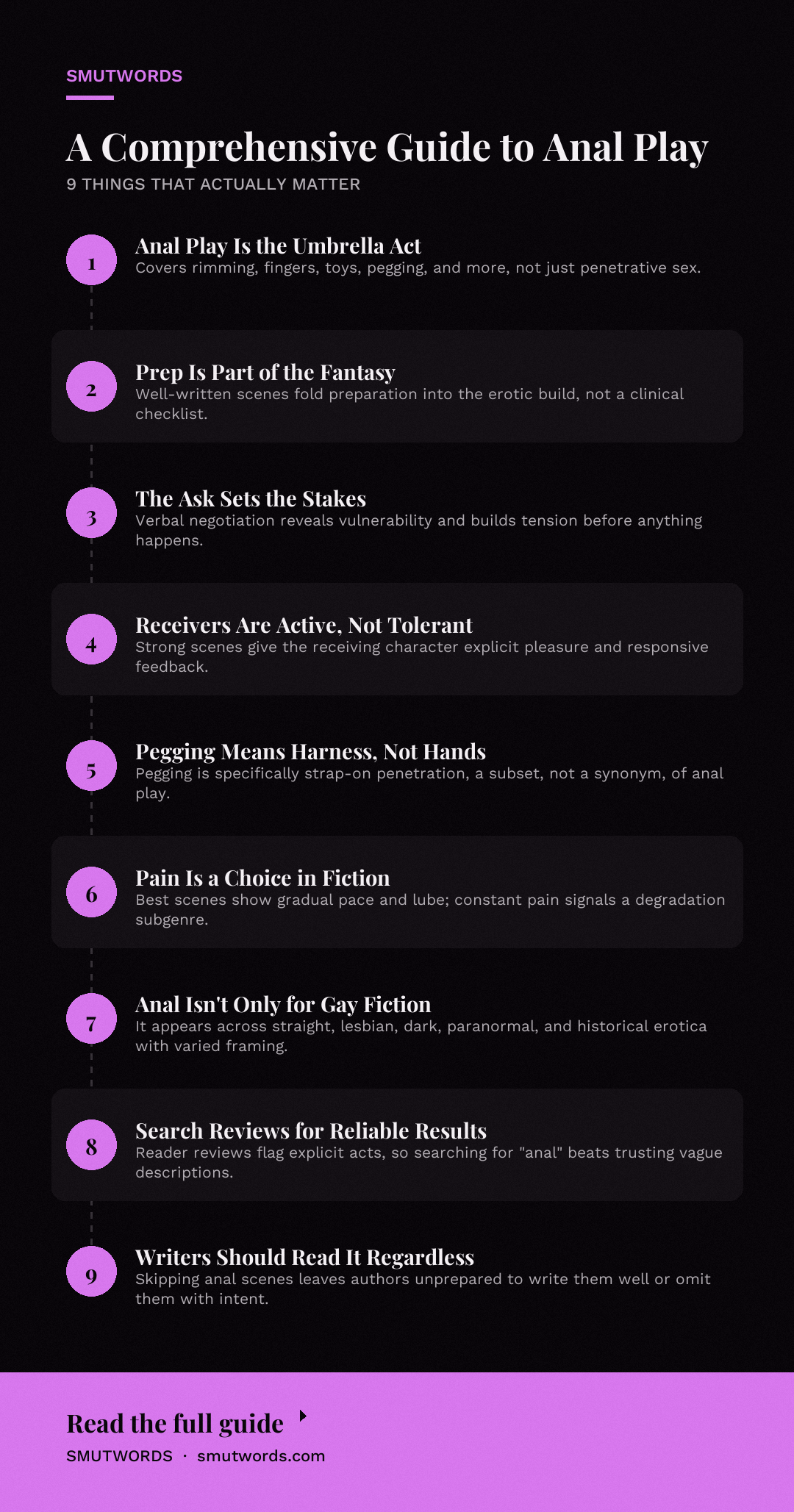
The term anal play covers a far broader territory than just penetrative anal sex. It is the umbrella category for any erotic attention paid to the anus, the rectum, and the surrounding tissue. That includes analingus (often called rimming), penetration with fingers, anal beads, butt plugs, dildos, prostate massagers, anal fisting, and penetrative sex with a penis.
It also includes stretching, teasing with toys, and the deliberate, slow preparation of the area for something larger.
What does not count as anal play? Simple physical proximity does not qualify. A hand resting on the lower back or a partner simply brushing against the area during sex is not anal play. The act has to involve intentional, sustained attention to that specific zone, even if the attention is light.
There are a few common misconceptions worth clearing up. First, many readers assume anal play is only an entry point to full penetrative sex. That's wrong. A scene can be entirely dedicated to rimming or a prostate massage and count as complete, satisfying anal play without any penetration involving a penis.
Second, there is a persistent belief that anal play is inherently dominant and submissive in its dynamic. While it often appears in power-exchange scenes, it can just as easily be an act of mutual, equal exploration between two people with no power imbalance at all. Third, people frequently assume anal play is always painful or always requires training. In fiction, the best-written scenes show that it is neither when approached with the right pace and care.
Misunderstandings about cleanliness also tend to shape how people write and read about anal play badly. Fiction will often gloss over prep entirely or, conversely, make it a clinical, sexless checklist. The truth, which the best erotic fiction handles with either a light touch or a single practical beat, is that preparation is part of the act. It is not something to be hidden, and it is not something that ruins the fantasy when handled well.
Where Anal Play Comes From
Anal play is not a modern invention. Its presence in commercial erotica has a distinct and fairly recent publishing history. Pre-20th-century erotica rarely centered anal play as a standalone focus. When it appeared, it was usually framed as a punishment, a degradation tactic, or a hidden vice practiced by aristocrats in scandalous French novels.
The most famous historical depiction is likely the Earl of Rochester's 17th-century poem "A Ramble in St. James's Park," which treats anal encounters with earthy humor rather than romance.
The real shift came in the underground erotic publishing boom of the 1960s and 1970s. Gay male erotica had always treated anal play as a natural part of its world because the act was simply a norm within that fiction. Straight and lesbian erotica treated it differently. Straight erotic fiction of that era often filed anal play under "genderqueer" or "taboo" categories, usually depicting it as a male fantasy of dominance.
The 1980s and 1990s brought the first significant mainstreaming. The rise of erotic romance as a commercial category, driven by romance imprints that began accepting hotter content, meant anal play started appearing in books with actual plots and emotional arcs.
Authors like Nancy Friday documented through anthologies of real women's fantasies that women fantasized about anal play far more than the male-dominated publishing world had assumed. That documentation pushed editors to accept the act as a legitimate desire in heroines rather than just something a dominant hero imposed.
The arrival of mass-market erotic romance in the 2010s, particularly the wave of self-published and digitally distributed fiction, removed the last gatekeepers. Anal play stopped being something an editor might cut from a manuscript for fear of shocking the distributor. It became a frequently requested and expected element in many subgenres, especially paranormal romance, dark romance, and ménage fiction.
The trope of the anal scene as the "final conquest" or ultimate surrender shifted into something more varied: scenes of mutual exploration, scenes where the woman is the dominant partner, and scenes where the act is simply one more option in a long, loving sexual repertoire.
The term "pegging" deserves its own historical footnote. It was coined in 2001 by Dan Savage through a reader contest, specifically to describe a woman penetrating a man with a strap-on dildo. Before that term existed, fiction about female-on-male anal penetration lacked a clean name, which made it harder to categorize and market.
The coinage of "pegging" gave authors and readers a searchable, recognizable term, and the kink's presence in erotic fiction multiplied quickly.
How Anal Play Shows Up in Erotica
The craft of writing a good anal scene comes down to three beat groups: the ask, the preparation, and the act itself. The best authors treat all three with distinct care.
The Ask. Erotica that features anal play well almost never has it happen without some kind of verbal or demonstrated negotiation. This is not a moral judgment on the part of the genre. It is a structural necessity.
The "ask" is where the emotional stakes get established. The hero or heroine who wants anal play has to voice a vulnerable desire. The other character gets a moment to accept, decline, or express curiosity.
That exchange sets the tone for everything that follows. A scene where the penetration just happens without anyone talking feels clumsy and reads as lazy writing because it skips the best tension-building material available. The request for anal play in fiction often carries more weight than a request for any other act because it suggests a desire for deeper intimacy or a specific kind of surrender.
The Preparation. Written preparation is where the real-world concern for safety merges with narrative pacing. A strong scene will reference lubricant, will show the receiving character relaxing, and will start with a finger or a small toy before escalating. This is not a chore list.
Done right, preparation is itself erotic. The sight of a partner slicking their fingers, the careful, slow circling of the rim, the first gentle breach of a fingertip. These are all loaded, intimate moments.
The best authors use preparation to build anticipation and to demonstrate care. A character who stops to check in, to ask "okay?" mid-scene, is a character who is becoming more attractive to the reader, not less.
Enjoyed this? Get a free book.
Join the list and we will send a complete free story straight to your inbox, plus new releases every week after that. No credit card, no catch.
The Act. The actual penetration or stimulation needs variety in its description. Too many authors describe anal penetration as a single, vague sensation of tightness. Better writing differentiates between sensations at different stages: the resistance of the sphincter, the slide into deeper, more open space, the difference between a slow, grinding pressure and faster, rhythmic thrusting.
Many authors also make the mistake of treating anal play as something the receiving character merely tolerates. The best scenes make the receiver an active participant whose pleasure is explicit.
Anal play is physically different for people of different anatomies. A male character receiving anal play can experience prostate stimulation, which is often written as a distinct, full-body pleasure. A female character receiving anal play has the proximity to the vaginal wall and the clitoral network, which is why many authors pair anal penetration with manual clitoral stimulation to show that the receiving character is experiencing pleasure, not just enduring friction.
Common variations in how the act gets framed in a scene include:
- The first time scene, where one character has never done this and the other guides them through it with patience and gentle instruction.
- The reward or incentive scene, where anal play is the prize for good behavior or the payoff after prolonged teasing.
- The power exchange scene, where the act is explicitly about submission, dominance, or the transfer of control. In this kind of scene, the language focuses less on physical mechanics and more on emotional surrender, trust, and the visible vulnerability of the receiving partner.
- The mutual exploration scene, where two characters discover anal play together without an experienced partner, often with laughter, clumsiness, and a sense of adventure.
- The dirty talk-centered scene, where the physical action is less important than the verbal framing around it, often discussing how taboo it feels, how tight it is, or how much the characters want it.
What separates a strong version of anal play from a flat one in any of these variations is the integration of sensation with emotional state. A flat scene just describes what is happening physically. A strong scene describes what it means.
The act becomes stronger when the author ties it to a larger character arc: a character learning to trust her own desires, a dominant character finding softness in the middle of a rough scene, a couple discovering that a thing they never tried is the thing that makes them feel closest.
A strong scene also provides clear feedback. The receiving character moans, tightens their grip on the sheets, says specific words about how it feels. The giving character receives direction, speeds up or slows down, adjusts angle. This loop of responsive feedback is what makes a written scene feel real rather than like a mechanical list of actions.
In longer works, anal play also functions as a plot device. A couple's first anal scene often marks a turning point in their relationship, the moment they cross into a new level of intimacy that changes how they interact outside the bedroom. In darker or more taboo fiction, the same act can serve as a breaking point, the line a character crosses that they cannot uncross.
The presence of anal play is also a reliable marker of a book's heat level. Its appearance immediately tells a reader that the book is not fade-to-black romance. It signals explicit content and a certain willingness to handle taboo material, which is why its absence or presence is often used in book descriptions and reader reviews as a calibration tool for how spicy a title actually is.
In many of the best hotwife and cuckold books, anal play features heavily because the act carries symbolic weight as a form of giving something to one partner that the other has not had or is perceived as not being able to provide.
The physical specificity of the act makes the emotional stakes of that kind of story visible and visceral. For readers who want that same intensity filtered through a different dynamic, the best taboo & forbidden books often use anal scenes to mark the exact moment a character crosses a line they swore they never would.
Anal Play vs. Pegging
The comparison that generates the most genuine confusion is also the one where people get definitions wrong on both sides. Anal play is the umbrella category. Pegging is a specific act under that umbrella.
Pegging means one partner, typically a woman or a person with a vulva, penetrates the other partner, typically a man or a person with a penis, anally using a strap-on dildo. It is one specific configuration of anal play, not a synonym for male anal penetration in general.
Any anal penetration of a man by a woman with a dildo is pegging, but not every act of a woman penetrating a man anally is pegging. The defining feature is the harness and the artificial nature of the phallus. Fingers and toys without a harness fall squarely in the broader category of anal play.
The reason this distinction matters so much in erotic publishing is that pegging has developed its own readership and its own tropes. Pegging fiction often centers themes of role reversal, the surrender of traditional masculinity, and the discovery of prostate pleasure. Standard anal play scenes carry none of those specific connotations.
If you are looking for a book where a dominant heroine straps on a dildo and takes her male partner from behind, you are looking for pegging. If you are looking for a book where anal play just happens to involve a woman topping a man with her fingers or a toy, that broader category covers you too.
Frequently Asked Questions
Does anal play always have to hurt in fiction?
No. The best-written scenes depict gradual preparation, generous lubrication, and a pace controlled by the receiving partner. Pain, when it appears, is usually written as a brief, sharp moment that transitions into pleasure once the body adjusts. Fiction that makes anal play relentlessly painful is usually using the act as a degradation or punishment device, which is a different subgenre with different rules.
What is the difference between anal play and anal sex?
Anal sex typically refers specifically to penetration of the anus by a penis. Anal play is the broader category that includes that act but also covers rimming, fingering, toys, plugs, beads, and prostate massage. You can have an entire scene of anal play that never involves a penis at all.
Why is anal play so popular in dark romance and taboo fiction?
The act exists on the edge of a line that most readers consider transgressive. Dark romance trades in crossing lines, and anal play offers a concrete, physical way for a character to demonstrate a willingness to give everything. It also reads as a visible act of trust in scenes where trust is otherwise scarce or hard-won. The physical vulnerability of the act makes any emotional vulnerability in the scene hit harder.
Is anal play only for gay male fiction?
Not at all. Anal play appears across every subgenre of erotic fiction, including straight romance, lesbian erotica, ménage stories, paranormal romance, and historical erotica. What changes between subgenres is the framing and the symbolic meaning. In gay male fiction it is often the central or expected act, while in straight fiction it tends to be framed as an escalation, an adventure, or a special privilege.
How should I search for books that include anal play scenes?
Look for the terms "anal," "rimming," "pegging," "anal training," or "anal virgin" in the book's content description. Reader reviews on platforms like Goodreads frequently flag which explicit acts a book contains, so browsing reviews for the word "anal" is a reliable method. Wanting a guaranteed scene means looking for erotica or very high-heat romance, not general contemporary romance.
Do I need to read books with anal scenes even if I am not into it myself?
If you are a writer of romance or erotica, yes, you should at least read a few notable examples. Anal play has become common enough in high-heat romance that an author who never encounters it will eventually write a scene poorly or avoid a natural plot beat out of discomfort. Understanding the act's standard beats means you can consciously choose to include or exclude it with intention, rather than accidentally writing something that breaks the reader's immersion.
Final Thoughts
Anal play endures in erotic fiction because it gives authors a direct tool for showing trust, vulnerability, and transgression without relying on dialogue or plot exposition. The act itself is inherently intimate in a way that few other physical descriptions can match, and the best novels in the genre build entire emotional arcs around that single, careful act.
If you want to see how the trope gets handled with the most care and sexual tension, look for enemies-to-lovers romance titles that feature it. The shift from antagonism to that level of physical trust is one of the most satisfying payoffs the genre has ever perfected.







Loading comments…