Dacryphilia is sexual arousal from tears, crying, or the sight of a partner sobbing. In erotica it usually arrives at the moment a character is overwhelmed past speech, when pleasure, grief, or sheer emotional force pushes tears out of them and the person watching or causing those tears feels a sharp pull of desire. The word covers both sides of that exchange: the character who cries and the character who wants them to.
It shows up in dark romance, in high-intensity power exchange scenes, and in softer books where the crying is relief rather than ruin. The short glossary version stops at "aroused by tears." The real thing has more texture than that, and this guide is about the texture.
What Dacryphilia Actually Means
The term comes from the Greek dakry, meaning tear, joined to -philia, the suffix for love or strong attraction. In clinical and academic writing it gets filed under paraphilias, usually alongside other arousal patterns tied to specific emotional or physical responses rather than specific body parts.
In practice, the clinical framing is thinner than it sounds. Most writing on dacryphilia agrees on the basic shape and disagrees on almost everything else, including how common it is and whether crying is the turn-on itself or a stand-in for something adjacent.
What counts: arousal from a partner's tears during sex, from the sound of crying, from the sight of a tear-streaked face, from the physical evidence of overwhelm (red eyes, wet lashes, a hoarse voice). Arousal from your own tears while someone watches you fall apart also belongs here. The kink can be built around causing the tears, witnessing them, or sharing them.
What doesn't count: enjoying a partner's vulnerability in general, with no particular interest in the crying itself. Plenty of people find emotional openness attractive without the tears mattering one way or another. Dacryphilia is specifically about the tears, the crying, the visible breakdown of composure.
A few misconceptions worth clearing out early.
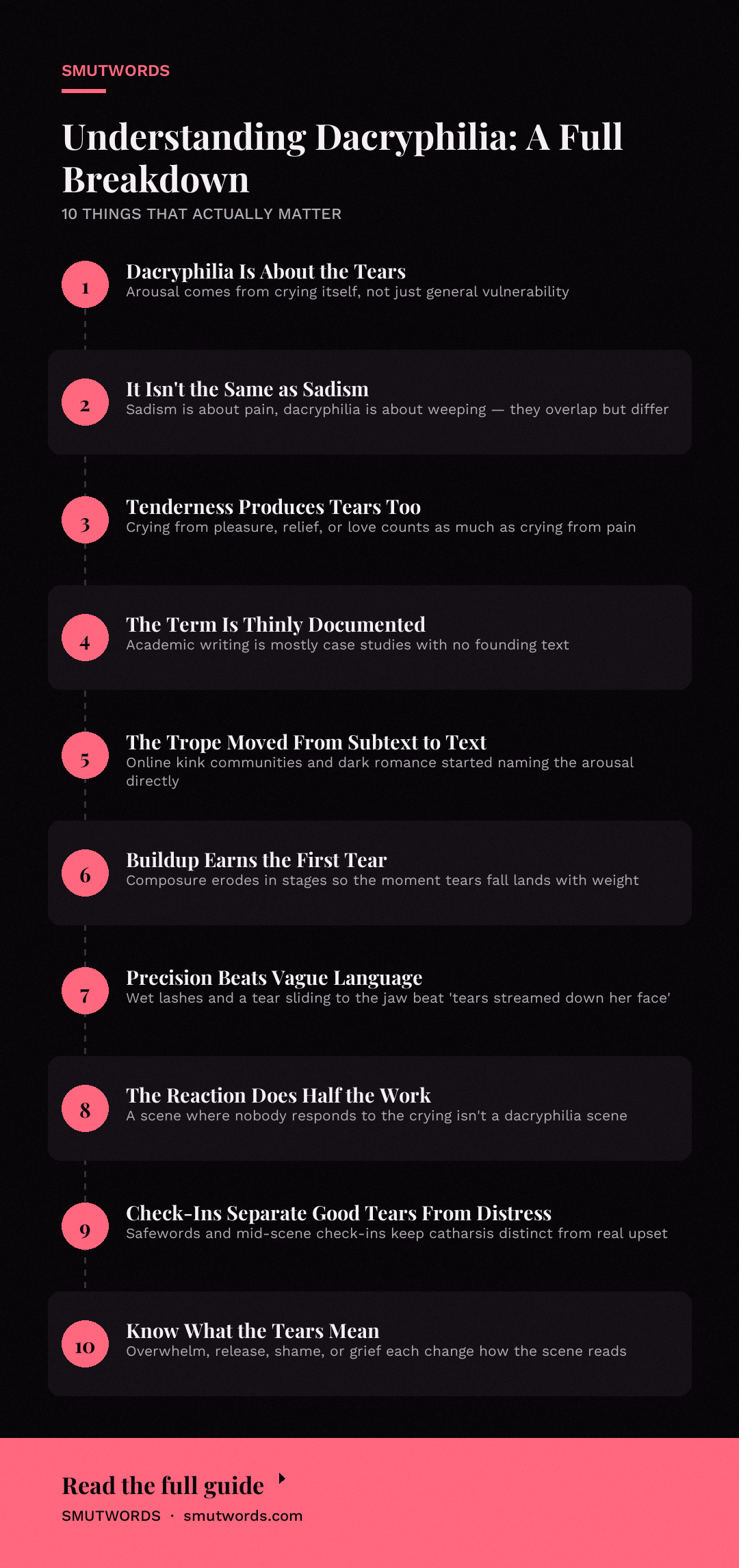
- It isn't the same as sadism. Some dacryphiliacs enjoy causing the tears, but plenty want to be the one crying, or want tears that come from pleasure rather than pain. Sadism is about pain; dacryphilia is about tears, and the two overlap without being the same thing.
- It doesn't require cruelty. A huge share of dacryphilia content in romance involves crying from being overwhelmed by pleasure, from relief, from being loved too hard to hold together. The tears are the point, and tenderness produces them as readily as roughness does.
- It isn't always sexual. Like most kinks, dacryphilia runs on a spectrum. Some people need it in the bedroom. Others just find tears intensely intimate and a little charged, and leave it there.
There's also a naming problem. "Tear kink" and "crying kink" get used interchangeably with dacryphilia, and while the three overlap heavily, "tear kink" sometimes gets claimed by people who mean the physical sensation of tears on skin or the taste of salt, which is a narrower and slightly different thing. In romance publishing the terms blur together, and readers searching any of them land in the same place.
Where Dacryphilia Comes From
As a clinical term, dacryphilia is recent and thinly documented. It doesn't carry the long institutional history that terms like sadism or masochism do, and the academic literature on it is mostly case studies and short survey work. There's no founding text, no famous researcher, no decades of clinical debate to report. Honest history here means the history of the trope in fiction, because that's where the term actually lives for most readers.
Crying as an erotic device is as old as melodrama. Nineteenth-century sentimental fiction ran on weeping heroines, and the swoon-and-tears register never fully left romance.
What changed is what the tears were for. In older fiction, tears were usually the character's private suffering, something the reader witnessed and the love interest was supposed to soothe. The desire to see them was the reader's, unspoken and unacknowledged.
The shift happened in erotic romance and fanfiction through the 2000s and 2010s, when authors started writing the arousal directly. A character watches their partner cry and the narrative admits the character is turned on by it. That admission is the modern dacryphilia scene. It moved from subtext to text mostly through online kink communities and serialized dark romance, where writers had room to be explicit about the wanting.
The evolution since then has been about who cries and why. Early versions leaned on pain and humiliation. Contemporary versions lean heavily on overwhelm, catharsis, and crying during or after intense pleasure. The "good crying" scene, where tears are the body's response to being handled so thoroughly that composure collapses, is now a staple of high-heat romance and one of the most reliably searched variations on the theme.
The other development is the safeword scene. The more dacryphilia has moved into mainstream erotic romance, the more often the crying is explicitly framed as consensual, checked in on, and safe. That framing didn't exist in older portrayals, and it's made the kink readable to a much wider audience.
How It Shows Up in Erotica
Craft-wise, dacryphilia scenes live or die on the buildup. A character bursts into tears and the love interest finds it hot: that's not a scene, that's an outline. The strong version slows down and lets the reader feel composure eroding. The character holds it together, holds it together, and the moment the tears actually fall has weight because the reader watched the holding.
The best dacryphilia writing works the body in stages.
Shiny eyes first. A voice going thick. A breath that catches and doesn't quite recover. Then the first tear, described precisely, because precision is what makes it hot.
A tear at the corner of one eye, sliding to the jaw. Wet lashes clumped together. A face going blotchy and raw. The physical specificity is doing most of the work, and vague language ("tears streamed down her face") kills it.
Point of view matters enormously. Third person limited that sits inside the crier's head gives you the losing-control angle, which suits cathartic crying and overwhelm. Point of view inside the watcher gives you the desire angle: the character noticing the tears, being pulled in by them, maybe hating how much they like it. Some books alternate, and the best ones use the watcher's reaction to tell the reader how to feel about the crying before the crier narrates it.
Common variations authors use:
- Crying from pleasure. The classic. The character is handled past their ability to stay composed, often in a scene with a lot of intensity, and the tears are proof that the handling worked. Overlaps naturally with monster cock kink and other overwhelm-driven premises where the whole point is being pushed past capacity.
- Cathartic crying. Tears after a long emotional buildup, where the sex is the release valve. This is the version that reads as tender rather than rough, and it's where dacryphilia overlaps most with hurt/comfort.
- Crying from shame or degradation. A character is humiliated into tears and the shame itself becomes charged. This variant leans on degradation kink mechanics, and the best versions are explicit about the character wanting it.
- Crying during restraint or helplessness. Tears as the visible sign of being genuinely unable to do anything but feel. Pairs with rope and bondage content, and it's where the safeword matters most.
- Crying during or after reconciliation. A couple fights, breaks, and the tears come during the reunion. The grumpy/sunshine versus enemies-to-lovers dynamics often end in this register, where all the accumulated friction converts into tears of relief.
- The watcher who can't admit it. A character discovers they're turned on by their partner's tears and has a small crisis about it. The crisis is often the hottest part, because it gives the desire a shape the reader can root for.
The flat versions all fail the same way: they use tears as a shortcut for intensity instead of doing the work of earning them. A character crying on page one of a sex scene, with no buildup and no reaction from anyone who matters, reads as an author reaching for a button. The tears have to matter to someone in the room.
Two more editorial notes. First, crying is loud and ugly and physically inconvenient (snot, hiccups, a face that swells), and good dacryphilia writing doesn't pretend otherwise.
Second, the reaction is doing at least half the work. A scene where someone cries and nobody in the scene responds to the crying is just a scene where someone cries. The kink lives in the responding.
For readers who like the emotional mechanics of this, the complete guide to power exchange covers the consent architecture that makes intense scenes readable, and it applies directly to crying scenes. The cupping kink piece is a good example of how a kink that looks niche on the surface gets written into mainstream romance.
Enjoyed this? Get a free book.
Join the list and we will send a complete free story straight to your inbox, plus new releases every week after that. No credit card, no catch.
What makes a dacryphilia scene strong versus flat
A strong scene builds tension before the tears, describes the crying with physical precision, and shows at least one character having a real reaction to the tears. Composure is eroded in stages, and the moment the first tear falls lands because the reader has been waiting for it.
A flat scene jumps straight to sobbing, uses generic language ("tears streamed down her face," "she cried out"), and treats the crying as a decorative touch rather than the emotional event the scene is built around. Nobody in the room seems to care about the tears, so the reader doesn't either.
A strong scene also knows what the tears mean. Are they overwhelm, release, shame, joy, grief? The answer changes everything about how the scene reads, and when the author doesn't decide, the reader fills in the blank with something random.
The safety layer, which is also a craft layer
Tears can mean overwhelm or they can mean genuine distress, and the body doesn't always make the difference obvious. Scenes built on crying need clear communication, established safewords, and check-ins that separate cathartic release from real upset. A character who's crying from intensity needs to be able to signal "keep going," and a character who's actually distressed needs to be able to stop everything without negotiation.
This is a real-world consideration, and it's also one of the tools that separates good dacryphilia writing from the lazy version. The check-in that happens mid-scene, where one character asks whether the tears are good tears, is some of the most intimate material available to a romance writer. Use it.
Dacryphilia and other intensity kinks
Authors often pair dacryphilia with other intensity drivers. Emotional edgeplay, the umbrella term for scenes that push emotional rather than physical limits, overlaps heavily because crying is one of the most reliable signs that a limit is being approached. BDSM-adjacent content like wax and rope adds physical sensation that produces involuntary tears, and the wax play for beginners piece is a useful guide to how those scenes get written safely in fiction.
It also shows up in broader intimacy contexts where vulnerability and helplessness are already on the table. You'll see crying scenes threaded through group dynamics in harem romance and group marriage stories, where the sheer number of witnesses raises the stakes. One-on-one setups get the same effect from one night stand premises, where crying in front of a stranger is its own kind of exposure.
Crying during sex after a fight has its own subgenre. The makeup sex scene frequently ends in tears, and that overlap is one of the most reliably popular configurations of the kink in contemporary romance.
If a scene involves a character getting something out of their partner's helplessness that goes beyond the sexual, consider whether use kink is the more accurate label, since the two overlap around the pleasure of being used or being used by. For the far end of intensity, there's scat play, which represents a different register entirely and only shares the "push past comfort" instinct.
Dacryphilia vs Sadism
These get confused constantly, and the distinction is genuinely useful for readers. Sadism is arousal from someone's pain, or from inflicting it. Dacryphilia is arousal from someone's tears.
Those overlap: pain can cause tears, and a sadist may enjoy the crying that results. But each can occur without the other. A character can enjoy making a partner cry through emotional overwhelm with no pain involved at all, and that's dacryphilia without sadism. A scene can involve pain with no tears, and that's sadism without dacryphilia.
The clean way to tell them apart is to ask what the arousal is attached to: the hurting, or the weeping.
The other distinction worth drawing is between dacryphilia and enjoying vulnerability in general. Most romance readers like a little vulnerability. Dacryphilia is when the tears themselves are the thing. But since both produce similar scenes on the page, plenty of readers go hunting for crying scenes without having a word for the kink.
Frequently Asked Questions
Is dacryphilia a real thing or just a fetish term?
It's a real pattern that shows up in clinical writing and in kink communities, though the research on it is thin. The term is used widely enough in paraphilia literature that you'll find it in sexology resources, and it's common enough in erotic writing that it has a stable set of conventions. Its thin documentation doesn't make it less real, just less studied.
What causes dacryphilia?
Nobody knows for sure, and the honest answer is that arousal patterns like this don't have a single cause. Theories range from early exposure and conditioning to the intimacy and vulnerability of tears and the raw emotional intensity they signal. Most people with the kink describe it as something they've had for as long as they can remember rather than something they developed.
Is dacryphilia the same as crying kink or tear kink?
For most practical purposes, yes. Dacryphilia is the more formal name, and crying kink and tear kink are the search-friendly versions readers use. The only nuance is that some people use "tear kink" for the physical sensation of tears specifically, like the taste or the feel on skin, which is a narrow subcategory. In fiction and romance, all three terms point at the same content.
Can dacryphilia be practiced safely in real life?
Yes, with clear communication and a safeword. The main risk with crying scenes is that tears can signal real distress, so both partners need a way to tell each other apart. Talk before the scene about what kind of crying is wanted and how to check in. Ongoing check-ins during the scene matter a lot, since a person who's really crying may have trouble speaking.
Why do romance readers like dacryphilia scenes?
Because crying is the most visible proof that a character has been pushed past their own control. It gives writers a way to show how much the characters feel without a single line of dialogue explaining it. Readers get the raw, exposed version of intimacy that regular sex scenes can only imitate, and the tears make the emotional stakes physical.
Do any mainstream romance novels include dacryphilia?
Plenty do, often without the word. Dark romance is full of it, and high-heat contemporary romance leans on crying-from-overwhelm scenes routinely. The kink mostly goes unlabeled in mainstream publishing, so readers searching for it usually have better luck looking for "crying" scenes in reviews and content warnings than for the clinical term.
Final Thoughts
Dacryphilia is one of the kinks that most rewards a writer who's willing to slow down. The scene is about buildup, precision, and reaction. The first tear landing is only worth the work you put into the moments before it.
If you want one book that does this well, The Hating Game by Sally Thorne pairs real emotional aggression with moments of total collapse in a way that makes the whole dynamic readable, even though it's a lighter register than this guide covers.
For the harder version, look for dark romance that tags crying on-page in its content warnings. Either way, the safe way to explore the kink on the page is the same as in real life: check in, get clear, and let the tears mean something.







Loading comments…