
Every reader has a public opinion about insta-love and a private bookshelf that contradicts it. You'll see the same person post a thread about how 300 pages of slow burn is the only honest way to build a relationship, then gulp down a 180-page fated mates novella in one sitting on a Tuesday night. The comment section says they hate it. The Kindle library says otherwise.
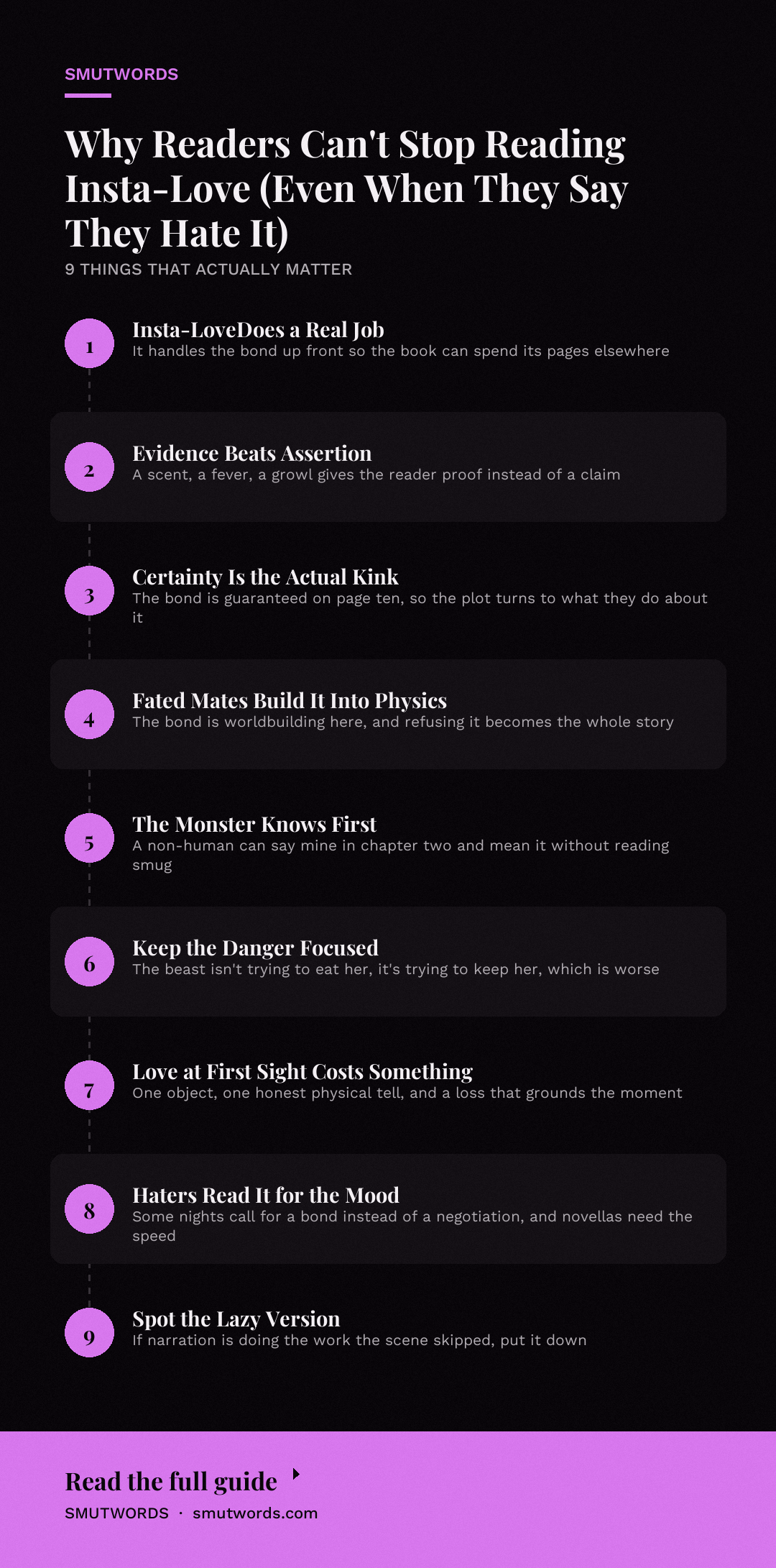
Why readers love insta love romance so much is rarely about laziness, though that's the accusation that gets thrown around most. Insta-love does a very specific job that slow burn physically cannot do, and monster romance, fated mates, and love-at-first-sight all offload their heaviest lifting onto it. Once you notice how it operates, you can't un-see it in every book you pick up.
What Insta-Love Actually Is, and Why It Gets a Bad Reputation
Insta-love is a romance where the connection lands before the characters have earned it in real-world terms. They meet, and something in the scene locks. The relationship is accelerated by an outside force: a supernatural pull, a marriage contract, a rescue, a shared room in a snowstorm.
The bad reputation comes from one specific failure mode. An author drops insta-love into a contemporary romance where nothing is supposed to be supernatural, and the reader has to accept on page four that two strangers are permanently bonded because of eye contact. When the execution is lazy, it feels like the writer skipped the work. When it's competent, it doesn't feel like skipping at all, because the shortcut is the mechanic.
Critics call it unbelievable. Readers call it a faster door into the same room.
The difference between lazy insta-love and well-built insta-love
A lazy version gives you nothing to grab onto. The characters announce the connection in narration and the plot moves on. A well-built version surrounds the instant bond with enough structure that the reader's brain stops objecting.
You get a mate bond with a physical symptom. You get the scent, the protective growl, the sudden fever. The body has data the skeptic character can't argue with.
That's the entire trick. Insta-love works when it gives the reader evidence rather than an assertion. The instant connection is a scene with a temperature, not a sentence.
The Psychology: Why a Fast Bond Feels So Good to Read
Readers aren't dumb for responding to this. Insta-love is doing something real. In a 300-page slow burn, the reader's job is to babysit doubt. The characters misunderstand each other, a third party causes friction, and the reader is asked to hold the safety of the romance in their hands for the entire ride.
That's nice when you want the slow burn. It's exhausting when you want the payoff.
Insta-love removes the doubt committee. The connection is pre-certified.
The reader then gets to spend the rest of the book on a different question: what will they do about a bond that's already there? That question is more relaxing. It's also more openly horny.
There's a fantasy logic at work too. In a real relationship, you don't get certainty. You get a coffee, an awkward text, and a three-month audition. Insta-love delivers the thing real life withholds: unmistakable proof that someone's entire body chose you before you had to be charming about it.
Certainty is the actual kink
That's the load-bearing wall. Certainty.
The fated mate knows. The monster knows. The love-at-first-sight scene works because the reader is handed a guarantee on page ten and then watches two people decide what to do about it.
The instant connection doesn't eliminate the plot. It eliminates the question of whether the relationship is real, which frees the plot up to be about control, loyalty, and how much a person is willing to give up.
That's why insta-love brushes up so naturally against power and possession. Once the bond is a given, the tension has to come from elsewhere: coercion, obligation, fear, the hunt. Which, conveniently, is exactly the fuel those other subgenres run on.
How Insta-Love Powers Fated Mates
Fated mates is the most honest insta-love engine in the genre, because the instant connection is built into the world's physics. You don't have to rationalize it. The characters don't have to either (mostly). The bond exists, and refusing it is the story.
A well-built fated mates book gives you the bond with sensory detail. The character who's spent four hundred years alone suddenly can't regulate their own heartbeat around this one person. The bond is a physical event. The instant connection is the first symptom, and the rest of the book is whether the characters can survive the treatment.
This is where "mate claim" language does the most work. The dynamic is a one-way valve in the characters' physiology: once it's open, it can't be closed. If you want the stakes and the specific beats readers ask for, Mate Claiming Relationships: Everything You Need to Know lays them all out.
Why the monster knows before the human does
Monster romance loves insta-love because non-human characters get to be honest about the bond. The lizard beast can say "mine" in chapter two and mean it without the author looking pathetic. A human hero trying to say the equivalent on page eight would read as smug. The monster's lack of social filter becomes the engine of the book.
That's why Lured by the Lizard Beast gets its shape so quickly. The insta-bond is the entry point, and the rest of the novella is the consequence. The "lured" in that title tells you exactly what kind of story you're in.
Love at First Sight, and Why It's the Same Engine With a Different Costume
Love at first sight is insta-love with its shoes off. No fangs, no bond, no supernatural pull. Just two people in a specific room at a specific moment and one of them decides.
That version is harder to sell in contemporary, which is why you see it most often in gothic, historical, and small-town settings where the world is slow enough that a soul-level connection on the first encounter doesn't read as silly.
In a small town sheriff romance, the first arrest can double as the first meeting, and the whole town becomes a witness. The world is tight enough that a stranger becomes public knowledge by noon. The instant connection gets absorbed into the town's gossip, which is the local version of a supernatural bond.
The tells of a love-at-first-sight scene that actually lands
- One specific object does the work. Not eye color. A ring, a scar, a bad tattoo, a jacket the reader will see again in chapter nine.
- One honest physical response. A stopped sentence. A shake in the hand. Not "electricity," which is the laziest shorthand in the genre.
- The scene costs something. The first-sight characters lose something in the moment: a bet, their dignity, a boarding pass. That loss keeps it from being pure wish-fulfillment.
- The other character resists. Love at first sight only reads as romantic when one of them is having a worse time with it.
When that structure is in place, the reader accepts the instant connection and stops calling it insta-love. That's how you know the trick worked: the reader forgets to object.
Enjoyed this? Get a free book.
Join the list and we will send a complete free story straight to your inbox, plus new releases every week after that. No credit card, no catch.
Why Monster Romance Rides Insta-Love Like a Racehorse
Monster romance is the subgenre where insta-love is at its most efficient, because the monster is allowed to be instinctive and the human is allowed to be frightened. Two postures, one bond, zero need for a meet-cute. Add fangs, scales, or a cave, and the story writes itself.
The catch: monsters that instantly feel "safe" don't work. The best monster insta-love keeps the danger in place. The bond doesn't make the monster less dangerous, it makes the danger more focused.
The beast isn't trying to eat the heroine, which is a smaller change than it sounds. The beast is trying to keep her, which is worse.
That's the exact note behind Lured by the Lizard Beast. The instant connection is the leash. What makes the novella work is that the leash doesn't belong to the reader, or to the human character. It belongs to the thing in the cave.
The subgenres where insta-bond is standard equipment
- Fated mates (paranormal, shifter, omegaverse): bond is worldbuilding, refusal is the story.
- Monster romance: non-human instinct sells the certainty, human fear sells the tension.
- Alien abduction romance: same engine, different ship.
- Insta-lust in dark romance: bond arrives first, trust never catches up.
- Small-town first meeting: community pressure substitutes for supernatural pull.
Why the People Who "Hate" Insta-Love Still Read It
The people sneering at insta-love are usually the same people putting monster romance novellas on hold. There are practical reasons for that, and none of them are hypocrisy.
First, insta-love is a format. Novellas need it. If the book is 150 pages, you can't spend fifty of them establishing doubt. Slow burn is a privilege of length.
Second, insta-love is a mood. Some nights you want a bond, not a negotiation.
The reader who just finished a 600-page enemies-to-lovers epic doesn't want another one of those; they want something they can finish before work. Enemies to lovers requires the reader to hold the emotional reservoir for hours. That's a different kind of reading, and it's not the only kind.
Third, insta-love is a fantasy about being chosen. The reader in question isn't asking "is this realistic." They're asking "would someone know within thirty seconds that I was the one." That question hits differently at 11pm.
The bookshelf that proves the point
Look at any reader's hold list and you'll find the contradiction in plain text.
Shared Without Shame: A Hotwife Exhibition & Sharing Fantasy sits alongside a 400-page literary romance. Permission Slip: A Cuckold Erotic Short Story sits alongside the five-book series. The reader isn't being inconsistent. They're ordering across a menu.
Insta-Love and the Other Kinks Readers Order Alongside It
Once you understand that insta-love is a structural shortcut rather than a subgenre, you start seeing it powering other material. The instant bond in Free Use Casino isn't romantic love in the traditional sense, but the book runs on a premise where consent to a dynamic is established in one stroke, and the rest is what happens in the room.
The same is true of proximity-driven dark romance. The instant connection in He Paid Him to Fuck Me doesn't get resolved through a slow-burn courtship. The book takes the bond and runs it through a financial transaction, which is a very different use of the same engine.
That's not a coincidence. Insta-love is the fastest way to get the reader to the kink, and for certain kinds of books, the kink is the destination. If you like the way those stories work, Understanding Dacryphilia: A Full Breakdown covers a kink that tends to show up in exactly this kind of fast-bond story, where the emotional intensity is built on the first page rather than earned across twenty chapters.
Even the tech-adjacent stuff uses the same move
Interesting side note: when authors work in cyberpunk romance, insta-love arrives disguised as a system error. The connection is framed as a bug in the software, a matched frequency, a data signature. Same engine, new vocabulary.
The AI Wants to Watch is fun to read alongside this because the "instant" connection there is between a human and a system, and the whole novella is about what happens when the bond has been established by something that can't be argued out of it.
The Case Against Insta-Love, Taken Seriously
The critics aren't wrong about everything. When insta-love lands badly, it produces a specific reading experience: the characters have no reason to be together and no reason to like each other, and the author is asking the reader to supply both. You can feel the author's hand on the lever.
The tell is narration doing work the scene didn't do. "He didn't understand why he felt so drawn to her." "She knew, in that moment, that nothing would ever be the same." When the sentence doesn't have a specific detail in it, it's a placeholder for the scene the author skipped.
A good insta-love scene gives you something physical, specific, and slightly embarrassing. A wet shirt. A dropped coffee. A hand that won't uncurl.
The moment is hot because it's embarrassing, and the reader needs to see the embarrassment. When the scene has that, the objection disappears.
How to Tell If an Insta-Love Book Will Work for You
A few things to check before you buy.
- Is there a stated force? Fated mate, bond, contract, accident. Insta-love lands better when it has an in-world reason.
- Does the scene have a specific detail? Open to the first meeting and see if there's a physical object in it. Scent, ring, scar. If it's all eye color and a feeling, put it down.
- Does one character resist? If both characters are instantly fine with the bond, you're reading wish-fulfillment, which is fine, but it means there's no story after page ten.
- Is the book honest about its length? A novella can do this. A 500-page book that opens with insta-love and never pays it off will feel thin by chapter twelve.
- What genre is it? Monster and fated mates can carry insta-love like it's nothing. Contemporary romance has to work harder.
One more test: does the bond cost the characters something? A good insta-love story sends the pair into the bond having already lost a job, a home, a family, or their privacy. The cost is what stops the book from being a fantasy of being chosen and turns it into a story about what the choosing takes.
Final Thoughts
Insta-love is the genre's most reliable structural shortcut, and the readers who claim to hate it are usually the ones who just read a fated mates novella in one sitting. That's not hypocrisy. It's a different mood, a shorter book, and a lower tolerance for doubt on a given night. The people who say they hate insta-love and mean it have usually only read bad versions of it.
So start with a good one. Read Lured by the Lizard Beast if you want the version that works, where the instant connection arrives with a temperature and the danger stays in the room. If it doesn't change your mind, you can go back to your slow burns, and nobody will know you cheated.






Loading comments…