
Most people who get curious about spanking arrive there sideways. A scene in a book, a throwaway comment, a partner's hand landing a little harder than expected during sex and the surprise of liking it. The spanking kink is one of the most common impact kinks, and one of the most misunderstood, because the version in fiction and the version you'd actually do in a bedroom are related but not identical.
This guide is for adults who want the real version: why the appeal works, how to bring it up without a clumsy segue, how to start light, where the hand should land and where it absolutely should not, and how to check in during and after so nobody's left sitting on a bruise and a bad feeling.
What Is a Spanking Kink, Exactly?
A spanking kink is arousal or satisfaction tied to the act of spanking: the sting, the sound, the position, the power dynamic around it, or some combination. Some people want to give. Some want to receive. Plenty want both, depending on the day.
It sits inside the broader family of impact play, which includes floggers, crops, and paddles. Hand-only is where most people start, because it needs no equipment and no shopping trip.
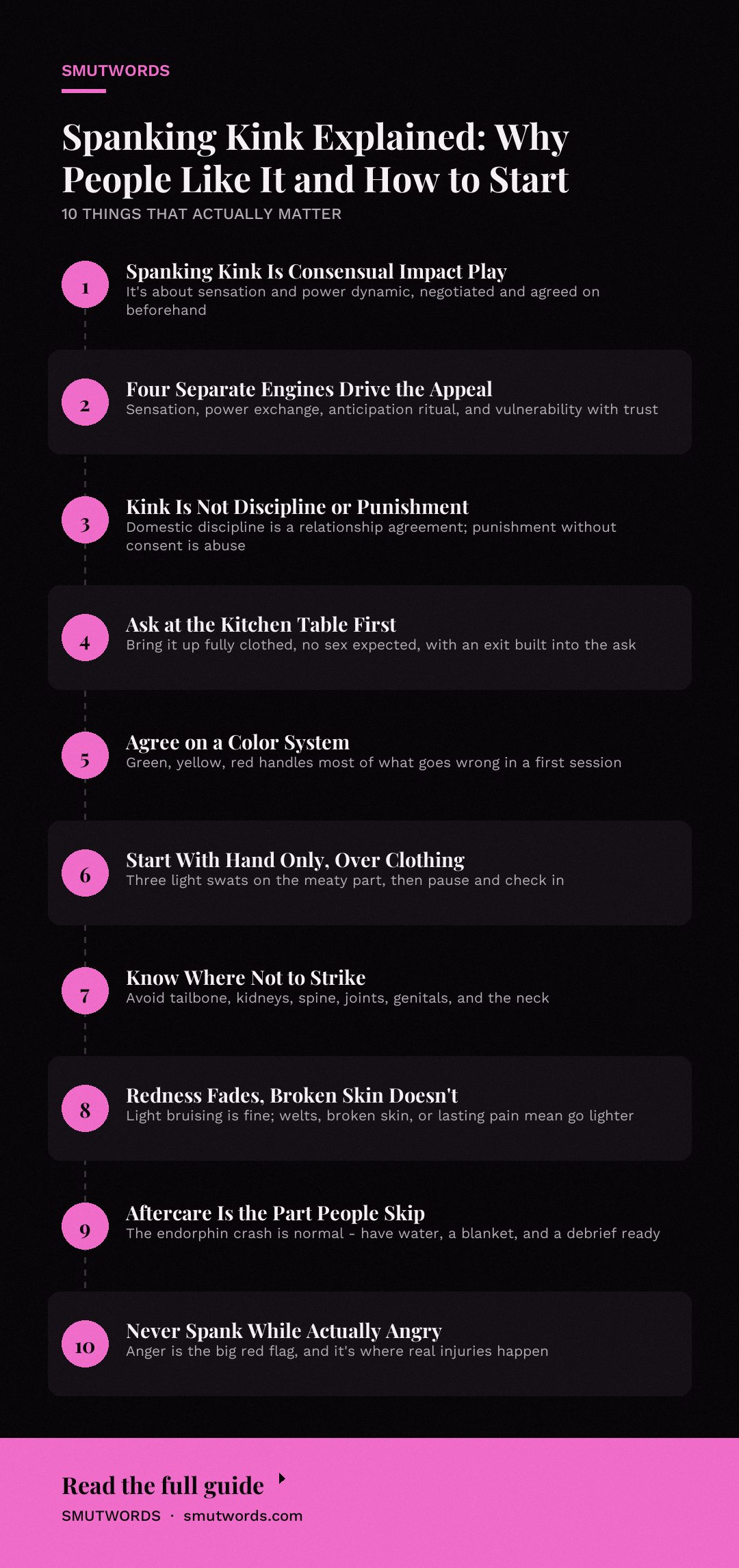
The important distinction: spanking as kink is consensual, negotiated, and about sensation and dynamic. Spanking as punishment, the kind that happens without agreement, is a different thing entirely and not what this article covers.
Why People Actually Like It
The appeal splits into a few separate engines, and knowing which one is yours makes everything easier to ask for.
- Sensation. A warm, stinging hand on the ass lights up nerve endings that are dense and responsive. The heat lingers. Some people chase the endorphin rush that follows a longer session.
- Power exchange. Being bent over someone's knee, or having someone bent over yours, is a posture of dominance and submission that doesn't need a single word of roleplay to be legible.
- Anticipation and ritual. The instruction to bend over. The pause. The counting. For a lot of people the build-up does more than the strike.
- Vulnerability and trust. Letting someone hit you, even lightly, is a small act of faith. Receiving that trust is its own charge.
The power-exchange piece overlaps with what fiction readers already love in hate to love dynamics, where the tension is about who's in charge and how that gets resolved. Spanking puts it in the room instead of on the page.
Spanking Kink vs. Punishment and Discipline
Three things get lumped together and shouldn't be. Spanking kink is about sensation and dynamic. Domestic discipline is a structured relationship agreement with rules and consequences, sometimes including spanking, sometimes not. Punishment without consent is abuse with a nicer name.
You can enjoy one, all three, or none. If your partner's idea of spanking comes from a discipline framework and yours comes from a sensation one, you're going to have two different conversations. Figure out which one you're having before anyone's pants are down.
How to Bring It Up With a Partner
The clumsy version is to spring it mid-scene and hope for the best. The better version is a conversation at a kitchen table, fully clothed, with no expectation of sex afterward.
Try something direct and low-stakes: "I've been curious about spanking. Would you be open to trying it, starting really light, with a way to stop if either of us doesn't like it?" That's a complete ask. It names the thing, sets a low starting bar, and includes an exit.
If you're the one being asked, you get to say yes, no, or "let me think about it." A partner who pushes after a soft no is telling you something important. Believe them the first time.
What to Agree On Before You Start
- A safe word, plus a non-verbal signal (a tap, a dropped object) because someone face-down on a bed with a mouth full of pillow can't always talk.
- Where the hand goes and where it doesn't. Say it out loud, both directions.
- How hard, on a scale of one to ten, and a reminder that most people overestimate their tolerance on the first try.
- How long. Set a rough window so nobody's guessing.
- What happens after. Water, blanket, a few minutes of no demands.
How to Start Light Without It Being Boring
Start with the hand and nothing else. No implements, no restraints, no roleplay script. If you can't have a good time with an open palm, a paddle isn't going to fix it.
Over clothing, or over underwear, is a fine first round. Have the receiving partner lie across the giver's lap or bend over the edge of the bed.
Begin with flat-handed swats on the meaty part of the buttocks, light enough to make a sound and no more. Two or three, then pause. Ask. Add more only if the answer is an enthusiastic yes.
The pause matters more than the strike. A check-in doesn't have to be a sit-down conversation. "Color?" works. Green means go, yellow means ease up, red means stop now.
That single word handles most of what goes wrong in a first session. Use it more than feels necessary.
If you want a fictional model of what the dynamic can feel like when it's charged rather than clinical, She Made the First Move: A Dominant Wife Awakening shows the power exchange from the receiving side, and What She Does in the Backrooms leans into the tension-and-anticipation piece. Read them as mood research. The safety rules still come from real life.
Where to Hit and Where Not To
The safe targets are the fleshy parts of the buttocks, the meaty area on the outer hip, and the upper thighs on the outside. These areas have enough muscle and fat to absorb impact.
Do not strike, at any force:
- The tailbone, lower back, or spine.
- The kidneys or flank, which sit higher and to the side than most people realize.
- The genitals or anus, unless you've specifically negotiated and know what you're doing.
- The back of the head or neck, ever.
- Joints: knees, elbows, wrists.
Aim for the center and the upper-outer curve of each cheek. Keep the hand flat or slightly cupped for the first sessions. That spreads the impact and reduces the chance of a stray finger catching something. If you're using an implement later, a paddle or a folded belt lands more force than an open hand and needs a much lighter swing.
Enjoyed this? Get a free book.
Join the list and we will send a complete free story straight to your inbox, plus new releases every week after that. No credit card, no catch.
Marks, Bruising, and What's Normal
Slight redness and warmth are expected and fade within an hour. Light bruising can happen and is usually not a problem. Anything that breaks the skin, leaves a raised welt with broken capillaries, or causes pain that doesn't fade within a few days means you went too hard and need to go lighter next time.
If either partner has a blood thinner prescription, a bleeding disorder, or an injury in the target area, spanking that leaves marks is a bad idea. Talk to a doctor or keep it to light over-clothing swats.
How to Check In During
Before the first strike, agree on the color system and repeat it back to each other so there's no fumbling mid-scene. Then use it at intervals: after the first few swats, whenever the intensity changes, and every so often even if everything's going fine.
Read the body, not just the words. Tension in the shoulders, silence where there was breathing, a sudden change in sound.
All of it warrants a pause and a direct question. A first session should never involve pushing through a yellow to reach a red. Stop at the first sign of genuine distress, not the second.
The same principles show up whenever you try something new in a physical kink, whether that's wax play for beginners: candles, temperatures, and safety or any other sensation game. Warm-up, check-in, cool-down. Wax play just happens to include an open flame, which is why that guide exists.
The Aftercare Part People Skip
Aftercare is the twenty minutes to an hour after, when the endorphins drain and people often feel raw, shaky, tearful, or inexplicably sad. It's normal. It happens to people who loved every second of it.
Have water ready before you start. Have a blanket within reach. Sit together and debrief: what worked, what didn't, what to change. Be honest even if the honest answer is "I didn't like it as much as I thought I would."
That's useful information, not a failure. If your partner's a reader, they already know the shape of this from fiction. If they're not, tell them the emotional crash after a height is a known thing and it passes.
Physical aftercare on the receiving side means a cool compress if the skin is hot, avoiding tight clothing, and not sitting straight down on a hard chair. On the giving side, aftercare means reassurance. The person whose hand did the spanking sometimes needs to hear that the dynamic was wanted. Say it.
Common Mix-Ups and What They Are Not
Spanking frequently gets confused with a few neighbors in the kink family. Here are the ones worth keeping straight:
- Impact play generally. Spanking is the hand-only starting point. Floggers, canes, and crops are impact too, with more force and more risk.
- Domestic discipline. A relationship structure with rules and consequences. Spanking is sometimes part of it, sometimes not.
- Humiliation kink. A spanking can be humiliating if the players want it to be, but the humiliation is the point in that case, not the sting.
- Pain play as a standalone. Some spanking lovers want pure sensation with no power dynamic. Others want the dynamic with minimal sting. Both are valid.
If you're drawn to the psychological side more than the physical, you might find mate claiming relationships: everything you need to know covers the possession-and-marking angle that overlaps with the spanking-as-claiming fantasy. Different mechanism, same engine.
When to Stop and When to Get Help
Stop the scene, immediately and without debate, if either partner says red, if someone's color goes yellow repeatedly and the giver isn't changing anything, if the receiving partner dissociates, or if the giver realizes they're angry and no longer playing.
Anger is the big red flag. Spanking your partner while you're actually mad at them is not kink, and it's where real injuries happen. If that's the state you're in, put the hand down and use words.
Seek medical attention for numbness in the legs, sharp pain that doesn't fade, skin that's broken, or any injury below the target zone. Marks on the lower back or tailbone that feel like bruising on the bone should be checked, not shrugged off.
If spanking leaves a persistent fear response, intrusive thoughts, or physical pain days later, that's a therapy conversation, not a "next time we'll go lighter" one.
Fiction to Point You in a Direction
Reading a fantasy and doing the real thing are separate hobbies and both are fine. If the spanking kink overlaps with a free-use or power-exchange fantasy for you, Free Use Dungeon Master's Harem plays with total-control dynamics in an explicit way, and My Hotwife Anne has the give-and-take-with-others tension that a lot of spanking fans enjoy. If you like the fantasy of being instructed, Incubation Protocol: Failed and Subroutine: Stretch Her both run on obedience-as-plot.
None of those instruct you on real-life practice. That's what the rest of this guide is for.
Final Thoughts
The spanking kink is one of the easiest impacts to try safely because the equipment is your own hand and the failure mode, done right, is a sting that fades.
So: pick one book that models the dynamic you want, talk it through with your partner at a kitchen table, agree on a color and a safe word. Start with three light swats over underwear and check in before the fourth. Subroutine: Stretch Her is a quick read and does the anticipation beats well. Read it, then put it down and go have the actual conversation.







Loading comments…