Marking kink is the erotic practice of leaving a visible physical sign on a partner's body during sex. A hickey sucked into the neck, teeth indenting a shoulder, fingernails raking red lines down a back, or a playful temporary tattoo pressed onto skin as a souvenir all qualify.
The sign can fade in hours or last for days, but its purpose is the same. Marking kink turns the body into evidence. It makes a private encounter public in miniature, a secret that any sharp eye could spot when a collar shifts or a sleeve rides up.
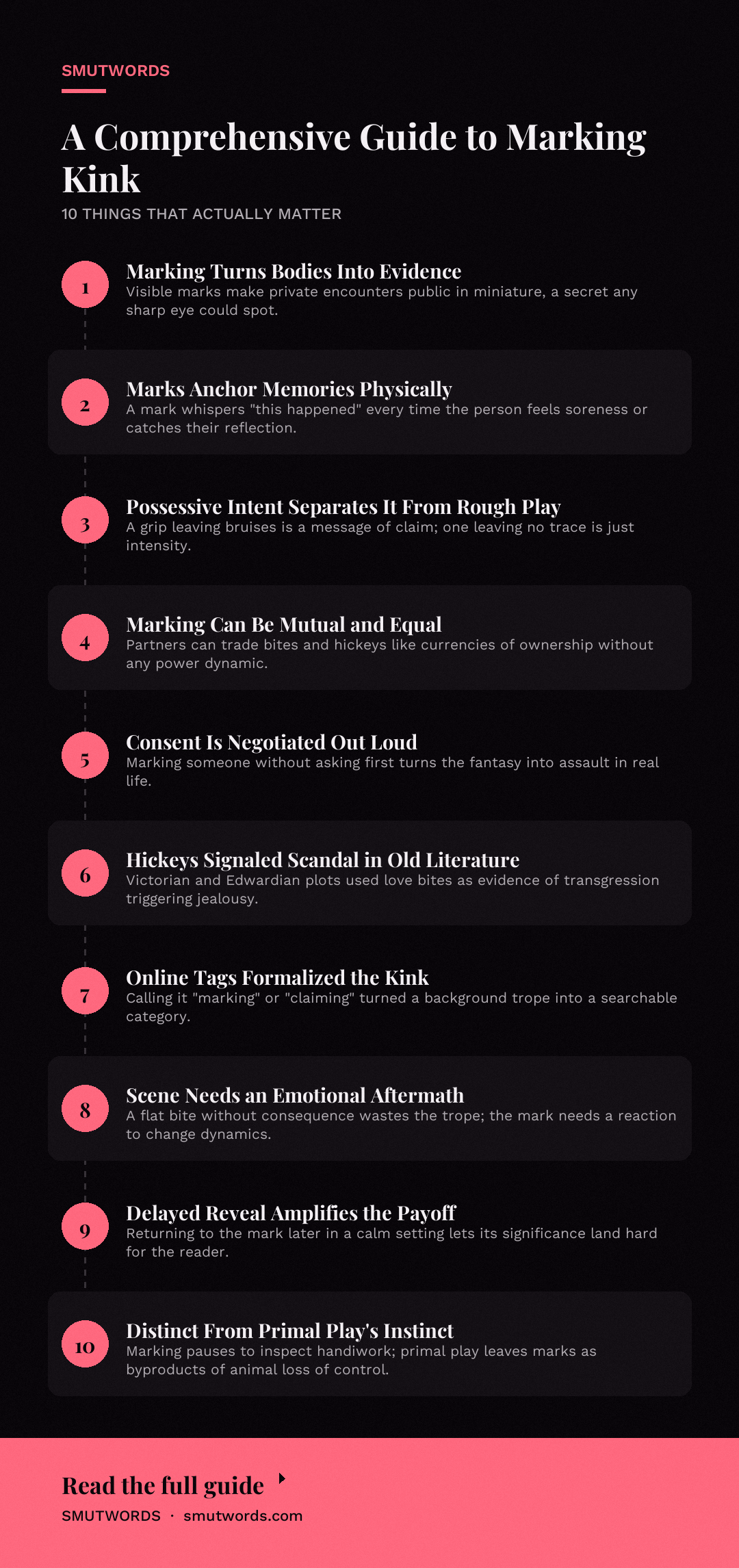
The appeal sits in that lingering proof. Once the scene ends and the sweat cools, the mark remains as a physical anchor for the memory. It whispers "this happened" every time the marked person catches their own reflection or feels a twinge of soreness under their clothes.
For many readers, that tangible quality is the entire point. The mark turns abstract desire into something you can trace with a fingertip hours later.
What Marking Kink Actually Means
Marking kink covers any deliberate act that leaves a visible or semi-visible trace on a partner's body, done specifically because that trace carries erotic charge. The trace itself matters more than the method. A hickey, a bite that leaves bruising, scratches down the thighs, a handprint that blooms red on pale skin, even ink drawn on with a marker: all of it qualifies if the intent is to claim, to remember, or to display.
The possessive aspect is usually central. When one partner marks the other, they are staking a claim that others can potentially see. That public dimension separates marking kink from plain rough play.
A hard grip that leaves no trace is just intensity. A grip that leaves finger-shaped bruises is a message. The mark says someone was there, someone wanted this body, and someone left their signature.
Marking kink is also often mutual and reciprocal. Both partners can mark each other, trading bites and hickeys like currencies of ownership, and plenty of readers enjoy the symmetry of two people who each walk away wearing the other's work.
It does not automatically imply a dominant and submissive dynamic. The act can be a shared game, a jealous display, or a prelude to a longer session. But it does usually involve at least a flicker of possession, whether playful or serious.
What does not count as marking kink: accidental scratches that neither party notices, or marks left without any erotic intent. The kink lives in the deliberate desire to mark and be marked.
Consent is also built into the fantasy as it appears in erotica, though the fictional scenes often skip the negotiation talk in favor of the raw moment. That is fine for fiction. In real life, marking someone without asking first turns the fantasy into assault.
Where Marking Kink Comes From
The urge to mark a lover is ancient, but the term and its current packaging as a named kink are recent inventions. Nineteenth-century erotica and early twentieth-century pulp fiction leaned on the hickey as a shorthand for recent sexual activity.
A "love bite" revealed that a woman had been with a man, often as a plot point that triggered scandal or jealousy in Victorian and Edwardian literature. The mark functioned as evidence of transgression, which is exactly how it still reads in much of today's romance and erotica.
Modern romance novels mainstreamed the hickey and the bite mark starting in the 1970s and 1980s, when bodice rippers and category romances began using visible marks as proof of a hero's virility and a heroine's claimed status. The scenes were usually heterosexual and heavily gendered: the man marked the woman, and the woman wore his mark like a badge.
That dynamic still dominates the genre today, though contemporary books increasingly show women marking men back or same-sex couples trading marks as equal partners.
What changed in the last twenty years is the kink's formalization. Online communities, fan fiction, and the rise of self-published erotica gave readers a vocabulary for naming what they already enjoyed. Calling it "marking," "claiming," or "possessive marking" turned a background trope into a searchable tag.
Platforms like Archive of Our Own and dedicated kink blogs let writers tag scenes precisely, and the term gained traction as a distinct category rather than a side effect of rough sex.
The evolution of the alpha-hero romance also pushed marking kink forward. As the dominant male lead became a fixture in paranormal, mafia, and dark romance subgenres during the 2010s, his need to mark his partner became a recurring character beat.
The mark shifted from simple erotic evidence into a narrative tool: a sign of devotion, a warning to rivals, and a physical reminder of the bond. That narrative utility is why the kink shows up so frequently across subgenres today, touching everything from soul-bond fantasies where marks glow or sync with emotions to gritty contemporary stories where a bite scar reads as a promise.
How Marking Kink Shows Up in Erotica
A strong marking scene does double duty on the page. It captures the physical sensation of the moment, and it drives home the emotional weight of what the mark means. Writers who nail both produce scenes readers remember long after the book closes. Writers who only describe the physical action end up with a bite that reads as violence, not intimacy.
The physical choreography matters. A bite should be described with attention to pressure, texture, and the shift from sharp initial sting to dull, throbbing ache. Sucking a hickey involves the drag of lips, the pull of blood to the surface, the wet sound that builds anticipation.
Scratching invites its own vocabulary: the burn of nails parting skin, the heat that follows, the raised welts that turn pink then red. Strong prose pays attention to how the body reacts rather than just cataloguing the act.
The emotional register varies by subgenre. In possessive dark romance, the mark usually lands during a moment of high intensity, often after a conflict or a near-loss, functioning almost like a brand of forgiveness or surrender.
In lighter contemporary romance, marking tends to be playful, a lover leaving a mark with a grin and a wink, daring their partner to complain. Paranormal romance leans on the supernatural: a mate bond that triggers a physical mark, a bite that seals a lifelong connection, or a claiming scar that glows or aches when the bonded pair is apart.
Common variants writers deploy include:
- The public reveal: the marked character walks into a room, and someone notices the hickey or bite mark, triggering jealousy, gossip, or smug satisfaction.
- The hidden mark: placed somewhere intimate like the inner thigh or just under the collarbone, known only to the two partners and spotted during a later, quieter moment.
- The mirror scene: the marked partner examines their new mark in a mirror, tracing it, remembering the moment it happened, often alone.
- The re-marking: one partner notices the prior mark fading and immediately works to replace it with something fresher, restarting the cycle.
- The matching set: both partners carry marks from each other, often in the same spot, as paired tattoos worn on living skin.
- The accumulation: a scene where one partner is covered in layers of marks over days, each one tied to a different encounter, building a map of recent history.
Flat versions of marking kink fail because they treat the mark as a line item on a checklist. The hero bites, the heroine gasps, and the scene moves on without consequence. That approach wastes the trope's best material.
The mark needs a reaction, an aftermath, a moment where its presence changes the dynamic. When the heroine catches her reflection the next morning and flushes, or when the hero deliberately kisses the bruise he left the night before as a silent reminder, the kink pays off.
One effective technique is the delayed reveal. The marking happens mid-scene in a blur of heat, then the writer cuts away and returns to the mark later, in a calmer setting, letting its significance land. This creates a beat of recognition for the reader that mirrors what the character feels.
Enjoyed this? Get a free book.
Join the list and we will send a complete free story straight to your inbox, plus new releases every week after that. No credit card, no catch.
Another strong pattern is the dialogue-free moment, where the only action is one partner touching the other's mark and the resulting eye contact. Those quiet beats do more work than any amount of explicit description.
Context matters enormously. Marking kink pairs naturally with a praise kink dynamic, where one partner murmurs "good job taking my mark" while the other shivers at both the physical sting and the verbal reward. It also overlaps with jealous-possessive arcs, like the jealousy kink, where marking becomes a visible rebuttal to a rival's attention.
In stories where someone is owned permanently, as in consensual non-consent (CNC) scenes, the mark often symbolizes the transfer of control. Those cross-trope combinations are where marking kink stops being a gimmick and becomes a loaded, repeatable motif.
Books that lean into taboo or forbidden territory often build the entire plot around a visible mark. In the best taboo & forbidden books, a hickey on a boss or a bite scar on a step-sibling becomes a ticking clock that risks exposure. The mark is the physical proof that would destroy the relationship or elevate it.
Similarly, best office & workplace books use visible marks as a workplace hazard: the heroine who cannot wear a scarf, the hero whose assistant spots the scratch on his neck and grins. The setting creates friction that makes the mark feel dangerous.
Marking Kink vs Claiming Kink and Primal Play
Marking kink is often discussed alongside two nearby concepts that get mistaken for it. The first is a broader "claiming" dynamic, and the second is primal play. They overlap but are not the same.
Claiming is the umbrella term for any act that establishes symbolic ownership. It often includes marking, but it also covers verbal claims, collar placement, a permanent ring, or even just a standing rule that one partner always initiates. In a claiming scene, the mark is one possible tool among several. Marking kink is narrower: the visible trace is the point, not a side effect.
Feral play and primal play are the wilder neighbors. These scenes lean on animalistic roleplay, wrestling, growling, and instinct-driven behavior. Biting and scratching are common in primal play, but they serve a different function.
The marks in primal scenes are byproducts of raw, animalistic coupling rather than deliberate claims. Marking kink keeps the deliberate intent center stage. A primal scene escalate into marking kink when one partner stops mid-act to inspect their handiwork and deliberately deepens a mark. That pause, that shift from instinct to intention, is where marking kink takes over.
For readers trying to figure out their own taste, the difference comes down to where the heat lives. If the thrill is in the animal loss of control and the mess that results, that points toward primal play. If the thrill is in the deliberate, knowing act of leaving your signature on someone, that points toward marking kink. Both can exist in the same scene, but the emphasis changes what the reader takes away from it.
Frequently Asked Questions
Is marking kink the same as BDSM ownership or collaring?
Not exactly. BDSM ownership often uses symbolic signs like collars or contracts that only the partners know about. Marking kink specifically wants a visible trace on the skin.
The two can overlap when a Dominant marks their submissive as a physical companion to a collar, but marking works fine on its own without any power exchange structure.
Why do hickeys and bite marks feel good for some people?
The sensation combines pressure, suction, and mild pain, which triggers endorphins and adrenaline that can blur into arousal. The emotional context also matters.
Being marked by someone you trust feels like being chosen and held onto, and that psychological boost enhances the physical sensation. For many people the arousal comes more from the meaning than from the mechanics.
How long do different marks actually last?
Hickeys typically fade in five to twelve days, shifting from red to purple to yellow-green as the trapped blood reabsorbs. Bite marks vary by pressure: light teeth marks vanish in an hour, while hard pressure that breaks capillaries can leave bruising for a week or more.
Scratch marks last anywhere from a few hours to several days depending on depth. Temporary tattoos follow their labeled schedule, usually a few days to two weeks.
Is marking kink always about possessiveness and ownership?
Often, but not always. Some couples use marks as simple souvenirs, a way to carry a memory of a great encounter. Others use them for playful bragging, or as a prelude to a longer session where the mark gets kissed, licked, and traced.
Possessiveness is the most common flavor, which is why the kink shows up so heavily in jealousy-driven plots and in stories that pair with the voyeur husband trope where one partner displays marks for another to witness.
Can marking kink fit into a healthy real-life relationship?
Yes, with communication. Both partners should agree on where marks are acceptable, how visible they can be, and how intense the biting or suction gets. Checking in during the moment matters because pain tolerance shifts.
Partners who work public-facing jobs or have family obligations often set a rule of "no marks above the collarbone" or "nothing that a t-shirt won't cover," which keeps the kink fun instead of stressful.
What should I read if I want stories heavy on marking kink?
Look for dark romance and paranormal romance, where the possessive claiming arc dominates, or check the fan fiction tag "marking" for thousands of short scenes. The best paranormal & sci-fi books list has several picks where mate-bond marking is central to the plot.
Office romance and enemies-to-lovers lists also carry strong marking scenes, since the contrast between public composure and private evidence creates built-in tension. The best enemies to lovers books are a reliable source: few things land harder than a bitter rival leaving a possessive mark on someone they claim to hate.
Is marking kink the same as scarification or permanent body modification?
No. Marking kink in erotica is almost always temporary, producing marks that fade in hours to weeks. Permanent scarification or branding is a separate practice with different consent and safety considerations.
The erotic appeal of marking kink relies heavily on the mark's impermanence, the knowledge that it will vanish and need to be renewed. Permanent alteration removes that cycle of re-claiming.
Final Thoughts
Marking kink endures because it speaks a universal language. The act says claim, remember, want again. It turns the invisible space between two people into something that can be seen and touched, and that physical proof hits readers with a particular force. The best versions of this kink balance heat with vulnerability, letting the mark carry meaning that words around it never quite reach.
Read a possessive dark romance with your heart rate up but your judgment still sharp. Let the bite bruise under a workplace shirt or next to a claiming scar on a supernatural mate. Notice how the better writers make you feel the mark's presence in every scene that follows.
The strongest marking kink stories stay with you the way the marks stay with their characters, fading gradually, and then surprising you with a jolt of memory when you least expect it.






Loading comments…