
Alpha/Beta/Omega Dynamics hand writers a ready-made excuse for composure collapse, and a lot of mind break fiction now lives in that space.
Where Mind Break Dynamic Comes From
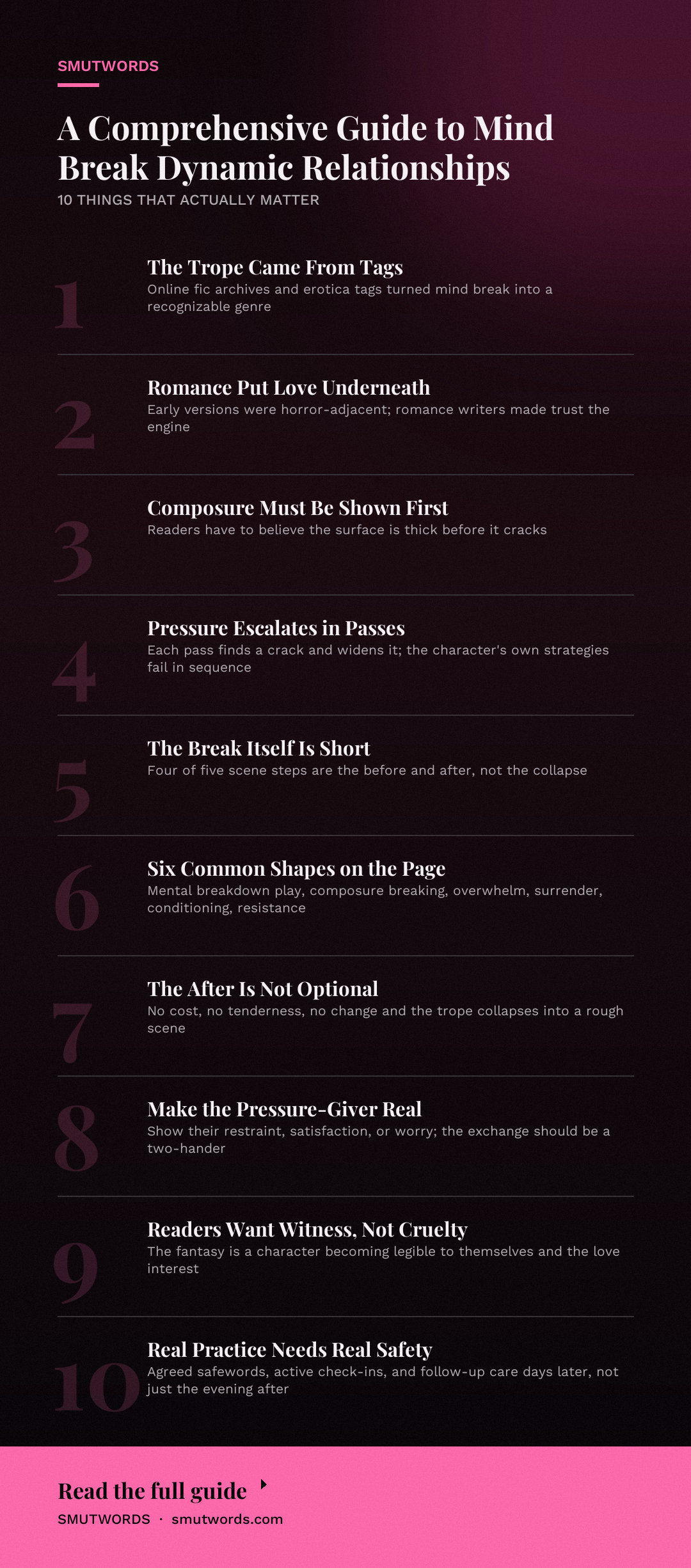
The honest history here is a publishing history. There's no single origin text for the mind break dynamic, and very little real-world BDSM lineage worth pointing to. The trope as it exists on the page is largely a creature of online erotica and, later, dark romance publishing.
It grew up in the spaces where amateur and semipro fiction was posted, read, tagged, and argued over: forums, fic archives, serial platforms. Those spaces are also where the vocabulary formed. "Mind break" as a tag shows up in the same ecosystem that produced overwhelm play, conditioning tropes, and the whole lexicon of psychological surrender.
Tags made the trope findable, and findability made it a genre. Writers started writing to the tag, readers started searching for it by name, and the term hardened into a recognizable category with its own conventions.
How it evolved
Early versions leaned horror-adjacent. The mind break was often the villain's move, or a consequence, or a punishment, and the cruelty was the point. Over time, romance writers picked the structure up and did what romance writers do: they put a love story underneath it.
That shift changed the trope considerably. Once the person applying pressure is a love interest rather than an antagonist, the machinery has to justify itself. Trust becomes the engine.
The pushing has to be wanted, or at least framed as something the pushed character is choosing into. The result is the modern version, where the psychological extremity and the intimacy are the same thing viewed from different angles.
Dark romance's boom in the 2010s and 2020s pushed it further into the mainstream of the genre. Alpha/beta/omega dynamics deserve credit as an accelerant here. That framework handed writers a built-in biological or instinctual justification for composure collapse, and a lot of mind break fiction now lives in that space. The same is true of soulbond stories, where the bond itself can be written as a pressure that erodes a character's defenses from the inside.
What changed on the page
Two things. First, interiority. Older versions often showed the break from the outside, as behavior. Modern versions spend pages inside the target's head, tracking the exact moment the running commentary stops working.
Second, the recovery. Contemporary romance and dark romance both expect the story to account for what breaking someone open costs, which is why aftercare scenes, however stylized, have become near-mandatory beats.
How It Shows Up in Erotica
This is the section for the working craft. If you've read a lot of these books, you know within a chapter whether the author understands the structure. A flat mind break dynamic is one where a character is simply overpowered, verbally or otherwise, and folds. A strong one is procedurally specific, and it earns its ending.
The anatomy of a scene that works
Strong versions almost always run the same arc, whether the author knows the vocabulary or not.
- Establish the composure. Show the character holding it together under normal pressure: cool, competent, controlled, maybe a little cold. The reader has to believe the surface is thick.
- Identify what the composure is made of. Is it pride? Fear? A job that requires a tight face? Elaborate coping? An author who names the material can break it with something specific instead of generic force.
- Apply the pressure in escalating passes. Repetition, sensory overload, humiliation, exhaustion, conditioning. Each pass finds a crack and widens it. The best scenes show the character's own strategies failing in sequence, so the reader watches every exit close.
- Land the break. One beat, often quiet, where the defense actually gives. The character goes pliant, or undone, or says the thing they would never say.
- Show the after. Consequences, tenderness, cost, changed behavior. The break has to leave a mark or the whole campaign reads as no different from a rough night.
Notice that four of the five steps are about the before and after. The break itself is short. New writers often spend the entire scene on the collapse, which is like writing a joke and skipping the setup.
Common variations authors use
The trope is elastic, and these are the shapes it most often takes on the page.
- Mental breakdown play. The most direct version, built on emotional disclosure. The pressure is conversation, interrogation, or confession, and the break is the character crying, admitting, yielding the secret they'd built their life around.
- Composure breaking. Focused on the surface rather than the depths. The character's dignity is what's targeted: their public face, their professionalism, their poise. Different flavor, more theatrical, often crueler in tone.
- Mind melting and overwhelm play. Sensory and cognitive. Too much of everything: pleasure, noise, orders, exhaustion. The mind stops being able to keep a narrative going and goes quiet. This version is common in intense erotic scenes where the mechanics are physical but the target is mental.
- Psychological surrender. Slower and more intimate. The break is a decision as much as a collapse, the character choosing to stop holding the line. Tends to land inside relationships the reader believes in.
- Conditioned submission. The most science-fictional end of the spectrum. Repetition and reward are used to install a response, and the break isn't a single moment but a new baseline. Pairs naturally with monster romance and territorial shifter stories where instinctual pressure is available as a tool.
- Resistance breaking. The physical is present but the real target is a character's refusal to want something. Often the root engine of enemies-to-lovers arcs in dark romance.
What makes the strong versions strong
Readers of this trope are not actually chasing generic cruelty. They are chasing the moment a character they've invested in becomes legible, to themselves and to the love interest, in a way they weren't before. That's why the best examples are intimate. Witness is what carries the fantasy.
The flat versions have a recognizable set of failures.
- The composure was decorative. The author told the reader the character was controlled but never showed it under pressure, so the break means nothing. Almost all failures start here.
- The pressure is generic. Vague degradation applied over and over without escalation or consequence. If each pass didn't cost more than the last, the reader stops believing in the stakes.
- The break is unearned. One line of dialogue, and the character who held out for 200 pages folds. Readers notice.
- The after is missing. No cost, no tenderness, no change. The trope collapses into one more rough scene and the intimacy at its core vanishes.
- The love interest is a prop. The person applying pressure has no inner life of their own in the scene. Real versions make the pressure-giver's restraint, satisfaction, or worry visible, which turns the exchange into a two-hander.
One more craft note. The strongest authors let the target retain a fragment of agency inside the break, even if it's just a refusal to use a safe word or a choice to stay. A completely passive target reads as an object. A target who never had a choice and never had a voice is not the story readers signed up for.
Where it shows up beyond dark romance
The structure appears in places readers don't always label. The bully-to-lover arc in bully cuck dynamics is running a variant of it: pressure applied until a character's self-image gives.
Enjoyed this? Get a free book.
Join the list and we will send a complete free story straight to your inbox, plus new releases every week after that. No credit card, no catch.
Relationship-chronicle stories about embarrassment and forced confession sometimes land closer to mental breakdown play than the author would call it. And in the more speculative corners of the genre, a writer working with an AI love interest or a monster partner often reaches for overwhelm dynamics to make the nonhuman partner's attentiveness feel threatening.
The same architecture does the work regardless of setting. At its core, a mind break dynamic is not about the severity of the pressure. It's about the visibility of the break, the completeness of the witness, and the shape of the after.
Mind Break Dynamic vs Related Terms
Two comparisons come up often enough among readers that they're worth separating cleanly.
Mind break dynamic vs bully cuck dynamic
The bully cuck dynamic is a distinct cross-glossary entry: usually power imbalance, humiliation, and a rival or third party at the center of the erotic charge. It can bend a character's self-image, which overlaps with mind break territory.
The difference is what each term is organized around. Bully cuck runs on social standing and jealousy. Mind break runs on the psychological mechanics of collapse itself. A scene can contain elements of both; the terms point at different things.
Mind break dynamic vs soulbond
A soulbond is a mechanism. It's the magical or instinctual link between two characters, and it can create exactly the wear on a character's mental defenses that mind break fiction loves.
The bond is the engine. The mind break is one result. They're a pairing, not a parallel comparison, and a lot of the most extreme composure breaking in speculative romance is powered by a soulbond pressure that the character can't switch off.
Frequently Asked Questions
Is a mind break dynamic the same as consensual non-consent?
They're adjacent, not identical. Consensual non-consent is a specific framework in which a scene is agreed to in advance but plays out without ongoing permission inside the fiction. A mind break dynamic can be built on that framework, but it's defined by the collapse of mental defenses rather than by the consent architecture. Plenty of mind break stories are fully consensual all the way through, and plenty of CNC stories have no mind break at all.
What's the difference between mind break dynamic and humiliation?
Humiliation is one of the tools that can drive a mind break. The dynamic itself is the larger structure: the campaign of pressure, the collapse, and the change that follows. A humiliation scene without an arc of pursuit and break is just that, a scene, not the dynamic.
Why is this trope so paired with alpha/beta/omega stories?
Because ABO fiction supplies a ready-made justification for instinctual, bodily compulsion that can wear a character's control thin. A writer doesn't need to justify why a composed character's defenses are failing if biology is doing it. The framework accelerates the trope, which is why so much composure breaking fiction lives in that space.
Do readers of this trope care about the aftercare beats?
Actively. The emotional logic of the trope requires the cost to be acknowledged, and readers who invest in a character's breakdown want to see them reassembled with care. Stylized aftercare is a reassurance beat the genre has quietly standardized, and skipping it is one of the fastest ways to lose a reader who was on board with the extremity.
Is a mind break dynamic safe to practice in real life?
The psychological toll can easily outweigh the physical, which makes safety structurally different from most kink. Real practice requires an agreed safe word (or a non-verbal signal for scenes where speech is part of the pressure), active check-ins during play, and attentive aftercare that continues past the immediate scene.
Anyone practicing this should read up on psychological edge play specifically and be honest with themselves about whether they can handle a partner's emotional costs. A responsible partner should build in follow-up days later, not just the evening after.
What's a good sign an author understands the trope?
The composure is shown before it's broken, and the break costs something on both sides. If the love interest applies pressure and the story never lets us see them worry, restrain themselves, or absorb the consequences, the author is writing something closer to villainy than the dynamic. Look for the two-hander.
Final Thoughts
A mind break dynamic is at its best when it earns every escalation. The composure has to be real. The pressure has to be specific. The break has to be witnessed and paid for.
Get those three right and the fantasy of being so thoroughly wanted that every defense falls lands with genuine force. For a version that does this at length, pick up a book that makes the control-breaking the central plot rather than a scene halfway through, and pay attention to how much of it happens in the character's own head. That's where the trope lives, and that's the test of whether it's being done well.





Loading comments…