Most readers who search for squirting vs female ejaculation are trying to settle an argument. Maybe a scene in a book described one thing and called it the other. Maybe a partner said something confident at 2 a.m. that didn't match what the body in front of them was doing.
The short version: they're related, they often happen together, and they are not the same fluid from the same gland. Knowing the difference changes how a scene reads on the page.
Anatomy first, because the fantasy gets sharper when the mechanics are right. Female ejaculation is the small-volume release of milky, whitish fluid from the Skene's glands, which sit along the lower wall of the urethra. It usually runs somewhere between a teaspoon and a few tablespoons, comes out with a push rather than a spray, and has a texture close to watered-down cream. Squirting is the larger, clearer, often forceful release that happens at orgasm or right before it.
Chemistry nixes the old claims. Studies analyzing squirted fluid find it's mostly urine diluted with a little prostatic-style secretion. That fact gets used as a gotcha in bad-faith arguments online.
In bed and on the page it just means the body released a lot of clear fluid under enormous pressure. Which is exactly the kind of physical event erotica was built to describe.
Squirting vs Female Ejaculation: The Actual Differences
Two fluids, two glands, two different volumes. Here's the breakdown readers keep looking for, laid out plain:
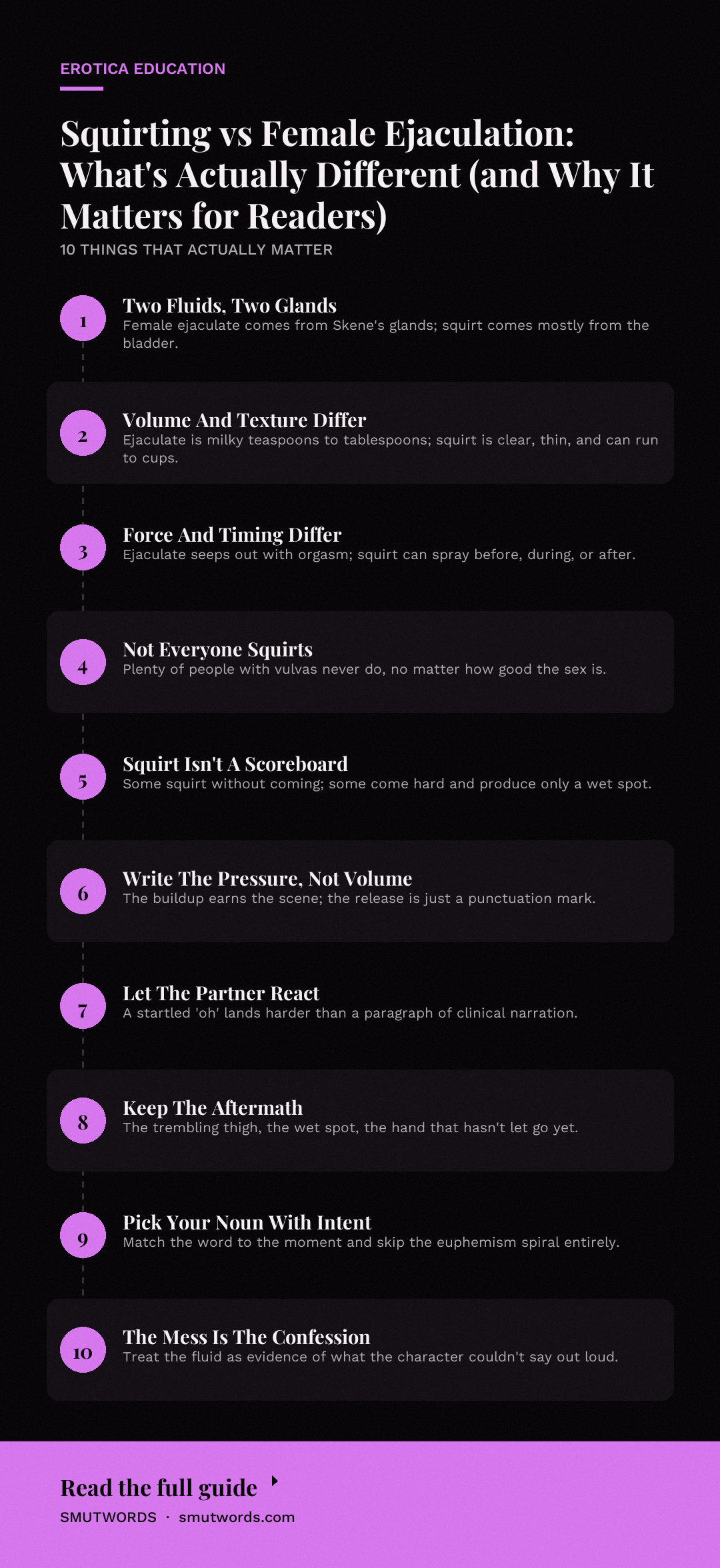
- Source. Female ejaculate comes from the Skene's glands. Squirt comes primarily from the bladder, mixed with Skene's fluid.
- Volume. Ejaculate is teaspoons to a few tablespoons. Squirt can run into cups.
- Color and texture. Ejaculate is milky and slightly thick. Squirt is clear and thin, close to water.
- Force. Ejaculate usually seeps or pulses out. Squirt can spray, especially with direct G-spot stimulation.
- Timing. Ejaculate tends to arrive with orgasm. Squirt can hit before it, during it, or in a series of pulses after.
The two events can overlap, which is where most of the confusion starts. A character who gushes fluid and also produces a thick milky emission just experienced both. An author who writes it that way sounds like they've been paying attention.
The Myths That Keep Showing Up in Erotica
Myth: Everyone squirts
Plenty of people with vulvas never have and never will, no matter how good the sex is. A scene where the heroine soaks the sheets every single chapter flattens the moment into a plumbing report. Save the flood for the scene that has earned it.
Myth: Squirting means the orgasm was better
Squirt and pleasure aren't a leaderboard. Some people squirt without coming. Some come hard and produce nothing more than a wet spot. Writing the second version with the same reverence as the first is one of the marks of an author who actually knows the territory.
Myth: It's pee, so it's gross
The fluid is dilute urine, and the people who do it tend to describe the release as overwhelming in a way that has nothing to do with shame. Readers searching squirting vs female ejaculation aren't looking for a hygiene lecture. They want the scene to land without the author flinching mid-sentence.
What Readers Actually Want From a Squirting Scene
Search data tells a blunt story. People looking up squirting vs female ejaculation are usually mid-scene, mid-argument, or mid-fantasy. What they want in fiction is specificity, a little aftermath, and a partner who reacts like a person instead of a fire hose operator.
The buildup matters more than the release. A scene that spends three paragraphs on a hand working the front wall of the vagina, the pressure building until the character is gripping the sheets and swearing, then half a sentence on the actual gush, will outperform the reverse every time. The release is a punctuation mark. The sentence before it does the work.
Reaction sells it. A lover who pulls back and says "oh" in a small voice is hotter than a paragraph of clinical narration. Let a character be startled by their own body, let the other person be delighted or wrecked by it, and skip the play-by-play of the mattress situation unless the wet sheets are part of the kink.
- Write the pressure, not the volume. Describe the sensation of fullness and the involuntary push.
- Give the body a tell. A thigh that starts shaking, a hand that grabs a wrist, a breath that stops mid-word.
- Let the partner react. Surprise, delight, a muttered curse. Skip the calm narrator.
- Keep the aftermath. The sticky thighs, the ruined sheets, the smug look. That's where the heat lives.
Accurate Language Without Killing the Heat
Clinical words flatten a scene. "She experienced a release of fluid from the urethra" reads like a discharge summary. The fix is choosing words with texture and knowing when to be exact.
"Squirt" is a good verb for the sudden, forceful version. "Ejaculate" works when the scene needs weight and formality, or when a character is being deliberately clinical for effect (a doctor, a narrator with a grudge, a dom who likes precision). "Gush," "spurt," "flood," and "release" all have different pressures. Pick the one that matches the moment.
For the smaller, milky event, "she came and it leaked out of her" is more accurate than "she ejaculated across the room." Most female ejaculation wouldn't reach a pillow from a foot away, let alone a headboard. A scene that treats it like a pressure washer is a scene that forgot the anatomy.
The other reliable trick is describing what the character feels instead of naming the fluid. The sudden urge to push, the hot spill down the inside of a thigh. The way the muscles clench and then let go all at once.
Sensation carries accuracy further than any clinical noun.
Where the Two Phenomena Overlap in Fantasy
In the right hands, both events serve the same narrative purpose. They publish the character's loss of control to the room. A character who squirts in front of a lover has just admitted something the dialogue couldn't get out. That's why the trope keeps showing up next to power-exchange scenes.
Enjoyed this? Get a free book.
Join the list and we will send a complete free story straight to your inbox, plus new releases every week after that. No credit card, no catch.
It's the same engine that drives a mind break dynamic, where the whole point is a character losing their composure in front of someone who knows exactly how to take it. Bodies that leak and gush and overreact make that loss visible. The sheet-soaking moment is the visible receipt.
There's also a quiet humiliation kink hiding in the trope. The character who didn't mean to make that much of a mess, the partner who notices, the smirk, the way the embarrassment makes the next round hotter. A writer who leans into that dynamic gets a better scene than one who treats the fluid like a triumphant special effect.
The same goes for scenes where the partner expected it, planned for it, and gets exactly what they were working toward. That's control and surrender sharing the same page. The mess is the proof the other character earned it.
Common Mistakes Authors Make
The biggest one is treating squirt as a finish line. A scene that builds for 2,000 words toward a single squirt and then stops has spent its climax on a fluid and given the reader nothing to feel. The fluid is the punctuation. The feeling is the sentence.
Second mistake is conflating the two until the scene sounds incoherent. If the fluid is milky and low-volume, don't call it a flood. If the character is spraying across the mattress, don't call it ejaculate and then describe a teaspoon. Readers who know the difference will trust the author less for the rest of the book.
Third is using a squirting scene to sidestep the emotional beat. A character who gushes during a first time with someone they've been circling for ten chapters should have a reaction to what just happened. Skipping that to write another round of penetration is a miss. The scene is a disclosure, and the author should write it like one.
The fourth, and the one readers complain about most in reviews, is the euphemism spiral. "Her womanhood released its essence" is not a sentence that belongs in erotica. Pick a word, commit to it, and get on with the scene.
How to Write It Without Losing the Fantasy
Accuracy and heat aren't enemies. The trick is to let the physical details live in the character's senses rather than a narrator's medical file.
A character can feel the push building without knowing the word for the gland behind it. A lover can notice the wetness before the narrator names it. A scene can spend a beat on the startled breath after, the way the character's thighs slide against each other, the smell of the room changing. Those details are anatomically correct and hot in the same sentence.
There's a useful habit from other trope writing here. A good territorial shifter trope scene doesn't explain the wolf biology in a footnote. It lets the scent and the growl do the worldbuilding.
Squirting scenes work the same way. Trust the reader to feel it.
A scene can also borrow from the slow-burn playbook. The cuckqueaning dynamic runs on the protagonist watching and being wrecked by what she sees, and that tension translates well to scenes where the character is her own audience, feeling the heat rise and knowing what's coming before it does. Suspense before the release, then the release.
The final lever is aftermath. Don't cut on the squirt. Cut on the trembling thigh and the wet spot and the way the partner's hand hasn't let go yet. That's where the reader lives.
Squirting vs Female Ejaculation: What Actually Belongs on the Page
You don't owe the reader a lecture on Skene's glands. You do owe them a scene that doesn't contradict itself. A hundred words of buildup that respects the anatomy beats a thousand that don't.
The best version of the trope treats the fluid as evidence of something the character couldn't say out loud. It's the same engine behind any good redemption arc romance, where the emotional dam breaks and the body follows. The mess is the confession.
Write the pressure, write the reaction, write the aftermath, and pick your noun with intent. Readers searching for squirting vs female ejaculation will find the answer and a scene worth rereading.
Final Thoughts
If you want to see the distinction handled well, Smell Fetish 101: Why Scent Turns People On and How to Explore It is worth a look for its approach to physical detail as a delivery system for heat. The same principle carries over here. Write the body accurately, keep your narrator's hands off the medical chart, and let the reader's own senses do the rest.




Loading comments…