
A caging kink is a practice kink built around confinement: one partner locked inside a cage, crate, kennel, or barred cell while the other holds the key, the schedule, and every decision about when the door opens. It overlaps heavily with pet play, bondage, and ownership dynamics. In erotica the cage does double duty as physical restraint and as a visible statement of status.
If you landed here from a search bar, you probably want the full picture: what the terminology covers, where the trope came from, how published fiction handles it, and the safety questions that come with writing or trying something this literal. That is what follows.
What Caging Kink Actually Means
Caging kink describes erotic confinement in an enclosure. The submissive goes in; the dominant controls the lock. The enclosure can be a real dog crate, a purpose-built steel cage, a converted closet, a barred alcove, or something elaborate enough to count as furniture.
What makes it a kink rather than a storage problem is the power exchange wrapped around the object. The person inside cannot let themselves out, cannot decide when they eat, and cannot choose when they are touched or displayed.
The word "cage" carries the whole emotional payload of the practice. It implies animal status, captivity, and containment all at once. Plenty of practitioners never use a literal cage and still describe what they do as caging: a locked room, a closet, a taped-off corner of a dungeon.
The strict definition, though, involves visible bars. Being seen inside the enclosure matters as much as the inability to leave it.
What counts, and what doesn't
There is a difference between caging and simple bondage. A rope harness restrains the body; a cage restrains the whole person and tells a story about what they are. A submissive in a crate can often move more freely than one in rope, which is exactly the point. The restriction is spatial and psychological rather than muscular.
Pet play and caging overlap constantly but are not the same thing. Pet play is the role: puppy, kitten, animal. Caging is the housing arrangement that role often implies.
You can do pet play without any cage and caging without any animal persona. When the two combine, which is common, you get crate training as a formalized ritual.
Common misconceptions are worth clearing up:
- It's not automatically degradation. Some dynamics lean hard into humiliation; others treat the cage as comfort, nesting, a safe den. Both are legitimate versions of the kink.
- It's not always sexual while it happens. Many scenes involve hours where nothing sexual occurs. The arousal sits in the waiting, the anticipation, the awareness of status.
- It's not the same as imprisonment fantasy. Consensual caging runs on negotiated consent, safewords, and the option to stop. Non-consensual captivity eroticized by a reader is a different trope with different rules.
- Size and spectacle matter less than control. A small, modest crate can produce a more intense scene than a showpiece cell if the dominant is precise about timing and attention.
Where Caging Kink Comes From
The history of caging as a written erotic trope runs through the twentieth century, and almost all of it lives in fiction before it lives anywhere else. Early leather-era writing and the mid-century underground paperbacks that circulated S&M stories leaned on cages, chains, and cells as props for power exchange. The cage was useful because it was visually legible. Any reader in 1965 could look at a barred enclosure on a page and understand, instantly, that someone was owned.
The literary lineage is older still. Captivity narratives, dungeon novels, and the gothic tradition of locked rooms all fed the erotic imagination around confinement long before anyone used the term caging kink. What changed in the twentieth century was that the confinement became consensual within the story, negotiated, and erotic for its own sake rather than a threat the heroine escapes.
Published erotica pushed the trope into specific territory through the 1990s and 2000s: the rise of BDSM romance as a commercial genre, the proliferation of online kink communities, and the fetishization of pet play. Dog crates entered the vocabulary because trainers, sex educators, and kink writers started acknowledging them as real equipment. Crate training as a formalized practice moved from private community knowledge into published fiction, and the popularity of puppy play in the 2010s cemented the association.
How the publishing depiction has shifted
Earlier erotica treated the cage mostly as humiliation furniture. The scene beat was the submissive being made small, ashamed, displayed. The emotional register was degradation first.
Contemporary books complicate that. Modern kink fiction increasingly writes the cage as a place of comfort, structure, and even care.
The dominant who locks someone in also brings food, checks temperature, and cleans up after. The enclosure becomes a statement about the relationship rather than a standalone torture device. The shift parallels a broader change in how published power exchange gets written across the genre, and if you want the macro version of that arc, the guide to total power exchange covers how full-time submission gets structured as fiction.
How It Shows Up in Erotica
Caging is a scene-level kink. It is one of the few practices that reliably forces a book to slow down, because confinement cannot be fast. The character stays in one place, and the prose has to fill that space with something other than motion: sensation, thought, waiting.
When it works, it produces scenes that land hard and can be quoted. When it fails, it reads like a prop dropped into a room with nobody tending it.
What a strong caging scene does, page after page, is specific: it stays inside the submissive's head and chest and body while physically nothing happens. The bar in the sight line. The sound of the latch. The unfamiliar floor under the knees.
The way time stretches when you cannot see a clock. A cage scene is a pressure cooker of interiority.
The variants writers use
Within published fiction, caging shows up in recognizable arrangements. Each one is doing different work.
- Crate training. The dominant uses a real dog crate and teaches the submissive a routine: in, settle, wait, release. The kink is in the obedience, the repetitive ritual, the reward structure.
- Kennel play. A formal kennel setup with labels, feeding schedules, and other "animals" nearby. This variation leans hardest on the pet persona and on visible status among multiple subs.
- Display cage. The enclosure is furniture, positioned in a room where the dominant can be observed or entertained, often during a party or scene night. The submissive is seen but not spoken to.
- Locking cage. A padlock is the point. The key is in the dominant's possession, often worn on a chain or kept somewhere the submissive knows is out of reach. The psychological weight lands on the fact of the lock, not the bars.
- Overnight confinement. The scene stretches across sleep. Interior monologue has to carry long stretches of nothing, and the dominant returns at dawn.
- Cage and rule set. Confinement is paired with a rules document: silence, posture, what happens on each wrong move. The punishment structure is written into the scene like a contract.
What makes a caging scene work
The best-functioning scenes share a handful of traits. They establish the enclosure's architecture early: dimensions, materials, where the door is, what the submissive can see. They anchor the passage of time with specific, small cues. They let the reader feel the decision about when the door opens land like a physical event.
They also tend to have a clear emotional thesis for the cage. Is it a punishment, an honor, a comfort, a rehearsal for submission, a demonstration of ownership? A scene that tries to be all of those at once feels muddy. A scene with one strong thesis can be devastating.
Weak caging scenes mostly fail in two ways. The first is underweighting: the cage is mentioned, the character sits in it, a paragraph passes, and the book moves on. The confinement has no consequence.
Enjoyed this? Get a free book.
Join the list and we will send a complete free story straight to your inbox, plus new releases every week after that. No credit card, no catch.
The second is overrendering: paragraphs of ornate description of the bars, the lock, the latch, until the erotic charge is lost in a spec sheet. The fix in both directions is the same: more interiority, less inventory.
The physical dominance details that readers notice
Readers who love this kink tend to be detail-sensitive about the mechanics of control. Specificity reads as authority. What actually happens while someone is inside is where the eroticism lives:
- Feeding through the bars. The dominant's hand coming through a gap with a bowl, water bottle, or piece of food. The asymmetry between the person who can leave and the one who cannot.
- Touch without access. Fingers through bars, no full contact. The submissive reaches, the dominant retreats. Frustration as foreplay.
- Being seen. The dominant pulls up a chair and watches. Nothing else happens for a while.
- Being heard. Orders given from across the room, the submissive expected to answer. Confinement sharpens the voice-only dynamic.
- The key. The physical possession of the key is often more charged than the cage itself. Where the dominant keeps it during the day tells the submissive everything about their status.
- Departure and return. The dominant leaves the room. Time becomes hostile. The submissive waits.
Each of those beats is a small power exchange in itself. A strong caging chapter is built out of a dozen of them, chained together.
Caging and scene play
Caging usually appears as a component of a larger scene rather than as a standalone kink. In a normal book, the cage is the setup, and the scene that follows (feeding, punishment, sex, release) is the payoff.
Writers who treat caging as a complete exchange in itself have to invent a lot of pacing to keep the page alive. Writers who treat it as the opening move in a longer scene play structure usually find the kink integrates more naturally into a plot.
Caging and total power exchange
Caging is the ultimate test of whether a power exchange is real on the page. A cage scene forces the dominant to prove that they hold power over time itself, not just over the submissive's body for ten minutes.
In total power exchange fiction, this is one of the most reliable ways to dramatize the depth of the dynamic. If you want to see how the wider genre handles full-time control, including how containment and daily routine function as narrative, that total power exchange guide runs through the structure.
Caging and smell
Close quarters concentrate everything. A cage scene can lean on smell more than most kinks do, because the enclosure itself traps scent: the dominant's hand on the bars, the submissive's own body, the bedding that has not been changed. Readers who respond to smell fetish material will find some of the richest scenes in this kink, since the enclosure makes scent unavoidable.
Caging and the rest of the kink repertoire
Caging rarely travels alone. It pairs naturally with pet play, collars and leashes, and formal ownership rituals. A ritual collaring ceremony sometimes precedes the first caging, framing the cage as a next-stage commitment.
It can also be layered with other practices, many of which are catalogued across the site, including how breath play and JOI books handle the interior-monologue rhythm that caging requires, and the seasonal twist available via cock warming, where a similarly patient, quiet scene style is required.
Caging Kink vs Related Practices
Two comparisons are worth making explicitly, because readers regularly mix them up.
Caging vs scene play
Scene play is the umbrella term for a negotiated erotic encounter with a start, middle, and end. Caging is a specific practice that often lives inside a scene, but the two are not interchangeable.
Someone can have a caging kink without doing full scene play around it (an everyday dynamic, a private ritual), and someone can do scene play without ever putting a partner in an enclosure. In fiction, caging works as a scene mode that gives scene play its most patient, dialogue-driven variant.
Caging vs cock warming
These two get grouped together because they share a quality: they both require stillness, waiting, and a dominant who is content to make the submissive sit with something. The difference is that cock warming is a physically intimate act with another person directly involved, while caging is confinement with the dominant often elsewhere.
Both reward a writer who can fill silence. Both fall apart in the hands of a writer who cannot. If you like the patient pacing of caging scenes, cock warming writing is a close aesthetic neighbor.
Frequently Asked Questions
Is caging kink the same as pet play?
Not exactly. Pet play is a role about becoming an animal; caging is a housing arrangement often attached to that role. You can practice either one without the other, though the two combine so often in published erotica that readers frequently treat them as identical.
Do you need a real cage to practice caging kink?
No. Many practitioners use a room, a closet, a large crate, or a bed with rails. What defines the kink is the confinement and the negotiated control over release, not the object itself. In fiction, the "cage" can be anything from a dog crate to a purpose-built cell if the writing sells it.
What safety steps matter most with a cage?
Quick-release access, agreed time limits, a safeword the submissive can use from inside, temperature and hydration checks, and aftercare once released. Anyone using a real enclosure should also verify that the bars or lock mechanism produce no injury risk, and should never leave the confined person unsupervised without a plan for rapid access. Reading about it is safe; practicing it requires the basics that every kink community emphasizes.
Can caging be part of a vanilla/kink relationship?
Yes. Some vanilla/kink mix relationships treat caging as an occasional scene rather than a lifestyle, which is common in published fiction where one partner is new to kink. The negotiation itself often becomes part of the story.
Why do readers like caging scenes so much?
Because the cage is a visual metaphor that does a lot of work in very little space. It encodes ownership, vulnerability, patience, and the dominant's absolute control over time. The scene is nearly cinematic, and readers respond to that.
What's the difference between a display cage and a locking cage?
A display cage prioritizes being seen, often during a party or scene with others present. A locking cage prioritizes the padlock and the possession of the key. A single scene can use both, and many do, but the emotional center shifts depending on which one the writing leans on.
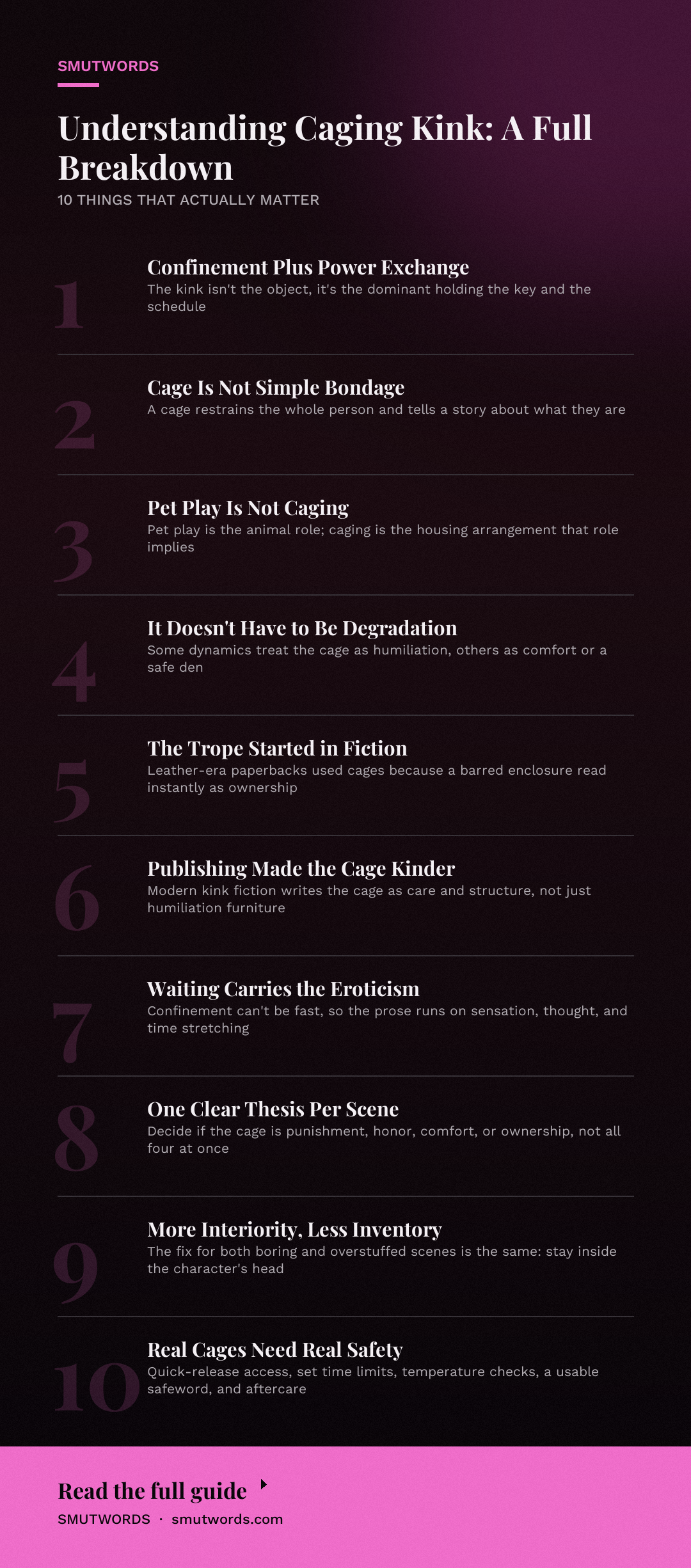
Final Thoughts
Caging kink is one of the few practices that asks a writer to slow down, sit still, and make waiting erotic. When a book commits to that, the scene becomes something you reread. If you want to see this done with real patience and a dominant who understands exactly what the cage is for, the books below are where to start.





Loading comments…