Most people meet the territorial shifter trope by accident: a boyfriend who growls when another man looks too long, a mate bond that snaps into place in a parking lot, a heroine who can't decide whether she's furious or wrecked. The territorial shifter trope is the convention in which a shapeshifter treats their romantic interest as declared territory, claiming them as a mate, guarding them like pack ground, and reading their own desire through an animal lens.
It runs through the shifter shelves of erotic romance with unusual consistency, and it does something few other dynamics manage: it makes devotion feel physical, urgent, and a little dangerous.
What Territorial Shifter Trope Actually Means
The word territory is doing real work here. Terrain in animal behavior is bounded ground an individual defends against intruders; a wolf marks it, patrols it, and reacts with violence when it's crossed. The trope borrows that logic and applies it to a person.
The shifter protagonist doesn't just love the object of their affection. They regard them as belonging inside the circle they patrol.
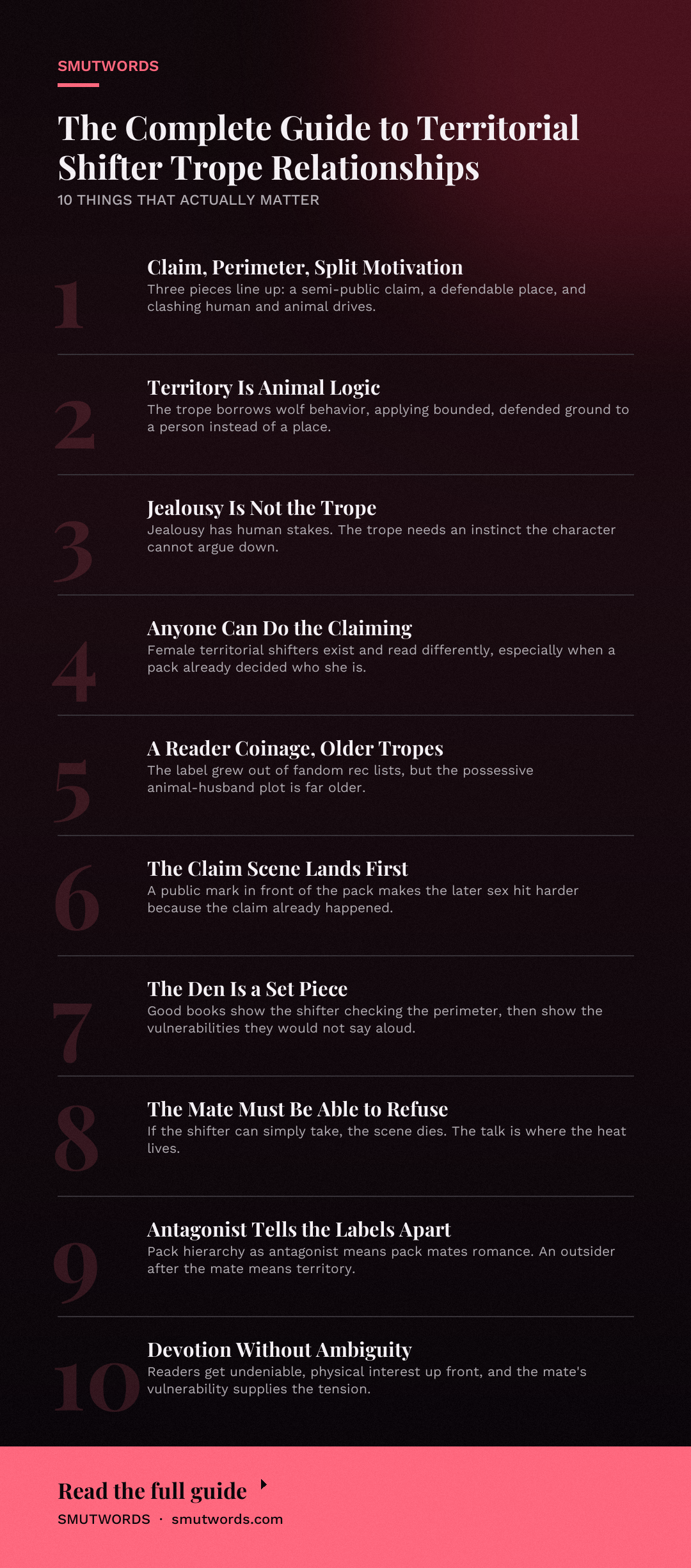
What counts as the trope is narrower than "any possessive shifter." Three pieces usually need to line up:
- A claim that is at least semi-public: a sentence spoken over a body, a scent mark, a hand at the back of a neck in front of the pack.
- A defensible perimeter: a house, a den, a pack border, a job site, a bed. The claim is attached to a place, not just to a feeling.
- Split motivation: the character wants the mate for human reasons and cannot stop reacting for animal ones. The gap between those two drives is where the erotic charge lives.
What doesn't count? A character who is merely jealous. Jealousy is a human emotion with human stakes. The territorial trope insists on an instinct the character can't argue down, a reaction that bypasses rational thought and forces a negotiation with the mate afterward.
A common misconception: readers assume the claim is always the male character's. Plenty of the best work inverts it or splits it. A wolf shifter heroine who marks her human boyfriend's wrists and tells her pack to deal with it is operating in the same territory. The dynamic just reads differently when the claim comes from someone who has been treated as claimed property before.
Where the Territorial Shifter Trope Comes From
The term itself is a reader coinage, a sorting label that grew up in fandom rec lists and eventually hardened into something like an official category. The tropes beneath it are older than the label. Shapeshifters have been part of erotic fiction at least since the pulp era, and the possessive animal-husband plot lived quietly in Gothic and paranormal romance through the 1970s and 1980s, where it usually arrived under the name beast and got resolved by the heroine's saving human warmth.
The recognizable modern version starts with mass-market paranormal romance in the early 2000s. That decade's vampire booms pushed shifters out of the background and gave them their own series and their own readership. Crucially, the shifter books that sold ran hotter than the vampire ones, and the mate-bond plot became the standard engine: two characters discover they're chemically bound, then spend a book working out whether they want it.
Two later developments pushed the trope toward where it is now. Self-publishing tore open the door for explicit content in the 2010s, which meant the territorial behaviors could be shown in detail rather than implied by a closed bedroom door.
Then Kindle Unlimited's binge model rewarded serials, novellas, and same-universe spinoffs with repeating setup, and the trope became a reliable series formula. The 2020s brought the omegaverse crossover, which layered heat cycles and mate-marking protocols on top of pack territory logic, making the territorial shifter trope a structural fixture rather than a flavor note.
The reading appetite shifted too. Early versions often framed the possessive man as a danger the heroine had to civilize. Contemporary versions lean harder on mutual claiming, more negotiation, more acknowledgement that a wolf who guards his mate well also has to stop guarding her like an object. That tension now gets written on the page rather than resolved by a single transformative kiss.
How It Shows Up in Erotica
On the page, the territorial shifter trope is a machine for generating heat from a very small number of moves. The craft is in how those moves are timed.
The Claim Scenes
A good claiming scene escalates in public. The shifter marks the mate in front of people who understand what the mark means, so the erotic charge comes partly from the crowd. A hand at the nape, a voice dropped low, a sentence with a threat in it addressed to a rival and a promise in it addressed to the mate. When a writer gets this right, the actual sex comes later and lands harder because the claim already happened.
The Perimeter and the Den
The house, cabin, or den is a set piece. Good territorial books show the shifter inspecting the perimeter before they'll let the mate sleep, then show the vulnerabilities they'd never say out loud in the daylight. The den becomes the place where the animal reason and the human reason finally agree, and the sex that happens there usually carries a specific animal reflex underneath it: smelling, rubbing, circling, the instinct to make a scent stick.
That instinct leads a lot of writers toward scent description, which is why the trope pairs so naturally with the Smell Fetish 101 territory: a mate's smell is the most common sensory claim marker in the genre.
Common Variations Authors Use
- The fated mate: the bond arrives first and the choice comes later; the whole book becomes the process of two people agreeing to a thing that already happened.
- The pack dominance claim: the territorial behavior is directed at the pack as much as the mate, putting the romance inside pack dynamics and its hierarchy politics.
- The alpha claiming trope: the shifter's status as alpha is what makes the claim dangerous, and the mate is often the person who can tell the alpha no without being thrown across a room.
- The possessive male shifter: the tightest single-character version, usually first-person and usually very explicit about the shifter's interior state.
- The cross-species version: a boundary argument across two shifter species, or a human mate who reads the rules only after they've been broken.
What Makes a Strong Version Work
The best territorial shifter books refuse to make the mate a passive object. The claim has to have a cost, and the mate has to be able to refuse it. If the shifter can simply take, the scene is dull. If the mate has to be talked into it, and the talk is good, the scene runs.
A flat version of the trope lifts the possessive behaviors and skips the interior contradiction. That produces a hero who is just controlling, or a heroine who is just frightened, and neither is hot. The contradiction is the point: the shifter wants to own the mate and wants the mate to want the owning, and those two desires don't easily fit in one body.
Enjoyed this? Get a free book.
Join the list and we will send a complete free story straight to your inbox, plus new releases every week after that. No credit card, no catch.
Strong versions also tend to keep the animal instincts concrete. A wolf that circles the bed isn't the same as a wolf that hovers. Specificity is what makes the instinct legible, which is the same craft lesson that shows up in the strongest dragon romance relationships, where the nonhuman traits need to be listed and then used.
The Serial Structure
Most of what you'll find on the shelves is serial. A novella spends its first third establishing territory, its second third testing the perimeter with an intruder, and its last third resolving whether the claim is mutual. The heat usually front-loads into the claim and back-loads into the mating, and the middle carries the reader on tension.
Writers who do this well build a world with multiple territories, so each book's claim plays against a larger map. That structure draws partly from the pack-heavy end of shifter romance, which is why the trope sits comfortably next to pack mates romance in rec lists and storefronts.
Hybrid books add a second variable by giving the shifter an unusual animal origin, and the mate-bond logic survives the transplant mostly intact: see the hybrid shifter romance entry for how that plays out.
The Heat-Level Question
Territorial shifter books range from closed-door to very explicit, and the trope doesn't depend on heat level. What it does depend on is whether the author will let the claiming have weight. Closed-door versions tend to resolve the claim with a single public declaration; explicit versions show the claim, the negotiation, and the mating separately.
The explicit end of the shelf is where most readers end up, which is part of why the trope burns so consistently. Series length and release cadence make them easy to chain: finish one mate claim, start the next brother's. Any reader testing the waters should know they're signing up for a formula, and the fun is in the variations.
Territorial Shifter Trope vs Pack Mates Romance
The two get confused constantly, and readers who enter from a rec list often can't tell which label applies to the book they're holding. The difference is what's doing the binding.
Pack mates romance is about belonging within a group: the heroine joins a pack, multiple wolves feature prominently, and the emotional stakes run through the pack's acceptance or the heroine's place in a hierarchy. The territorial shifter trope is about the boundary around the mate, which a single individual polices. Pack mates books can use territorial behavior, and territorial books often take place in packs, but you can have one without the other.
The practical tell: if the answer to "who's the antagonist?" is the pack hierarchy, it's pack mates romance. If the answer is "someone outside the territory who wants the mate," it's the territorial trope.
Frequently Asked Questions
What is the territorial shifter trope?
It's a shifter-romance convention in which the shapeshifter protagonist claims their love interest as mate and territory, defends them like a den, and reads the resulting possessiveness through animal instinct. The claim and the defense are usually at least semi-public, so the romance is witnessed by the pack and by the reader.
Is the territorial shifter trope the same as the fated mates trope?
They overlap heavily but they're not identical. Fated mates is about the discovery of an involuntary bond; the territorial trope is about how the bond gets expressed through claiming, guarding, and exclusion of rivals. Many books use both, since fate supplies the premise and territory drives the plot.
Why do readers like possessive shifter books so much?
The possessiveness offers devotion without ambiguity. The shifter's interest in the mate is unquestionable and physical, so the reader doesn't have to wait for the emotional confirmation a contemporary romance would otherwise spend chapters arranging. The mate's vulnerability inside that attention supplies the tension.
Does the territorial shifter trope always involve male shifters?
No. The possessive male shifter is the most common version, but female territorial shifters exist and read very differently, since a claiming female often has to argue with a pack that has already decided who she is. Gender-flipped versions are worth seeking out.
Is it related to alpha/beta/omega dynamics?
They cross-pollinate. The territorial trope predates the modern omegaverse by years, but the two now share a lot of readers, and plenty of contemporary books fuse them, using alpha/beta/omega dynamics to supply the hierarchy and the territorial instinct to supply the romantic plot.
Is territorial behavior in these books realistic animal behavior?
Only loosely. Real territoriality is about resources and rivals, not romantic love, and real wolves don't claim mates the way shifter novels claim them. The books borrow the vocabulary of animal behavior to describe human devotion, and the best ones use the borrowing openly rather than pretending to write field notes.
Final Thoughts
The trope survives because it gives readers something a standard love story can't: a protagonist whose desire shows up in their body, their jaw, their house, their willingness to stand in a doorway and say no to a whole pack.
Pick a book where the mate gets a chance to say yes back. The claim is only half the fun. For a version that leans hard on the instinct-vs-negotiation part with an unusual animal underneath, start with a hybrid shifter title and watch how fast the territory logic takes over.



Loading comments…