
The possessive alpha trope is the engine behind a huge share of the romance genre's most obsessive reads: a male lead with power, territory, and teeth who decides one person belongs to him and then behaves accordingly. He watches. He intervenes. He gets jealous in ways that would be a red flag in a coworker and a plot point in a novel.
In paranormal and contemporary romance alike, that intensity gets framed as devotion, and readers keep coming back because the fantasy on offer is being wanted with a force that leaves no room for doubt.
If you have ever finished a shifter book at 3 a.m. with your heart rate up and your standards for fictional men quietly recalibrated, you already know the possessive alpha trope. This guide is the long version: what it means, where it came from, how authors actually build it on the page, and how to tell a well-written possessiveness from a lazy one.
What the Possessive Alpha Trope Actually Means
"Possessive" describes the hero's emotional stance toward the heroine: she is his, stated plainly, and he organizes his behavior around keeping her. "Alpha" describes his social position: he leads, he protects, he outranks the competition, whether that authority comes from a wolf pack, a boardroom, a fae court, or a motorcycle club. Put both words together and you get the trope's core promise: a hero whose dominance and whose hunger point at the same target.
The name borrows from wolf biology as pop culture has always imagined it, the pack leader who guards his mate and his land against all comers. Romance took that shorthand and ran with it far past anything resembling field biology. In practice, the possessive alpha trope is a dynamic device, a way of writing a hero whose desire expresses itself as protection, surveillance, and territorial claims.
What counts as this trope, and what doesn't, matters more than readers often admit:
- Counts: jealousy with consequences. The hero reacts to a rival with visible tension, and that tension moves the plot, whether through a confrontation, a public claiming, or a private reckoning.
- Counts: protection as desire. His guarding behavior reads as erotic because the book frames it that way, not despite it.
- Counts: the singular focus. Other people exist to him only as obstacles or allies. The heroine occupies the center of his attention.
- Doesn't count: generic bossiness. A hero who gives orders but shows no jealousy and no protective drive is just dominant, which is its own fine thing.
- Doesn't count: actual cruelty without repair. Possessiveness in the trope runs hot, but it bends toward the heroine's safety and pleasure. A hero who simply harms her and never reckons with it is a different kind of book entirely.
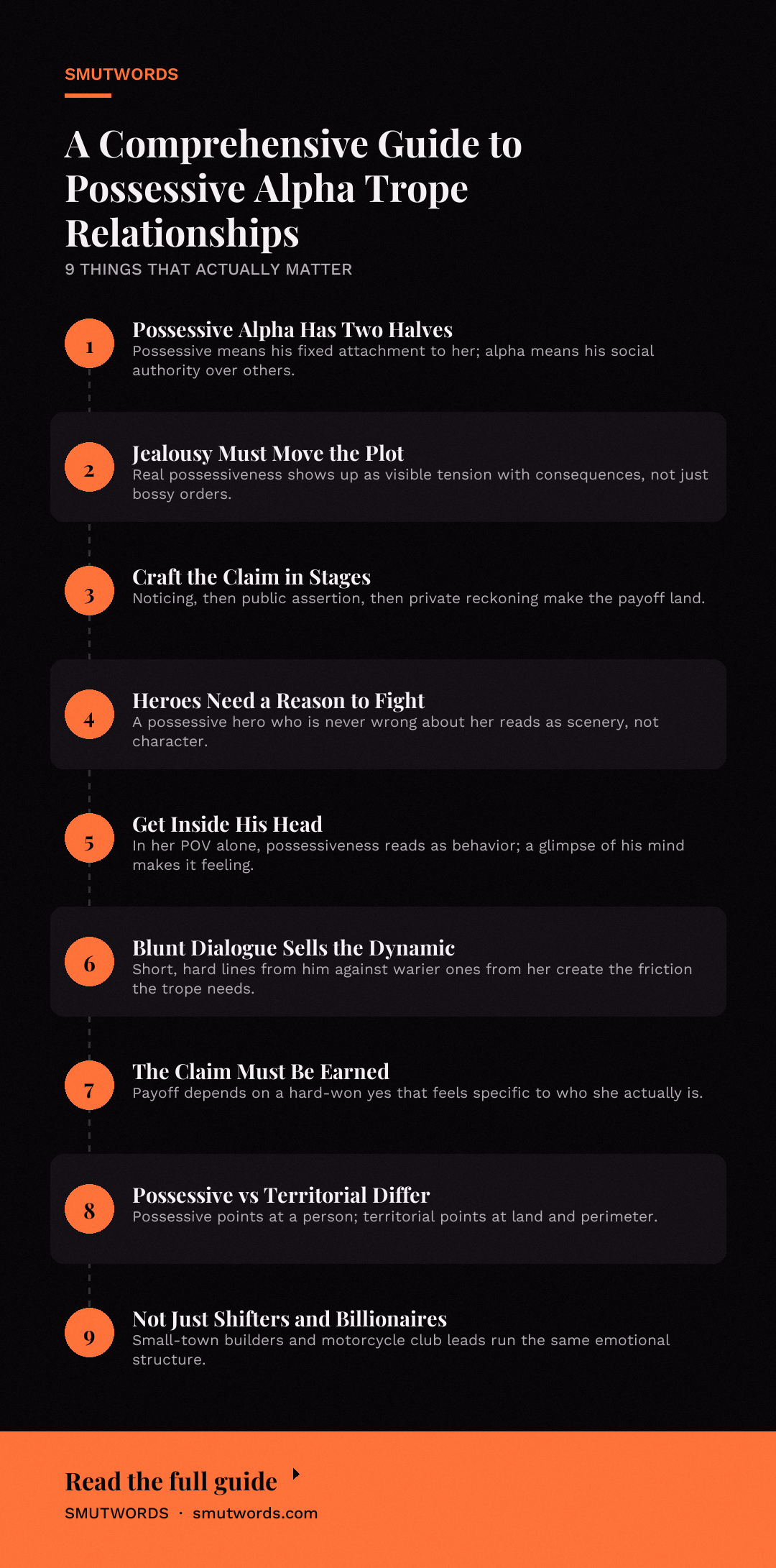
A common misconception holds that the possessive alpha has to be a shifter or a billionaire. Plenty of these heroes run small businesses, ride for clubs, or govern courts of faeries. The alpha part is about social gravity. The possessive part is about fixation. Species and net worth are set dressing.
Another misconception: readers of this trope want a doormat heroine. The books that work best give her backbone, a reason to push back, and enough power to make his claim something he has to earn rather than simply declare. A possessive hero with nothing to fight against gets boring by chapter six.
Where the Possessive Alpha Trope Comes From
Trace the possessive alpha trope back far enough and you hit the romance genre's older obsession with the brooding, high-handed hero, the Rochester and Heathcliff lineage of men whose love arrives wrapped in menace. Twentieth-century category romance kept that archetype alive in the form of the imperious tycoon, and readers of a certain era will remember shelves of paperbacks where the hero's jealousy functioned as proof of feeling.
The word "alpha" enters the picture through wolf pack lore that spread into popular culture across the late twentieth century, and paranormal romance seized on it as a ready-made hierarchy for its heroes. The shifter boom of the 2000s took that vocabulary mainstream, and each later wave sharpened the possessive half of the formula.
Where an earlier era's alpha guarded his pack and his chosen mate, the newer version guards his mate with an intensity that becomes the book's central spectacle. Indie publishing changed the trope's publishing history more than any single author did.
Digital-first romance let writers push jealousy, claiming, and obsession harder than print category lines typically allowed, and readers rewarded that intensity with astonishing loyalty. Covers went shirtless, titles went possessive ("His," "Claimed," "Kept"), and the trope found a marketing language all its own.
Over the past decade the shift has been in the heroine's side of the bargain. Earlier versions often ended with her surrender. Current versions increasingly stage a negotiation. She wants him, she says so, and the claiming that follows is something she chooses.
The possessiveness stays. What has changed is who holds the pen at the moment of yes.
Fated mates mechanics also reshaped the trope's history. Once a book can declare two people destined, jealousy gets cosmic stakes, and the hero's possessiveness comes with a built-in excuse. That device migrated from territorial shifter romance into contemporary and fae settings, where authors use magical bonds to do the work jealousy used to do through plot alone.
How the Possessive Alpha Trope Shows Up in Erotica
Watch what a good possessive alpha scene actually does with the possessiveness. It externalizes the feeling in physical detail: a hand at the back of the neck, a low-voiced "mine" delivered close enough to feel, a hero stepping between the heroine and a rival without breaking eye contact with her. The craft move is to make the claim sensory and specific instead of abstract.
Strong versions build the claim in stages. The first beat is noticing, where his attention fixes on her and refuses to slide off. The second is the public assertion: a dinner-table arm around her shoulders, a jacket dropped over hers, a name used pointedly in front of someone who hoped to hear a different one. The third is the private reckoning, where the jealousy converts into heat and the book pays out what it has been building.
Flat versions skip the stages and arrive at the payoff in scene one. When a hero growls "mine" before the heroine has done anything worth wanting, the claim reads as boilerplate. The possessiveness needs something to bite against: a rival, a risk, her own hesitation, or the simple fact that he does not yet deserve her yes.
Enjoyed this? Get a free book.
Join the list and we will send a complete free story straight to your inbox, plus new releases every week after that. No credit card, no catch.
Writers working this trope have a set of variations to draw from, and each one changes the book's temperature:
- Jealous hero, contemporary. The alpha runs a company or a family, and his possessiveness shows up in access and surveillance: knowing her schedule, buying the building, showing up uninvited with a reason that only just hangs together.
- Fated mates shifter. Biology does the heavy lifting. His wolf recognizes her, and the possessiveness arrives as instinct he then has to negotiate around her human concerns.
- Pack leader. The hero's claim on the heroine doubles as a claim on territory, so his possessiveness serves the whole pack and she has to decide whether she wants that weight. Books like this live inside pack dynamics, where who belongs to whom is the central political question.
- Obsessed hero, darker register. The possessiveness leans stalker-adjacent, and the book leans into the reader's awareness of how far he could go before pulling the thread back toward safety.
- Protective possessive. The claim expresses itself mainly as guarding. He is not jealous so much as lethal about threats, and the erotic charge comes from being defended with that kind of focus.
- Cross-species claim. Fae lords, meremen, cryptid leads, and even dinosaur heroes of cryptid romance can run the possessive alpha structure when the hero places his nonhuman power at the heroine's disposal and then refuses to share her attention. The fae romance shelf uses courts and bargains instead of instincts, but the possessive architecture is identical.
Craft decisions that separate the strong versions from the thin ones cluster around consent and consequence. The hero's possessiveness should cost him something, even if only his pride. He should misread her once, overreach once, and have to correct course. A possessive hero who is never wrong about her reads as scenery rather than a character.
Pacing matters too. Jealousy needs a witness, so the rival has to be real enough to threaten but not so real that readers root against the heroine. The best versions make the rival's scene quick, clarifying, and hot, then return the hero's attention to her with more force for having been tested. A well-placed public claiming scene can carry an entire third act.
Interiority is where the trope either breathes or suffocates. If the book stays only in the heroine's point of view, his possessiveness reads as behavior. One glimpse inside his head and it reads as feeling. Authors who alternate points of view often save the hero's most obsessive interior passage for the moment his claim is about to be tested.
Dialogue sells the dynamic more than description. "You looked at him" lands harder than a paragraph explaining that the hero felt jealous. Short, blunt lines from the alpha, paired with longer, warier lines from the heroine, create the friction the trope runs on. Keep his sentences hard and hers wary, and the scene will do most of its own work.
Finally, the payoff of the possessive alpha trope depends on a hard-won yes. Whether the book is a slow burn that saves its heat for the last third or a fast burn that front-loads the claiming, the heroine's choice has to feel earned and specific to her. Readers forgive a hero nearly anything if they believe his devotion is aimed at her as she actually is, not at an idea of possession she happens to satisfy.
Possessive Alpha Trope vs the Territorial Shifter Trope
Readers often use these two interchangeably, and the overlap is genuine, but the difference is worth knowing. The possessive alpha trope centers on the hero's attachment to a specific person. The jealousy, guarding, and claiming all point at the heroine. The territorial shifter trope centers on land and perimeter, so the hero's instinct to defend a place drives the story and the heroine becomes part of what belongs inside that perimeter.
In practice many shifter books run both at once, because a wolf who guards his territory naturally guards the mate standing in the middle of it. Contemporary and fae books rarely carry the territory element at all. If the hero's defining instinct is "mine," you are reading possessiveness. If his defining instinct is "do not cross this line," the territorial structure is doing the work, and the possessive claim rides along.
Frequently Asked Questions
What is the possessive alpha trope in romance?
It is a dynamic where a dominant, protective male lead claims a specific partner as his own, with jealousy, guarding, and territorial behavior framing that claim as devotion. The trope shows up across paranormal, contemporary, and fae romance, plus darker registers where the obsession is the point. The possessiveness runs hot but bends toward the heroine's safety and pleasure.
Why do readers love possessive alpha heroes?
The fantasy is being wanted with unmistakable force by someone powerful enough to act on it, and the jealousy sequence makes the eventual payoff feel hard-won. There is also a safe-distance pleasure in the intensity: the stakes run high, the risk stays on the page, and the reader's own life stays untouched. It is a controlled experiment in being someone's whole world.
What is the difference between an alpha hero and a possessive alpha?
Alpha describes position and authority, so an alpha hero can be dominant without being obsessive. Possessive describes the emotional stance, so a possessive alpha makes the relationship itself the territory he defends. A book can deliver a strong alpha lead without a single jealous scene, and those scenes are what move a character from one category into the other.
Is the possessive alpha trope popular in shifter and fae romance?
It is one of the genre's most reliable engines. Shifter romance uses fated mates to give possessiveness an instinctive logic, while fae romance trades instinct for bargains and court politics. Both shelves use the same architecture: a hero with power chooses one person, and the story works out what that claim costs him.
Do possessive alpha romances always involve shifters or monsters?
No. Contemporary possessive alpha books run the exact same emotional structure with billionaires, small-town builders, and motorcycle club leads. The supernatural version just makes the instincts literal. The trope lives in the hero's behavior, not his species, and plenty of readers of the subgenre never open a werewolf book at all.
Final Thoughts
The possessive alpha trope earns its permanent shelf space because it stages a recognizable human hunger at enormous volume: wanting one person badly enough to rearrange your life around them, and then learning what that costs.
Read it for the claiming scene if that is your thing. Stay for the moment the hero discovers his alpha authority cannot deliver her choice, because that is the scene the good ones are actually built around.
If you want a book that runs this dynamic at full pressure, with a shifter lead whose claim has real teeth, grab a strong fated mates novel from the list below and read it the way it wants to be read: late at night, all at once.







Loading comments…