
Rope bondage is the practice of restraining a partner with rope for sex, for the picture it makes, for the feel of it on the skin, or for all three at once. A top wraps, knots, and tensions the rope, and a bottom wears the result. The kink lives in the slow, deliberate cooperation that builds between them as rope meets the body.
Anyone who has fallen down the rope bondage rabbit hole knows the appeal is less about helplessness than about the communication it demands. It runs from a quick two-column tie with a length of jute to a full suspension rig with a body hanging from an overhead point.
In between sits a whole vocabulary of patterns, each with its own feel and its own risks. This guide covers what the term means, where it came from, how it works on the page in erotica, and how writers get it right.
What Rope Bondage Actually Means
The phrase covers any restraint practice built around rope: cotton, jute, hemp, nylon, or synthetic blends. The rope can be thick or thin, natural or bright pink. What makes it rope bondage rather than, say, handcuffs is that the tie is constructed around a body, often deliberately, often with line and shape in mind.
A few things count that people sometimes exclude. Self-bondage with rope counts. Aesthetic ties that hold nobody in place count. Rope worn as decoration, harnesses over clothes, counts as rope play even when no restraint happens.
The category is generous. Some things don't count. A necktie used to bind wrists for thirty seconds is a game, not rope bondage, though nobody needs to police the label. Fabric strips can do the job, but most practitioners think of rope bondage as specifically rope-based, with knots and tension doing the work.
The term also gets used loosely for any elaborate tie in fiction. That's fine for a scene, less fine for a glossary. If a character is strapped to a bed with leather cuffs, that's restraint play, not rope.
Shibari, Kinbaku, and Rope Bondage
Shibari is the Japanese word usually translated as "to tie" or "to bind," and in Western kink spaces it has become shorthand for decorative Japanese-style rope work. Kinbaku means "tight binding" and leans harder toward the erotic and the psychological. Rope bondage is the umbrella term for all of it.
Strictly, shibari and kinbaku are Japanese practices with their own lineages, aesthetics, and conventions. Rope bondage in English covers those traditions and everything adjacent: Western floor work, suspension rigs, self-ties, and playful two-minute wrist wraps. A character can practice shibari without calling it that; plenty do.
Common Misconceptions
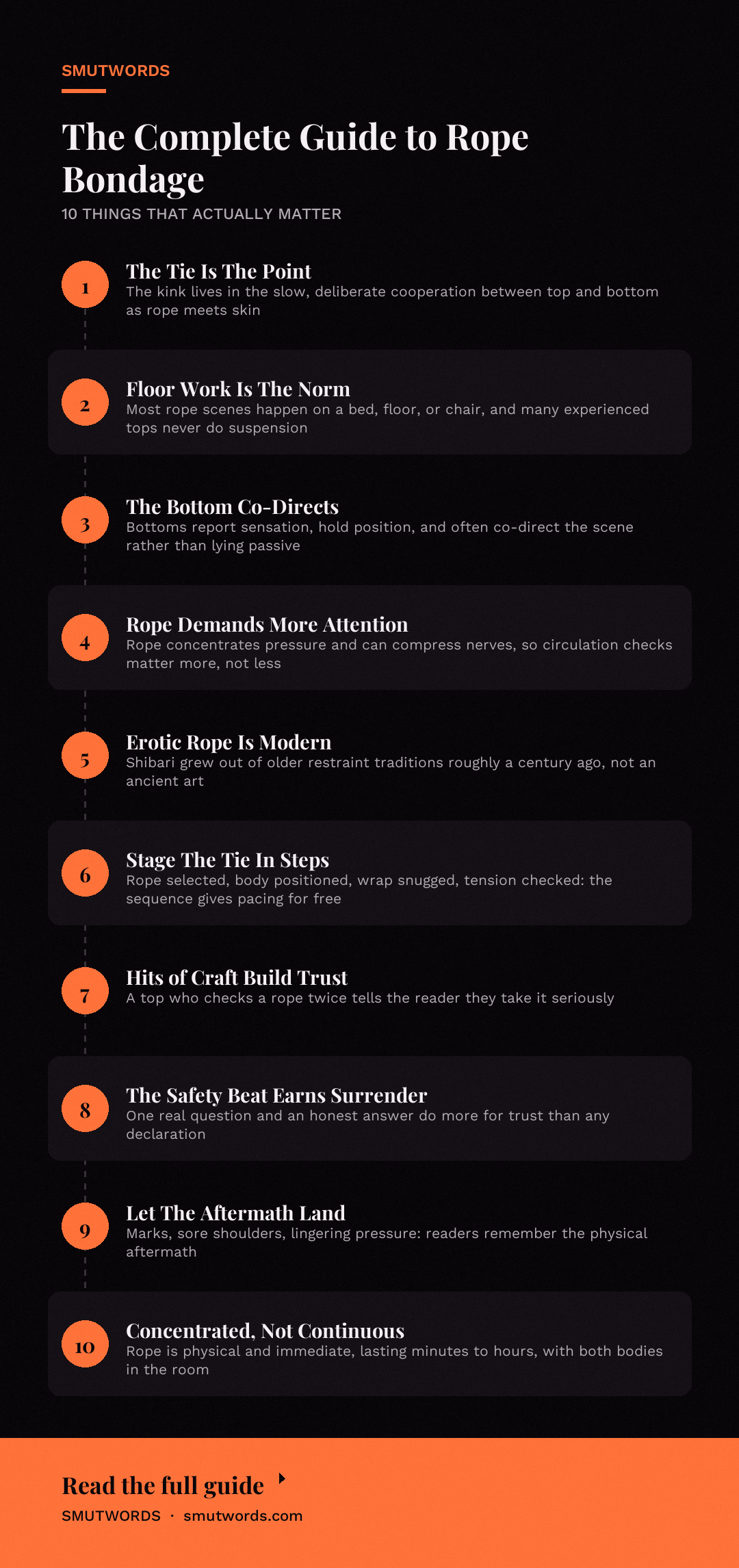
- It's always about suspension. Most rope scenes happen on the floor, on a bed, or in a chair. Suspension is the advanced specialty, and plenty of experienced tops never do it.
- It requires a professional rigger. A safe floor tie is learnable in an afternoon. Suspension is not, and anyone who teaches it otherwise is a hazard.
- The bottom is passive. Good rope work is a collaboration. The bottom reports sensation, holds position, and often co-directs the scene.
- Rope is gentler than leather. Rope concentrates pressure and can compress nerves. It demands more attention to circulation, not less.
- It's only for pain. Many bottoms describe rope as grounding, warm, and calming. The restraint itself can be the whole point.
If your characters are into being watched while tied, you're already in the territory covered in Voyeurism vs Exhibitionism. Rope just adds the apparatus.
Where Rope Bondage Comes From
Japanese rope restraint has centuries of history in policing and martial arts, where hojojutsu was used to secure prisoners. The erotic and artistic tradition of shibari grew out of that lineage in the twentieth century, shaped by photographers, performers, and magazine culture in post-war Japan. Names like Ito Seiu and the publisher and artist community around him built much of the visual language that traveled west.
That history is real, and it's often oversimplified in English-language writing into "ancient Japanese art." The erotic form is modern, roughly a century old, and it borrowed from older restraint techniques the way modern boxing borrowed from bare-knuckle prizefighting.
Rope bondage entered English-language erotica through several doors at once. Mid-century fetish magazines carried rope imagery. Pulp paperbacks used bondage covers as a selling point. By the 1970s and 1980s, kink communities in the US and UK were running workshops and publishing zines on safe rope technique.
The internet flattened the learning curve. Tutorials, photo sets, and forums spread shibari patterns to readers who had never seen a live demonstration. The 2010s brought rope bondage into mainstream romance and fanfic in a way earlier decades never managed, partly because the visual language of rope translates well to book covers and fan art.
The genre drift matters. Early rope scenes in erotica emphasized helplessness and capture. Modern rope scenes in romance tend to emphasize craft, consent, and the relationship between the people in the tie. The rope became a way to show intimacy, and the tying itself became part of the plot.
How It Shows Up in Erotica
On the page, rope bondage scenes are built out of sequence. The tie goes on in stages: rope selected, body positioned, first wrap snugged, tension checked, the next line laid down. A good scene lingers in those stages because the order of operations gives the writer pacing for free.
Writers who rush the tie lose the best part. The first touch of rope on skin, the sound of it being drawn through a loop, the small pause while the top decides where the next pass goes: these are the moments that carry the kink. A scene that jumps from "he tied her up" to penetration has skipped the foreplay of the whole practice.
Common variations show up again and again in the catalog:
- Floor work: the entry-level scene. Rope work on a bed, cushion, or mat, often with wrists, ankles, and chest ties. Low risk, high intimacy, easiest to write and to stage.
- Suspension: the showpiece. A body hung from a single point or a frame, often in a partial suspension like a hip harness. The stakes climb because the physical risk climbs.
- Futomomo: a bent-knee tie that folds the leg into a compact shape. Reads as visually striking and practical at the same time.
- Takate Kote (TK): a box-tie style upper-body harness, the classic kinbaku pattern. It is also the most technically demanding pattern to get right, which makes it a good marker for an experienced character.
- Self-bondage: a character ties themself, often as a private ritual. Excellent for interiority, because the character is alone with the rope and nobody is watching.
- Rope harnesses worn under clothes: the tie that nobody sees. Great for public scenes where the tension lives under a button-down shirt.
The strongest scenes do two things at once. They show the craft of the tie, and they show the emotional state of the people in it. A top who checks a rope twice tells the reader they take it seriously. A bottom who leans into the rope tells the reader they're choosing this, which is what makes the surrender land.
The flat version skips the checking. It has the top tie with unshakable confidence and the bottom feel only pleasure. That reads as wish fulfillment, which is fine for a fantasy, but not as a scene a reader will remember.
Two craft moves writers use well. The first is sensory layering: rope texture, the smell of treated jute, the sound of a knot seating, the pressure at a wrist. The second is the safety beat, where one character asks a real question and the other answers honestly. That beat does more for trust than any number of declarations.
A related shape is the scene where the rope is a test of control for the top, not the bottom. A dominant who has to slow down, who notices a tingling finger and stops the scene to retie, is more compelling than one who never checks. If your character is on the other end of the scene and struggling after it ends, the dynamic of dom drop is worth understanding at the writing desk.
Enjoyed this? Get a free book.
Join the list and we will send a complete free story straight to your inbox, plus new releases every week after that. No credit card, no catch.
What Makes a Rope Scene Work on the Page
Specificity. "He tied her wrists together" is generic. "He wrapped the first pass twice around her wrist, then pulled it snug against the second, leaving enough give to slip a finger under" tells the reader the tie is real and the top knows how to do it.
Pacing. Slow down for the tie, speed up for the sex. The contrast is the pleasure of the scene, and the reader feels it in the sentence rhythm.
Communication. A quick exchange ("feels okay?" "Tighter on the left") makes the characters feel real and the scene feel safer. It also gives you dialogue where you'd otherwise have description.
Consequence. If the tie is the centerpiece, let the consequences land: the marks after, the sore shoulders, the linger of pressure. Readers remember the physical aftermath more than the knot count.
Consent on the page. Not as a checklist, but as behavior. A top who asks before the scene begins and a bottom who answers plainly is a scene the reader trusts.
If your writer's instinct is to make the top verbally appreciative while tying, the technique in this guide to writing a praise kink scene applies directly, and it's a common rhythm in rope scenes: the praise comes as the rope goes on.
The Real-World Considerations
Writers who want their scenes to sound accurate should know the safety basics, even if the scene never mentions them. Rope compresses nerves and can cut circulation. Every tie needs a way out in seconds, which means a safety cutter or a quick-release loop for every knot. Rope scissors belong in the room.
Suspension is its own discipline. It requires a load-rated hardpoint, rated rope, a spotter for the bottom's head and body, and a plan for the worst case. Suspended bodies can faint.
Nerve pressure that builds slowly can cause injury that doesn't show up until later. Two experienced people is the floor for a suspension rig. A solo character doing suspension in your novel needs a reason to be reckless, or the scene needs to flag the risk.
Aftercare matters for both sides. Rope leaves marks. The tie gets untied slowly, sensation comes back in stages, and a warm drink and a blanket are good writing beats. If your characters are exploring kink more broadly, the glossary entry on keyholding is a useful comparison for how power-exchange scenes build trust over time.
Rope Bondage vs Keyholding
Rope bondage is a physical practice: a tie, a body, a rope. Keyholding is a power-exchange practice: one partner holds the key to a lock the other wears, and the control happens through time and waiting rather than through a physical tie.
Readers confuse the two because both are ways of making a partner stay limited. A character in a chastity device is restrained the way a character in rope is restrained, but the restraint is symbolic and continuous rather than physical and immediate.
That's a real distinction worth writing deliberately. Rope scenes are concentrated: minutes or hours, with both bodies in the same room. Keyholding scenes stretch across days or weeks, and the tension lives in the wait. The two can coexist, and the overlap is a favorite in long-form kink romance.
A character who loves the temporary helplessness of rope may or may not want a lock they can't open. The practices share language about trust, but they test different kinds of it. If you're writing both, let the characters name the difference. If your cast includes a robot or an AI partner working through the same power dynamic, robot romance covers how those relationships get built.
Frequently Asked Questions
What's the difference between shibari and rope bondage?
Rope bondage is the umbrella term for rope restraint and rope play generally. Shibari is the Japanese-influenced decorative tradition, with its own patterns and aesthetics. Most shibari is rope bondage, but plenty of rope bondage isn't shibari.
How long does a rope bondage scene usually last?
Anywhere from a few minutes for a quick wrist tie to an hour or more for a full harness and suspension. Rope scenes tend to run long because the tying itself is part of the scene. The untieing takes far less time if the top knows what they're doing.
Is rope bondage safe?
It's as safe as the person tying, the rope, and the plan. Floor work is low risk with basic precautions: safety cutters, regular checks on sensation, and a signal for stopping. Suspension shifts the risk meaningfully and needs rated hardware and experienced hands.
What do the different rope types feel like?
Jute and hemp are classic natural ropes with a rough texture and a stiff, grippy feel. Jute takes a snug tie and leaves marks more readily. Cotton is softer and better for beginners. Nylon is smooth, strong, and the most common for suspension-grade work, though it lacks the tactile feel of natural fiber.
What is takate kote?
It's the box-tie style upper-body harness common in kinbaku, often called TK. It wraps the chest and arms into a single integrated tie. Some purists reserve the term for the traditional pattern rather than any chest harness, and it's the pattern most serious riggers practice for years before attempting.
What are the signs a rope bondage scene went well?
The bottom reports the right pain, which is to say sore shoulders and lingering marks rather than numbness, tingling, or sharp nerve pain. Both parties come out of the scene happy to have done it. If something felt wrong, they can name what it was. Aftercare basics get covered and nobody wakes up unable to move a hand.
Final Thoughts
Rope bondage rewards the writer who takes it slow. Get the tie right on the page, let the rope do the work of showing trust, and give the reader a reason to remember the knot. If you want a scene that does exactly that, the next shelf to visit is a book where the rope is crafted as carefully as the relationship. Pick a title from the list below and see how a practiced author builds a knot.







Loading comments…