
Coach/athlete romance is the erotic subgenre built on a single combustible premise: the person who tells you what to do with your body is also the person you want in it. It's a relationship romance between an athlete and their coach, trainer, or mentor, usually with an age gap, always with a professional power gap.
The entire engine of the story is the tension between the discipline that made the athlete and the desire that could wreck them both. You'll find coach/athlete romance shelved under sports romance, forbidden romance, and age gap, and it earns its place in all three.
The trope has been a reliable seller for decades, and for good reason. It comes preloaded with stakes, structure, and a built-in clock. A season has a beginning and an end. A body has a limit. A career has a window.
That's more narrative machinery than most tropes get handed for free.
What Coach/Athlete Romance Actually Means
The basic definition is simple: the romantic and sexual relationship develops between an athlete and the person coaching them. The expanded version matters more. This is a power-imbalance romance where the imbalance is professional, institutional, and often generational at once.
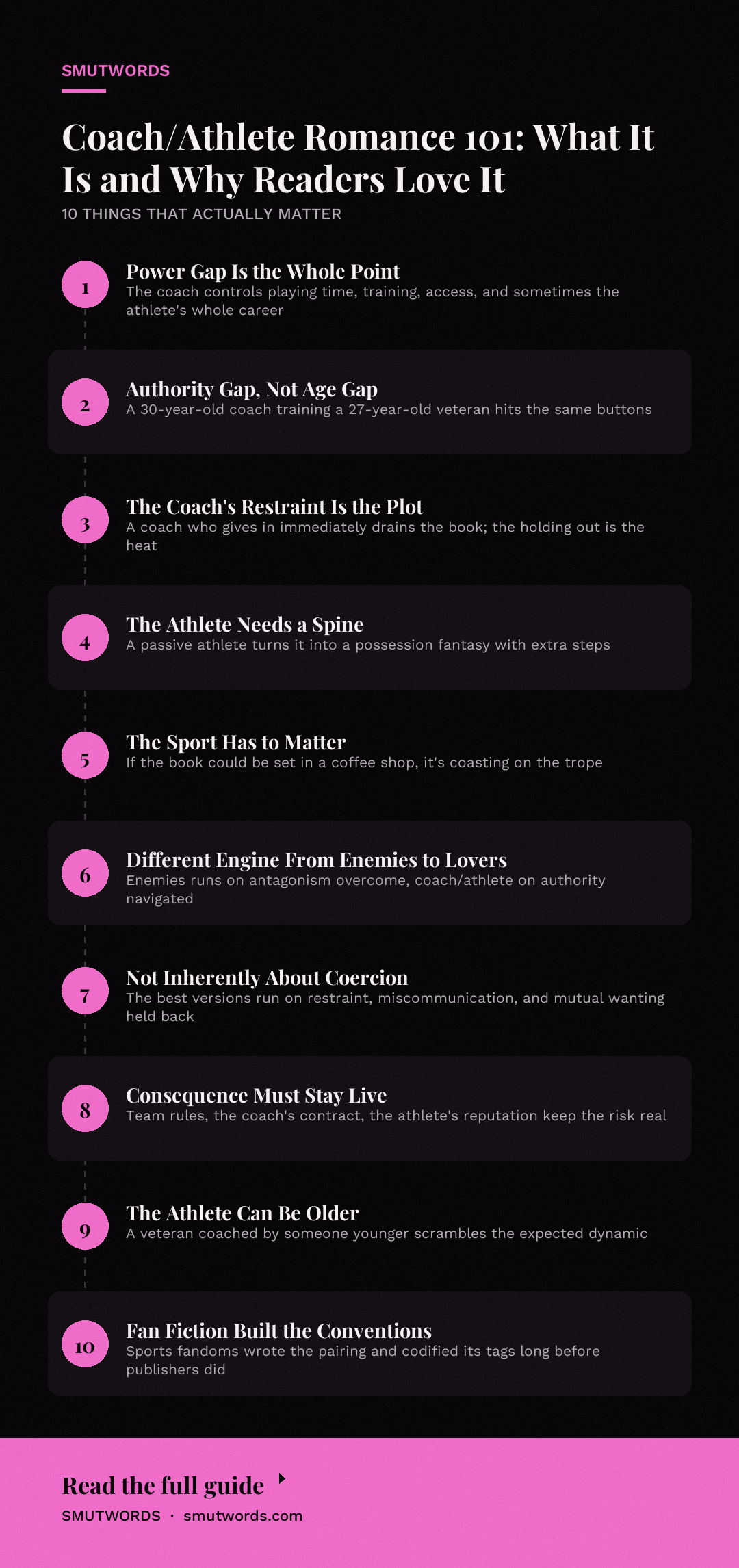
The coach controls playing time, training, access, and sometimes the athlete's entire shot at a career.
What counts as the trope: any dynamic where one character holds formal authority over the other's athletic performance and the two of them cross the line between professional and personal. The coach can be an official team coach, a private trainer, a former champion hired to resurrect a career, a mentor with decades of experience, or even an older athlete assigned to train a rookie.
What doesn't count: teammates who hook up, athletes from rival teams, or a coach and an athlete who meet before any professional relationship exists and are equals by the time it starts. The power gap has to be live on the page. If the coach has no real authority over the athlete's future, you're writing a different book.
Common misconceptions are worth clearing up. First, this trope is not inherently about coercion. The best versions are built on restraint, miscommunication, and mutual wanting held back by rules. Second, it's not always about an older man and a younger woman, though that's the dominant iteration in traditional publishing.
Third, it isn't the same as real-world abuse dynamics. The fiction lives on the fantasy of being wanted by someone who is supposed to be above wanting you. That distinction matters when you're evaluating whether a book handles the material well.
The name itself is almost literal. Publishing has used "sports romance" as a shelf tag since the 1980s paperback boom, and coach/athlete emerged as a distinct subcategory once readers started asking for the specific forbidden setup rather than sports in general. The slash in "coach/athlete" mimics pairing notation used across fan fiction and ship culture, which is where a lot of the trope's conventions were codified long before mainstream romance caught up.
Where Coach/Athlete Romance Comes From
The trope's real history is a publishing history, not a BDSM lineage. There's no leather-clad origin story here. What there is: a steady climb in sports-adjacent romance through the 1980s and 1990s, when category lines like Harlequin's sportier imprints started putting athletes on covers with shirtless chests and a lot more implied sweat than the typical historicals.
The forbidden-mentor setup existed long before sports romance as a shelf existed. The erotic charge of a teacher-student or master-apprentice relationship runs through centuries of literature, and the coach is a modern recasting of that archetype. The shift worth noting is how the trope moved from the coach as obstacle (a disapproving background figure in early sports romances) to the coach as the love interest.
Three developments pushed coach/athlete into its own category:
- Fan fiction and the internet, from the late 1990s on. Sports fandoms wrote the pairing long before publishers did, and tags and tropes in that space did a lot of the early genre-building around forbidden age gaps and professional power.
- Erotic romance's expansion through the 2000s and 2010s. Once publishers realized readers wanted the imbalance on the page rather than implied in the backstory, the coach got promoted from side character to hero.
- Self-publishing's football, hockey, and gymnastics subcultures. Indie romance is where the trope got its most explicit treatment, from short taboo novellas to multi-book series following one team through a season.
How the portrayal has changed matters too. Early versions leaned heavily on the coach as stern, withholding authority figure and the athlete as ingenue. Modern versions give the coach interiority (guilt, restraint, career damage if caught), give the athlete agency (often she's the aggressor, or he's the younger one), and treat the institutional rules as the actual antagonist rather than as a convenient excuse for drama.
The rise of women's sports fiction and LGBTQ+ entries in the subcategory has forced the trope to diversify since roughly 2015. The hockey and figure skating subgenres in particular have moved toward same-sex pairings and toward coaches who are younger or less decorated than the athlete, which scrambles the age-gap formula in interesting ways.
And the trope overlaps with other categories enough to be a gateway. If you like the professional-power friction here, the same forbidden dynamic drives a good bodyguard romance, where the person paid to protect you is also the person you can't have. That article is worth reading alongside this one for the structural comparison.
How It Shows Up in Erotica
What a coach/athlete romance actually does on the page is a specific kind of discipline-to-desire pipeline. The scene structure tends to repeat: professional correction, then personal attention, then a moment where the correction becomes erotic.
A coach's hand adjusting the athlete's form. A stern talk after a bad performance that ends somewhere else entirely. The recurring move is proximity under the excuse of work.
The strongest versions understand that the coach's restraint is the plot. A coach who immediately gives in drains the book. A coach who holds out, and whose holding out costs him something, keeps the reader turning pages. The best coaches are the ones whose discipline is a form of desire they're trying not to name.
Common variations authors actually use:
- The older coach, younger athlete. The classic. Age gap plus authority gap. The coach has a career, sometimes a family, and everything to lose. The athlete has nothing but ambition and a body that's the whole plot.
- The retired champion turned coach. The coach's own career is over and the athlete is either the redemption or the temptation. This variant lets the coach carry grief and envy, not just authority.
- Personal trainers and private clients. Same power structure, more intimate setting, no team or institutional scrutiny. The stakes are the coach's business and reputation rather than a league's rules.
- The peer coach. A slightly older teammate assigned to train a rookie. The age gap is smaller and the power gap is unofficial, which makes the tension messier and often hornier.
- The mentor pairing. Not strictly athletic. A dance coach, a riding instructor, a martial arts sensei. The childhood friends to lovers trope can intersect here when the coach has known the athlete since they were a kid, which is a favorite and a tricky one to write without squick.
The craft question readers ask most is what makes a strong version work versus a flat one. Three factors do most of the work.
Enjoyed this? Get a free book.
Join the list and we will send a complete free story straight to your inbox, plus new releases every week after that. No credit card, no catch.
First, the athlete has to have a spine. A passive athlete turns the book into a possession fantasy with extra steps, and while that's a valid subgenre, the coach/athlete variation works best when the athlete pushes back, wants out loud, and exercises judgment. The coach's authority is more charged against someone who can say no.
Second, the restraint has to be legible. If the coach's hesitation is a plot convenience, the reader feels it. If it's tied to a real consequence (a suspension, a lost job, a team implosion), the hesitation becomes part of the heat.
Third, the sport has to matter. A coach/athlete romance that could be set in a coffee shop is a missed opportunity. The training, the competition, the physicality of the sport are the setting, and they give the writer a whole vocabulary for the erotic.
Rope bondage, for instance, is a sport in its own right when it shows up in a gymnastics or climbing book. The Complete Guide to Rope Bondage is the technical reference if a scene calls for it.
The praise kink is nearly mandatory here, and it's easy to do badly. A coach saying "good girl" after a drill is a cliché, but the same beat done with specificity and earned buildup lands. The guide to writing praise kink without the cheese is worth reading if you're building that dynamic into a coach who doesn't otherwise talk that way.
Where the trope intersects with other categories tells you a lot about its range. The possessive coach who wants to mark the athlete as his is very close to the possessive alpha trope, just with a whistle instead of a growl. And when the coach's past or the athlete's former abuser becomes plot, the book can slide into revenge romance territory without missing a step.
A final craft note: scene play. The coach/athlete dynamic lends itself to formalized scene work because the sport already has a scene, a drill, a practice. The complete guide to scene play covers how to structure those beats for maximum charge. Use the existing athletic structure and you get eroticism for free.
Coach/Athlete Romance vs Enemies to Lovers
The confusion is real and worth addressing because coaches and athletes are in conflict constantly, and readers sometimes reach for the wrong tag. The two are built on different engines.
Enemies to lovers runs on antagonism that has to be overcome. The characters start genuinely opposed and the plot tracks the grudging thaw.
Coach/athlete romance runs on authority that has to be navigated. The characters often like each other from the start. The obstacle is the professional line, not personal dislike.
You can combine them. The coach who took the athlete's scholarship, or the athlete the coach cut from the team years ago, gives you enemies-to-lovers friction inside a coach/athlete frame.
But the two tags do different work, and readers searching for one often bounce off the other. If there's no authority gap, it's not coach/athlete. If there's no real animosity, it's not enemies-to-lovers. State which engine you're running and you'll keep the right readers.
Frequently Asked Questions
Is coach/athlete romance the same as teacher/student romance?
No, though they share DNA. The teacher/student trope is usually set in an academic institution with an evaluation structure (grades, exams, assessments). Coach/athlete replaces grades with performance and adds the physical intensity of training and competition. The power gap and the forbidden-ness are similar, but the settings and the physical vocabulary are different enough that readers treat them as separate subgenres.
Is a coach/athlete romance always about an age gap?
No. The age gap is common but not required. The essential element is the professional power gap. A 30-year-old coach training a 27-year-old veteran athlete hits the same buttons.
What can't be missing is the coach's formal authority over the athlete's performance and future. Age gap is one route to that, not the definition.
Do the characters have to get caught or punished for the relationship to work?
No, but the possibility of consequence has to be live. A strong coach/athlete romance keeps the institutional risk visible: the team's rules, the coach's contract, the athlete's reputation. Whether the book pays that risk off with a punishment, a public reveal, or a quiet resolution is up to the author. The risk has to feel real for any of those to land.
Can the athlete be the older one?
Yes, and it's a growing variation. A veteran athlete near the end of a career being coached by someone younger, or by someone who used to be their competitor, scrambles the expected dynamic in a way that some readers find fresher than the standard older-coach setup. The power gap is still the spine; the age gap can invert.
Is coach/athlete romance considered taboo or dark romance?
Forbidden romance is the usual tag. Dark romance is a stretch unless the book includes genuinely darker elements like coercion, blackmail, or the coach's past abuse of power. The trope overlaps with forbidden, age gap, and sports romance, and sits in dark romance only when the author makes it dark. Most versions are steamy-but-hopeful.
What should I expect from a well-written version?
Three things: an athlete with agency, a coach whose restraint costs him or her something real, and a sport that actually matters to the plot. If the athlete is passive, or the coach's hesitation is convenient, or the sport could be swapped for any other setting, the book is coasting on the trope rather than delivering on it.
Final Thoughts
Coach/athlete romance rewards the writer who takes the sport seriously and the reader who wants the power gap on the page rather than implied. If you only read one book to see how the trope is done at full strength, pick one where the coach is the one holding the line and the athlete is the one pushing past it.
That's where the heat lives. A whistle and a forbidden kiss don't get you there on their own.






Loading comments…