
Scene play is the practice of building a kink encounter inside a container: a set period of time, a negotiated set of roles and acts, and an agreed way for it to end. Two people decide in advance what happens, who does what, and how it stops. Then they step into it.
The container is the whole point. Scene play gives a writer a beginning, a middle, and a hard stop, which is why it powers so much of the best kink fiction on the shelf.
The term covers everything from a twenty-minute impact session to a weekend-long interrogation roleplay. What unites those is structure. The people involved know they are inside something with edges. That clarity is what lets a character go further than they would in an open-ended encounter, because the exit is already built.
What Scene Play Actually Means
A scene is a bounded fiction two or more people agree to live inside for a while. It has a frame: a start, a negotiated middle, and an end. The frame is not decoration. It is the mechanism that makes the intensity possible.
The word "scene" comes from theater, and the borrowing is deliberate. Stage actors know where the act begins and where the curtain falls. Kink borrowed that language because it describes the same thing: a stretch of performed reality with agreed roles. The performance is real in its effects even though everyone knows it is a scene.
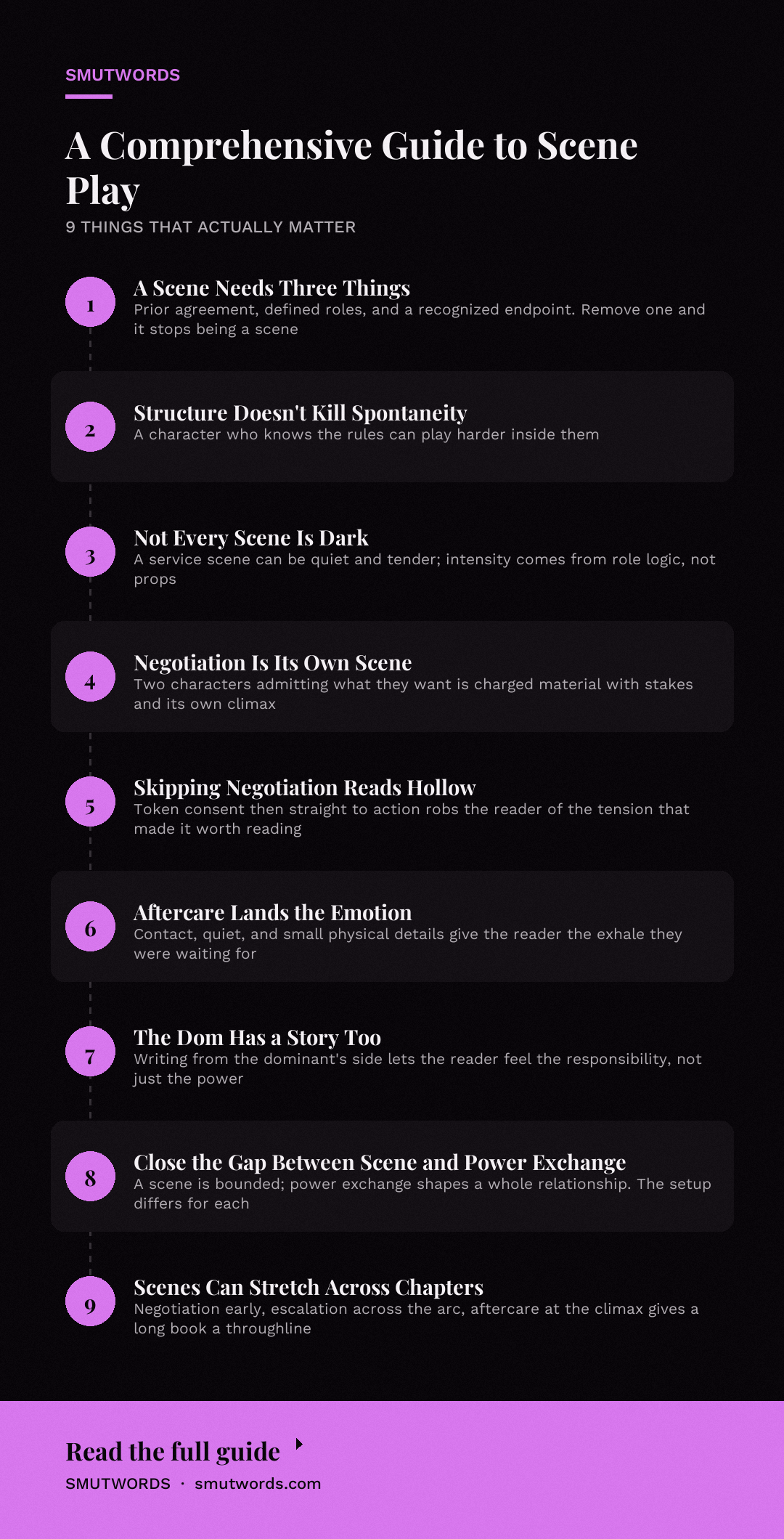
Three elements have to be present for something to count. There is prior agreement about what will happen. There are defined roles, even loose ones.
Then there is a recognized endpoint. Take away the endpoint and you have a dynamic, not a scene. Take away the agreement and you have something else entirely.
What does not count is just as useful to know. A spontaneous dominant gesture in bed is not automatically a scene. A long-term power-exchange relationship is a relationship, not a single scene, though it may contain many. A scene is a discrete unit, and its discreteness is what a writer can put on the page.
Common Misconceptions
The biggest one is that structure kills spontaneity. In practice it does the opposite. A character who knows the rules can play hard inside them. The container absorbs risk so the scene can carry more heat.
The second misconception is that a scene is always heavy or dark. A service scene can be quiet and tender. A pet play scene can be playful. The intensity comes from the role logic, not from the props.
The third is that scenes are entirely scripted. Good ones leave room for improvisation inside the agreed frame. Negotiators set the guardrails; the players drive.
Where Scene Play Comes From
Scene play's history as a term runs through kink community practice rather than literary criticism. The vocabulary of negotiation, safewords, and aftercare grew up in real-world scenes and crossed over into fiction because it gave writers a ready-made dramatic architecture.
In erotica and romance specifically, the scene became a structural unit long before readers had a name for it. Victorian flagellation literature was organized around discrete encounters. Mid-century pulp built entire books from a string of set pieces with clear roles.
What changed was the vocabulary. The 1970s and 1980s brought a public language of negotiation and safety into print, and fiction absorbed it.
The real shift came later, as romance publishing grew comfortable with explicit consent on the page. Earlier kink fiction often let the scene run without showing the conversation that set it up. Contemporary romance made negotiation part of the seduction. A character spelling out limits became its own kind of chemistry.
That shift tracks the rise of community frameworks like RACK (Risk-Aware Consensual Kink), which replaced rigid safety checklists with an explicit acknowledgment that people choose risk consciously. Fiction picked up the language because it made for better dialogue. A negotiation scene is a conversation with stakes, and readers respond to that.
The most recent evolution is scale. Writers now run scenes across chapters, build them into series arcs, and use the scene's end as a plot beat rather than a finale. The unit has stayed the same. The ways authors stretch it have multiplied.
How It Shows Up in Erotica
The craft question with scene play is simple: what does the container let your characters do that they could not do otherwise? If the answer is nothing, the scene is decoration. If the answer is a lot, the scene is doing the work.
A strong scene on the page follows a recognizable arc. Negotiation sets the terms. The scene itself escalates inside those terms.
Aftercare lands the emotional weight. Each beat earns the next. Writers who skip negotiation rob the reader of the tension that made the scene worth reading.
Common variations authors use map to the roles being played:
- Impact play scene: physical intensity with a clear before and after, often the most literal use of the container.
- Age play scene: caretaker and dependent roles, where negotiation happens more in the setup than the middle.
- Pet play scene: handler and pet logic, heavy on restraint and reward.
- Interrogation scene: power asymmetry and withheld information, a natural fit for mystery or dark romance plots.
- Medical scene: clinical setting and procedure, where the apparatus supplies the tension.
- Service scene: one character serves another through tasks and rituals, quieter and often more emotionally focused.
The interrogation scene is the clearest case for why the container matters. Without negotiated limits, an interrogation scene is just a threat. With them, the withheld information becomes a shared game, and the reader can enjoy the tension because the rules are holding. That distinction is what separates a compelling scene from a cruel one.
Restraint-heavy scenes lean on the same logic. A character who agrees to mummification has already accepted the vulnerability before the wraps go on, and the reader gets to enjoy both the anticipation and the surrender. The bondage safety conversation is not a spoiler; it is foreplay.
What Makes a Scene Work on the Page
The best scenes have a strong reason for the scenario to exist. A milking table scene works because the setup is exotic and the negotiation around the milking table scene can carry its own charge. A medical scene works because the procedural details give the reader something to track.
The second element is escalation with a purpose. Each beat should raise the stakes or deepen the role, never just add a prop. A scene that escalates physically without escalating emotionally feels like a checklist.
The third is aftermath. The impact play aftercare that follows a scene is where the emotional payoff lives. Characters who shift back into themselves after the scene ends give the reader the exhale they were waiting for.
Weak scenes share a common failure: they treat negotiation as an obligation to rush through. A line of token consent, then straight to the action. That reads as hollow. The negotiation is where the characters reveal what they want and what frightens them, and readers replay that dialogue in their heads long after the scene's end.
Praise-driven scenes need the same care, and our guide on how to write a praise kink scene without it sounding cheesy walks through the specific language problem. A scene built around praise succeeds or fails on the dialogue, because the container is emotional rather than physical.
The same is true of scenes that depend on an audience. If the scene's appeal is being watched, the writer has to know which character is the watcher and which is the watched. Our breakdown of voyeurism vs exhibitionism is useful here, because a scene with a third party present changes the negotiation entirely.
The Negotiation Scene as Its Own Craft Problem
Writers often dread the negotiation scene and shoehorn it into summary. That is a mistake. A negotiation is a scene in its own right, with tension, reveals, and its own small climax. Two characters admitting what they want for the first time is charged material.
The trick is to let the conversation do double duty. Negotiation reveals character, establishes stakes, and builds anticipation. A character who names a limit is telling the reader something about their history. A character who hesitates before agreeing is showing the reader what the scene will cost them.
Enjoyed this? Get a free book.
Join the list and we will send a complete free story straight to your inbox, plus new releases every week after that. No credit card, no catch.
Different characters negotiate differently. A controlled character lists terms. A reckless one agrees too fast.
A shy one needs prompting. Those differences are the scene.
Writers who make the negotiation as vivid as the action get two scenes for the price of one. Readers who skip ahead to the action are rare once the dialogue is doing its job.
Aftercare and the Emotional Landing
A scene has to end, and the ending is where a lot of books either land or fall flat. Aftercare is the transition out of role, and it carries the emotional resolution the reader has been waiting for.
Good aftercare isn't a paragraph of reassurance. It is contact, quiet, and the small physical details that signal safety: a glass of water, a blanket, a hand that doesn't let go. The intensity of the scene determines how much decompression the characters need.
Not every character decompresses the same way. A dominant might need reassurance that the scene was welcome. A submissive might need silence. Getting those needs wrong is fertile ground for conflict, which is why aftercare often does double duty as the setup for the next emotional beat.
The Dom's Side of the Scene
Most scene play fiction spends its time in the submissive's head. That is a missed opportunity, because the dominant's experience is equally rich. A dominant who is performing control has to hold a lot at once: the other person's responses, the timing, the role itself.
Our guide on dom drop covers the emotional crash that can hit a dominant after a scene. Fiction that shows that vulnerability gives the power dynamic real weight. The person in charge is also the person who has to come down afterward.
A scene written from the dominant's point of view lets the reader feel the responsibility as well as the power. That dual perspective is what separates a scene that feels like a performance from one that feels like a relationship.
Consent, Safewords, and the Reality Check
Scene play requires clear pre-negotiation, safewords, and a plan for aftercare to address physical and emotional shifts. Fiction has to show those without turning into a manual, and the best writers fold them into character.
A safeword can be a small detail with big payoff. The moment a character uses one is a turning point, and the other character's response tells the reader exactly who they are. The consent negotiation that precedes a scene sets up that moment.
A character who respects a safeword is a character the reader can trust. A character who anticipates a limit before it's spoken is the kind of dominant readers fall for. Both make the scene feel safe enough to enjoy.
Scenes Across a Longer Arc
Some of the strongest scene play writing stretches a single container across chapters or a whole book. The negotiation happens early, the scene escalates across a plot arc, and the aftercare lands at the climax. That structure gives a long book a clear throughline.
Longer arcs also allow the scene to change as the characters do. A second scene that revisits the same roles can show growth, or loss, or a hard-won ease. The container is the same, but the people in it are not.
Some subgenres make the extended scene nearly structural. Robot romance asks what happens when one participant in the scene is designed to comply, and a parallel universe romance can reset the rules of a scene entirely, letting a character negotiate a dynamic that only exists in another world.
When the Container Isn't Shared
One of the richest conflicts scene play can generate is the mismatch between characters who want different things from the container. A scene requires both people to be inside it, and a character who doesn't understand the frame can wreck it without meaning to. That's the engine behind the vanilla/kink mix relationship, where one partner has never learned the vocabulary and the other has built their whole erotic life around it.
Writing that conflict well means giving the kink partner real stakes in the scene and the vanilla partner a real reason for hesitating. The negotiation becomes the plot.
Scene Play vs Power Exchange
Scene play and power exchange get tangled together because both involve one character holding authority. The difference is duration and scope. Power exchange is an ongoing arrangement that shapes a whole relationship; scene play is a bounded performance inside an agreed window.
Most kink fiction contains both. A couple in a power exchange dynamic can still stage a scene on a Friday night. The scene sits inside the larger relationship, and its rules are a subset of the larger rules.
The distinction matters for writers because it determines how much setup a scene needs. A scene inside an established power exchange can lean on shared history. A scene between strangers needs the negotiation on the page.
Reading for that difference is a good test of craft. If the scene could be lifted out of the relationship without losing anything, it was probably written as a set piece. If it depends on the surrounding dynamic, it's doing real work.
Frequently Asked Questions
What does scene play mean in kink and romance?
Scene play is a bounded kink encounter with negotiated roles, acts, limits, and a defined end. It differs from an ongoing power exchange by having explicit edges. In fiction it works as a unit of tension that allows intensity inside agreed terms.
Do you need a safeword for scene play?
Safewords are standard practice in real-world scenes and common in fiction, though some established partners use other check-in methods. What matters is that every participant has a way to stop without breaking role. Fiction that shows the safeword honored earns the reader's trust.
What is the difference between scene play and roleplay?
Roleplay is the acting element inside a scene; scene play is the whole container, including negotiation and aftercare. A scene can include roleplay, or it can be more physical and less theatrical. The frame is what makes it scene play.
How long does a scene usually last?
There is no fixed length. A scene can run twenty minutes or an entire weekend, and fiction sometimes stretches one across chapters. The container's boundaries matter more than its duration.
What kinds of scenes do writers use most?
Impact play, interrogation, medical, age play, pet play, and service scenes appear most often, along with milking table setups. Each variant supplies its own role logic and its own negotiation demands.
Does a scene always need aftercare?
Most scenes benefit from some form of decompression, even a quiet one. The amount and style depend on intensity and on the characters. Fiction that skips aftercare often leaves the reader without the emotional exhale they were promised.
Final Thoughts
Scene play rewards the reader who wants to feel the edges of a story. The container is what lets the characters go far and the reader follow them without fear. When you sit down with a book that uses it well, you get the whole arc: the negotiation that sparks it, the scene that delivers, and the aftercare that lets everyone come home.
If you want to see the arc done with real care, start with a book where the negotiation is as charged as the action. The scene is its own seduction, and the best writers know it.







Loading comments…