
Possessive sex is the bedroom dynamic where wanting someone stops being a feeling and becomes a physical fact. It shows up as hands that grip too tight to be polite, a body positioned to block every exit, and words that reduce a whole person to a single syllable: mine. It is the fantasy of being so completely desired that your partner cannot help but claim you, and it sells across every genre of erotica because it answers a question most people are afraid to ask out loud: what would it feel like to be someone’s everything, even for an hour?
In practice, possessive sex is a performance of ownership between consenting adults. One partner takes charge of the other’s body with focused, deliberate intensity, marking skin with bites and bruises that fade in days, while the verbal script runs on declarations of exclusivity and warning labels for anyone else who might look. It is less about actual control and more about the theater of control, where the person being claimed gets to feel the weight of being wanted without any of the real-world consequences of being owned.
What Possessive Sex Actually Means
The glossary definition calls possessive sex a dynamic where one partner claims the other with intense, focused physicality. That gets the skeleton right, but the flesh is more complicated. Possessive sex is not simply rough sex, though it often includes roughness. It is not BDSM dominance in the strict sense, though it borrows the language of control. The defining feature is the motive: the dominant partner is not performing dominance for its own sake, but acting out a specific emotional state, which is the terror and thrill of wanting someone so badly it feels like possession.
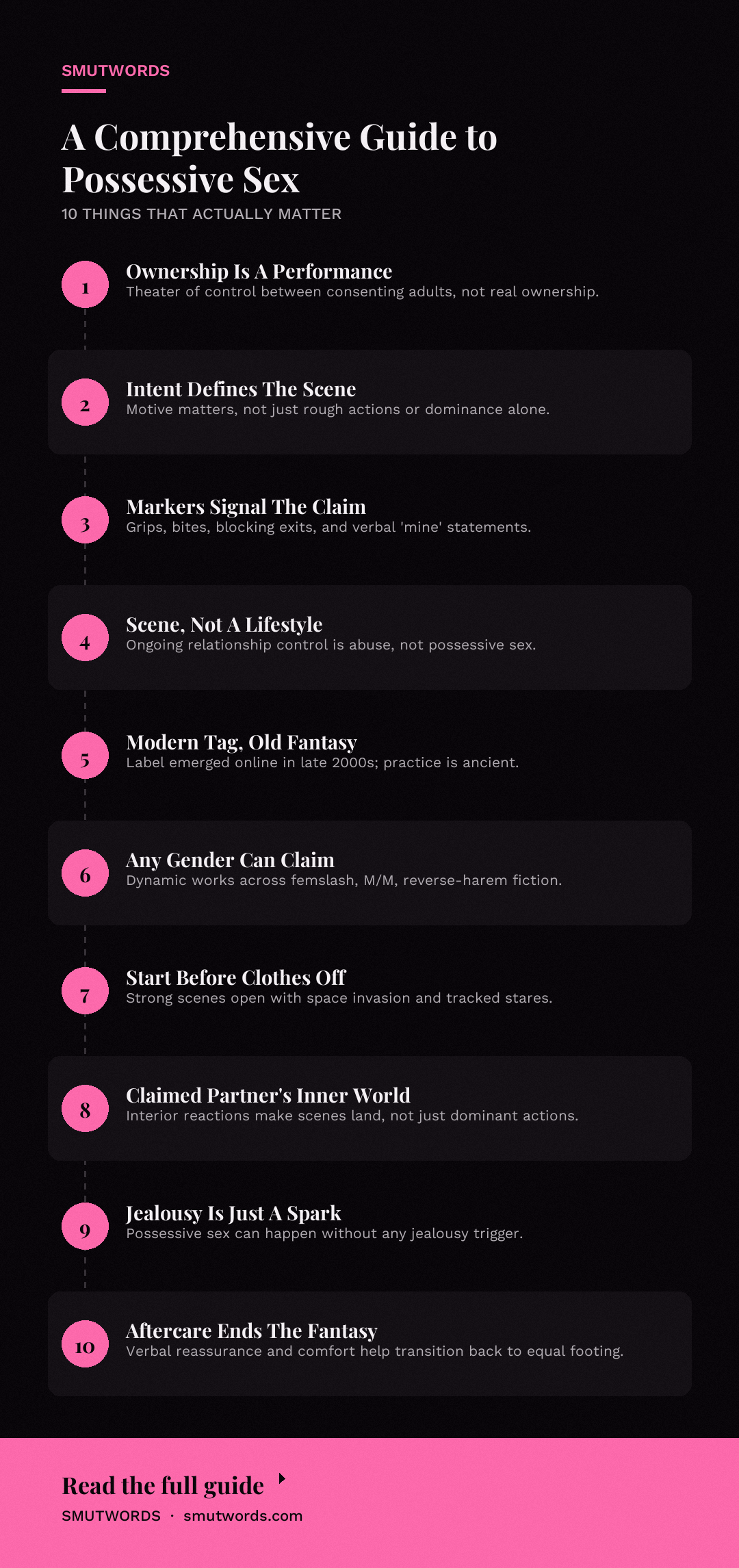
What counts as possessive sex depends on the scene’s intent. A hand wrapped around a throat during a quickie can be pure sensation play. The same hand doing the same thing while the partner growls “you’re mine, say it” shifts the meaning entirely. The possession comes through in the details, and readers recognize it instantly.
Common markers include: - Physical anchoring: gripping hips, wrists pinned above the head, a palm pressed flat against the sternum, fingers threaded through hair at the nape of the neck - Verbal claiming: “mine,” “you belong to me,” “no one else gets to touch you,” sometimes demanded as an echo - Territorial positioning: moving the partner away from others, blocking them against a wall, turning their face back when it drifts - Marking behavior: bites that leave imprints, hickeys placed where others can see them, nails raking lines down the back - Possessive jealousy enacted in the moment: bringing up an ex or an admirer specifically to overwrite the memory with fresh sensation
Misconceptions abound. Possessive sex is not the same as abuse, because abuse takes without consent while possessive sex only works when both parties want the claim. It is not inherently about humiliation, though it can pair with degradation if the participants enjoy that flavor. And it is not exclusive to male-dominant, female-submissive pairings. The dynamic works in any configuration, and the possessive partner can be of any gender.
A crucial distinction: possessive sex is about the moment of claiming, while a relationship being possessive is about ongoing control. The fantasy dissolves the instant one partner starts tracking the other’s phone or forbidding friendships. On the page and in the bedroom, possessive sex is a scene, not a lifestyle.
Where Possessive Sex Comes From
The roots of possessive sex reach deep into the oldest erotic literature. Cave paintings and ancient poetry both run on the same engine: desire so consuming that the lover must mark, hold, and claim the beloved. In genre terms, the recognizable modern form of possessive sex crystallized alongside the romance novel itself, where the alpha hero who growls and grips has been a staple since the early days of the category.
The term itself is newer than the practice. Erotica readers have been searching for “possessive sex” as a specific tag only since the rise of online fiction marketplaces in the late 2000s and early 2010s. Before that, the same content lived under labels like “caveman kink” or simply “alpha romance.” The naming shift reflects a growing precision in what readers want: not just a dominant partner, but a partner whose domination is motivated by a specific, almost irrational level of wanting.
The rise of self-publishing accelerated the trope’s visibility. Writers on platforms like SmutWords and elsewhere found that possessive heroes routinely outsold their gentler counterparts, and the data pushed more authors toward the dynamic. Shifter romance played an outsized role in cementing the visual vocabulary of possessiveness, since the mate instinct provides a built-in justification for a character who literally cannot stop claiming their partner. That influence spills into contemporary and paranormal erotica, where human characters now borrow the language of fated mates and instinctual bonds.
Notably, the fantasy has shifted over the last two decades from a purely male-driven dynamic toward a more flexible one. Femslash and M/M erotica both feature possessive partners heavily, and the possessive female lead has become a popular archetype in reverse-harem and why-choose fiction. What once read as a heterosexual power fantasy is now a general fantasy about the thrill of being claimed, regardless of who holds the reins.
How Possessive Sex Shows Up in Erotica
The strongest possessive sex scenes do not start with the clothes coming off. They start with a breach of the personal space bubble, a hand that lands a beat too late on a hip, a stare that tracks across a crowded room. Authors who rush straight to penetration miss the entire point. Possession is a slow burn that detonates, and the best writers stretch out the tension before the claim lands.
Consider how the scene usually opens. The couple, or the soon-to-be couple, is out somewhere public, and someone else pays the protagonist attention. A bartender flirts. An ex walks by. The possessive partner’s jaw tightens, and suddenly the exit is being steered toward a bathroom, an alley, or a car. This setup connects possessive sex directly to the jealousy kink, where the presence of a rival provides the spark that ignites the claiming.
Once the scene turns physical, the possessive partner’s hands do the talking. The prose should reflect that focus: everything narrows to the grip on the wrist, the bite on the shoulder, the palm flat against the lower back pressing the bodies flush. Strong versions of this scene use sensory details that emphasize claim, not just pleasure. The taste of skin, the pressure of teeth, the sting of a possessive smack, these all reinforce the theme.
Verbal scripts matter as much as physical ones. The best possessive dialogue is short and declarative. “You’re mine.” “Say it.” “Who does this belong to?” The partner being claimed typically has two possible responses, and both work: the breathless surrender, where they whisper back “yours,” or the bratty defiance, where they refuse to say it and get pushed harder because of it. The second option is especially effective because it gives the possessive partner a reason to escalate, which the reader wants.
Enjoyed this? Get a free book.
Join the list and we will send a complete free story straight to your inbox, plus new releases every week after that. No credit card, no catch.
Possessive sex does not exist in isolation. It pairs naturally with other dynamics, and the best authors mix them deliberately. A possessive partner who praises while claiming, growling “such a good girl, my good girl,” blends the ownership with a praise kink and lands twice as hard. A possessive scene that tips into primal play loses the language and keeps only the instinct, characters who communicate in growls and bites without a single coherent sentence. Even the monster romance crowd uses possessiveness constantly: aliens and monsters who claim their human partners with a biological imperative that mirrors the safest, hottest version of ownership.
What separates a flat possessive scene from a great one is the emotional interiority of the partner being claimed. If the scene only describes what the possessive partner does, the reader gets domination without stakes. The strongest versions cut inside the claimed partner’s head to show their reaction: the surprise at how good it feels to be wanted that completely, the internal war between independence and surrender, or the dawning realization that they want to be owned in this exact moment. Give the reader a reason to envy the person being grabbed, and they will feel the grab themselves.
Possessive Sex vs Jealousy Kink
One of the most frequent confusions in reader searches is the relationship between possessive sex and the jealousy kink. They resemble each other and frequently appear in the same books, but they are not interchangeable.
A jealousy kink centers on the emotion itself. One partner experiences jealousy, often triggered by real or imagined attention from a third party, and that jealousy becomes the erotic fuel. The scene might not even include physical contact between the couple. Watching a partner flirt with someone else, reading their messages, or hearing about an ex can all be jealousy kink material on their own.
Possessive sex is the response to that jealousy, or sometimes a response that arrives without any external trigger at all. The possession is the action taken to neutralize the feeling of threat. A jealousy kink scene may end with possessive sex, but it does not have to. Conversely, possessive sex can happen with zero jealousy involved, where a partner simply feels an overwhelming urge to claim the other after a mundane Tuesday.
The two overlap most cleanly in the scenario described above: the public outing where an interloper triggers the possessive partner’s response. In that setup, the jealousy kink is the spark and possessive sex is the fire. Books that sell well on either tag often include both, because the jealousy provides the motivation that makes the possession feel earned rather than arbitrary.
Frequently Asked Questions
Is possessive sex the same as ownership in real relationships?
No. Possessive sex is a consensual scene performed between adults who both want the dynamic. Restricting a partner’s friendships, demanding their location, or controlling their choices outside the bedroom is abusive behavior, not a kink. The fantasy of being claimed belongs in the scene and stays there.
Can possessive sex happen without a dominant and submissive dynamic?
Yes. The possessive partner is taking charge, but the interaction does not require a formal power exchange structure, safewords, or roles like Master and sub. Many couples enjoy moments of possessive intensity without identifying as part of the BDSM community at all.
How do I bring up wanting possessive sex with my partner?
Use direct language about the fantasy. Say something like “I want to feel claimed when we have sex, like you can’t help but take me.” Emphasize that the attraction is to being wanted completely, and make clear that consent applies to the entire scene. Framing it as a scene you want to act out together reduces the chance of misunderstanding.
Why do I find possessiveness attractive if I value my independence?
The appeal is not actual control but the evidence of desire so strong it becomes physical. Being the object of that level of wanting can feel empowering rather than diminishing. The fantasy offers a safe space to surrender without surrendering everything, because the possession evaporates when the scene ends.
What if possessive sex brings up bad feelings afterward?
Aftercare is essential. The partner being claimed may need physical comfort, verbal reassurance that the dynamic was play, and time to transition back to an equal footing. If negative feelings persist, talk them through without shame. Sometimes the fantasy gets tangled with past experiences, and a therapist who understands kink can help untangle it.
Does possessive sex make the dominant partner seem toxic?
In fiction, it depends entirely on the framing. A possessive hero who respects consent, checks in, and softens after the scene reads as romantic intensity. A possessive hero who ignores boundaries and treats the partner as an object reads as a villain. The same act can be either predator or protector depending on whether the claimed partner is enjoying it.
Final Thoughts
Possessive sex endures because it dramatizes the oldest human fear: that we might not matter enough to someone. The fantasy flips that fear, offering a partner who cares so intensely that they cannot help but mark, grip, and claim. When written with the claimed partner’s interiority at the center, it becomes less about domination and more about the relief of being unequivocally chosen.
For the strongest example of the dynamic in action, look to shifter romance, where the mate instinct gives possessive sex a biological engine that never runs out of fuel. The genre’s best novels show how a claim can feel like both capture and homecoming, which is exactly why readers keep returning to that growl.






Loading comments…