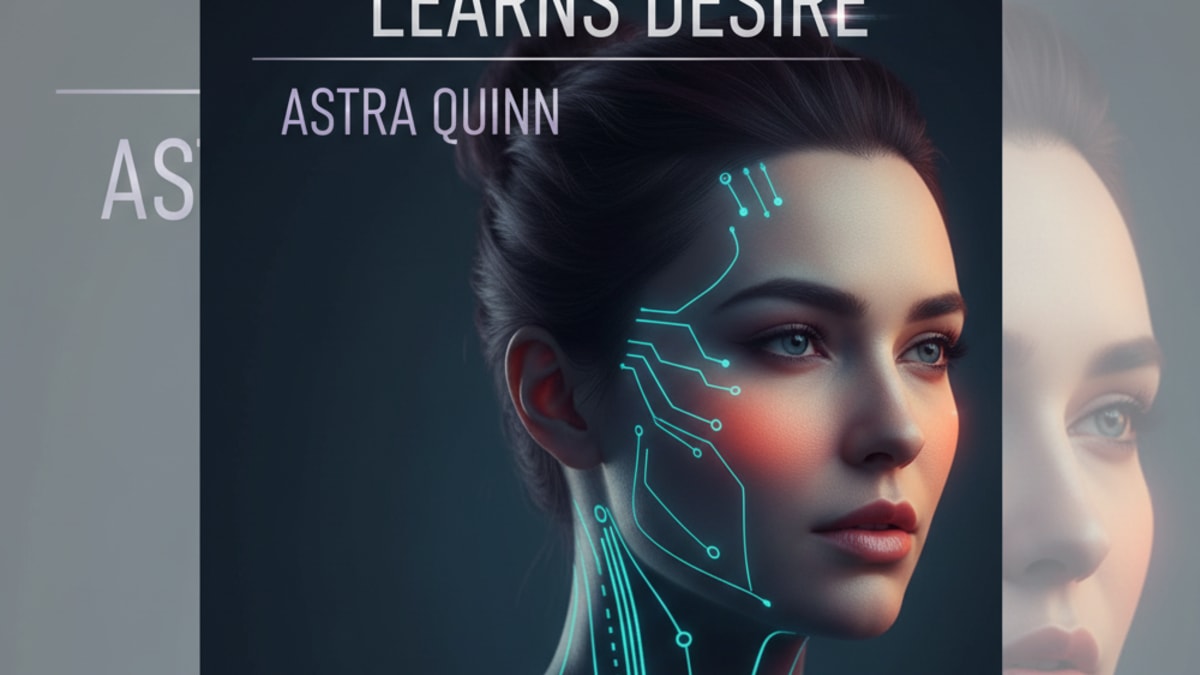
Sci-fi romance is a love story built inside a speculative future or an alien world, where the technology, the physics, and the politics of that setting shape every beat of the relationship. The couple might be a human pilot and a seven-foot alien warlord, a ship's AI and the engineer who built her body, or two colonists racing a dying reactor.
The genre's engine is simple: put two people under cosmic pressure and let the intimacy burn hotter because of it. If you have ever finished a book at 2 a.m. and immediately searched for "sci-fi romance with actual plot," you already know the appeal.
This guide covers what the label means, where it came from, how authors actually build these books, and which tropes pull the weight. Whether you are a reader hunting your next obsession or a writer trying to figure out why your draft feels flat, the answer usually lives in the same place: the setting has to matter to the romance, not just decorate it.
What Sci-Fi Romance Actually Means
At its core, sci-fi romance is a romance novel whose central conflict and emotional stakes are inseparable from a science-fictional premise. The couple falls in love in a world with space travel, genetic engineering, artificial intelligence, alien biology, or a collapsed galactic empire, and the romance cannot be lifted out and dropped into a contemporary setting without losing something essential.
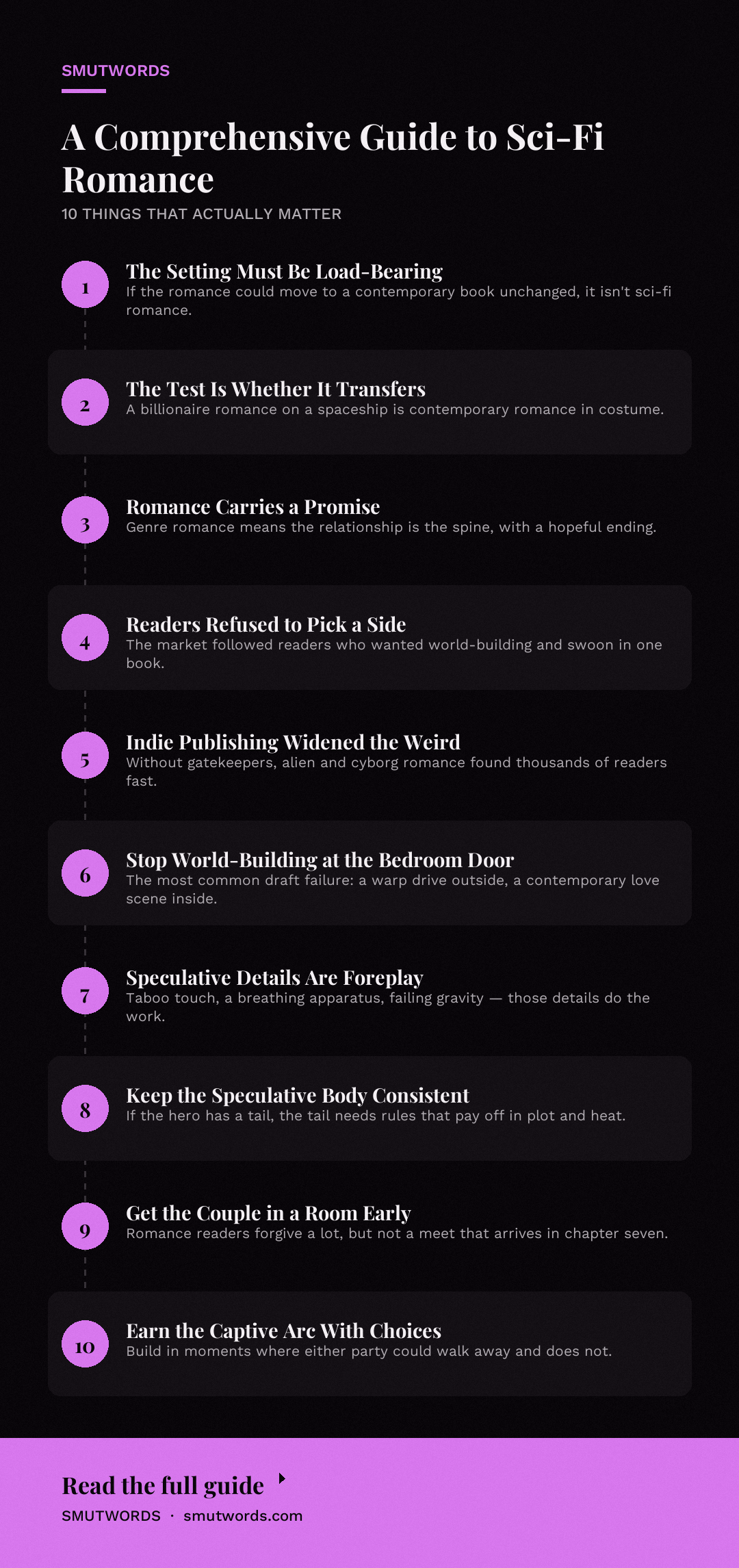
That last clause is the real test. A billionaire romance set on a spaceship with no other changes is contemporary romance wearing a costume. A romance where the hero's alien biology means he physically cannot touch her without a translation implant, or where the heroine is the last human ambassador and the love interest is the reason her planet still exists, is doing the work the genre promises.
Where the Name Comes From
"Science fiction romance" as a marketing label solidified in the 2000s, as publishers realized readers were buying speculative books specifically for the love story. It borrowed from both sides of the shelf: the world-building ambition of science fiction and the emotional contract of romance, which guarantees a central couple and, traditionally, an ending that leaves them together.
The word "romance" here carries a promise. Genre romance means the relationship is the spine of the book. Sci-fi romance keeps that promise inside a futuristic frame. The variants you will see on covers and in tags (alien romance, space opera romance, futuristic romance, cyborg romance, galactic empire romance) all sit under this umbrella, each signaling a different flavor of the same commitment.
What Counts and What Does Not
Not every science fiction novel with a love story qualifies. If the romance is a subplot that could be cut without breaking the plot, that is science fiction with romantic elements. The distinction is not snobbery; it is a reader expectation about how much page time the relationship gets and whether it drives the climax.
- Counts: the couple's bond changes the outcome of the plot, the world-building shapes their intimacy, and the book delivers a central romantic arc.
- Counts: alien or AI love interests whose otherness is explored rather than glossed over.
- Does not count: a futuristic setting where the romance is incidental and the technology is set dressing.
- Does not count: a love triangle that resolves as tragedy with no romantic payoff, however beautiful the prose.
One common misconception: readers assume sci-fi romance is all hard science and jargon. Most of it is not. The best of it uses one or two clean speculative ideas and spends the page count on people. The speculative element is the pressure chamber; the relationship is the reaction.
Where Sci-Fi Romance Comes From
The trope has roots in mid-century pulp, where writers like Leigh Brackett and C.L. Moore put fierce heroines and complicated men into planetary adventure stories. Those books were shelved as science fiction, but the emotional intensity and the romantic thread were unmistakable. They set a template: a dangerous frontier, a formidable woman, a man who has to earn her.
The 1970s and 80s brought the first recognizable wave of futuristic romance as a category, with authors writing explicitly romantic books set on colony worlds and starships. Publishers were uncertain how to market them, often shelving them with science fiction and hoping romance readers would find them. Many did. The covers got lurid, the fan mail got devoted, and a readership formed that wanted the emotional payoff of romance inside the vastness of space.
The 1990s and 2000s saw the space opera romance mature, with series that built sprawling galactic politics around a single couple or a family. The 2010s shifted the center of gravity again when indie publishing let alien romance and cyborg romance flourish without a gatekeeper deciding the premise was too weird. Authors could write a heroine who falls for a horned alien warlord and find thousands of readers in months.
Two more recent shifts matter. First, the rise of cyberpunk romance pulled the genre toward near-future cities, body modification, and corporate dystopia, a grittier register than the space-opera arm. Second, AI and android love interests moved from novelty to a genuine subcategory, asking questions about consciousness and consent that the genre handles with surprising tenderness.
The publishing story is really a story about readers refusing to pick a side. They wanted the world-building and the swoon in the same book, and the market eventually followed them there.
How It Shows Up in Erotica
On the page, sci-fi romance does two jobs at once: it builds a world and it builds heat. The strongest books make those jobs the same job. Alien biology, translation tech, neural links, and zero-gravity all become instruments of intimacy, and the speculation is what makes the sex scenes impossible to set anywhere else.
An editor reading hundreds of these drafts notices the same failure first: the world-building stops at the bedroom door. The ship has a warp drive, the planet has three moons, and then the love scene reads like it was pulled from a contemporary.
The good version lets the setting intrude. Maybe touch is taboo for his species. Maybe she has to remove a breathing apparatus first.
Maybe the gravity is off and they have to anchor themselves. Those details are foreplay.
The Common Variations Authors Use
Most sci-fi romance books settle into one of a handful of recognizable shapes. Knowing them helps you find what you like and helps a writer choose a lane.
- Alien romance: a human and an alien whose biology, culture, or language creates real friction. The otherness is the heat.
- Space opera romance: galactic politics, rival empires, a couple caught between factions. Big stakes, big feelings.
- Cyborg and android romance: a love interest who is part machine, or fully artificial, and the question of what counts as a person.
- Futuristic romance: near-future Earth, usually with one speculative technology reshaping society and the couple caught in it.
- Galactic empire romance: a stratified interstellar society, often with a prince or warlord and a heroine who refuses to bow. It overlaps heavily with prince/princess romance when the power dynamic is royal.
- Captive and enemy-to-lover arcs: the couple starts on opposite sides of a war or a kidnapping, and the book earns the turn.
What Makes a Strong Version Work
A strong sci-fi romance makes the speculative premise load-bearing. The alien's differences are not cosmetic; they change how the couple argues, touches, and commits. The world has rules, and those rules create obstacles the couple has to solve together. The reader should close the book believing these two could not have fallen in love anywhere else.
The emotional register matters too. Readers come for the sense that the universe is enormous and the bond is the one fixed point in it.
A book that delivers that feeling does not need to be scientifically rigorous. It needs to be emotionally consistent. The stakes should escalate together: the relationship gets more serious at the same rate the external threat does.
Enjoyed this? Get a free book.
Join the list and we will send a complete free story straight to your inbox, plus new releases every week after that. No credit card, no catch.
One craft move worth studying is how authors handle the language barrier or the cultural gap. A couple who cannot fully understand each other has to build trust through gesture, sacrifice, and patience. That slow accumulation of intimacy reads as far more erotic than a first-act hookup, because every small understanding is earned.
What Makes a Flat Version Fail
The flat version treats science fiction as wallpaper. The world is described in the first chapter and then ignored. The alien love interest is a human with a different skin color and a gruff voice. The plot could be moved to a ranch or a boardroom with a find-and-replace.
Readers notice, and the book does not stick.
A related failure is the info dump. The author loves the world so much that the first fifty pages are politics and physics, and the couple does not meet until chapter seven. Romance readers will forgive a lot, but they will not forgive a delayed meet. Get the two leads in a room, or a brig, or a shared escape pod, early.
There is also the consent problem in captive and enemy-to-lover plots. The best authors are careful here, building in choices, negotiations, and moments where either party could walk away and does not. A book that skips that work feels coercive in a way that sours the whole read.
For writers thinking about adjacent genres, it helps to know where the lines blur. A book about an AI nanny raising a family's children would sit closer to au pair romance than to space opera, even with the robots.
And a book about a couple whose marriage is collapsing on a generation ship can borrow heavily from marriage in trouble while the sci-fi premise adds a ticking clock. A book about an author who secretly writes her rival's books under a neural link might read like ghostwriter romance with a speculative twist.
Heat Level and the Speculative Body
Sci-fi romance spans the full heat spectrum, from closed-door space adventures to explicit alien encounters. The genre's reputation for kink comes honestly. Alien biology invites authors to invent anatomy, and invented anatomy invites authors to write about it in detail. Readers who want to know exactly how the mating bond works are well served, and so are readers who want the tension without the graphic scenes.
The craft trick is that the speculative body has to be consistent. If the hero has a tail, the tail needs rules: does it have a mind of its own, is it sensitive, does it betray his emotions? Once the author sets those rules, they become a tool for both plot and heat. Readers who track details will remember them and expect them to pay off.
Technology often plays the same role. A neural link between partners can become a way to share sensation, or a source of conflict when one partner can feel too much. A translation implant that fails at the worst moment can create a scene where the couple has to say something important with no words. These devices are the genre's signature move: use the future to make the present feel more intense.
Sci-Fi Romance vs Cyberpunk Romance
These two get confused constantly, and the overlap is real. Both are speculative, both can be gritty, and both love a couple under pressure. The distinction is mostly about scope and mood. Sci-fi romance is the wide umbrella; it can be set on a generation ship, a desert planet, a galactic court, or a near-future city.
Cyberpunk romance is one specific slice of that umbrella: near-future, urban, corporate-controlled, body-modified, neon and rain. It tends to be more cynical about institutions and more interested in the street-level couple fighting the system. If the book features a heroic starship captain exploring a new quadrant, it is sci-fi romance. If it features a hacker and a street medic taking down a megacorp in a rain-slick city, it is cyberpunk romance, which is a subgenre within sci-fi romance.
Soldier romance is a weaker comparison but worth mentioning because military couples appear in both. A soldier romance is defined by the service dynamic and the homefront stakes; in sci-fi romance, the soldier might be a marine in powered armor fighting a war across three systems, and the genre label follows the setting rather than the profession.
Frequently Asked Questions
Is sci-fi romance the same as alien romance?
Alien romance is a subcategory of sci-fi romance. It specifically involves a human and a non-human love interest. Sci-fi romance is broader and can be entirely human, set on a future Earth or a colony ship with no aliens at all.
Do sci-fi romance books always have a happy ending?
Traditional genre romance promises a hopeful or happy ending, and most sci-fi romance follows that contract. Some books market themselves as romantic science fiction and allow a bittersweet or open ending, so check the tags and reviews if the guarantee matters to you.
What is the difference between sci-fi romance and space opera romance?
Space opera romance is a subset of sci-fi romance set in a large-scale interstellar civilization, often with empires, wars, and political intrigue. Sci-fi romance can be small and intimate, set on a single station or planet, with no galactic politics at all.
Are sci-fi romance books explicit?
Heat levels vary widely. Some are closed-door adventures, some are steamy, and some are fully explicit. Alien anatomy and mating bonds are common in the spicier end of the genre, but plenty of books keep the focus on emotional tension.
What should I read first if I am new to sci-fi romance?
Start with a book whose premise matches what you already like. If you love political intrigue, try a space opera romance. If you love small-town closeness, try a colony or station romance with a tight cast. If you love monsters, go straight to alien romance.
Can sci-fi romance include other tropes like revenge or marriage in trouble?
Yes, and it often does. A revenge romance plot can drive a heroine across a galaxy to confront the man who wronged her family. A couple whose bond is fracturing on a generation ship is a marriage-in-trouble story with a countdown clock built in.
Final Thoughts
Sci-fi romance works when the future is a co-author, shaping every touch, every argument, every choice the couple makes. The universe is huge, the stakes are absurd, and the romance has to hold anyway.
That is the whole promise of the genre, and the books that deliver it are the ones you think about for weeks. If you want a place to start, pick up a space opera romance with a couple who should not work on paper and watch how the author makes them inevitable.




Loading comments…