
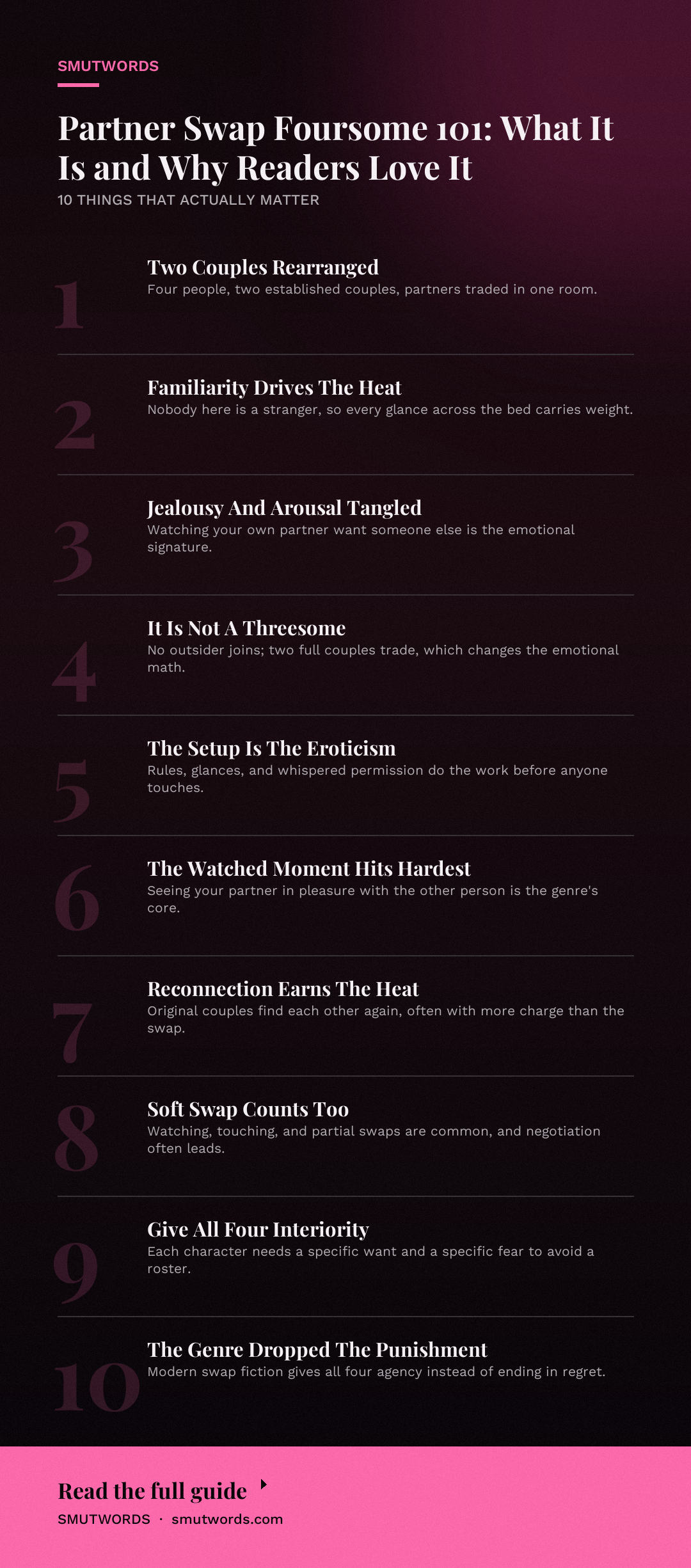
A partner swap foursome puts two established couples in one room and rearranges them: each person ends up paired with the other couple's partner, often in the same bed, while all four stay present and involved. The couples already have history together, so every look across the sheets carries weight.
That shared intimacy is the whole engine of the trope. Unlike anonymous group play, nobody here is a stranger, and the story leans hard on what it means to watch your own partner want someone else in front of you. Readers get jealousy, arousal, negotiation, and usually all four perspectives.
The device shows up constantly in erotic romance and erotica, under names like wife swap, husband swap, couple swap, and swap foursome. It has enough of a following to rank as its own category on SmutWords. The reason is simple: the emotional stakes are built in before anyone undresses.
What Partner Swap Foursome Actually Means
The name describes the shape of the scene: four people, two couples, partners traded. The act of trading is the point. In a standard foursome, any configuration can happen. In a partner swap foursome, the configuration is the premise.
Couple A's two members split, couple B's two members split, and each half joins a member of the other couple. The swap requires that existing partnerships get rearranged, even temporarily.
Several things commonly get lumped in that don't actually qualify. A foursome where one couple invites two singles doesn't count. Neither does a scene where two couples have sex in the same room without crossing over.
The concept sits under the broader umbrella of couple swapping, which covers the practice of two partnered people trading sexual partners with another couple. The foursome version keeps everyone in one space rather than splitting into separate rooms, and that proximity is where the drama lives.
A few common misconceptions worth clearing up:
- It's not anonymous. The characters know each other, often well. That familiarity is why the tension runs so high.
- It's not always a full swap. Some stories keep it to watching, touching, or partial swapping. The variant matters.
- It's not purely physical. The best versions are about loyalty, permission, and what happens to a relationship after the trade.
- It doesn't erase the original couples. Most partner swap foursome stories end with the original pairings reconnecting, often with more heat than before.
Readers searching for a swap foursome usually want the negotiation as much as the act. The buildup, the rules, the glances, the moment someone crosses a line: that's the content.
Where Partner Swap Foursome Comes From
The swap as a story device has deep roots in erotic publishing. Wife swapping as a genre of pulp fiction and men's magazines has existed since at least the mid-twentieth century. Those early stories leaned on shock value and often ended in punishment or regret. The wife swap framing carried a distinctly gendered anxiety: the husband's possessiveness was the engine, and the wife's desire was the threat to be managed.
Over the decades, the trope shifted. Contemporary erotica treats the swap as a mutual adventure rather than a moral test. The wife swap label still exists in publishing and search, but modern partner swap foursome fiction usually gives all four characters agency and desire.
The husband swap version flips the gendered default. The couple swap version goes fully mutual. Each label signals a slightly different flavor to a reader scanning a shelf or a search bar.
The four-person, same-room version gained particular traction in indie erotica and serialized online fiction, where writers could give every character a point of view across chapters. Four perspectives in one scene is a technical challenge and a commercial draw. Readers get inside every head, including the one watching their partner get touched by someone else. That inside-the-jealousy vantage is hard to pull off in any other configuration.
The publishing history here is really a history of reader appetite. Swap stories have always sold because they dramatize a fear and a fantasy at once. The genre matured by giving the fear somewhere to go: check-ins, reconnection, aftercare. The modern version keeps the heat and drops the punishment.
How It Shows Up in Erotica
On the page, a partner swap foursome is a scene of controlled logistics. Four bodies need arranging. Writers who do it well treat the geometry as part of the eroticism.
Who stands where. Who watches whom. Whose hand is on whose hip. The reader tracks all four positions as the tension builds.
Here's the craft problem the trope creates: you have two relationships to protect and four perspectives to sustain. A flat version rushes to the sex and treats the swap as a checklist of pairings. A strong version builds in anticipation play before anyone touches anyone, letting the unspoken rules do the work.
The glances across the room. The whispered permission. The moment a character's partner says yes, and everything changes.
The best scenes tend to follow a loose structure that authors repeat because it works:
- Setup and rules. All four agree on what's allowed before the scene starts. The agreement itself is erotic.
- The first crossing. One pairing breaks the seal. The reaction of the remaining two carries the scene.
- The tangle. All four involved, positions shifting, perspectives rotating.
- The watched moment. A character sees their partner in pleasure with the other person, and the jealousy hits alongside the arousal.
- Reconnection. The original couple finds each other again. This scene often has more voltage than the swap itself.
The fourth item is the heart of the genre. Jealousy and desire tangled together is the emotional signature of swap fiction, a dynamic close to what the tension between conflict and desire produces. The anger is different from jealousy, but the mechanism is the same: strong feeling gets rerouted into heat.
Common variations the reader will encounter under the swap foursome umbrella:
- Full swap: Every character partners with someone from the other couple. The most intense version.
- Soft swap: Touching, watching, and play short of full intercourse between traded partners.
- Wife swap / husband swap: The traded partner's gender gets the marketing emphasis, often signaling which perspective leads.
- One-sided swap: Only one couple actually trades; the other watches or participates partially.
- First-time swap: All four are new to it, so the negotiation carries most of the drama.
- Cuckold-adjacent swap: One character's pleasure in watching their partner becomes the dominant thread.
The reconnection scenes deserve special mention. After the swap, the original couples withdraw, and what happens next determines whether the story earns its heat. A good reconnection combines reassurance with a charge that wasn't there before.
Enjoyed this? Get a free book.
Join the list and we will send a complete free story straight to your inbox, plus new releases every week after that. No credit card, no catch.
The partner feels newly wanted. The jealousy gets addressed instead of ignored.
This is functionally a form of emotional aftercare, scaled to the intensity of the scene, and novels that skip it leave readers cold.
Writers who handle the foursome badly tend to flatten the characters into positions: the bold wife, the jealous husband, the nervous newcomer. Stronger versions give each person a specific want and a specific fear. The wife who suggested it and is secretly terrified of how much she'll like it. The husband who agreed to prove something and is about to learn what he's proving.
Give all four interiority and the partner swap foursome becomes a real ensemble scene instead of a roster.
Readers coming from group sex more generally should note the difference in emphasis. Group sex often prioritizes the sheer mass of bodies and sensation. The swap foursome prioritizes the web of existing relationships and the cost of the trade. Both are hot. They scratch different itches.
For authors working a scene that includes restraint or pain play alongside the swap, the physical safety basics still apply: rope safety for any binding, and a clear understanding of what counts as a scene with a defined start and end. Four people mean four sets of limits to check, and the swap itself is best framed as a scene with rules.
Partner Swap Foursome vs Other Group Configurations
Readers often confuse the partner swap foursome with a few nearby terms. The distinction matters if you're hunting for a specific flavor.
Versus a threesome. A threesome brings a third person into an existing couple, so the drama is about the intruder or the guest. A partner swap foursome involves two full couples and no outsider. If you want the two-couples dynamic, an FFM threesome won't satisfy it, because the emotional math is different.
Versus couple swapping in general. Couple swapping is the broader category. It covers separate-room arrangements, ongoing lifestyle swaps, and full partner exchanges over time.
The partner swap foursome is the subset where all four stay in one room, one bed, one continuous scene. The proximity is the whole distinction.
Versus a ritual scene. A ritual collaring ceremony is about marking a committed kink relationship with ceremony and permanence. The swap foursome is about temporary rearrangement inside two committed relationships. Both deal in commitment, but the swap puts that commitment under stress rather than formalizing it.
Versus anonymous group play. Orgy-style scenes often feature strangers and lookalike bodies. The swap foursome depends on the characters knowing each other's histories, limits, and relationships. The knowing is the point.
Frequently Asked Questions
What is a partner swap foursome?
It's a four-person erotic scene where two established couples trade partners, so each person ends up with the other couple's partner in the same room or bed. The story emphasizes shared intimacy and the tension between loyalty and desire, rather than anonymous group sex.
Is partner swap foursome the same as swinging?
Swinging is the real-world lifestyle practice; the partner swap foursome is the fictional scene built on the same trade. Erotica uses the term for the one-room, one-night, all-four-present version, which sometimes overlaps with how real couples arrange swaps but exists primarily as a narrative device.
What's the difference between wife swap and couple swap?
Both describe the trading of partners, but the labels signal emphasis. Wife swap and husband swap tend to foreground a specific partner's perspective, often with a possessive theme. Couple swap is the neutral, mutual term. All three sometimes appear under the trick umbrella of a swap foursome when all four characters stay in one space.
Why do readers like partner swap foursome stories?
The draw is the emotional crossroads: the characters already have history, so jealousy runs hot next to arousal. Readers like watching two couples negotiate what they're allowed to want from each other, and the reconnection scenes afterward land harder because the original pairings got tested.
Do partner swap foursome stories always end with a full swap?
No. Soft swap, partial swap, and watching-only variations are common, and many stories spend more time on the negotiation than the consummation. The label describes the scenario, not a guaranteed act, and the best writers use the ambiguity to build tension.
What should I look for in a well-written swap foursome scene?
Four characters with distinct wants, a clear rule-setting before the scene, the moment of watching a partner with someone else, and a real reconnection afterward. Skip stories where any of the four characters feels interchangeable or where the aftermath gets rushed.
Final Thoughts
The partner swap foursome lives or dies on what happens between the traded partners and the people who love them. Whether you're here for full swap heat or a first-time negotiation that never quite goes through, the genre rewards stories that give all four characters room to want and fear at once.
The clearest way to see the trope at full strength is to start with one of the ranked swap foursome titles SmutWords has gathered below. Pick one, read the negotiation scene first, and you'll know within a chapter whether the author understands what makes the trade worth making.





Loading comments…