The search bar doesn't lie. Somebody typing "age gap smut" into Google at 1 a.m. wants something very different from somebody browsing the romance shelf at a bookstore. The two genres get folded together constantly even though they scratch different itches.
Age gap smut vs age gap romance is a real distinction, not a marketing label slapped on the same product twice.
One is built to get you off in twenty minutes. The other wants to make you feel something about a twenty-year age difference across three hundred pages and a slow-burn courtship. Both can be good. They are not interchangeable, and treating them like they are is how readers end up disappointed by a book that never promised what they wanted in the first place.
Here's the split, plainly: age gap romance spends most of its word count on the tension of the gap itself. Age gap smut spends most of its word count on what two people do once they've already decided the gap doesn't matter. Everything else follows from that one structural choice.
What "Age Gap Smut" Actually Means
Smut, as a category, runs short. A novella, a serial installment, a 40-page standalone that hits the meet, the tension, and the explicit scene inside the first two chapters. Plot exists to justify the sex, and the sex exists in full, unflinching detail with nothing cut away.
If you're new to how the genre labels itself, the difference between a scene that fades to black and a scene that doesn't is the entire reason the word "smut" exists as a search term separate from "romance."
The age gap version of this keeps the gap as a heat source, not a plot mechanic. Younger woman, older man, or any pairing with a decade-plus between them, and the gap gets used to crank up the power imbalance in bed rather than to fuel a slow emotional reckoning. He's experienced. She isn't, or she is and he underestimates her.
Either way, the story gets to the point fast. What you get, typically:
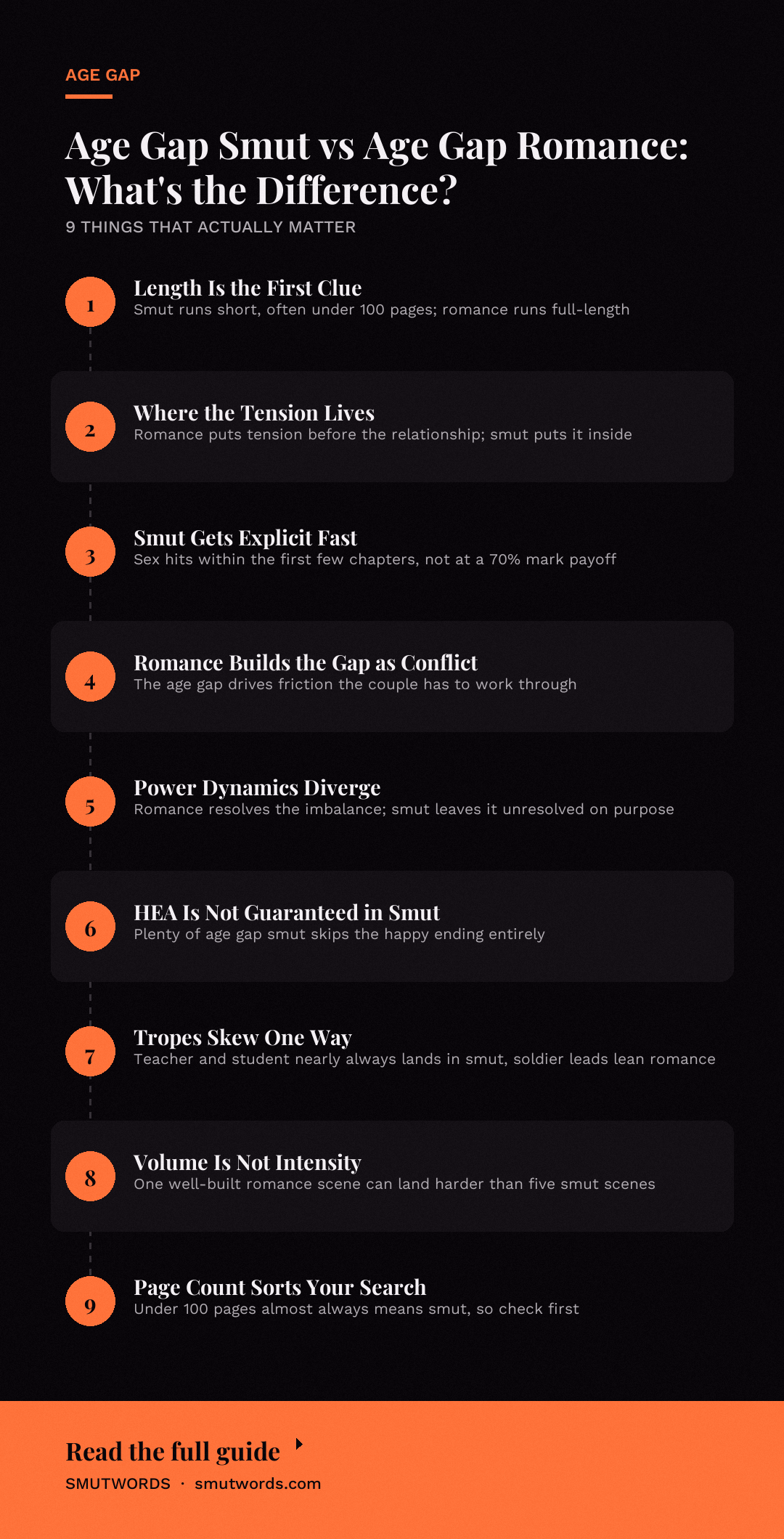
- A short page count, often under 100 pages, sometimes under 40
- Explicit sex within the first few chapters, not saved for a 70% mark payoff
- Minimal subplot. The relationship is the plot.
- Power dynamics played up directly: mentor/student, boss/employee, family friend, coach/athlete
- Endings that resolve fast, sometimes in the last five pages, sometimes with no HEA at all
That last bullet matters more than people admit. Age gap romance readers expect a happy ending or at least a hopeful one. Plenty of age gap smut doesn't bother, because the ending was never the point. The scene was.
What "Age Gap Romance" Actually Means
Full-length age gap romance treats the gap as the central conflict, and it has to, because a three-hundred-page book needs something to sustain it. The forty-year-old love interest isn't just older, he's at a different life stage. He's got an ex-wife, or a kid the same age as the heroine, or a career that's already peaked while hers is just starting.
The gap creates friction the couple has to actually work through. The sex, when it arrives, arrives later and means more because the emotional stakes have been built for two hundred pages first.
The heat level varies wildly here. Some age gap romance is closed-door, some is explicit, most lands somewhere in the middle with two or three sex scenes that serve character development as much as they serve the reader.
If the gap is fifteen years and the hero is her father's best friend, the book has to spend real time on what her parents think, what his reputation costs him, whether the relationship survives the social fallout. That's the engine. The sex is a passenger.
The Real Difference: Where the Tension Lives
Put them side by side and the structural difference is almost embarrassingly simple. Age gap romance puts the tension before the relationship: will they, should they, what does everyone else think. Age gap smut puts the tension inside the relationship: how far will they go, who's in charge, what happens when the older one loses control.
That's why a reader who loves one often bounces off the other. Romance readers who want the slow build get bored by smut that skips straight to the bedroom with no emotional groundwork. Smut readers who want the explicit payoff get frustrated by romance that spends 200 pages on will-they-won't-they before anybody takes their clothes off.
Neither reader is wrong. They're shopping for different products that share a search term. It's worth knowing where your own taste sits before you buy, because the blurbs don't always tell you. Some books get tagged "age gap romance" when they're really smut with a plot, and vice versa, and the cover art won't save you.
A quick self-check before you pick a book
- Do you want the sex scene in chapter two, or chapter twenty?
- Do you care what the heroine's mother thinks of the relationship? If yes, romance. If it never crosses your mind, smut.
- Does a fade-to-black ending ruin the book for you? Then stay away from closed-door romance.
- Do you need an HEA, or is a satisfying final scene enough?
- Does a 300-page slow burn sound indulgent or unbearable?
Answer honestly and you'll save yourself a lot of refund requests.
Power Dynamics Play Out Differently in Each
The age gap is intrinsically a power gap, and how each genre handles that power is where the two really diverge. In romance, the power imbalance is usually something the couple has to resolve or at least acknowledge. She gets older, gains confidence, calls him on his condescension, and by the last act they're equals who chose each other. The book earns its ending by closing the gap emotionally even if the years stay the same.
Enjoyed this? Get a free book.
Join the list and we will send a complete free story straight to your inbox, plus new releases every week after that. No credit card, no catch.
In smut, the power imbalance is frequently the point and stays unresolved on purpose. He's in charge, she likes it, the reader likes it, and nobody needs the hero to learn a lesson about equality before the final scene. That's not a flaw in the genre. It's the fantasy.
Readers who want a story where the older man gets humbled should stay in romance. Readers who want him to stay exactly as domineering on page one as he is on page forty should stay in smut.
The hate to love dynamic shows up in both, but it plays by different rules depending on length. In a romance it's a genuine arc, enemies becoming allies becoming lovers over hundreds of pages of earned turns. In smut it's often just a spark that ignites the first scene and gets abandoned the moment clothes come off.
Common Age Gap Setups and Which Genre They Usually Land In
Some tropes default to one side of the divide almost automatically, and knowing the pattern helps you sort search results faster.
- Father's best friend / best friend's father: splits almost evenly. Romance if the fallout with family gets real page time, smut if it's just the forbidden premise for a single scene.
- Boss and intern: skews smut in short form, romance in full-length, especially when the workplace consequences get explored.
- Teacher and student (adult, always): almost always smut, because the taboo is the draw and romance publishers rarely want to build a whole courtship around it.
- Age gap with a military or veteran lead: leans romance more often than not, since soldier romance tends to build in a whole emotional backstory for the older character that short smut doesn't have room for.
- Age gap in a biker world: splits down the middle, but motorcycle club romance tends to run longer and darker, so the gap usually gets treated as part of a broader power structure rather than a one-scene device.
None of these are hard rules, just patterns that hold often enough to be useful when you're scanning a tag cloud.
Heat Level, Honestly Compared
People assume smut is automatically hotter than romance. Usually true in terms of page count devoted to explicit sex, but not always in terms of intensity. A well-written romance can have one scene that lands harder than five scenes in a smut novella, because the emotional setup does half the work. What smut offers is volume and directness, not necessarily better sex writing.
The tradeoff cuts both ways. Romance can afford to make a single scene devastating because it's been building for 250 pages. Smut has to make every scene count on its own, which is a different and often harder craft problem.
When it works, it works because the writer understands that an age gap scene needs the power dynamic front and center, not buried under generic dirty talk that could belong to any couple of any age. If explicit detail is what you're after, the heat isn't a side effect of the age gap, it's the reason the subgenre exists as a search term distinct from plain romance. Nobody types "age gap smut" hoping for a fade-to-black.
Where the Subgenres Overlap More Than You'd Think
Cyberpunk and celebrity settings complicate the split, because both tend to run long enough to qualify as romance while carrying smut-level heat. A cyberpunk romance with a twenty-year age gap between a seasoned operative and a younger recruit can hit both markets, explicit sex plus a full plot about the gap's consequences.
Same with celebrity romance, where the age gap often comes bundled with a power gap around fame and access that gets treated as seriously as the years between them. This is where the "smut vs romance" binary gets fuzzy, and honestly, some of the best age gap books live in that fuzzy zone. Long enough to build real feeling, explicit enough that nobody's skipping pages to get to the good part.
How to Search for What You Actually Want
Search engines don't distinguish between the two, so you have to do the sorting yourself. A few practical filters:
- Check the page count first. Under 100 pages almost always means smut.
- Read the one-star reviews. "Too much sex, no plot" means smut. "Too slow, nothing happens until chapter 15" means romance.
- Look at the heat rating if the retailer provides one. Explicit with a slow burn tag is romance. Explicit with an instalove tag is smut.
- Check whether the blurb mentions family, career, or social fallout. That's a romance signal. A blurb that's all about the first night together is a smut signal.
Genre tags lie less than blurbs do, but neither is foolproof. The page count is usually your best single clue.
Why the Distinction Matters for Readers, Not Just Writers
Knowing which side of the divide you're shopping on saves you from the specific disappointment of picking up a book that promised heat and delivered three hundred pages of longing glances, or the reverse, a book that promised a slow-burn relationship and delivered nothing but scenes. The age gap itself isn't the variable that determines which experience you get. Length and where the tension lives are.
Writers who understand the split write better books in both lanes, because they're not trying to satisfy two audiences with one manuscript. A smut novella that stops to build a family drama subplot loses its own momentum. A romance that rushes to the bedroom in chapter three loses the slow burn that was supposed to make the payoff land.
The age gap trope works in both formats precisely because it's flexible enough to power either engine, but only if the book commits to one.
Final Thoughts
If you want to see the distinction in practice, pick up a short age gap title and read it back to back with something full-length, and the difference will be obvious within twenty pages. For a starting point, our The Caretaker runs short and explicit enough to show you exactly what age gap smut does when it commits to the format, no padding, no detours, just the dynamic doing the work a longer book would spend chapters building toward.







Loading comments…