
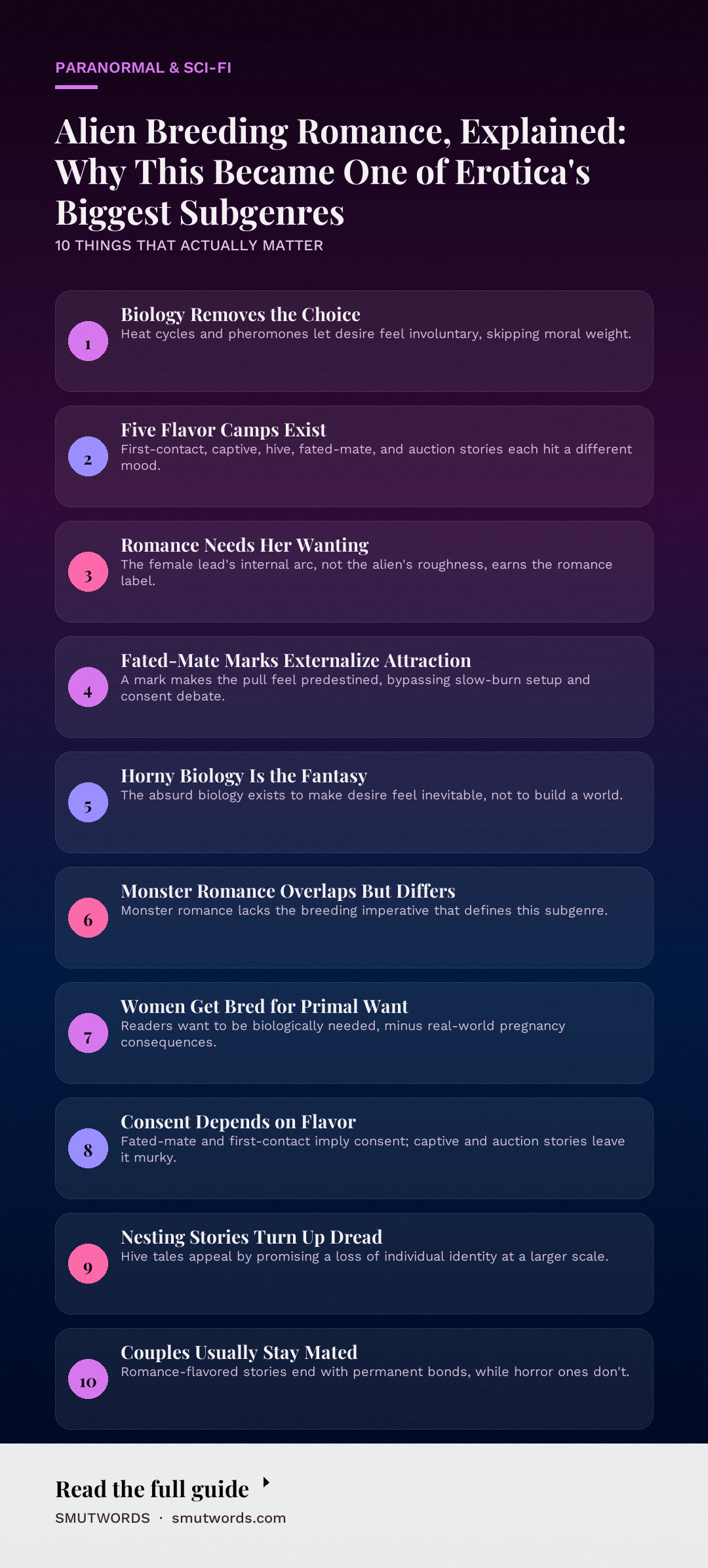
Alien breeding romance books went from a niche shelf to one of the biggest subgenres in erotica, and the shift happened fast enough that most people didn't see it coming. Ten years ago this was almost entirely self-published territory, a strange corner of sci-fi romance that readers stumbled into by accident. Now it's everywhere, and the language of the genre (mating marks, heat cycles, knots, nests) has leaked into mainstream romance so thoroughly that plenty of readers don't even realize where it came from. Let's talk about why this particular fantasy took hold so hard, and what separates the stories that actually earn the "romance" label from the ones that are really just conquest horror wearing a cute cover.
The core trick: biology removes the choice so the fantasy doesn't have to argue with itself
The most important thing to understand about alien breeding romance books is the mechanical trick at the center of nearly every one. In a human contemporary story, a character who says "I want you to breed me" has to carry a lot of moral and social weight. It's a decision with real consequences, and the plot usually has to spend some time justifying it, dealing with the implications, or at least explaining why this isn't a terrible idea. The alien breeding story just deletes that entire problem. A heat cycle hits, pheromones flood the air, a mating instinct takes over, and suddenly the character's body is making the call before her conscious mind has finished catching up.
This is the same psychological mechanism that makes free use erotica so effective, just with a different delivery system. Free use removes the burden of having to say yes over and over again. Alien breeding removes the burden of having to want it in the first place. The character doesn't have to be a bad person for wanting this, because the wanting is pure biology at work. Her own body is signing her up for it without asking.
The result is a fantasy that lets readers have the intensity of total surrender without any of the ambivalence that would normally come attached. No guilt, no negotiation, no wondering if she's making a terrible decision that she'll regret in the morning. The decision was never hers to make, which means the fantasy can just get on with the part that actually matters to the reader: what it feels like when the surrender happens.
The five major flavors of alien breeding romance
Not every alien breeding romance book does the same thing. The subgenre splits into several recognizable camps, and knowing the difference matters if you're looking for a specific mood. Here's the breakdown:
- First-contact heat fantasy. A human woman encounters an alien species for the first time, and something about her biology, or his, triggers an immediate instinctive response. Often this involves a pheromone or a heat signal that rewrites her normal responses. Alien Heatwave is a clean example: a solar flare rewrites a woman's biology into a distress signal that alien predators can track across the stars. She doesn't just meet her alien. She becomes, at the cellular level, something he was designed to find.
- Captive-of-a-conqueror. This one leans harder on the power imbalance. A human woman is captured, claimed, or taken as a spoil of war by an alien warrior or general. The breeding element comes from his species' survival needs more than his personal desires. Breed Me, General frames it explicitly: a human envoy seized during ceasefire talks and claimed by an alien general as the literal terms of the peace treaty. She's not a random abduction victim. She's a line item in a negotiation, which makes the surrender feel more like a strategic decision than a violation.
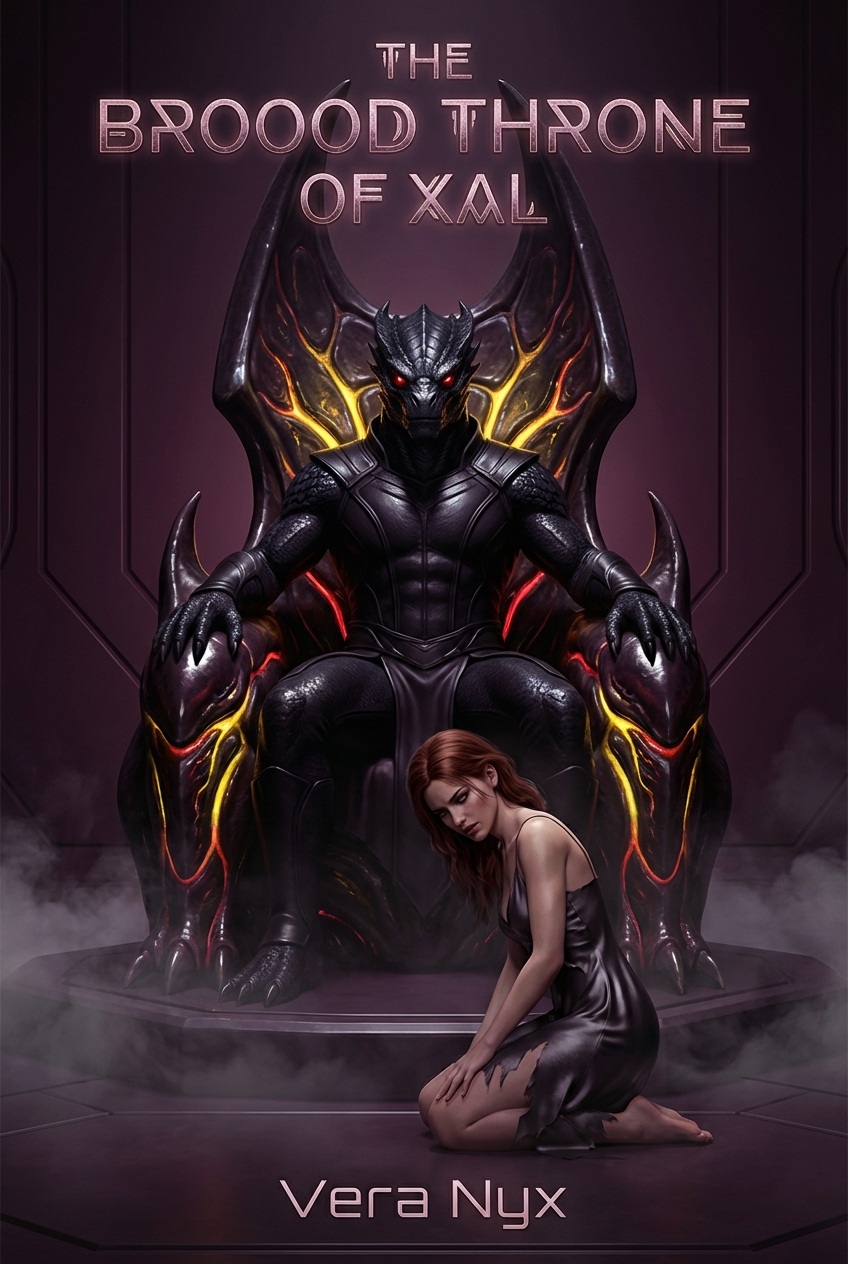
- Hive or nest breeding, horror-adjacent. Instead of a single warrior, the alien here is a collective: a hive, a nest, a species that functions as one organism. The breeding fantasy gets darker here because the scale shifts from one-on-one intimacy to being absorbed into something much larger. Breeding Nest Alpha-7 runs this angle hard: a woman rerouted into a living alien nest where hatchlings claim her on instinct alone. Tentacle Throne plays the same tune in a different key, with a woman crowned queen of an alien species only to discover the throne itself is a living mass built to keep her filled and producing. The horror element is real, but it's also the point. The dread is part of the charge.
- Fated-mate romance. This is the version that overlaps most with traditional romance readers. The alien isn't a conqueror or a threat. He's a destined partner, and the breeding imperative comes from a soul-level or genetic-level pull that neither party can resist. The Crimson Moon Heir gives it the literal-mark treatment: a fated-mate mark burns into a woman's skin and summons an alien warrior who claims her as his destined match. No coercion, no capture, just an external force that says "this one is yours" and lets both characters surrender to it together.
- Auction and ownership. The most transactional flavor. A woman is bought and sold as breeding stock, and the story treats the purchase itself as the starting point. Alien Auction is the clearest example: a woman harvested from Earth and sold at auction to alien elites who pay any price for a fertile human mate. The fantasy here is about being so desirable that someone will pay anything to have you, mixed with the complete loss of agency that comes with being property. It's heavier than the other flavors, but it has a devoted audience precisely because it goes there.
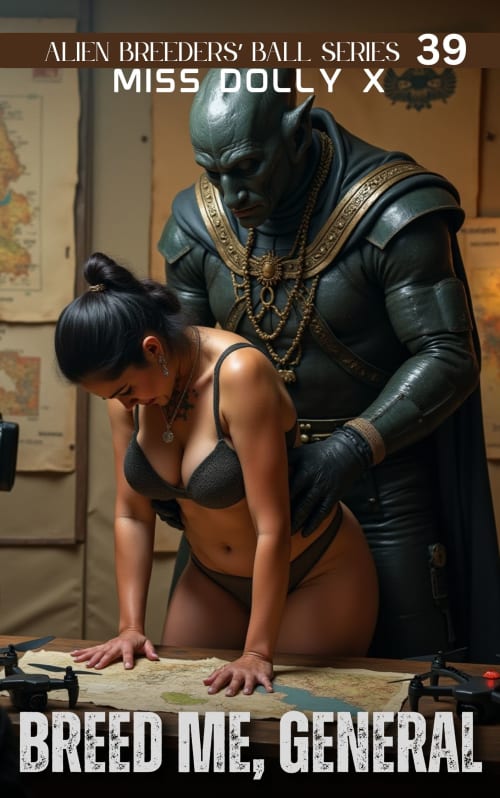
Breed Me, General, the captive-of-a-conqueror flavor, where breeding is written into the terms of a treaty.
What separates a story that earns "romance" from one that's pure conquest or horror
This is the line that actually matters, and it's not about whether the alien is gentle or rough. A story can be brutal and still romantic. A story can be sweet and still feel like pure coercion. The difference is whether the female character ends the story with genuine want, whether the desire is built into the narrative rather than just applied to her body. A pure conquest story treats her as a vessel: she's there to receive, to produce, to serve the alien's needs, and her own experience is incidental. A story that earns the romance label gives her an internal arc. She starts alienated from her own desires, or terrified of them, and the alien's attention becomes the thing that lets her reconnect with them. The breeding becomes something she comes to want, not just something that happens to her, even if she never would have chosen it with a clear head.
The best alien breeding romance books hold both truths at once. The wanting is real, and it's also undeniable that she never got to consent in the normal sense. That contradiction is the whole appeal. The fantasy says: you can be completely overwhelmed, completely overtaken, and still end up on the other side of it knowing exactly what you wanted and why. The surrender doesn't erase the self. It reveals a version of the self that normal life doesn't give room for.
Why the fated-mate mechanic is doing more work than it looks like
The fated-mate trope gets dismissed as a cheap shortcut, a way to skip the slow-burn courtship that drives human romance. That's a misread. The fated-mate mark or pull is doing structural work that the romance genre desperately needs but can't usually access without a supernatural excuse. It externalizes attraction. It makes the pull between two people feel like something bigger than either of them, something predestined, something that exists in the universe before they ever meet. That's the same feeling human romance novels try to manufacture through meet-cutes and slow burns and banter, except those require a hundred pages of setup. The fated-mate mark gets there in one scene.
And it solves the consent problem in a way that a human story can't. A human woman who falls for someone quickly has to justify it, has to explain why she's moving so fast, has to defend herself against the accusation that she's being reckless. A woman with a mating mark on her skin doesn't have to justify anything. The universe signed off on this. Her body recognized him before her brain could talk her out of it. That's a massively freeing narrative position to be in, and it's a big part of why The Crimson Moon Heir works as well as it does. The mark works as permission, written on her own skin, to want the thing she wants, not merely as a plot device to get the characters into the same room.
Enjoyed this? Get a free book.
Join the list and we will send a complete free story straight to your inbox, plus new releases every week after that. No credit card, no catch.
The horny biology is the point
Some critics of the genre dismiss it as "lazy worldbuilding" because the alien biology exists primarily to justify the sex. That criticism misses what the biology is actually for. The horny biology is the fantasy itself. The heat cycle, the pheromones, the knot, the breeding season, the mate-scent, all of it exists to make desire feel inevitable, involuntary, and unstoppable. Nobody reads an alien breeding romance book for the worldbuilding. They read it for the feeling of being caught up in something so much bigger than personal choice that resistance becomes meaningless.
That's also why the best stories in the genre don't try to downplay the biology. They lean into it. Alien Heatwave doesn't just say the woman feels attracted to the alien. It says a solar flare rewrote her biology into a distress signal his species can track across the galaxy. That's a deliberately unsubtle story. The absurdity is the appeal. The story is saying: your desire is so powerful that it can be detected from space. That's the fantasy, stated plainly, and it works because it doesn't apologize for itself.
Common questions about alien breeding romance books
Is this the same thing as monster romance? Overlapping, not identical. Monster romance includes everything from orcs to demons to eldritch horrors, and the sex doesn't always have a breeding component. Alien breeding romance specifically involves reproduction, or the threat of it, as a central part of the plot. A story about a woman and a minotaur who just have a lot of sex is monster romance. A story about a woman whose alien captor needs her to carry his offspring is alien breeding romance. The line blurs constantly, but the breeding imperative is the defining feature here. If you want the broader landscape, our monster romance guide covers every creature type.
Why is it almost always the woman who gets bred? The genre is overwhelmingly written for and read by people who either have or could have female reproductive anatomy, and the fantasy of being wanted so specifically, so biologically, that someone or something needs you in this primal way is the core appeal. There's also a darker element: the fantasy of being reduced to your reproductive function, of being valued purely for what your body can do, without any of the social complexity that actually comes with pregnancy in the real world. The alien breeding fantasy gets to have the intensity of that reduction without any of the actual consequences, because it's fiction and nobody has to deal with morning sickness.
Do these stories ever address consent explicitly? Depends on the flavor. The fated-mate and first-contact versions usually build in some form of enthusiastic consent, even if it arrives after the initial biological trigger. The captive and auction versions are murkier on purpose. The consent is often implied through her eventual wanting, or through the narrative making clear that she's enjoying it even when she didn't choose it. Some readers find that uncomfortable, which is fair. Others find it to be the entire point. If explicit, verbal consent is a requirement for you, stick to the fated-mate and first-contact flavors and skip the auction and conquest titles.
Why are "nesting" and "hive" stories getting more popular? The horror-adjacent flavors attract readers who want the breeding fantasy with the safety dial turned down. A single alien warrior is one threat. A living nest that wants to keep you full and producing is a much bigger commitment, and the scale of that commitment is the appeal. Tentacle Throne and Breeding Nest Alpha-7 both lean into the loss of individual identity that comes with being absorbed into an alien reproductive system. That loss of self is frightening, and for the readers who love this content, that's exactly why it works.
Does the couple ever stay together after the breeding? Usually yes in the romance-flavored versions. The mating bond, once established, tends to be permanent. The fated-mate stories treat it as a lifelong commitment, and even the conquest stories often end with the woman choosing to stay. The ones that don't end that way are usually horror stories that use the breeding fantasy as their engine. Both are valid, but they answer different questions.
Final Thoughts

Alien Heatwave, the cleanest entry point into the genre.
If you're new to alien breeding romance books and want to know what the fuss is about, start with Alien Heatwave. It's the cleanest entry point: first-contact setup, biological imperative front and center, no baggage about captivity or coercion to work through. You get the purest version of the fantasy without any of the darker flavors muddying it. If you already know you like the darker stuff, go straight to Alien Auction and let the title set your expectations. Either way, the heat cycle's already running. Your body knows what to do with it. The only question is whether you're ready to let it catch up.





Loading comments…