
An ash kink is an arousal pattern built around ash, soot, and the residue of something burned, especially when that residue ends up on skin. In erotica, it shows up as a physical trace left after a fire, a cremation, a ritual, or a burned letter: a smudge on a cheekbone, gray fingerprints on a hip, a streak of cinder transferred from one body to another.
The appeal is specific and visceral. Something ruined touches something alive, and the mark it leaves says what happened without anyone having to speak it aloud.
Readers who seek out ash kink stories tend to describe the same handful of pleasures: the taboo of pressing something dead against a warm body, the grief that colors the image, and the fact that the mark is temporary. It will smudge, flake, or wash off before the scene is over.
That impermanence carries its own charge. You get the intensity of a permanent claim with a built-in expiration, and the scene has to hold the feeling before the evidence disappears.
What Ash Kink Actually Means
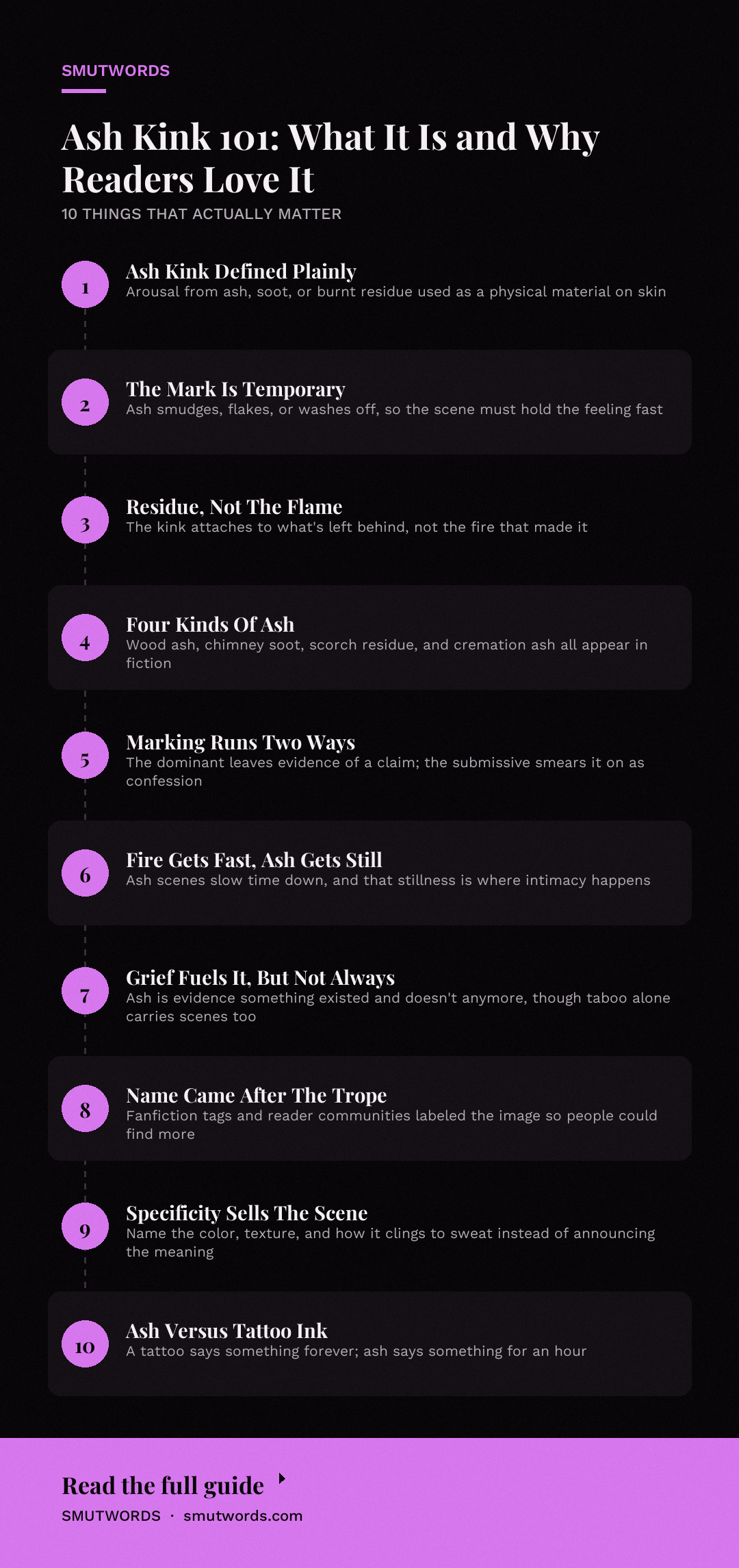
The plain definition is narrow: arousal from ash, soot, or burnt residue as a physical material in sexual or intimate contexts, or from the act of marking and being marked with it. The material itself is the fetish object, the same way leather or hair can be. The smudging is the action, and the person doing the marking and the person wearing the mark are the two roles the dynamic runs on.
"Ash" covers more ground than people assume. In published fiction, it usually means one of a few things: wood ash from a fireplace or bonfire, soot from a chimney or a scorched wall, the gray residue left on skin or clothing after proximity to flames, or cremation ash, which is the most charged version and the one that appears most often in dark romance and paranormal plots.
Some scenes use symbolic ash instead, like the burned remains of a letter or a photograph, rubbed between fingers or pressed against a mouth.
The term is reader shorthand more than an established clinical category. It circulated through fanfiction tags, dark romance communities, and kink discussion spaces as a way to flag a very particular image: the moment after destruction, when the evidence is still on someone's hands.
It sits close to scar kink and blood kink in the way it treats damage as an intimacy medium, with one key difference. Scars are permanent and blood is wet and immediate. Ash is dry, gray, and already finished burning. It is the aftermath, and that is the point.
What counts as ash kink, and what doesn't
- Counts: A character deliberately marks a lover with soot from their own hands, fingers, or mouth. A scene where ash from a ritual, fire, or cremation is pressed into skin with intent. Arousal drawn from the visible trace afterward, the gray print that shows where someone was touched.
- Counts: The reader-facing thrill of a body that is dirty in a specific, meaningful way, where the dirt is the story of what the character survived or did.
- Doesn't count: Generic dirtiness or grime with no fire or burn history behind it. That territory belongs to wet and messy fetish play, which has its own texture and logic.
- Doesn't count: A scene set near a fire with no ash on anyone. Aesthetics alone do not make the kink. The material has to be used, touched, transferred, seen.
- Doesn't count (technically): Soot as costume makeup with no erotic charge toward it. The kink requires that the ash itself, or the mark it leaves, is doing something for someone in the scene.
A common misconception: people assume an ash kink is the same thing as a fire kink or a burn fetish. It is not. Fire is the source, but the kink attaches to the residue, not the flame. Many ash kink scenes have no fire in them at all; the fire happened earlier, off-page, and the scene is about what it left behind.
Another misconception treats the kink as always grief-driven. Grief is one of its strongest fuel sources, but plenty of ash kink writing runs on pure atmosphere and taboo, with no mourning plot involved.
Where Ash Kink Comes From
The history here is a publishing history. Ash as an erotic image has lived in literature for a long time (the Catholic imposition of ashes, the cremation rites of many cultures, the widow in gray, the burned letter as a romantic prop), but as a named kink in genre fiction, it is young. It gathered force in dark romance and paranormal romance, two genres that were already comfortable treating destruction as foreplay.
Paranormal romance did a lot of the early work. Once you have immortals, demons, phoenixes, witches, and creatures who can survive fire, the ash left behind becomes a romance problem: proof of what someone is, or was, or did. Writers discovered that a smear of soot on a vampire's wrist or a demon's collar could carry more sexual charge than pages describing the fire itself. The residue outlived the event, and the residue was where the bodies touched.
Dark romance picked it up second and pushed it further. Captivity plots, revenge arcs, and grief-driven second-chance stories needed a physical object to carry the emotional weight, and ash suited that job.
It is silent. It is intimate. It cannot be spoken around, because it's visible on the character's body. A smudge on a jaw is a confession.
The naming came later than the trope. Fanfiction tag systems, reader communities on Tumblr and beyond, and kink-adjacent discussion boards gave the image a label so people could find more of it, which is how most niche fetishes get named.
The shift over the past decade has been from incidental ash (it shows up because a fire happened in the plot) to deliberate ash (the marking is the scene, and the plot bends around it). That shift is the moment the kink fully arrived as its own recognizable thing.
It also travels with a wider family of material fetishes. Leather as a kink got its charge from animal hide and the smell of tannery. Ash is less wearable and more held, which makes it closer to a body fluid kink in the way it depends on substance and transfer. Something has to pass from one body to another, and the passing is the event.
How It Shows Up in Erotica
On the page, ash kink is mostly a scene-level device. It rarely carries an entire book; it carries a chapter, or a beat within one, and it works by slowing time down. Fire is fast. Ash is the moment after, when everyone is standing still and the air tastes like a burned house.
That stillness is where intimacy gets to happen. A character dips their fingers into the ash and lifts their hand to someone's face, and the motion is slow enough to be read like a line of dialogue.
A strong ash scene usually has three parts. First, the source: something burned, mentioned with enough specificity that the reader believes the material.
Second, the transfer: the deliberate marking. A thumb dragged down a cheekbone. A handprint on a thigh. A mouth that tastes of smoke because the scene demands it.
Third, the aftermath: the mark smudges, flakes, or stays. The scene holds on the trace and lets the reader do the emotional work of interpreting it.
Common variations authors use:
Enjoyed this? Get a free book.
Join the list and we will send a complete free story straight to your inbox, plus new releases every week after that. No credit card, no catch.
- Marking by the dominant character. The classic version. Someone comes from the fire and touches their partner deliberately, leaving evidence of where they were. Reads as claiming, and as dirty in a way that is visible to the reader but not to anyone outside the room.
- Marking by the submissive character. The reverse. A character who touched the ashes smears them on their own chest or neck as an offering. This variant puts the agency in the hands of the character who is the marked, which shifts the emotional register from claim to confession.
- Cremation ash. The heavy one. A character keeps the ashes of someone dead, and at a moment of extreme grief or hunger those ashes are handled intimately. This variant needs a careful hand. Played badly, it reads as shock value; played well, it reads as a person trying to hold two lives in one room.
- Ritual and ceremony ash. Common in paranormal and fantasy settings, where ash has a position in the world's magic or religion. The mark carries a ritual meaning the scene can lean on.
- Burned objects. Letters, photographs, a wedding dress, a dress shirt. The object is destroyed, and the residue becomes the physical instrument of what happens next.
- Fire-adjacent touch. The mark is made immediately after a character came near the fire, so the soot is fresh and warm, and the scene gets to mix heat with tenderness.
What separates the strong version from the flat one is specificity about the material and restraint about its meaning. The flat version announces itself: "He was covered in ash, and she wanted him." The strong version tells you the color, the texture, the way it clings to sweat, the way one character flinches and the other does not.
It also trusts the reader to work out that the ash means grief, or guilt, or the last time someone touched this particular person.
Several kinks cluster naturally around ash writing, and these adjacencies are worth knowing if you want to see where the trope is going. The hair fetish shares with it a focus on a physical material that reads as alive and dead at once; a scene where ashes are worked into someone's hair is not rare in dark romance. The transformation fetish shares the post-destruction angle, where a character is remade by what burned.
The petrichor kink sits beside it in the domain of aftermath smells, wet earth after rain versus dry soot after fire, and the two kinks often appear together in the same author's work.
The mark matters in a particular way because it is impermanent. Leather, tattoo ink, and scarification all produce marks that stay, and the kinks built around them get their charge from permanence. The leather fetish and the tattoo fetish lean on that.
Ash leaves a mark meant to disappear, so the scene has to hold what the mark is holding for the reader before it fades. That short window is where the writing earns its money.
How to write an ash scene that lands
Ground it in a burned thing the reader already cares about. A generic bonfire gives you generic ash. A letter the character was never supposed to read, a house that belonged to someone's mother, a wedding ritual turned literal: that gives the ash weight.
Get the material details right. Ash is fine and grey and clings to sweat and lines in the creases of skin. It has a smell, dry and faintly sour, and it tastes like the inside of your mouth after a nightmare.
The more concrete you can be about the way ash behaves on a body, the more the reader's senses lock in and the more the kink gets to do its work. Soot is coarser and blacker; cremation ash is finer and paler, more like powder than like dust. Get the specific type right and the rest follows.
Decide who is doing the marking and why, and let that choice carry the emotional stakes. Two people making the same gesture are having completely different experiences, and the kink lives in the tension between those experiences. If both characters are getting exactly what they think they're getting, the scene is flat. If one is claiming and the other is confessing, you have a scene.
Finally, put the mark on the page and leave it there. It sits on a shoulder, a hip, a cheek. It shows.
The reader sees it before the character does, and the reader knows what it means before the character has decided. That lag is the erotic engine. The scene should give the reader a beat or two where they are ahead of the character who owns the body, and then the character looks in the mirror.
Ash Kink vs Tattoo Fetish
These two get confused because both involve marking skin, and the confusion is understandable. The tattoo fetish is arousal from permanent ink on skin, the design, the artist's craft, the pain and ritual of the needle. Its charge is durability. A tattoo is a decision the body carries for the rest of its life.
Ash kink runs the other direction. The mark is made to smudge, flake, or wash away before the scene ends. The tattoo fetish gives you a mark that cannot be removed; ash gives you a mark that has already started leaving. Writers who confuse the two end up making ash scenes feel small, because they treat the mark as a claim when it is actually evidence of a moment that is already slipping.
The tattoo fetish rewards the reader with a body that says something forever. The ash kink rewards the reader with a body that says something for an hour.
Frequently Asked Questions
Is ash kink a real fetish or just a writing trope?
Both. The imagery is strong enough that some readers and players report genuine arousal from ash and soot, and the trope in erotica reflects that. In fiction it functions largely as a device for building scenes around grief and destruction. There is overlap between readers who enjoy the kink in stories and people who practice it in real life, but the two populations are not the same.
How do you safely do ash play in real life?
Cool the ash completely before it touches skin, and keep it away from eyes, mouth, and any open wound or broken skin. Agree on limits and cleanup before the scene starts. Pick a source you know: wood ash from untreated wood, or clean ceremonial ash, rather than anything from a burned object that could have varnish, paint, or plastic residue in it. Have a wash station ready.
What is cremation ash kink and why do people write it?
Cremation ash kink is the specific variant where the ashes of a dead person are used in a sexual or intimate scene. It appears in dark romance and in literary fiction that deals with grief. Writers use it to dramatize how grief and desire get tangled up in the same body, and the taboo is part of the charge. It is the most emotionally loaded version of the kink, and it needs careful, specific writing to work.
What are the other names for ash kink?
Soot kink, cinder play, ash marking, ashes on skin, burnt residue fetish, and cremation ash kink all show up in reader and fandom communities. Most of them refer to the same underlying image. "Cinder play" usually signals the broader fire-adjacent version, while "cremation ash kink" narrows it to the grief variant.
Does ash kink always involve fire?
The material has to come from somewhere burned, so fire is usually part of the backstory, but it doesn't have to happen on the page. Many scenes begin after the fire has already gone out, and the plot is entirely about what was left behind. Some writers use burned paper or charcoal instead of a literal fire.
Is ash kink connected to grief?
Often, yes. Ash is the evidence that something existed and no longer does, which makes it one of the most natural physical props for a grief scene. Dark romance writers lean on that link deliberately. That said, plenty of ash kink writing runs on taboo and atmosphere without a grief plot, and readers who seek the kink out for the physical charge alone will find plenty of that too.
Final Thoughts
The ash kink rewards patience from a writer. The scene belongs to the moment after, and the moment after is where the bodies get close and the evidence gets shared.
If you want to see the trope handled with real control, look for work where the ash does the emotional work the characters can't say out loud, and the smudge on someone's face is the only confession the book gives you. Start with the dark romance titles that sit closest to grief and fire, and let the trace on the skin tell you what happened.





Loading comments…