A beauty and the beast retelling takes the bones of the classic fairy tale, the imprisoned innocent, the monstrous lover, the contract that binds them, and rebuilds it in a new setting, usually with far more explicit sex. In modern erotica, this is a permutating trope that swaps the enchanted castle for a corporate penthouse, a gated estate, or a criminal hideout.
The beast is rarely a literal monster anymore. He is a scarred soldier, a reclusive billionaire, an outlaw biker, or a guarded crime lord. The beauty is the one person who sees past his exterior, and the erotic charge comes from that slow, inevitable breaking down of walls.
These stories are not about taming a man. They are about the erotic tension of being alone with something dangerous and discovering that the danger is layered with unexpected gentleness. The romance genre has loved this shape for decades, and smut has made it rawer, louder, and more physically urgent.
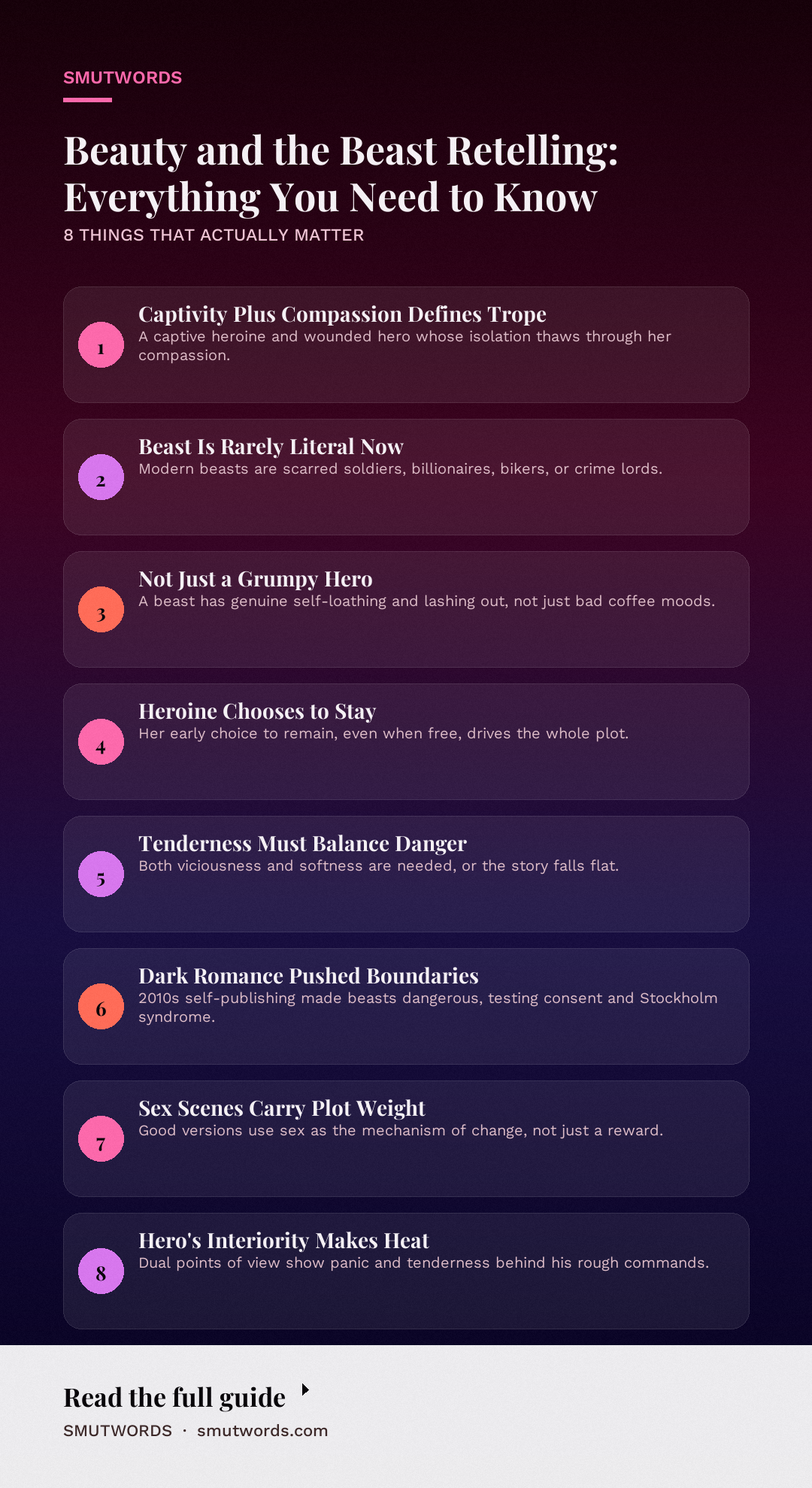
If you are looking at a book where a woman is trapped in a remote location with a powerful, emotionally wounded man who shows her terrifying and tender sides, you are almost certainly holding a beauty and the beast retelling.
What a Beauty and the Beast Retelling Actually Means
The term describes a romance or erotica novel that follows the structural beats of the original fairy tale: a young woman becomes a captive or a guest of a reclusive, intimidating man with a curse or a trauma, and her presence slowly thaws his isolation. The curse is usually metaphorical, taking the form of PTSD, a disfiguring injury, a criminal past, or a psychological barrier against intimacy.
The beast is never merely grumpy. He is genuinely fearsome, often physically imposing, socially isolated, and nursing a wound that makes him lash out.
What does and does not count as this trope. A simple grumpy hero with a soft spot for the heroine is not a beast. A beauty and the beast retelling requires the specific power dynamic of captivity or forced proximity, paired with the hero's active self-loathing and the heroine's role as the only person who can reach him.
The heroine must choose to stay, early on, even when she has a chance to leave. That choice is the engine of the plot.
Misconceptions crop up constantly. The hero does not need to be ugly, although physical scarring is common. Some of the best modern versions make him extraordinarily handsome but emotionally monstrous, a man whose cruelty or coldness is the real cage.
The tale also does not require magic. Contemporary retellings strip out the enchanted rose and the talking furniture and replace them with legal contracts, security systems, and therapy. The core tension survives the modernization because the fairy tale was never about the enchantment. It was about a woman's compassionate courage changing a man's fate.
A key feature is the "beastly" behavior existing alongside an unexpected capacity for tenderness. The reader needs both. If the hero is purely vicious, the story becomes a thriller about a hostage. If he is purely soft, the story fails to generate any heat.
The best versions keep the beast visible while letting the reader glimpse the man beneath, usually through small acts of service, protective instincts, or moments of vulnerability he immediately regrets showing.
Where Beauty and the Beast Retellings Come From
The fairy tale itself is ancient, with variants like "The Pig King" and "Cupid and Psyche" stretching back to antiquity. The version most readers know, Gabrielle-Suzanne de Villeneuve's 1740 French novel and Jeanne-Marie Leprince de Beaumont's 1756 abridgement, established the template.
But the trope's life in genre romance is a more recent phenomenon, accelerating sharply in the late twentieth century as romance novels began pushing toward steamier content.
The rise of the modern retelling tracks closely with the popularity of two archetypes in romance publishing. The first is the Gothic romance boom of the 1960s and 1970s, where a young woman often arrived at a foreboding estate and had to unravel the secrets of a brooding male lead. Those books borrowed heavily from "Jane Eyre," which is itself a cousin of the beast story.
The second is the surge of paranormal romance in the 1990s and 2000s, led by authors like Christine Feehan and J.R. Ward, who gave the beast literal fangs and a warrior's body and made the physical threat explicit.
The shift toward explicit content transformed how the trope plays on the page. Older versions, especially the 1980s and 1990s category romances, often kept the sex off-screen or faded to black. The beauty and the beast retelling in modern erotica exists specifically to get the two of them into a bed, a hot tub, a library floor, or the back of a limousine.
The captivity that was once a narrative inconvenience becomes an erotic premise: she cannot leave, and he cannot stop wanting her.
The genre's own history matters more than the fairy tale's lineage. As self-publishing matured in the 2010s, authors took the trope in darker directions. The beast stopped being a misunderstood aristocrat and started being a human trafficker, a mafia don, or a man outright holding the heroine prisoner.
This "dark romance" wave pushed the consent boundaries hard, creating space for a captive woman to develop Stockholm syndrome and for the author to sell that psychological progression as romance. The trope now spans from sweet contemporary romances, where the beast is simply a reclusive grump, to extreme dark erotica where the beast is genuinely dangerous and the heroine's survival depends on her appeal.
How It Shows Up in Erotica
The sex scenes in a beauty and the beast retelling carry the thematic weight of the entire book. They are not filler. Each physical encounter should represent a step in the beast's transformation or the beauty's surrender.
A flat version of this trope treats the sex as a reward for the heroine's patience. A strong version makes the sex the mechanism of change.
Common variations on the page include the "scar reveal," where the hero has kept his body or face hidden and the heroine finally sees the full extent of his damage. This moment is usually intensely vulnerable and often leads to the first fully consensual, emotionally open sexual encounter.
The hero expects revulsion. The heroine gives him acceptance instead, and the author needs to sell her genuine arousal at the thing he hates most about himself. When done well, this is the emotional climax that precedes the physical one.
The captivity sex dynamic deserves careful handling. In many retellings, the heroine is technically free to leave but trapped by circumstance. She is snowed in, or she owes a debt, or she signed a contract. A strong erotic scene in this space plays with the power disparity.
Enjoyed this? Get a free book.
Join the list and we will send a complete free story straight to your inbox, plus new releases every week after that. No credit card, no catch.
He orders her to undress. He demonstrates his control over her body while making it clear that her pleasure is his goal. The most effective scenes let the beast show a flicker of restraint he does not have with anyone else, proving her special status.
Variants that readers specifically search for:
- The scarred veteran: a soldier home from war with visible wounds and invisible trauma. The heroine is his physical therapist, his neighbor, or the woman he rescued. Sex is his way of reclaiming his body and her way of proving his wounds do not diminish him. This overlaps heavily with Soldier Romance.
- The billionaire beast: a corporate raider with a ruined reputation and a taste for control. He buys her, literally or metaphorically, as a contract. The Billionaire Romance template supplies the opulence, and the beast structure supplies the psychological wound.
- The feral shifter: a paranormal version where the beast is an actual animal or shifter who has lost his humanity. Her presence drags him back to his human form. The sex is often rougher, more instinctual, and less verbal.
- The hooded outlaw: the biker or crime lord who keeps his identity hidden or his face scarred. She stumbles into his territory and becomes his "old lady" or his captive. Her trust is the currency.
- The masked captor: she never sees his face, but he touches her in the dark. The anonymity amplifies the heat and fear, and the eventual unmasking provides the final act's tension.
What separates a strong version from a weak one is the hero's interiority. The reader needs access to his thoughts, his loathing, his shock that she wants him. A flat beauty and the beast retelling keeps the beast as an external force, a collection of growls and commands.
The erotic charge in the best books comes from dual points of view that show the gap between how he presents himself and how he actually feels. He tells her to get on her knees, then internally panics because she obeyed. He takes her roughly, then cleans her up with shaking hands. That contradiction is the heartbeat of the trope.
The heroine's agency is another marker of quality. She should not be a passive victim who simply endures his advances. The strongest versions give her an active sexual curiosity and a will of her own.
She initiates. She talks back. She touches him before he allows it. Her fear is present but not paralyzing. She is the only person in his life who has ever said no to him and lived, and that refusal is what makes her irresistible.
Objectionable content varies by subgenre. Dark versions include dubious consent or outright non-consent framed as a negotiated dynamic. Lighter versions keep the hero gruff but never genuinely threatening. The reader should know within the first chapter which flavor they have picked up.
A beautiful captive who whips a champagne bottle across the room at his head reads very differently from one who trembles and obeys. Both can be hot. Both need the author's consistency in tone.
Beauty and the Beast Retelling vs Forced Proximity
These two tropes share a lot of real estate, and readers often conflate them. A Forced Proximity romance is any story where the characters are stuck together against their will: a snowstorm, a broken elevator, a shared hotel room. It is a situation, not a character dynamic.
A beauty and the beast retelling uses forced proximity as a tool, but it adds the specific ingredient of the beast's monstrousness and the beauty's redemptive compassion.
The difference matters when you see a book blurb. A forced proximity romance can have two perfectly normal people who annoy each other into lust. A beauty and the beast retelling requires one of them to be fundamentally damaged or dangerous in a way that makes emotional intimacy the real obstacle.
The proximity gives them time. The beast's nature gives them the conflict. If you take away the beast's wound, the story becomes something else entirely.
The confusion happens because almost every beauty and the beast retelling contains a forced proximity element. The castle or the estate is isolated precisely so the heroine cannot simply walk out. But the reverse is not true.
Most forced proximity books have no beast at all. If the hero is just a grumpy businessman stranded with a sunny waitress, you are in forced proximity territory, not a fairy tale retelling.
Frequently Asked Questions
What counts as a beauty and the beast retelling?
A story that follows the fairy tale structure: a captive or reluctant guest heroine, an isolated and emotionally or physically scarred hero, and a romance that develops through her compassion and his slow opening up. The scar can be literal or psychological, and the setting can be any genre from contemporary to paranormal.
Do the hero and heroine have to be literally a beast and a beautiful woman?
No. In modern erotica, the beast is a metaphor for trauma, anger, or social isolation. He can be physically scarred or completely handsome. The heroine does not need to be described as exceptionally beautiful, though most authors lean into her inner beauty as the quality that reaches him.
Can the heroine be the beast instead?
Yes, though it is rarer. Role-reversed versions exist, often with a scarred or emotionally damaged female lead and a patient, nurturing hero. The dynamic works identically, and some readers seek out the reversal specifically for fresh takes on the trope.
Why is the captivity element so common in these stories?
Captivity creates the prolonged exposure the relationship needs. The heroine cannot run from the beast's worst moments, and she has to live with his tenderness when it surfaces. The isolation also raises the stakes, since there is no outside help, only the two of them working through the tension.
Is a grumpy hero automatically a beast?
No. Grumpiness is a personality trait. A beast has a genuine wound that makes him lash out, isolate himself, or believe he is unworthy of love.
The grumpy hero just needs coffee. The beast needs a fundamental shift in his self-perception, and the heroine is usually the catalyst for it.
How dark do these retellings get?
As dark as the author wants. The spectrum runs from sweet contemporary stories with a recluse hero who just needs company to hardcore dark romance where the heroine is an actual prisoner and the sex is non-consensual before it becomes negotiated. Always check the trigger warnings and the expected heat level before you start.
Final Thoughts
The beauty and the beast retelling endures because it dramatizes the most primal romantic fantasy: being the only person who sees past a terrifying exterior to the wounded soul beneath.
It gives the reader a hero who is dangerous enough to thrill and vulnerable enough to break her heart at the same moment. The best versions make you forget the fairy tale entirely and believe, page after page, that this specific scarred man and this specific brave woman were always meant to find each other.
If the itch for a great one is on you, look for a story where the beast truly frightens you in the first third, because the turn from fear to desire is the part worth the price of admission.






Loading comments…