
What D/s Protocols Actually Are
Most people picture whips and contracts when they hear the word protocol. The reality is smaller and stranger and more useful than that.
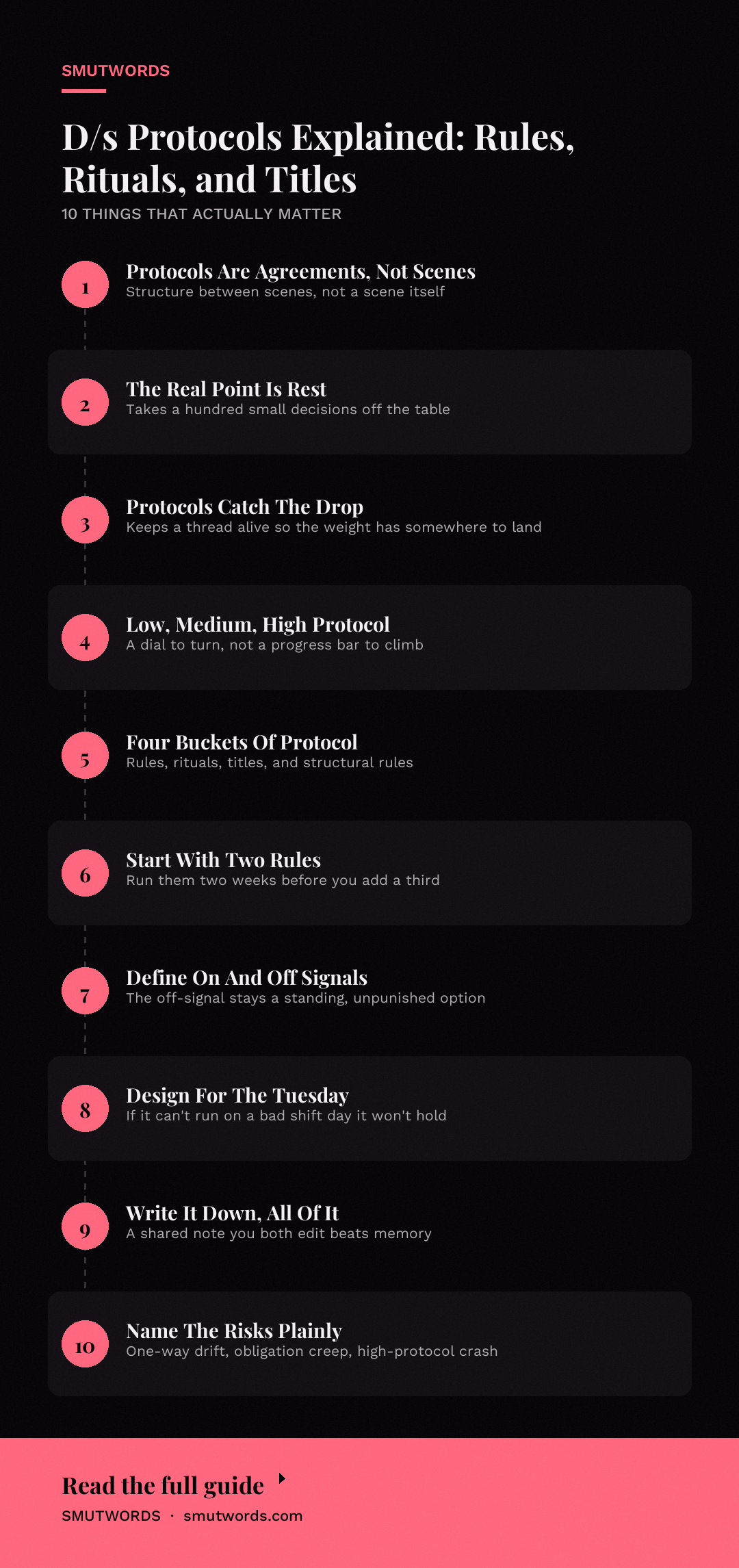
A D/s protocol is a shared agreement about how two people speak to each other, move through a space, and mark a power dynamic that doesn't run constantly at full volume. It's the difference between a scene and a relationship structure.
Some couples run protocols for an hour on Saturday. Some run them twenty-four hours a day and rebuild their whole calendar around it. Both of those work.
The question is never "how serious is this," it's "does this fit the life we actually have."
A protocol isn't a personality test. It's a design problem, and like any design problem, it has a brief, a list of constraints, and a revision cycle. If you've ever read a romance novel and thought "I want whatever those two have," what you want is probably the structure underneath the scene. Here's how to build it without breaking anything.
Why People Actually Run Protocols
The obvious answer is power. The less obvious answer is rest. A protocol takes a hundred small decisions off the table.
When she doesn't have to ask whether tonight is a scene night, or whether to kneel when he walks in, the answer is already in the agreement. That's a relief, not a cage.
Protocols also solve a real problem with kink: the drop between scenes. When the dynamic lives only inside the scene, the moment the scene ends, so does the structure, and you're left holding the emotional weight of an encounter that suddenly has nowhere to go.
A protocol that keeps a thread alive between scenes gives that weight somewhere to land. A text at 3pm that says "kneel when I get home" does more for most couples than a whole weekend of elaborate setup.
And yes, some of it is just hot. Watching someone use a title correctly in a group text without anyone else noticing is its own kind of charge. The private grammar is half the pleasure.
Low Protocol, Medium Protocol, High Protocol
The kink community describes this as a ladder from low to high protocol, and while the terminology is imprecise, it's useful shorthand. Here's roughly what each tier looks like in practice.
- Low protocol: A few agreed rules, mostly verbal, mostly in-scene. A word or phrase that signals a drop into the dynamic. A title that only appears in private. You can run this from a three-bullet list you both remember without checking.
- Medium protocol: Rules apply some of the time, often with a signal that turns them on and off. Titles in written messages. A standing ritual before bed. A weekly check-in that's scheduled, not improvised. This is where most long-term couples land because it survives actual life.
- High protocol: A near-constant structure. Specified clothing. Formal modes of address. Scripted greetings. Rituals for entering and leaving the house, using the bathroom, eating. This is genuinely demanding to run, and it is also the tier where things go wrong most quietly, because both people are performing the protocol even when neither of them wants it that day.
High protocol is not "more serious" than low protocol. It's higher maintenance. A couple running three solid low protocols for a decade is doing something a couple running high protocol for three months usually isn't.
Don't treat the ladder as a progress bar. Treat it as a dial.
The Four Categories You'll Actually Be Designing
Almost every protocol falls into one of four buckets. If you can name which bucket a rule lives in, you can tell whether it's realistic.
Rules
Standing instructions about behavior. "You don't finish without permission." "You wear the collar when I'm out of town." "You don't call me by my first name between 10pm and 8am." Rules should be specific enough to be broken, otherwise there's nothing to enforce.
Where rules fail is when they're vague. "You're mine" is a vibe, not a rule. "You check in with me before you leave the office" is a rule. One of those you can actually keep.
Rituals
Repeated actions with a fixed shape. Coffee made a specific way. A kneel at the door. A specific phrase said before any scene.
Rituals don't have to mean anything big, but they need to be the same each time, or they stop being rituals and become habits.
Titles
Sir, Daddy, Mistress, Commander, pet names, honorifics, "my love," "little one," whatever combination fits the two of you. Titles are the most portable protocol because they work in public without anyone knowing what they're hearing. If you're drawn to the way a voice can carry a dynamic, the voice kink guide gets into why a single word in the right tone does more than a whole sentence.
Structural rules
Not "don't" rules but calendar rules. Who decides what's for dinner on Fridays. Who sets the pace of the week. What time the dynamic is live.
Structural protocols are invisible to anyone outside the relationship and are usually the ones that carry the weight.
One note on the shape of the dynamic itself: if you're drawn to the dark, formal, ritual-heavy style, sci-fi and dark romance run it at full fantasy volume. Bound to the Galactic Alpha: Dark Alien Captive Romance with Rite of Binding, Forced Obedience, and Explicit Sci-Fi Erotica puts a formal rite of binding at the center of the whole power exchange, which is the high-protocol version of the thing you're reading this for.
Useful as fantasy fuel, not as a template. More on that below.
How to Bring It Up With a Partner
The conversation that ends most would-be protocols is not "I want to try this" but "how do I say it without sounding ridiculous." Here's a version that works better than a formal pitch.
Start by naming what you're already doing. If you already check in before you go out, or you already have a nickname you use in bed, you've already got a proto-protocol. Point at it.
"I notice I like it when you ask me before you go out. I want to make that a thing we actually do on purpose." That's the entire ask.
It doesn't require a contract or an evening of negotiation. It requires one sentence and a pause.
Enjoyed this? Get a free book.
Join the list and we will send a complete free story straight to your inbox, plus new releases every week after that. No credit card, no catch.
If the answer is no, that answer is information, not rejection. Some people genuinely don't want the outside-scene structure, and pushing it will wear both of you down. If the answer is "maybe, what did you have in mind," that's your opening to have the longer conversation below.
If the answer is "that sounds silly," the honest move is to ask what part sounds silly and address that specific piece, not the whole concept. A lot of resistance is aimed at one specific rule, not the structure at all.
Building a Protocol That Survives Actual Life
Here's the part that most guides skip. A protocol that works in your head will usually fail in the first week, not because you did it wrong but because you designed it for a fantasy version of your schedule.
Start with two rules, not twelve
Pick two. Maybe a title and a nightly ritual. Run those for two weeks.
If both hold, add a third. Adding rules before the first ones are automatic is how protocols die. The first two weeks are the audition.
Write it down, all of it
Not because you'll enforce it like a contract but because memory is unreliable and revision is impossible without a record. A shared note works. A shared note you both edit works better.
Half of the value is watching the document change over time. The other half is having a clean answer when one of you asks "wait, what did we say about Sundays?"
Define the on and off signals
Every protocol needs a way in and a way out that doesn't require renegotiation each time. A word, a gesture, a specific item of clothing, a change in how you address each other. Without an off-signal, the protocol either runs past the point it's wanted or gets abandoned silently, and both of those hurt.
Decide how much of it is visible
Assume most of your protocols will happen in a kitchen. If you can't imagine the rule working while one of you is doing dishes and the other is on a work call, it's a scene element, not a protocol. Keep the two separate in your head.
Don't design for the fantasy, design for the Tuesday
The version of your partner who is patient, rested, and looking at you like a project is not always the version who comes home from a bad shift. A protocol that assumes the first version of both of you will hold up for a week and then fall apart. A protocol that's short enough to run on the worst day of the month is the one that survives the year.
If you want a fictional version of this exact problem done well, Coach's Little Secret spends most of its runtime on a dynamic that has to keep functioning around an ordinary, unromantic schedule, which is a better model for real life than most of what's on the shelf.
When Protocols Stop Working
Sooner or later, one will. That's not failure, that's the system working. The rule kept you safe for a while and now it doesn't fit. Here's how to tell the difference between a rule that needs revising and a dynamic that needs a break.
Signs a rule needs revising: you keep forgetting it and feel guilty about forgetting. You've started resenting the check-in. You've started complying out of obligation instead of desire. One of you has started to skip the ritual and neither of you said anything.
Signs the dynamic needs a break: either of you has started hiding something from the other to avoid the protocol. Either of you is running the structure to please the other and not themselves. You can't remember the last time either of you enjoyed the ritual and not just the completion of it. Physical or emotional warning signs, undefined but persistent, that something is off.
The revision conversation is the same as the intro conversation. Name what's not working. Ask what's underneath it.
The rule itself is usually not the problem, the assumption baked into it is. If you built a rule around being greeted at the door every night and one person now gets home after the other is asleep, the rule needs a different hour, not a different couple.
One specific thing to check: most protocols quietly assume the same person is leading. If the couple has swapped brat/sub energy, or the dynamic is a switch, or either of you is in the middle of a life change (new job, new medication, grief), the rules you wrote a year ago are probably reading from an old map. Rebuild for the person in the room, not the person who was in the room when you wrote it.
And if you want the version of this problem at its most emotionally charged, real-world-rendered fiction does the messy version better than any listicle can. Weekend at the Bull's runs a formal structure against people who have feelings about each other that the structure wasn't designed for. It's a useful reminder that protocols are supposed to make life easier, not to substitute for the conversation you don't want to have.
Real Risks, Plainly
Protocols are safer than a lot of kink because the rules are agreed and usually verbal, but there are real failure modes worth naming out loud.
- The one-way drift. One person keeps enforcing a rule the other has stopped wanting, and neither of them says anything because the structure doesn't have a place for "I don't want this anymore." Fix: make the off-signal a standing, unpunished option.
- The obligation creep. A rule that started as a gift becomes an expected chore over months. Fix: check in on the rule, not the person. Ask whether the rule is still a gift or now a tax.
- The high-protocol crash. A couple ramps fast into a near-constant structure and burns out in three weeks. Fix: don't let the fantasy write the calendar. Two rules for two weeks before a third.
- The secrecy problem. A dynamic that only works when no one else knows becomes a dynamic that stops working the first time someone has to be lied to. Fix: decide together what's private and what's simply not announced, and know the difference.
- The trust gap. Protocols assume trust and don't build it. If the trust is thin, the protocol will run on adrenaline for a while and then fail somewhere it matters.
None of these are unusual. All of them are survivable. What isn't survivable is pretending that a structure with this much weight behind it can run on vibes alone. Name the risk before it happens and you can revise the rule in a text message instead of in a long conversation after a bad night.
Where Fiction Fits
The reason so many people come to D/s protocols through fiction is that fiction gets to run the version with no laundry and no Tuesday. That's fine. Fiction is where you find the shape of the thing, and then you build the version that fits your actual life.
Free Use Airport Lounge runs a public-space protocol that would be impractical in real life and works precisely because the fiction handles the logistics for you. Zorgon's Pet does the formal-owner version at a scale no living room matches. Wetware Slave takes the protocol to a full system with rules coded into the environment.
What all of these have in common is that the protocol is legible. You can point at a page and say "that, that's the thing I want the real version of." That's the most useful thing fiction does for a kink. It gives you vocabulary you don't yet have. Once you have it, the conversation with your partner gets shorter and more specific, which is exactly what a workable protocol needs.
If you want more on how power-exchange dynamics get written into other kinds of romance, the site's marriage bed trope guide touches on how formalized intimacy plays out inside an established relationship. Similar mechanics, different stakes.
Final Thoughts
Start with Coach's Little Secret if you want a working model of what a dynamic looks like once it has to survive an ordinary week. It's the closest thing on the shelf to the version you'll actually be running at home, and it's a better starting point than anything that ends before the dishes need doing.







Loading comments…