
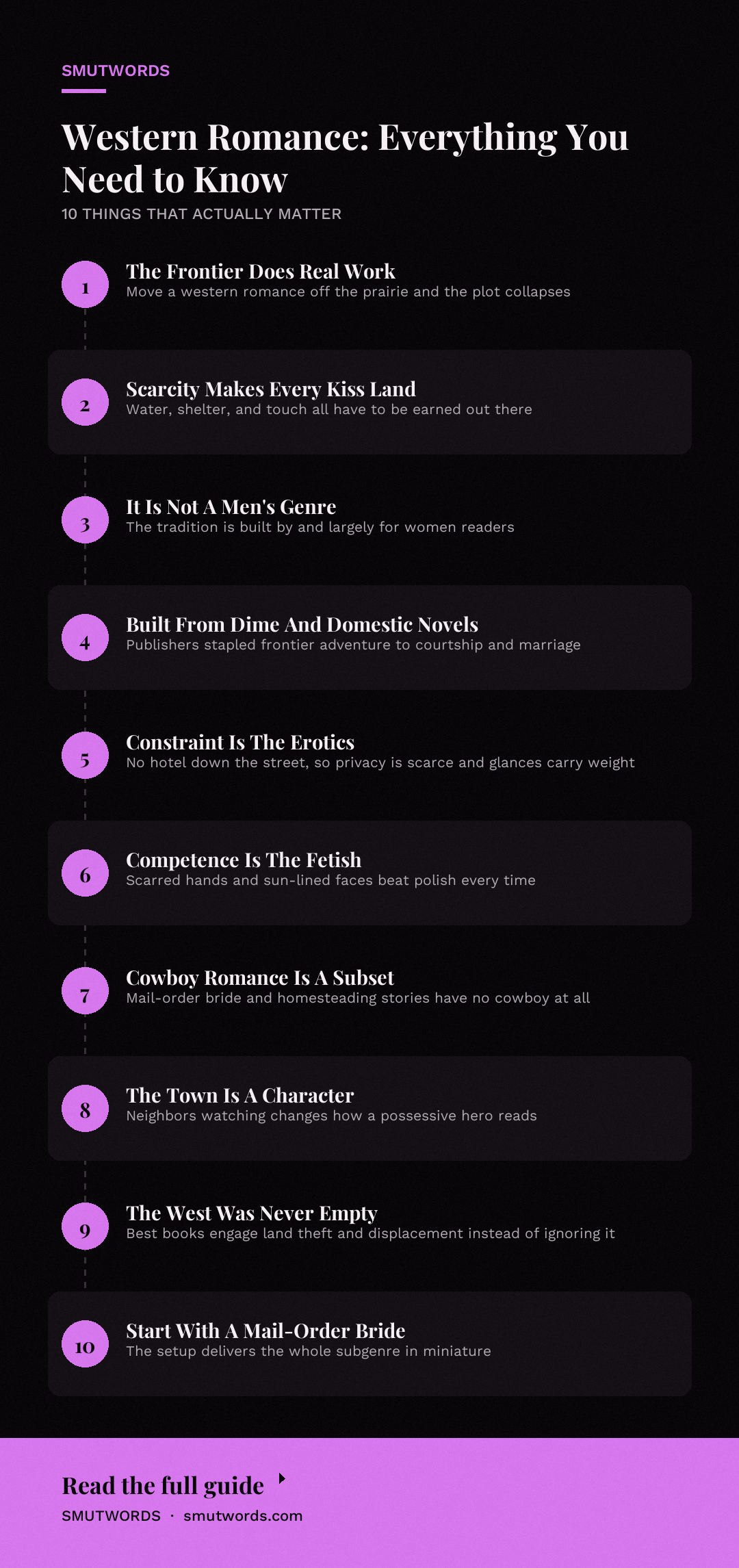
Western romance is love fiction set on the American frontier, most often in the second half of the nineteenth century. Cowboys, ranchers, homesteaders, mail-order brides, and the occasional outlaw fall hard against a backdrop of open range, brutal weather, and miles of nothing between them and help.
The genre's engine runs on scarcity and sweat. Water, shelter, safety, and touch are all things you have to earn out there, which makes every kiss land heavier than it would in a drawing room. If you have ever finished a book and immediately wanted to smell leather and gunpowder, you already understand the appeal of western romance.
What Western Romance Actually Means
The term covers a wide tent. At its core, a western romance is a love story in which the setting does active work. The frontier is not wallpaper; it shapes who the characters can be and what they can have.
Geography sets the subgenre apart from other historical romance. A Regency ballroom story can swap its location for another ballroom without changing much. Move a western romance off the prairie and the plot collapses. The isolation, the distance from law and medicine, the physical labor of surviving: that's the story.
What counts:
- Historical westerns set roughly between 1850 and 1910, on ranches, cattle drives, homesteads, mining towns, or stagecoach routes.
- Contemporary westerns set on modern ranches, in small mountain towns, or on rodeo circuits, featuring the same archetypes in Wranglers instead of chaps.
- Mail-order bride stories, where a woman travels west to marry a stranger she has only corresponded with.
- Ranch romance, focused on working ranches and the families that run them, often across multiple generations.
- Prairie romance, leaning toward homesteading, sod houses, and pioneer survival rather than cattle.
What does not count: a story that happens to be set in Montana but has no relationship to the land, the work, or the isolation. The American West as a backdrop is not the same as the West as a character.
A common misconception is that western romance is a men's genre wearing a cowboy hat. It isn't. The tradition is built by and largely for women, and the emotional interiority of the heroine is usually the point of view the reader lives inside.
Another misconception: that the subgenre is morally simple. The best western romance is honest about what settlement actually involved, including land theft, violence, and displacement, and increasingly authors write that reckoning into the love story rather than around it.
Where Western Romance Comes From
The subgenre grew out of two nineteenth-century publishing phenomena colliding: the dime novel and the domestic novel. Dime novels sold frontier adventure to a mass audience, all shootouts and stagecoach chases and noble scouts. Domestic novels sold courtship, marriage, and moral instruction to women readers.
Western romance is what happened when publishers realized the same reader would buy both, stapled together.
Early twentieth-century pulp magazines ran westerns by the hundreds, but romance as the central plot took longer to dominate. Through the mid-century, the western was mostly a male-coded adventure genre. Women were prizes, burdens, or corpses.
The shift came with the paperback boom of the 1970s and 1980s, when historical romance exploded as a category. Writers like Janet Dailey, LaVyrle Spencer, and later Linda Lael Miller and Diana Palmer pushed the western setting to the front of the romance shelves, complete with clinch covers of a shirtless hero and a heroine in a torn calico dress.
Those books defined the tropes readers still recognize: the hardened rancher, the mail-order bride arriving to a man she has never seen, the widow holding a failing homestead, the half-breed gunslinger with a past.
The 1990s brought more interiority and more complicated women. The 2000s and 2010s brought the contemporary western, where the ranch is a business, the trucks are diesel, and the emotional conflicts are about inheritance, addiction, and small-town judgment rather than Comanche raids. Authors like Lorelei James, Carolyn Brown, and Maisey Yates moved the subgenre into the modern era without losing the dirt and the dust.
The most significant recent shift is whose West is being written. Native authors, Black authors, and queer authors have taken the setting and centered people the early paperbacks pushed to the margins. That has widened the subgenre considerably and made it more interesting.
One publishing note worth knowing: the western has never fully left the romance bestseller lists for more than a decade at a time. Every generation declares it dead and every generation rediscovers it, usually right after a Hollywood cowboy revival.
How It Shows Up in Erotica
On the page, western romance and its spicier cousins share a signature: intimacy under constraint. There is no hotel down the street. If two people want each other, they are doing it in a barn, a line shack, a creek bed, a wagon, or a single-room cabin with a child asleep four feet away.
That constraint is the erotics. Proximity is forced and privacy is scarce, so every charged glance across a campfire carries real weight. Writers who understand the subgenre use the setting to create tension that a city apartment simply cannot manufacture.
The physical archetype does a lot of work too. The hero is typically described in terms of labor: scarred hands, sun-lined face, shoulders built from hauling hay and wrestling calves. The eroticism comes from capability rather than polish.
This is the same reason the lumberjack romance works, applied to a different landscape. Competence is the fetish.
Common variations authors use:
- The slow burn on the trail. Weeks of travel with one bedroll or a shared bed at a way station. Tension accumulates through forced closeness.
- The marriage of convenience. Often a mail-order bride or a widow who needs a name on the deed. The wedding happens early and the desire arrives later. That's the opposite of the genre's usual arc, and twice as hot.
- The ranch hand and the owner's daughter. Class friction plus daily proximity plus a secret. A reliable engine.
- The outlaw and the woman hiding him. High stakes, short timeline, intense physicality. Frequently built on a redemption arc romance structure, where the hero's past is the wall he has to climb.
- The second-chance rancher. A first love who left for the city and comes back to a spread that is falling apart. Nostalgia plus competence plus unresolved heat.
- The snowed-in cabin. A blizzard, one stove, one bed, and no possibility of leaving. The most efficient setup in the subgenre.
What separates a strong western romance from a flat one is whether the land is doing real work or just decorating a generic love story. A weak version drops the characters onto a ranch and lets them behave like urban professionals in boots. A strong version lets the environment dictate the plot: the drought, the blizzard, the fence line, the river crossing, the distance to the nearest doctor.
Dialogue matters more here than in most subgenres. The laconic western hero does not monologue. He says four words and means nine, and the heroine has to learn to read him. Writers who can make restraint feel like heat are the ones who last.
Enjoyed this? Get a free book.
Join the list and we will send a complete free story straight to your inbox, plus new releases every week after that. No credit card, no catch.
Physically, the best scenes in the subgenre are often about restraint before release. A hand at the small of the back. A thumb brushing a knuckle over a coffee cup. Then the barn door closes, and the same characters who have been economical with language all book are suddenly anything but.
The unsanitized reality of the historical setting also raises the stakes in a way modern readers respond to. No reliable birth control, no antibiotics, no guarantee the man rides back from town. That mortality is a spice all its own, and the mail-order bride premise, like the secret baby trope, leans on it directly: the child arrives, the father may not.
Authors who write the subgenre well also understand that the West was never empty or safe. The tension between the romance fantasy and the actual history is something the best books engage instead of ignore, and readers have rewarded that honesty.
One thing the western shares with grumpy/sunshine is the emotional architecture: a weathered, closed-off hero and a heroine who refuses to be intimidated by him. The dynamic is older than the labels, but it is the default setting for a ranch romance, and it works because the hero is not actually cold. He is just careful.
For readers who like the intensity dial turned up, the western can also carry darker material. A possessive rancher who will not let the heroine leave the property is, structurally, doing the same thing a stalker romance does, just with more acreage. The stalker romance glossary entry is worth reading alongside this one if that flavor of obsession is what draws you to the subgenre.
Where the western differs from those adjacent kinks is the moral frame. The setting presumes community, even a distant one. There is a town, a church, a sheriff, a neighbor who will notice. The hero's possessiveness has to survive the fact that other people are watching, which changes how it reads.
Building that community is often what separates a one-note book from a series readers will follow for ten installments. The best western romance authors write the town as a character, with its own feuds and secrets, and let the central couple act inside that pressure.
If you want a window into how shared fantasy and long-term partnership actually work in spicy romance, the SmutWords piece on kinky couples is a useful companion. It's especially good for the marriage-of-convenience stories where the couple has to build trust from scratch under one roof.
The soldier romance also overlaps heavily with the subgenre. So many western heroes are veterans of the Civil War or the Indian Wars, and the trauma they carry home is often the emotional obstacle the heroine has to help them move through.
Western Romance vs Other Frontier-Adjacent Tropes
The comparison readers search for most is western romance versus lumberjack romance, and the distinction is narrower than expected. Both center a competent, physical hero, a rural setting, and a heroine who has to earn her place in it.
The difference is geography and industry. The lumberjack romance sits in the timber camps and logging towns of the Pacific Northwest, often in the same century, and trades cattle and open range for axes, rivers, and old-growth forest. The isolation is similar. The daily labor is different, and the details of that labor are most of what a reader comes for.
Another real point of confusion is western romance versus prince/princess romance. Both are about power, hierarchy, and a hero who arrives with more status than the heroine.
But the western inverts the power logic. The frontier is the one place where a title does not buy you water, and a duke's daughter has to learn to churn butter like everyone else. Readers who love one often bounce off the other because the fantasy is different.
Frequently Asked Questions
What is the difference between a western romance and a cowboy romance?
Cowboy romance is a subset. Every cowboy romance is a western romance, but not every western romance has a cowboy. Mail-order bride stories, homesteading novels, and outlaw romances belong to the subgenre without a single cattle drive.
Are western romances always historical?
No. Contemporary westerns are a large and growing category, set on modern ranches and in small mountain towns with pickup trucks and cell service. The cowboy archetype persists, but the world is the present day.
Where does the mail-order bride trope come from?
It is drawn from real nineteenth-century practice. Newspapers and matrimonial agencies arranged marriages between men in the West and women in the East or in Europe, often sight unseen. The romance genre took that genuine uncertainty and made it the central emotional engine.
How explicit are western romances?
It ranges from sweet, with the bedroom door closed, to extremely explicit. The subgenre has a strong tradition of both. Historical westerns skew more toward sensuality and emotional interiority. Contemporary ranch romances often run hotter, with graphic sex on the page.
Is western romance the same as prairie romance?
Prairie romance is a variant that leans toward homesteading, farming, and pioneer family survival rather than cattle, ranching, and gunfights. The two overlap heavily and are often shelved together. The distinguishing feature is usually the work the characters are doing in the opening chapters.
Why is the setting so important in western romance?
Because the frontier removes everything familiar. No neighbors, no doctor, no law, no escape. That scarcity forces the two leads into each other's orbit and makes every small gesture of care feel enormous. The land is what makes the love story work.
Final Thoughts
Western romance is for readers who want a love story built out of hard work and long silences, not banter and cocktails. New to the subgenre? Start with a mail-order bride book. The setup delivers the whole thing in miniature: a stranger arriving to a life she cannot picture, a man who has been alone too long, and a landscape that will decide whether either of them makes it.
Once that one lands, you will know exactly which corner of the frontier you want to ride into next.






Loading comments…