
Readers ask us this one constantly, usually after finishing a book that felt like both categories at once. They want to know which shelf it belongs on. So here's the clean version: dark romance vs taboo romance comes down to where the transgression lives.
Dark romance puts the danger in the tone, the power exchange, the cruelty the love interest is capable of. Taboo romance puts it in the relationship itself, in the fact that these two people wanting each other is the thing the world says they're not allowed to have. A book can be one, both, or neither, and once you can see the seam between them you'll stop getting mad at recommendations that missed the mark.
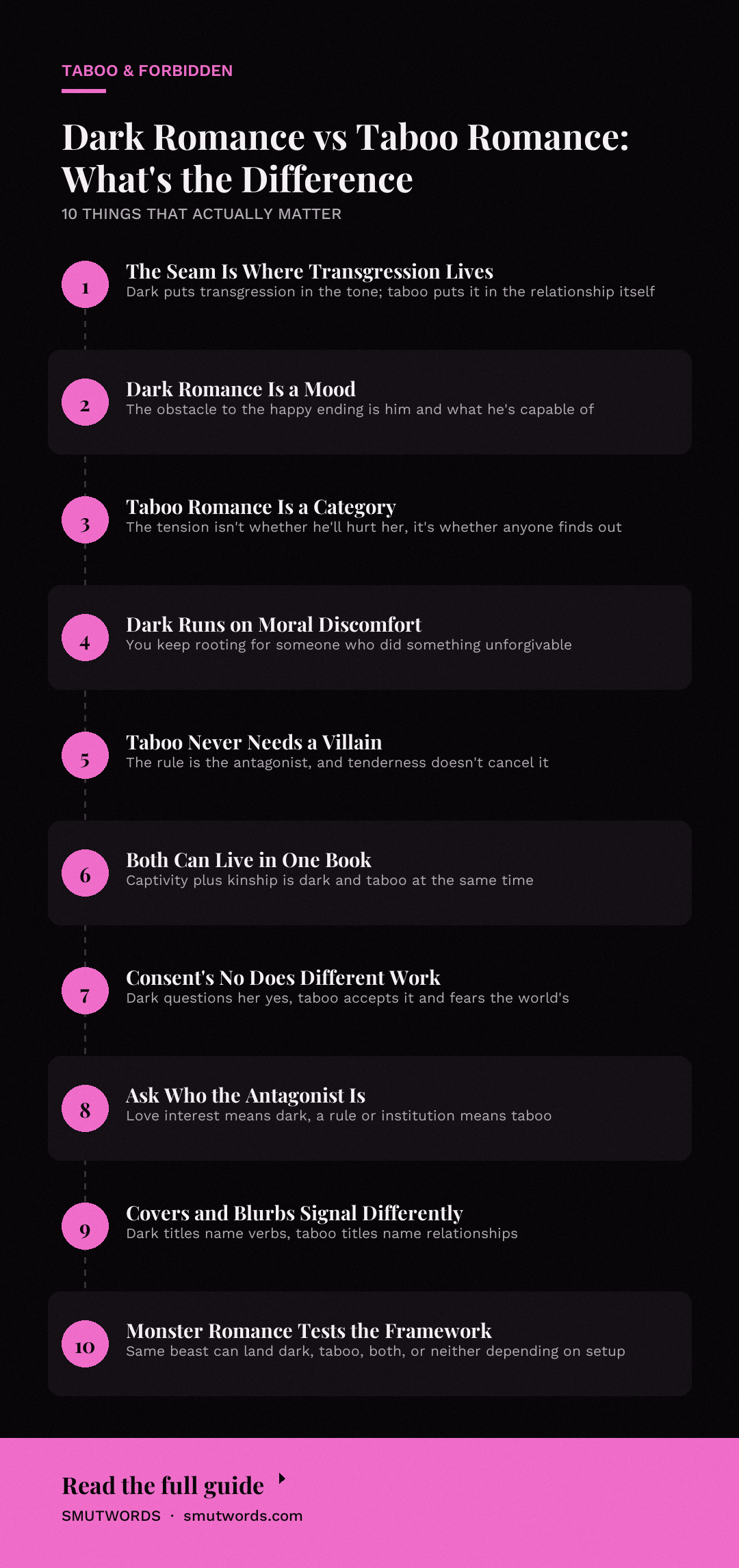
The Short Answer: Tone vs. Structure
Dark romance is a mood. It's the kidnapper who genuinely might not let her go. The mafia enforcer who kills a man in chapter three and thinks about it for exactly zero seconds afterward. The stalker who has been inside her apartment before she ever noticed him.
The obstacle to the happy ending is him, mostly: his capacity for harm, his refusal to apologize for it, the question of whether love can exist in the same body as that kind of violence.
Taboo romance is a category. It's the relationship that violates a rule: blood relation, step-relation, teacher and student, priest and parishioner, boss and the intern whose visa he's holding, two people whose families would disown them, a marriage that's technically still on paper when the affair starts.
The romantic tension doesn't come from whether he'll hurt her. It comes from whether anyone will ever find out. A story about a woman falling for her deceased husband's brother can be heartbreaking and gentle and completely taboo with zero dark content.
A story about a hitman who falls for his target can be pitch black and not remotely taboo, because nothing about a contract killer dating a stranger breaks a social rule anyone enforces. That's the whole distinction in two examples. Everything past this point is the fiddly part.
Why Dark Romance Feels Dangerous
Dark romance runs on moral discomfort. Not shock for shock's sake. The genre earns its label when the reader is asked to keep rooting for someone who has done, or will do, something genuinely unforgivable, and the book doesn't let you off the hook by revealing that he was secretly a good guy the whole time.
The classic beats are easy to name. Captive/captor setups where the lock on the door is real. Morally gray men who run criminal operations and don't pretend otherwise.
Dubious consent, or consent that gets negotiated in a situation where "no" carries no weight. Revenge plots where the love interest started out as a pawn and then didn't stay one.
The Lured by the Lizard Beast story sits right in that territory: the creature's interest in her is not consensual in any conventional sense, and the book's whole charge is that she stops wanting it to be.
What dark romance needs to actually work
Danger with no interiority gets boring fast. What separates a dark romance that lands from one that's just a guy being awful for 300 pages is usually one or more of these:
- A love interest who is dangerous in ways that cost him something, not just a checklist of violent acts
- A heroine with real agency inside her restraint, even if that agency is mostly in her head
- A power imbalance that shifts at least once, so the dynamic breathes instead of sitting flat
- Consequences. Someone gets hurt. Someone pays. The HEA has a scar on it.
Skip those and you're reading violence with a romance sticker on it. Include them and the darkness does emotional work, which is the entire point. This is also where the subgenre overlaps heavily with hate to love territory, because enemies who genuinely want to ruin each other need somewhere for all that hostility to convert into wanting.
Why Taboo Romance Doesn't Need a Villain
Taboo romance runs on prohibition. The heat comes from desire pressing against a rule, and the rule doesn't have to be violent to be devastating. A tutor/student arrangement can be entirely tender and still taboo, because the age and authority difference sits in the room no matter how kind he is.
The age gap romance books we've covered before land the same way: nothing cruel happens, and the setup still makes your stomach drop, because the imbalance itself carries the risk.
The most-read taboo categories on the site break down roughly like this:
- Stepfamily setups: stepbrother, stepsister, the stepmother's new husband. Almost never blood-related, which is exactly why they work, because the reader gets the transgression with a built-in escape hatch.
- Teacher/student and tutor/student, where the gap is authority rather than biology.
- Religious or institutional prohibition: priests, nuns, married congregants.
- Infidelity and affair-adjacent stories, including marriage in trouble books where the rupture is already inside the relationship.
- Arbitrary social prohibition: wrong family, wrong class, wrong town, wrong time, "anyone but her."
We've written more about the last two in Forbidden Affair Tropes: Married, Off-Limits, or Just Wrong, and the pattern holds: the relationship doesn't have to be unsafe for it to be forbidden. Forbidden is about the rule, not the risk.
Dark Romance vs Taboo Romance: The Overlap and the Gap
Plenty of books are both at once. A story about a man who acquired his stepsister in a business deal, keeps her locked in his house, and refuses to let her leave would sit in both categories simultaneously: taboo because of the step relation, dark because of the coercion and captivity. That's a real and common combination, and it's usually what people mean when they say "dark taboo."
But they're separate axes. Let's lay them out.
| Dark Romance | Taboo Romance | |
|---|---|---|
| Source of tension | What he's capable of, what she might want from him | What they're not allowed to be to each other |
| Typical obstacle | His ruthlessness, her danger, the cost of loving him | Social rule, family law, institutional prohibition |
| Where the heat lives | Power exchange, coercion, threats, moral gray | Risk, secrecy, the possibility of being caught |
| Can exist without the other? | Yes, easily | Yes, easily |
| Needs a villain? | Often, and the villain is usually the love interest | Rarely. The rule is the antagonist. |
One clean example of a pure taboo that's not remotely dark: a single mother falls for her dead husband's best friend, everyone involved is kind, and the transgression is entirely in the loyalty violation. One clean example of pure dark that isn't taboo: an assassin falls for his newest mark.
Enjoyed this? Get a free book.
Join the list and we will send a complete free story straight to your inbox, plus new releases every week after that. No credit card, no catch.
Nothing about that pairing breaks a social rule (nobody clutches pearls over contract killers dating). The discomfort is the violence, and the violence alone.
The Question of Consent in Each Category
This is where readers get confused the most, because both categories can involve a "no" that the romance wants you to read against. But the "no" is doing different work.
In dark romance, dubious consent is a feature of the power dynamic. He holds the leverage, and the question of whether her yes is really a yes stays live across chapters. Breed Me, Commander plays this cleanly: the commander's authority over her body is the story, and the tension sits in how much of her compliance is need, how much is fear, and how much is surrender she chose. Readers go to dark for exactly that friction.
In taboo, the "no" is usually external. They both want it. The mom who'd disown her, the college that would fire him, the wife in the next room would all say no on their behalf. Consent between the two people is often clear and even fierce, and the ache is the certainty that the world is going to punish them for something they did to each other perfectly willingly.
Stepfamily Romance: Why It's One of the Biggest Taboo Subgenres unpacks that dynamic more fully, and the throughline is always the same: the lovers know, and the fear is everyone else finding out.
The easiest way to tell them apart in one question
Ask yourself who the antagonist is. If the antagonist is the love interest, or the force he represents, you're in dark romance. If the antagonist is a rule, a family, an institution, or the outside world, you're in taboo. If it's both, you're in the overlap, and there's a lot of it.
Where Each Category Shows Up in Book Covers and Blurbs
Dark romance sells itself with cover signals: dark backgrounds, men with scars or masks, the word "ruin," "destroy," "claim" in the subtitle. The blurb usually tells you what he's going to do before she even meets him. You're not being sold the taboo there. You're being sold the danger, and the marketing assumes you're in for it.
Taboo romance signals differently. Covers are often warmer, more domestic, more suggestive than graphic, because the scandal is in the premise, not the aesthetic. Blurbs lean on the relationship axis: "my stepbrother," "my professor," "the priest," "my husband's brother." 50 Best Taboo & Forbidden Books You Can Read This Year is a good scan for those title patterns. You'll notice taboo titles name relationships; dark titles name verbs.
For a story that wears both labels well, Mounted by Midnight is a useful case study. The midnight setting and the mysterious figure give it the dark tone, while the woman's isolation and the secret nature of the encounters push it into taboo space too. The distinction gets blurry on purpose in books like that.
Where Monster and Beast Romance Fits
Monster romance is a good stress test for this whole framework, because it can be either, both, or neither depending on the story. A gentle fated-mates book about a lonely orc building a cabin for a woman who wandered onto his land isn't dark (he's sweet) and isn't taboo (nothing is being violated; she's single and free). That's more lumberjack energy with a tail.
Move the same premise into "he takes her and she has no way to leave," and it turns dark fast. Move it into "she's the daughter of the man who poached from his territory, and he's keeping her as restitution," and it turns taboo too, because the relationship now sits inside a rule about revenge and restitution that neither of them chose.
Alien Auction and Sea Beast's Breeding Toy are both worth reading with this lens: the danger is creature-based, but the actual blocker is that she's property, which is a rule, which makes it structurally taboo on top of whatever darkness the beast brings to the room.
Tail Raised is another one where the tone is hot and animalistic and the setup is what pushes it into forbidden territory. The creature's lack of human social rules doesn't remove the taboo, it just relocates it: she's the one who knows what she's crossing, and the reader feels that every time her body beats her better judgment to the punch.
How to Pick Between Them for Your Own Reading
Match the transgression to the mood you're actually in.
- Want to feel the floor drop out and be complicit in it? Dark. You want the love interest to be a problem.
- Want that chest-tight feeling of wanting the wrong person? Taboo. You want the world to be the problem.
- Want both edges at once? Look for dark taboo: captivity plus kinship, blackmail plus blood.
- Want power imbalance without fear? That's often soldier romance or the softer prince/princess end of the forbidden spectrum: structural, controlled, and rarely violent.
None of this is a ranking. Dark romance and taboo romance just do different jobs on the nervous system. One makes you ask whether you should want him. The other makes you ask whether you're allowed.
Plenty of nights you want both questions on the table at once, which is exactly why the overlapping shelf is so crowded.
Final Thoughts
If you want to feel the difference in your chest in a single sitting, read Lured by the Lizard Beast back to back with one of the stepbrother books from the taboo roundup.
The first one will make you sit with the possibility that whoever's holding the reins is genuinely dangerous. The second will make you sit with the possibility that the two people at the center of it are committing a sin the entire story has already agreed to punish them for. You'll come out the other side knowing exactly which feeling you're chasing next.




Loading comments…