Love at first sight is the romance trope where two characters meet and something in them locks on immediately, before a single conversation has been had, before names are fully exchanged. One look, one collision in a hallway, one glance across a crowded room, and the story quietly rearranges itself around the certainty that these two people are going to end up together.
It's a device built to deliver a jolt of instant romantic possibility, and it's one of the oldest and most durable engines in the genre. The love at first sight trope shows up in historicals, contemporaries, paranormal romance, and everything between. It does a very specific job on the page: it tells the reader the destination before the journey has even started.
The short glossary version calls it a bolt of recognition, fate stepping in, a character overwhelmed the first time they meet someone. Accurate, but it undersells how much craft goes into making that bolt land. A flat version of this moment is just two beautiful people noticing each other. A strong version rewires a character's entire sense of their own future in the space of a paragraph.
What Love at First Sight Actually Means
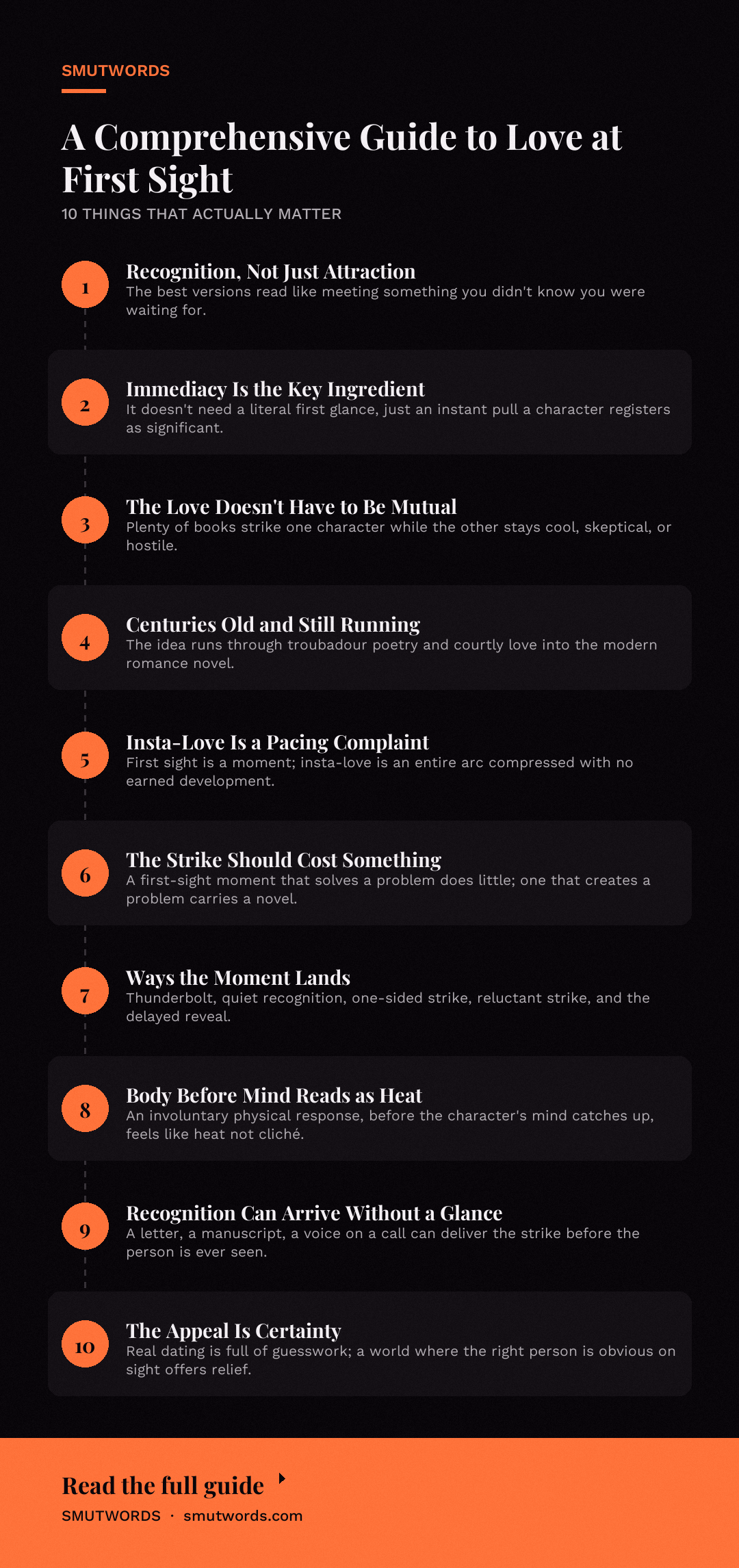
The name describes itself, which is part of why it's persisted for centuries: the love arrives on first visual contact, or near enough to it. Recognition is the operative word. The best-written versions read less like attraction and more like a character encountering something they didn't know they'd been waiting for.
What counts as this trope is broader than a literal first glance.
It covers any instant, overwhelming pull that a character registers as significant the moment it happens. A handshake that lasts a beat too long. A voice heard from another room. The first time eyes meet across a ballroom, a courtroom, a hospital corridor.
The trigger can be visual, but the essential ingredient is immediacy. What doesn't count: slow-building attraction where two people gradually warm to each other over chapters. That's a different engine entirely, closer to the territory covered in sexual tension vs slow burn.
Nor does it count when a character simply notices someone is attractive and files it away. The trope requires a character to feel that something has been decided, whether they want it or not.
A few persistent misconceptions are worth clearing up. The trope doesn't require the love to be mutual, instant, or requited. Plenty of books give the thunderbolt to one character while the other stays cool, skeptical, or openly hostile.
It also doesn't require the couple to get together quickly. Some of the most effective uses of love at first sight put years, continents, or entire wars between the first glance and the happy ending.
And it isn't the same as instant sexual chemistry, though the two often travel together. Chemistry is about the body's response. This trope is about a character's sense that their life has just been redirected, which is a bigger and harder thing to write well.
Where Love at First Sight Comes From
The honest history here belongs to literature and publishing, not to any real-world practice. The idea that love strikes like an arrow on first contact runs through the oldest surviving romances in the Western canon. Dante reportedly saw Beatrice once, at nine years old, and carried her in his imagination for the rest of his life.
Romantic love as a sudden, fated wound is baked into troubadour poetry, courtly love, and the medieval romances that fed directly into the genre we read today.
The modern romance novel inherited the device wholesale from the eighteenth and nineteenth centuries, when it was often paired with moral consequence: the instantaneous attraction that launches a courtship is also the thing that threatens ruin. Jane Austen built entire plots on the gap between first impressions and reality, and the tension in those books comes from watching a character's instant certainty get complicated by everything that follows.
The twentieth century paperback boom changed how the trope functioned. Category romance and mass-market historicals needed a hook in the first chapter, and a fated first meeting was the most efficient hook available. By the 1980s the device was close to default in the genre. Publishers leaned on it hard, and readers came to expect the thunderbolt inside the first twenty pages.
The last two decades have seen a real shift in how it's deployed. Contemporary romance got more skeptical of destiny, and authors started giving the instant recognition to one character only, letting the other spend chapters catching up.
Insta-love as a label emerged partly as a backlash term, used by readers who found the trope too convenient, and partly as a fond shorthand. The controversy itself is instructive: a trope readers argue about is a trope readers care about.
The rise of fanfiction and indie publishing also reshaped the trope. Writers freed from strict category formulas started pairing the instant meeting with much slower emotional development, so the first-sight moment became a starting gun for tension rather than a resolution.
How It Shows Up in Erotica
On the page, this trope is a structural device, and a very handy one. It gives the writer a reason for two characters to be intensely focused on each other from chapter one, which is exactly what heat requires. Without some version of it, you need pages of setup before the friction can start. With it, you get the friction and the setup in the same scene.
What a scene actually does with the moment varies, and the variations are worth knowing if you're writing one or trying to spot what a book is doing.
- The thunderbolt: a full-body physical event. Time slows, sound drops out, the character forgets what they were saying. Effective but easy to overdo.
- The recognition: quieter and more unsettling. The character feels they already know this person, or have been waiting for them, without being able to explain why.
- The one-sided strike: only one character gets hit. The other is oblivious, hostile, or married to someone else. This is the engine of a great deal of hate to love plotting, where the instant pull curdles into resentment because it isn't returned.
- The reluctant strike: the character recognizes the feeling and actively fights it, because the person is inconvenient, forbidden, or dangerous.
- The delayed reveal: the moment happens in a prologue or flashback, and the bulk of the book deals with what it cost.
The craft question that separates a strong version from a flat one is almost always the same: does the instant attraction create a problem, or does it solve one? A first-sight moment that simply confirms two people are hot for each other and then gets out of the way is doing very little work.
Enjoyed this? Get a free book.
Join the list and we will send a complete free story straight to your inbox, plus new releases every week after that. No credit card, no catch.
A first-sight moment that makes the character's life harder, that arrives at the worst possible time, that the character cannot afford to feel, is doing the heavy lifting of a whole novel.
The strongest erotic use of the trope ties the physical event to the emotional stake. When a character's body responds before their mind catches up, you get an involuntary quality that reads as heat rather than as cliché. The primal instinct kink material often overlaps here, because both live on the idea of the body responding ahead of the conscious mind.
Genre context changes the flavor significantly. In a prince/princess romance, the lightning-strike glance across a formal ballroom is practically mandatory, and the class gap supplies the obstacle. In a celebrity romance, the trope often has to compete with fame itself, since one character is already accustomed to being stared at and the recognition has to cut through that armor.
The ghostwriter romance has a genuinely interesting angle on it, since a character can fall hard for a voice or a written persona before ever seeing the person behind it. Some of the sharpest uses of love at first sight happen across a medium: a letter, a manuscript, a phone call, a message board. The glance never actually happens, and the recognition still arrives.
Authors also use the device as a contrast tool. Placing a first-sight couple beside a childhood friends to lovers pair in the same series sets up two very different trajectories, one built on instant certainty and one on years of accumulated intimacy. Readers notice the comparison and argue about it in reviews.
One common failure worth flagging: treating the instant moment as a substitute for building anything afterward. If the book assumes the reader is invested because the characters are, the middle sags. The recognition has to be the start of a problem the book then takes seriously.
When the immediate certainty has to survive a marriage in trouble arc, the stakes get much more interesting, because the reader knows how strong the original spark was and watches the couple try to find it again. That reconnection work carries its own specific mechanics, and the SmutWords guide on reconnecting after a long dry spell covers the real-world version.
Love at First Sight vs Insta-Love
These get used interchangeably, and they shouldn't be. Love at first sight describes a moment: the instant of recognition, one scene, one charge. Insta-love describes a pacing pattern: the couple's entire emotional arc compressed into very little page or calendar time, often culminating in commitment or declarations inside the first few chapters.
A book can absolutely use love at first sight without being insta-love. Plenty of novels open with a devastating first meeting and then stretch the emotional reckoning across four hundred pages, with the characters apart or at war the whole time. Conversely, a book can be guilty of insta-love without any genuine first-sight moment at all; the characters simply go from strangers to soulmates with no scene that earns it.
The distinction matters because the criticisms attach to different things. Readers who complain about love at first sight are usually objecting to the convenience of the setup. Readers who complain about insta-love are objecting to the missing development.
Fixing the second one requires writing more of the relationship. Fixing the first usually requires making the instant moment cost something.
Frequently Asked Questions
Is love at first sight a real thing?
Psychology has studied the version people report in real life, and what they describe is usually intense initial attraction plus a strong sense of familiarity, not durable love. That distinction doesn't matter much in fiction, because the trope is about narrative fate rather than empirical claim. The fantasy is the point.
What counts as insta-love in romance?
Insta-love is a pacing complaint more than a formal category. It applies when characters fall deeply and permanently in love with little time, interaction, or development to support it. The label is usually aimed at books where the emotional payoff hasn't been earned by the events on the page.
Why do readers enjoy the love at first sight trope?
The appeal is certainty. Dating in real life is full of guesswork, misread signals, and wasted effort. A world where the right person can be identified on sight, without ambiguity, offers relief from all of that. It also flatters the idea that some connections are too deep to be coincidence.
Does love at first sight work in enemies-to-lovers romance?
It can, and the combination is popular. When only one character gets struck, the instant pull becomes humiliating, and humiliation curdles nicely into resentment. The resulting tension is much hotter than straightforward mutual attraction, which is why so many hate to love plots run on it.
How is love at first sight different from instant chemistry?
Chemistry is physical and can be experienced about someone a character doesn't even like. The first-sight trope involves a sense of significance, of something being decided. Chemistry gets you a steamy scene. Recognition gets you a plot.
What is the "meet-cute" and how does it relate?
The meet-cute is the scene where two characters first encounter each other, usually in an amusing or memorable way. It's a device for staging the introduction, and it often hosts a first-sight moment, but it isn't the same thing. Plenty of meet-cutes are purely comic and carry no charge of fate at all.
Final Thoughts
The trope endures because it solves the hardest problem in romance in a single scene: getting two people to want each other badly enough that the reader believes the whole book. Done well, the instant of recognition isn't the destination. It's the promise the novel then has to keep.
If you want a book that takes that promise and spends four hundred pages making it expensive, pick up a romance that opens with a devastating first glance and then does everything it can to keep the couple apart. The best ones make the certainty hurt before it pays off.





Loading comments…