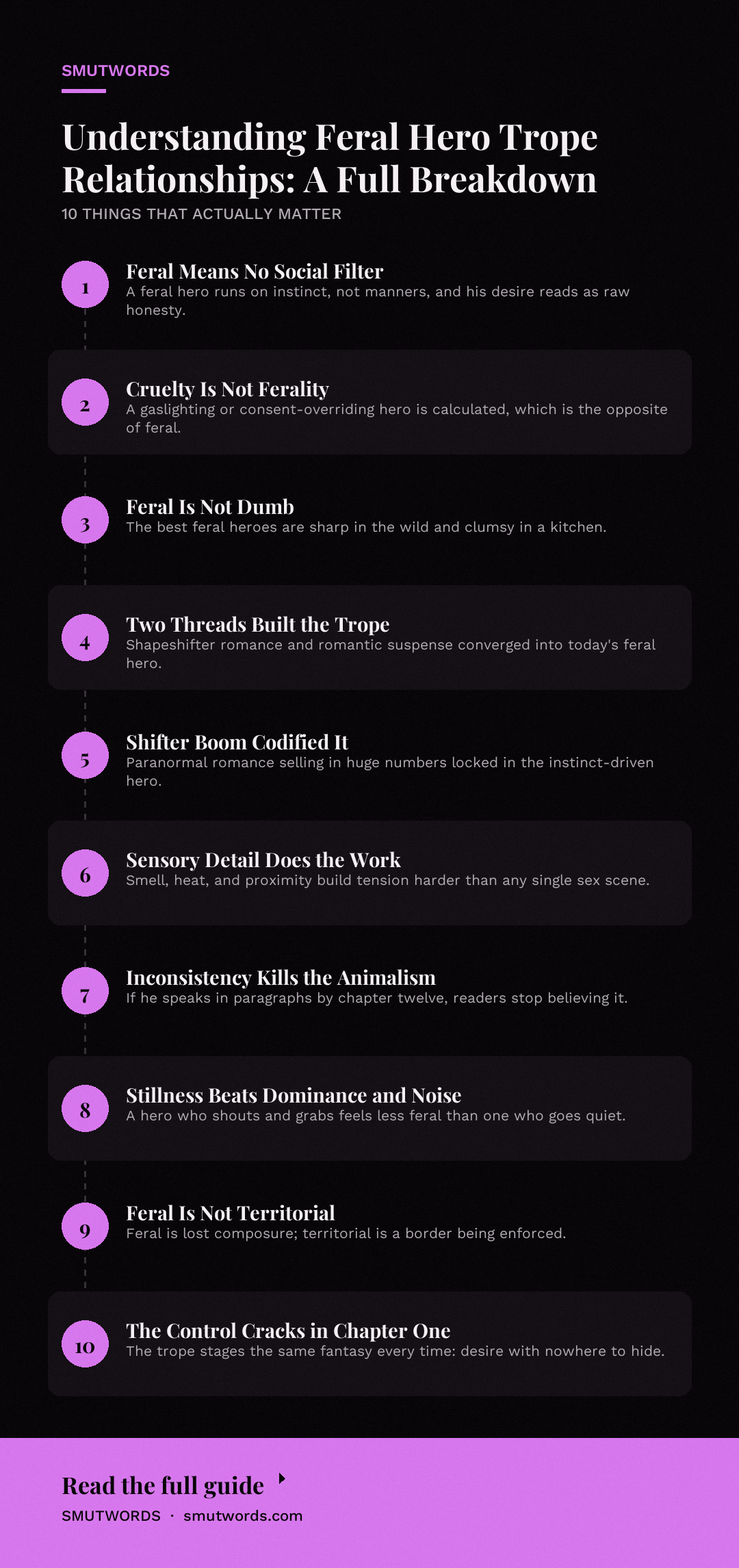
The feral hero trope is exactly what it sounds like: a male lead who runs on instinct rather than manners, a man who has spent enough time outside ordinary society that the usual rules of politeness and restraint have worn thin or never taken hold at all. He wants in a way that reads as bodily and immediate. The story is always about what happens when that force meets a woman who does not flinch from it.
Sometimes he is literally an animal shifter. Sometimes he is a man who has simply chosen the woods, the fight, or the edge of the map over a mortgage and a dinner party. The feral hero trope is one of the most durable engines in modern romance because it dramatizes a fantasy readers keep returning to: being wanted by something that cannot fake it.
What Feral Hero Trope Actually Means
"Feral" is a word borrowed from animal behavior, where it describes a domesticated creature that has returned to a wild state. Applied to a hero, it signals the same thing: a man whose social training has come unstuck. He may be dangerous, but the danger is the point. He cannot perform the small courtesies because he does not see the logic in them.
What counts as feral varies by degree. A full feral hero might not speak in complete sentences for the first several chapters and communicates mostly through scent, touch, or presence. A partial version might be perfectly articulate in a boardroom and still treat his attraction as a thing to be acted on rather than negotiated. The through-line is that his desire is honest, unmediated, and a little frightening even to him.
Several things do not count, and readers are quick to notice the difference. A cruel hero who manipulates and gaslights is not feral; he is calculated, which is the opposite. A domineering hero who simply overrides consent is not feral either.
The feral hero's intensity is directed at protecting and claiming a willing partner, and the strongest versions of the trope make that willingness explicit. The animalism is a texture and an energy. It does not excuse the absence of consent.
A common misconception is that feral means dumb. It does not. Plenty of the best feral heroes are sharp in the ways that matter to survival and hopelessly clumsy in the ways that matter to conversation. The gap between his competence in the wild and his confusion in a kitchen is where a lot of the charm lives.
Where Feral Hero Trope Comes From
The literary ancestor is older than romance as a genre. The wild man of the woods has been a figure in folklore and fiction for centuries, and the beauty-and-the-beast structure is ancient. But the specific romance publishing phenomenon that readers call the feral hero trope has a shorter, traceable history.
Two threads converge in the 1990s and 2000s. The first is the rise of the shapeshifter romance, where wolf and big-cat heroes brought animal instinct into the foreground as an explicit part of the romantic premise. The second is the romantic suspense wave that gave readers the lone operative, the ex-military recluse, and the mountain man who lives off-grid because society failed him. Both threads share the same engine: a man whose isolation makes his attachment to one woman absolute.
The trope hardened into a recognizable cluster in the paranormal romance boom, when shifter series began selling in enormous numbers and codified the idea of a hero driven by instinct and a mating pull he cannot override. That groundwork is directly visible in the way alpha/beta/omega dynamics and pack dynamics organize so much of the shifter shelf today.
What has changed is the balance of vulnerability. Earlier feral heroes were often written as barely contained threat, with the emotional arc tilted toward the heroine civilizing him. Contemporary versions give the hero more interiority. Readers want to see the moment his instinct and his tenderness collide, and the genre has responded by letting him be wrecked by his feelings rather than only ruled by his body.
A second honest shift is in how the trope now reaches readers outside the shifter category entirely. Contemporary romance authors borrow the exact same beats and apply them to the lone motorcycle club romance president, the reclusive security contractor, or the tech billionaire who bought the mountain and never comes down. Feral is now a delivery system, not a subgenre of its own.
How It Shows Up in Erotica
On the page, the feral hero trope does its heaviest lifting through sensory detail and restraint. Authors who write it well lean on smell, heat, proximity, and the small involuntary signs that the hero's body is running ahead of his mind. Sexual tension that builds through those cues is doing more work than any single sex scene, which is a point worth pressing on if you have read our breakdown of sexual tension vs slow burn.
A strong version of the trope usually includes a few identifiable beats. Not every book hits all of them, but you will recognize the shape.
- The control cracks. Something in his environment or his proximity to her makes the leash slip, and the reader sees it.
- The involuntary confession. He says something raw he would never have said in his previous life, often without meaning to.
- The grounding. Her presence organizes him. A specific touch or scent brings his scattered attention back to one point.
- The protective surge. Threat enters the story, and his response is instant and disproportionate.
- The aftermath. He is confronted with what the instinct revealed, and the relationship has to absorb it.
Location does more work than most authors get credit for. A remote cabin, an island, a ship, a cave, a wilderness station: these settings strip away the social scaffolding that would normally moderate a man, and the trope gets room to breathe. You can watch the same structural move applied with a different texture in kraken romance, where the isolation is oceanic rather than terrestrial.
Language is the other big variable. Some authors write feral heroes who barely speak during sex, letting gesture and breath carry everything. Others give them long, rough monologues that fall apart into short sentences as they lose composure.
Neither is better. What matters is that the language reflects the loss of control rather than merely reporting on it.
The most common failure of the trope is inconsistency. If the hero cannot string a sentence together around the heroine in chapter three but speaks in full paragraphs in chapter twelve, the reader stops believing in the animalism. The other failure is mistaking dominance for noise. A hero who shouts and grabs feels less feral than one whose stillness makes the room feel dangerous, and the second version is what readers mean when they say a scene "worked."
Readers of erotica specifically look for a few things the trope does exceptionally well. Public restraint that collapses in private. The first time he touches her and cannot stop. Sex that starts as communication rather than performance, where the animalism reads as attentiveness rather than force.
Enjoyed this? Get a free book.
Join the list and we will send a complete free story straight to your inbox, plus new releases every week after that. No credit card, no catch.
Our guide to clothed sex is a useful companion to any feral scene where the clothes come off late, because the delayed reveal is often where the heat lives.
Common variations authors use
The feral hero trope has sprouted enough distinct flavors that readers tend to know which one they want before they hit Buy. These are the ones that recur most:
- Alpha wolf shifter. The pack-based origin, where instinct is social as well as sexual and the hybrid shifter romance shelf often picks up where the classic wolf story leaves off.
- Mountain man recluse. A human hero who retreated from society and has to be reintroduced to it by her.
- Feral billionaire. The same instinct and possessiveness, dressed in extreme wealth, where his isolation is chosen rather than imposed.
- Lone wolf mercenary. Violence as his daily work, with all of the restraint pressure that comes from a man who usually operates alone.
- The beast within. A hero who wrestles with an internal force or second self, sometimes literal and sometimes not, and whose control depends on her continued presence.
There are also flavors that push the trope into adjacent territory. Elf romance borrows the isolation and the instinct without the animal body. Alien abduction romance can run a feral hero premise by casting the male lead as someone wholly outside human social norms, and the instinct reads as alien rather than animal.
Some authors go further out. Angel romance flips the trope by starting from a being whose self-control is a doctrine, and the heat comes from watching it fail. Dinosaur romance takes the animalism literally and is a much older branch of the trope than most readers expect.
What holds the whole family together is the same promise. The hero's body and his desire are honest, and the heroine is the only thing that can organize them. If you want the real-world version that echoes this dynamic, our full breakdown of the primal instinct kink covers the consensual version readers sometimes go looking for after a steady diet of these books.
Feral Hero Trope vs Territorial Shifter Trope
Readers confuse these two constantly, and the confusion is worth clearing up because it changes what to expect from a book. The feral hero trope is about instinct and the loss of social control. The territorial shifter trope is about a specific claim: an area, a home, or a person, and the way a shifter enforces the border around it.
A hero can be one without the other. A perfectly composed wolf shifter who marks his property and handles threats with unnerving calm is territorial but not feral. A wild, half-verbal hero wandering an empty coastline with no strong sense of place is feral but not territorial. Many of the best books in the current catalog overlap both, which is why the terms get used interchangeably.
The practical test is what the scene is doing. If the chapter is about the hero losing composure and having to be grounded by the heroine, you are reading feral.
If the chapter is about someone crossing a line and being made to regret it, you are reading territorial. Books that hit both beats well tend to rank among the most reread in this category, since the two tropes share a preference for soulbond mechanics to make the claim feel permanent.
Frequently Asked Questions
What makes a hero feral instead of just aggressive?
Ferality is about the absence of social filtering, not about force. A feral hero is ruled by instinct and physical response, and his intensity comes out as raw honesty rather than as cruelty. Aggression that is calculated or meant to control a partner reads as a different kind of character entirely.
Do feral hero romances always involve shapeshifters?
No. The shifter shelf is the most visible home for the trope, but the mountain man, the feral billionaire, and the lone-wolf operative all run the same engine without any animal transformation at all. Human-only contemporaries borrow the same beats and often ground them in a remote setting.
Is the feral hero trope the same as primal instinct kink?
They are related but not identical. The feral hero is a character type in fiction, while primal instinct kink is a real-world practice with its own negotiation and consent structures. The fictional trope often draws energy from the same instinctual dynamic.
What is the appeal of a hero who can barely hold a conversation?
The appeal usually runs through honesty. A hero who has no social performance to hide behind makes the reader trust what he wants, because there is nowhere to hide it. Readers describe the resulting possessiveness and protectiveness as feeling pure rather than managed.
Why do feral hero books often take place in isolated settings?
Isolation strips away the social scaffolding that would normally moderate a man, and without it the trope has room to move. A remote cabin, a ship, or a wilderness station creates the pressure that lets a hero lose control and the intimacy that lets a heroine ground him again.
Can a feral hero be a healthy partner by the end of the book?
The best versions make the growth the point. He does not stop being intense, but he learns where the instinct protects and where it needs to be held. The civilizing-through-connection arc is what draws most readers, and it usually depends on the heroine having her own needs and voice throughout.
Final Thoughts
The feral hero trope endures because it stages the same fantasy every time: a man whose desire for one woman cuts right through all the ways he has learned to keep the world at a distance. Start with a strong alpha wolf shifter romance from the catalog below and watch how quickly the control cracks in chapter one.
Our guide on sex after a long dry spell is a good pairing for the read if you want to see what the grounded dynamic looks like in real life.





Loading comments…