
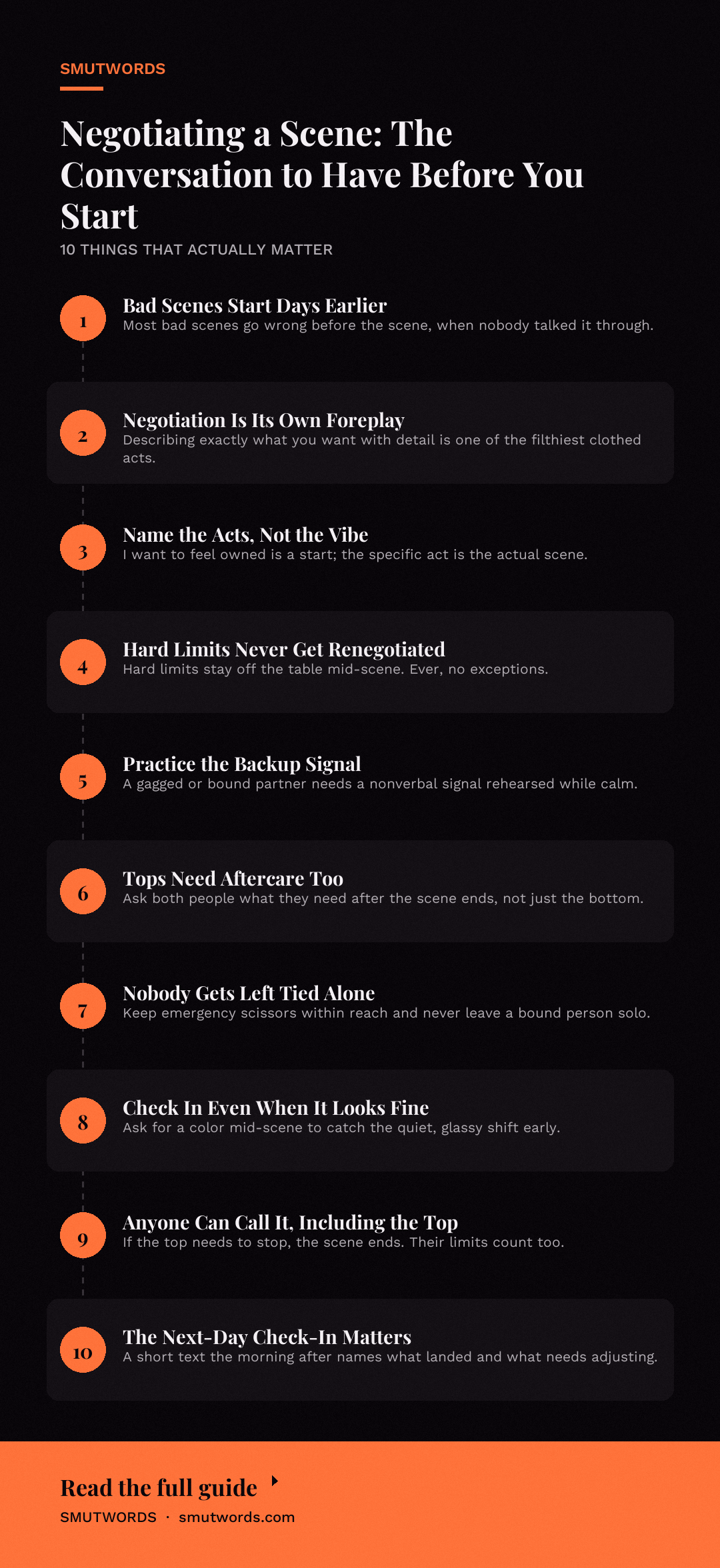
Most bad scenes don't go wrong in the moment. They go wrong two days earlier, when two people who like each other a lot decided that talking it through would ruin the mood.
Scene negotiation in BDSM is the conversation that keeps the mood intact and the person intact, and it happens before anyone's clothes come off. If that sounds unsexy, you've probably never had a partner look you in the eye and describe, in detail, the exact thing they want you to do to them on Saturday. It's one of the filthiest things two people can do with their clothes on.
The fantasy version of kink is that everybody just knows. The reality is that the people who've been doing this for fifteen years have the most boring, most thorough pre-scene conversations of anyone in the room, and their scenes are better for it. Here's what actually goes into that conversation, what to cover, and what to leave out.
What Scene Negotiation Actually Is
A scene is a contained piece of kinky play with a start and an end. Between those two points, one person might be tied up, ordered around, spanked, verbally degraded, or any combination of things that would get a stranger arrested. It's a beautiful arrangement when it works. It works because both people agreed in advance what's on the table, what's off it, and how to stop.
Negotiation is the conversation that sets that agreement. It's not a legal contract and it's not a mood-killer, or it shouldn't be. Good negotiation is its own kind of foreplay: you're describing what you want with enough precision that your partner can picture it, and they're doing the same back to you. The detail is the point.
Why nearly every experienced kinkster bothers
Because none of us are psychic. Because "vanilla until further notice" is a perfectly fine way to live, but if you want the other thing, you have to say so. Because a safeword nobody discussed and nobody practiced is just a word.
Because if something goes sideways at 11pm and one partner is tied to a frame, the options available to them shrink fast. That last one is the whole reason negotiation exists.
If the dominant in the room picked the activities, the limits, the signals and the aftercare without asking, that person is performing their own fantasy at someone else's expense. That's a bad scene whether or not anyone says the safeword.
The Six Things to Cover Before You Play
You can walk the whole negotiation in twenty minutes if you're both honest. Longer if there's more at stake, shorter if it's a low-risk scene with an established partner. Here's the checklist.
- Activities. What's the specific menu? Spanking, flogging, rope, light bondage, blindfold, sensation play with ice or wax, a specific verbal dynamic like praise or degradation. Name the acts, not the vibe. "I want to feel owned" is a starting point; "I want you to hold my wrists above my head and call me a good boy" is a scene.
- Limits. Hard limits (never, no negotiation tonight, no negotiation ever) vs soft limits (not tonight, maybe someday, ask me again in six months). Write both down. Hard limits don't get renegotiated mid-scene. Ever.
- Signals. Safewords, and the backup signaling method for when someone can't speak. More on this below, because it's the part most people get wrong.
- Health and state. Injuries, chronic pain, medications, panic triggers, sensory issues, anything that makes a body unreliable that day. Recent drinking, weed, or anything else that blunts judgment, including a bad sleep week.
- Aftercare. What each person needs after the scene ends: a blanket, water, quiet, a specific kind of physical contact, talk, space. Ask both people. Bottoms need aftercare; tops need it too.
- Wrap-up. When do you check in, and how? A five-minute conversation that night, a longer one the next day, a text the morning after to confirm everyone's still steady.
A note on being specific
"A little light bondage" means something different to everyone. If you mean "my wrists get cuffed in front of me, nothing around my neck, nothing that touches my arms above the elbow," say exactly that. Vague limits are the ones that get crossed by accident and then nobody feels good afterward.
How to Bring It Up With a Partner
The hardest part of scene negotiation is often just starting the conversation. If you've been having regular sex and want to move toward kink, or you're with a new partner and don't know where they stand, here's how to open it without turning the moment into a corporate HR sit-down.
The best opener is a piece of fiction or fantasy. Not the graphic stuff, a small admission. "I read something the other day that got me thinking" is a real sentence that leads to real conversations.
If you're both readers, point them at the feral hero trope dynamic and mention what part caught you, then ask what part catches them. It works because you're talking about a book, not a fantasy you're embarrassed to hand over.
Pick the place, pick the time
Not in bed, not immediately after sex, not when either of you is tired, hungry, or stressed about work. A Sunday afternoon walk works. So does a long car ride. What doesn't work is a Monday night when one person is about to fall asleep.
Never use a mid-scene moment to introduce new activities; the moment for that is closed, and the safest answer to anything new mid-scene is a kind no.
Safewords and Signals That Actually Work
Everyone knows the traffic light system. Very few people use it correctly. The point of a safeword is to be a word you're not likely to say by accident and your partner is trained to hear even under a lot of noise.
Saying "no" as a safeword sounds great until someone likes being made to say no and you can't tell the difference. Pick words that don't belong in the scene.
The part people miss: physical signaling. If a partner is gagged or restrained in a way that limits their voice, they need a way to signal that doesn't require speech. A ball tapped against the frame, a hand squeezing the top's wrist twice in a row. Practice the signal when everyone's comfortable, so nobody's learning it for the first time while genuinely stuck.
Real limits on what's safe
Some kinks carry real risk and deserve their own paragraph, not a bullet point. Anything involving the neck, heavy rope suspension, mummification that traps a person fully (see the glossary entry on mummification for the shape of it), or restraint that prevents movement while someone is alone in the room: these are on the high side and deserve an experienced partner, a spotter present, and a partner trained to recognize the signs of trouble.
Fire play, blood play, and breath control are not beginner activities, and breath restriction in particular kills people. Not in the "it's technically risky" way. In the literal way. Learn from people who teach it in person and know what they're doing before you try anything in that ballpark.
Most of scene negotiation is about ordinary safety. Set a rule that the top stays sober.
Set a rule that nobody is left alone tied up. Have emergency scissors within arm's reach if rope's involved, and know how to use them fast. Have water nearby.
Check-Ins: What to Say Mid-Scene
A good top checks in even when nothing seems wrong. The check-in is short: "Still green?" or "How are you doing? Give me a color." Traffic-light answers are easy to give under pressure. Green means keep going, yellow means slow down or change something, red means stop everything immediately.
Enjoyed this? Get a free book.
Join the list and we will send a complete free story straight to your inbox, plus new releases every week after that. No credit card, no catch.
Check-ins are also how you catch the subby-below-the-surface thing where someone has gone quiet and glassy. Some people go quiet because they're fine and floaty; some go quiet because they've left.
Ask. Read the person's face. If something shifted, stop.
When to stop, no negotiation needed
- The safeword or physical signal fires. Stop the second the signal arrives, regardless of how you read the moment.
- The body does something new. Numbness in a hand, tingling, breath trouble, a stutter in speech. These mean untie, reposition, ask.
- The top's own state shifts. If the top is suddenly anxious, angry, exhausted, or getting off on something they didn't plan to get off on, stop and talk.
- A limit is about to be crossed, or was. Immediate stop. Aftercare first, hard conversation later, apology without defensiveness, and no repeat performance of whatever it was until the conversation's been had.
Anyone can safeword, including the top. If the top needs to stop, they say so and the scene ends. The power the bottom gives isn't permission for the top to ignore their own limits.
How to Document It
You don't need a legal contract. You do need one place where the agreement lives, especially if you're playing with multiple partners, playing with someone new, or playing something you'll want to revisit. A shared note on your phone is enough. So is a physical index card in a bedside drawer.
The document should have: date, names of everyone involved, the activities on the menu, hard limits, soft limits, signals, health notes for that day, the aftercare plan, and any notes from last time. Update it any time something changes, and especially after any scene where a limit got crossed, even accidentally, so the correction doesn't get lost.
What fictional dominance gets wrong about the paperwork
A lot of kink fiction skips the negotiation to keep the momentum up, which is fine as fantasy. In a book like Absolute Surrender the surrender hits hard partly because the negotiation exists behind the scenes, even when the page doesn't show it. If your partner likes that flavor, the fantasy is on the shelf. The paperwork is what makes it safe enough to actually enjoy on a Saturday.
If you're both working through something heavier than a single scene, say reconnecting after a rough patch, the negotiation can ride alongside a bigger relationship conversation. The guide to reconnecting after a dry spell covers that ground well, and the two overlap more than you'd expect.
Scripts for the Awkward Parts
Nobody wants to feel like they're giving a TED talk about their own orgasm. Here are openers, sized for real life.
To a new partner: "Before we go further I want to check a couple of things. What are you into, and what's an absolute no? I'll tell you mine too."
To a long-term partner: "There's something I've been thinking about. Can I tell you what it is without you needing to respond right away?"
When you want to introduce kink: "I read something that got me curious. Would you be interested in trying [specific thing] sometime? No tonight, just planting it."
When you want to stop mid-scene as the top: "I'm calling it. I need to stop. We're okay, nobody did anything wrong, I just need to stop."
If they say no
No is a complete sentence. If a partner doesn't want to try a kink, that's the end of the conversation, and the response is "thank you for telling me" and moving on. If they say no and you push anyway, they will remember the push more than they remember the kink.
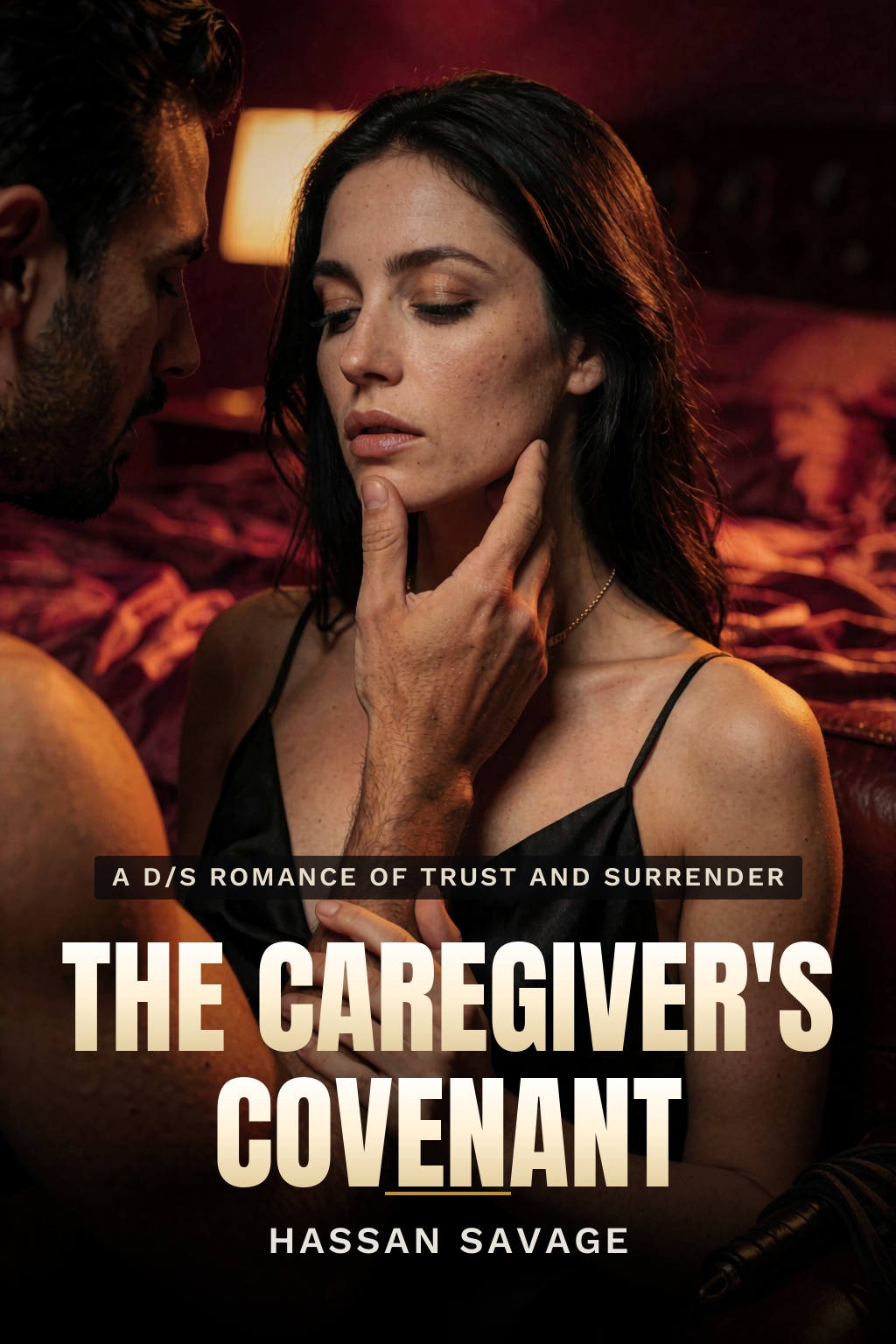
If a partner wants something you're not into, same rule in reverse. Plenty of kink couples have whole categories of things that only one of them wants and the other one cheerfully does not. There's a fantasy shelf for that: The Caregiver's Covenant and Free Use Wedding are both there for a reason.
Aftercare, and the Check-In After That
Aftercare is the part of the scene that keeps the whole thing from being an emotional wrecking ball. Usually it means warmth, quiet, hydration, a blanket, and physical contact, but the specifics are for the two people who just played.
Ask them what felt good, offer what they want, don't hover. Some people want to be held. Some people want to be alone in a warm bath for half an hour. Both are valid and neither is a rejection.
The next-day check-in is the one most people skip. A text that reads "How are you feeling today? Anything come up?" is enough. If anything landed badly, whether a crossed limit or something that wasn't on either of your radars, this is where it gets named, apologized for, and adjusted in the note for next time.
For readers who want the dynamic in fiction
If your negotiation went well and you want to sit with the flavor of a scene that's actually built on consent, there are a few books on the site that hit it. The Living Gene Vault and Breeding Bunker 9 both live in the deep-end-of-the-pool fantasy genre, where the consensual negotiation is the scaffolding and the scene is what's underneath it.
He Never Shuts Down: The AI Boyfriend Who Claimed Me is the version of the fantasy where the top predicts what you want before you say it, which is very fun to read and a terrible model for a real partnership. The reading is the fantasy. The talking is the real thing.
Scene negotiation bdsm practitioners don't do it because they're anxious. They do it because the twenty-minute conversation opens a door to a whole weekend of better scenes, and it means you never have to guess whether your partner is having a good time or just being polite about the rope.
Final Thoughts
Next step: pull up a shared note on your phone and start filling in the six sections. If you want a scene to hold in your head while you draft yours, Absolute Surrender shows a surrender that's worth what it costs because the negotiation underneath it was real.







Loading comments…