
Dominant vs Submissive: What Each Role Actually Does
Most people come to the dominant vs submissive question through fiction first. A scene in a book, a dynamic between two characters that made something click, and suddenly you're reading a glossary at 1am trying to figure out if you're allowed to want that.
You are. But the books get one thing consistently wrong: they show you the drama and skip the mechanics. Here's the part they leave out.
The Basic Definitions, Without the Fluff
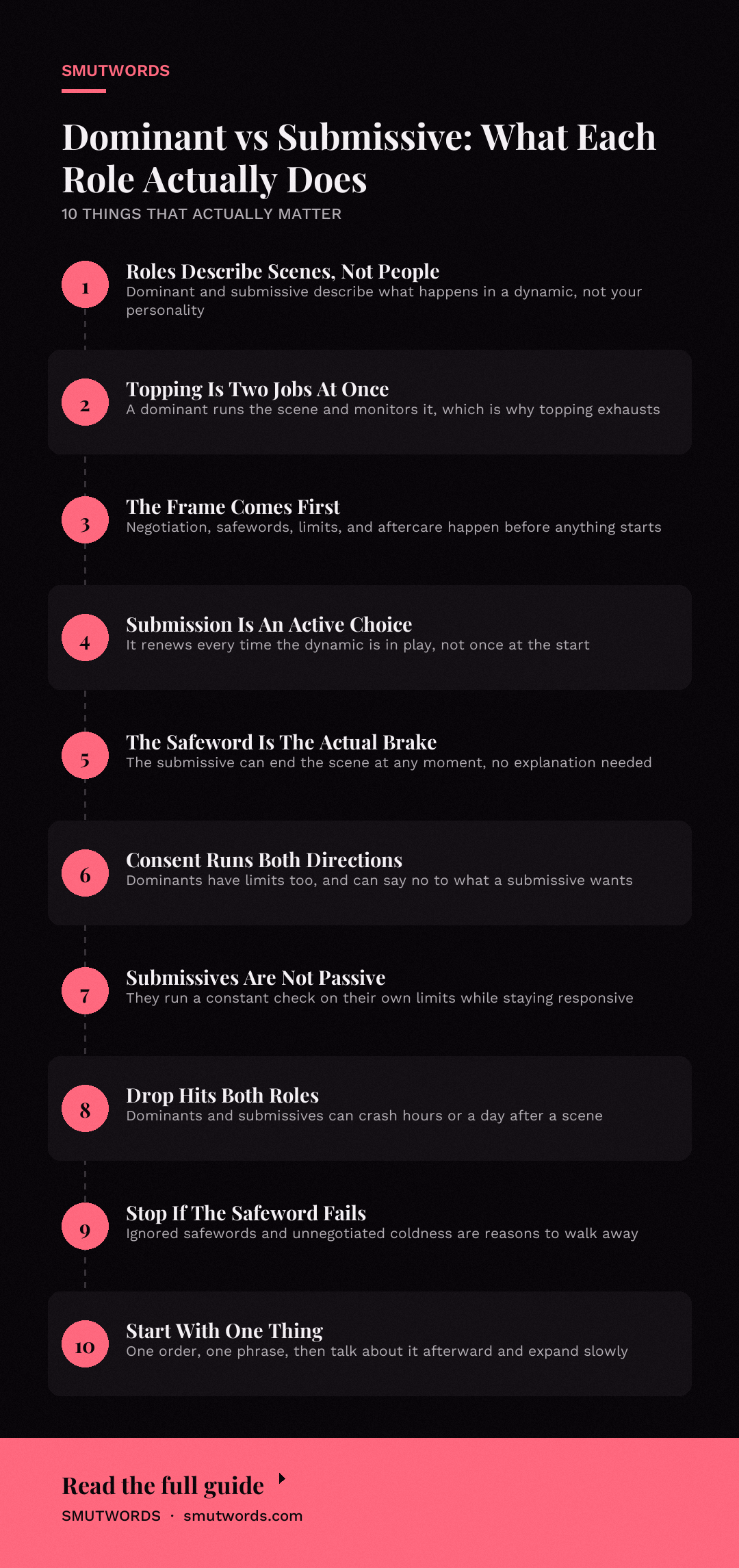
Dominant and submissive describe roles in a power-exchange dynamic. The dominant partner takes charge of a scene or a relationship structure; the submissive partner hands over control within agreed limits. That's the skeleton. Everything else is negotiation, preference, and the specific shape two people build together.
What these roles are not: a personality type, a measure of toughness, or a fixed identity you're stuck with. Plenty of people who run boardrooms want to be told what to do in bed. Plenty of quiet, soft-spoken people are stone-cold dominants. The role describes what happens in the dynamic, not who you are at a dinner party.
Some people switch, moving between roles depending on the partner or the day. That's a wider range, not indecision.
What the Dominant Actually Does
The fantasy version of a dominant is someone who commands and receives. The real version carries the logistical weight of the whole scene, often while appearing effortless. That gap between appearance and effort is most of the job.
Reading, Checking, Adjusting
A dominant is tracking their partner constantly: breathing, skin color, muscle tension, the quality of a moan, whether the answer to "how are you doing" is a real answer or a push through discomfort that's gone too far. That attention doesn't stop because the scene is going well. It runs the entire time.
This is why experienced dominants often say topping is more exhausting than bottoming. You're doing two jobs at once: running the scene and monitoring it.
Setting the Frame Before Anything Happens
Good dominants do most of their work before the scene starts. That means a conversation about what each person wants, what's off the table, what words mean stop, and what happens after. A dominant who skips this and just starts issuing orders isn't dominant. They're just doing whatever they want, which is a different thing entirely.
- Negotiation: what's on the menu, what's off, what's untested but interesting
- Safewords: a clear stop signal, plus a slower "check in with me" signal if the scene is intense enough to need one
- Physical limits: injuries, joints, medications, anything that changes what's safe tonight vs. last month
- Aftercare: who needs what when it ends, and roughly how long it takes to come down
Holding Responsibility for the Outcome
If something goes wrong, the dominant is the one who called the scene. Not because the submissive had no agency, but because the dominant is the one steering. That responsibility is real, and it doesn't disappear when the scene is over.
Anyone who wants the title without the accountability is telling you exactly who they are. Believe them the first time.
What the Submissive Actually Does
The cultural story about submission is that it's passive. Someone lies back and receives. That's not submission, that's a warm body. Real submission is active, deliberate, and requires more self-knowledge than most vanilla sex ever asks for.
Choosing to Hand Over Control
A submissive is making an ongoing choice. Not a one-time decision at the start of the relationship, but a decision that renews itself every time the dynamic is in play. The moment that choice stops being freely made, the dynamic is over whether anyone has said so out loud or not.
Knowing your own limits well enough to state them is a skill. So is noticing when you're pushing past a limit because you want to please your partner, which is the most common way scenes go sideways. A submissive who can say "I need to stop" mid-scene, clearly and without apology, is doing the hardest part of the role.
Communicating in Real Time
Submissives aren't supposed to just endure. They're supposed to communicate: safeword if something's wrong, a check-in word if they're close to a limit, plain language if something hurts in the wrong way. A good dominant can't read your mind, and shouldn't be expected to.
If you can't say stop, you're not ready to play with someone who might need to hear it.
Why the Submissive Holds the Real Power
This gets said a lot, and it's worth being precise about it, because the vague version is easy to dismiss as a comfort blanket for people who feel weird about wanting to submit.
The Brake Is Real
Here's the concrete version. In a functioning dynamic, the submissive sets the outer boundary of what's possible. The dominant operates inside it.
The submissive can end the scene at any moment and the scene ends. No negotiation, no explanation required in the moment. That's the actual brake, and it isn't symbolic.
A dominant who resents that brake, who treats a safeword as a personal insult or a mood-killer, has misunderstood the job. The safeword working is the thing that makes the whole dynamic possible. Without it, you're not playing. You're just doing things to someone.
Consent Flows Both Ways
The mistake people make is imagining consent as something the submissive gives and the dominant takes. Consent runs in both directions, always, at every stage.
A dominant consents to lead the scene, take on the responsibility, and do the specific things that were negotiated. If a submissive pushes for something the dominant doesn't want to do, the dominant says no. Being in charge doesn't mean being available for whatever the other person wants. Both people get to have limits and both get to change their minds before anything starts.
This is also why prediscussed, pre-negotiated scenes work better than improvised ones, especially early on. Ambiguity is where bad things happen. Specificity is where good scenes live.
Common Myths About Dominant vs Submissive
Myth: submissives are weak or passive. They're running a constant internal check on their own limits while being present and responsive. That's work.
Myth: dominants are cruel or unfeeling. The good ones are attentive to a degree that would exhaust most people, and most of them are more emotionally invested in their partner's experience than anything else in the scene.
Myth: you have to pick a role and stick with it forever. Roles can shift, expand, shrink, or swap entirely. What you want this year might not be what you want in five.
Myth: submission means never having preferences. A submissive who says "I don't care, whatever you want" to every question is often hiding a limit they're afraid to voice. That's a warning sign, not devotion.
Myth: a dominant has to want sex at the end of every scene. Power exchange and sex overlap constantly but they're not the same thing. Plenty of scenes end with both people on the couch eating crackers and talking about the weather.
Enjoyed this? Get a free book.
Join the list and we will send a complete free story straight to your inbox, plus new releases every week after that. No credit card, no catch.
How to Figure Out Which Role You Lean Toward
You don't have to know before you start. You don't have to commit to a label. Notice what actually gets your attention, rather than what you think should.
- Sit with a scene you've read or watched and ask which character you were tracking. Whose experience were you imagining from the inside?
- Ask yourself what you'd want to happen next if a partner asked "and then what?" They want you to do it to them, or they want to do it to you?
- Try low-stakes versions first. A single order in the bedroom, a held wrist with agreed language, a sentence of praise delivered in a specific voice. You'll learn more from ten minutes of that than from months of reading.
- Talk to your partner about what you noticed before you decide what to call it.
The label comes last. It's a description of what's happening, not a prerequisite for it. And if you want to see how other writers handle that discovery, the forest spirit romance shelf is full of characters working it out slowly, in ways that feel recognizably human.
Bringing It Up With a Partner
The conversation is usually less dramatic than people fear. You don't need a script, but knowing roughly what you want to say helps.
Lead with what you noticed, not with a category. "I read something that stuck with me, and I've been thinking about it" lands better as an opener than "I think I'm submissive." That phrasing gives your partner somewhere to go that isn't yes or no.
Expect one of three reactions. Curiosity, which is the easy one. Hesitation, which usually means they need more information before they can say what they think. Or a hard no, which is a legitimate answer you have to respect.
If you're in a relationship that's otherwise healthy, a no to this isn't automatically a crisis. Sometimes it's a no to this specifically. Sometimes it's a no for now. Sometimes it opens the longer question of what each of you actually needs.
If you want a frame for how dominance and submission get shaped between two specific people, a lot of readers find the dynamic easier to feel than to explain.
That's why so much of the good fiction in this space is basically relationship tension wearing leather. The enemies to lovers structure is the obvious entry point, since the power struggle is the plot. Billionaire romance runs on the same engine with a suit on top; here's a solid breakdown of what billionaire romance actually is and why it works. And if something more structured is what you're looking for, Plugged For Transport is a good example of a scene built entirely around protocol.
The Real Risks and How to Lower Them
Most of what goes wrong in power exchange goes wrong for predictable reasons. None of it requires bad intentions from anyone.
Physical Risks
Restraint carries real injury risk: nerve compression, joint strain, circulation problems, and falls when someone's balance is compromised. Never restrain anyone alone if you're both new. Never put anything around the neck. Breath restriction is a separate category of danger that doesn't belong in a beginner scene and shouldn't be attempted without supervised training and a spotter, full stop.
If you're using any kind of impact, agree on areas that are off limits before you start (joints, spine, neck, kidneys, tailbone) and know that marks fade but a broken bone doesn't.
Emotional Risks
Drop happens. Both dominants and submissives can crash hard after a scene, sometimes hours later, sometimes the next day. Plan for it before it arrives. Water, food, warmth, and a person who's willing to sit with you while you feel weird about everything you just did voluntarily.
Drop is a physiological and emotional comedown, not a sign that something went wrong. But if it happens every time, or if it comes with shame spirals that don't resolve, that's worth talking about with someone outside the dynamic.
For a detailed look at what aftercare actually looks like when the scene itself was intense, this guide to somnophilia aftercare is useful even if that particular kink has nothing to do with you. The structure transfers.
Relational Risks
Power exchange can leak out of the scene and into the rest of the relationship. It can be hard to notice when it's happening, because it feels normal from inside it. A dominant who's making decisions outside the agreed dynamic is overstepping.
A submissive who's using the dynamic to avoid having opinions in general may be using submission to sidestep a harder conversation. Scenes are supposed to be containable. If they aren't, the negotiation needs to happen again.
The hate to love arc in fiction works because the tension is the point. Real relationships need the tension to resolve. Power exchange sits inside a relationship that has to work when the scene is over, and if the only time things feel functional is during a scene, that's a signal, not a solution.
When to Stop
Stop if a safeword is ignored. Stop if you're being pressured to do something you didn't agree to. Stop if your partner is doling out punishment in the form of withholding affection, insult, or coldness that wasn't negotiated.
Stop if you can't voice a limit without a fight. Stop if you're doing it because you think you have to, whether that's a partner's expectation or a fantasy version of yourself you're trying to perform.
Stopping mid-scene is allowed at any moment. Stopping the entire dynamic, permanently, is also allowed. If you feel like you can't stop, that's the clearest sign that you need to.
Where Fiction Fits In
None of this means you can't enjoy the fantasy version. The fantasy is allowed to skip the negotiation scene and the safeword check. That's part of what makes it hot. But knowing the structure underneath makes the fantasy better, not worse, because you can tell when a scene in a book is doing something real versus something that would get someone hurt.
If you read a line like the "you can take more, sweetheart" beat and it lands, it lands because you can hear the check-in inside it. Writers who get that right write dominants who are actually paying attention. Writers who get it wrong write dominants who aren't. Once you can hear the difference, you can't unhear it, and the good scenes hit harder.
For something more elaborate, The Work Party Dare plays with control in a public setting, where the whole tension is what can't be said out loud. If you want the same structure extended and formalized, Gangbang Booking Week is entirely about the coordination and consent logistics that make an intense scene possible. And if you want submission mapped onto a sci-fi frame, The Pleasure Drone Experience is worth a read for the way it handles total surrender as a premise.
How to Start, Concretely
Pick one thing. Not a scene, not a dynamic, one thing. An order, a posture, a phrase with agreed meaning. Try it with someone you trust and who you've already had the real conversation with.
Then talk about it afterward, when both of you are calm. What worked, what didn't, what surprised you. The conversation after is where you learn more than the thing itself ever teaches you. Repeat, expand slowly, and let the shape of it get discovered instead of declared.
Most people who get into this don't start with a contract and a collar. They start with a stupid-looking experiment in a bedroom that ends up being a lot more interesting than either of them expected. That's the whole on-ramp.
Final Thoughts
Read The Living Gene Vault if you want to see a dominant character written with the patience and attention the role actually requires. The power in that book works because the lead is genuinely watching, not just commanding. That's the version worth aspiring to, and the version worth recognizing when you see it.






Loading comments…