
Billionaire romance runs on a simple collision: a man with more money than he could spend in ten lifetimes falls for someone who has none of it. The penthouse, the private jet, the black card that solves problems money should never be able to solve. None of it works unless the man behind it is wrecked in some specific way.
Total financial security plus total emotional vulnerability. That's the deal the subgenre has been making with readers for decades, and it keeps working because it hits something real.
What Billionaire Romance Actually Means
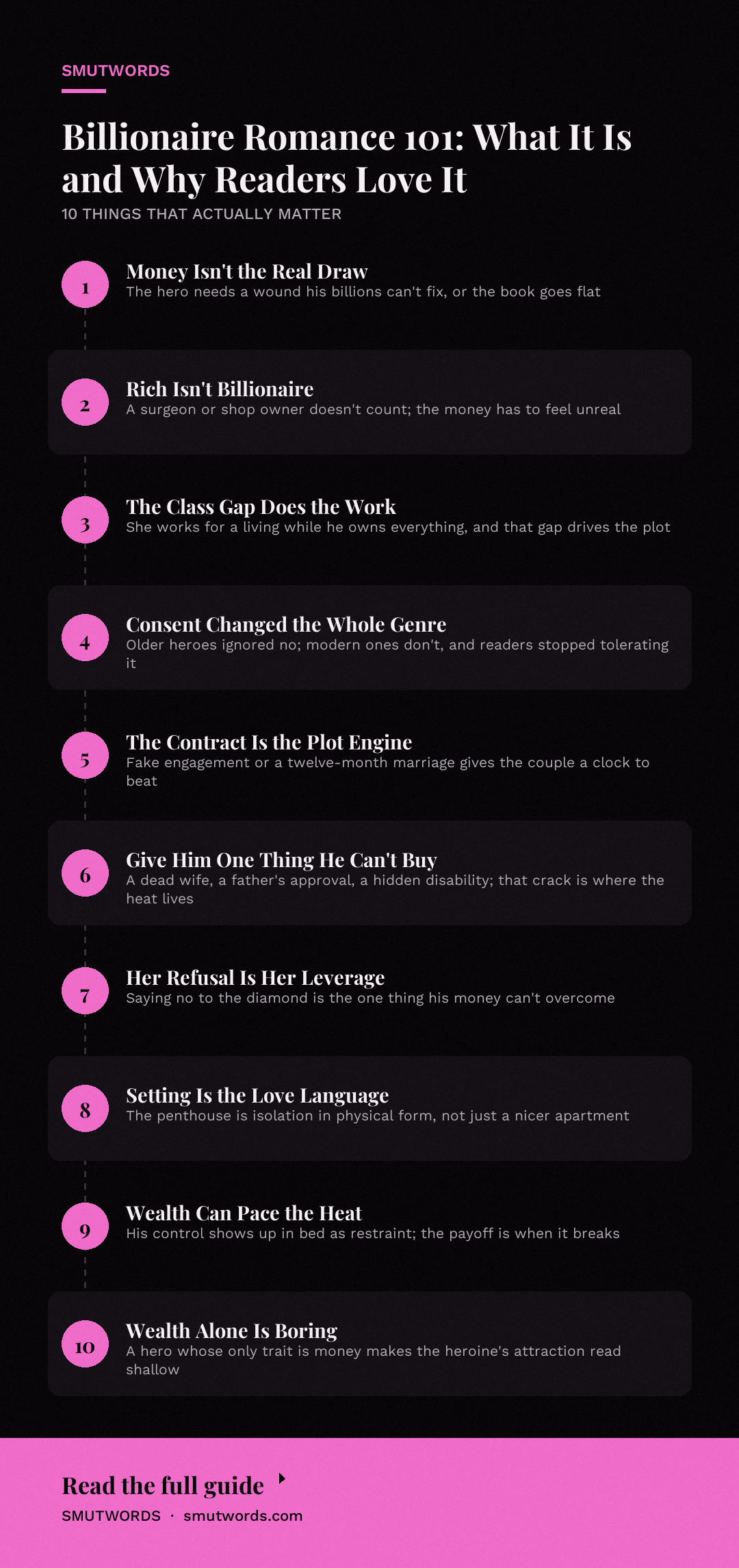
The name is almost literal, but the definition needs more than a one-line version. A billionaire romance centers on a romantic hero (occasionally a heroine, though the trope skews male) whose wealth is so extreme it functions as a kind of superpower. The number matters less than the effect. This is a person for whom financial constraints have ceased to exist.
What counts: a hero whose money changes the physical circumstances of the romance, where they live, how they travel, what they can give. What doesn't count: a hero who is merely rich. A successful surgeon is not a billionaire hero. Neither is a small business owner.
The threshold, functionally, is that the money must feel unreal, almost mythological, and it must drive much of the plot's tension or pleasure.
The heroine is usually, though not always, someone who has to work for a living. That asymmetry is the point. The genre needs the gap between their worlds to generate both the fantasy (being swept into a life of ease) and the conflict (feeling like you don't belong there, or being made to feel that by others).
A few things billionaire romance is not, despite common assumptions:
- It's not the same as mafia romance. Organized crime heroes have money, but the money isn't the draw, the danger is. Mafia romance runs on threat and loyalty codes. Billionaire romance runs on boardrooms, contracts, and the soft violence of social class.
- It's not automatically a dark romance. Plenty of billionaire books are warm and low-conflict. Others shade into dark territory. The wealth is the constant, not the tone.
- It's not just wealth porn. The strongest versions make the hero's money a mirror for his wound. He built an empire because he couldn't have the thing he actually wanted. The heroine gives him the first real choice he's made in years.
The term sits inside the broader celebrity romance family in one sense: both involve a hero whose public persona exceeds his private self, and both play on the tension between being known and being seen. Where celebrity romance deals in fame as currency, billionaire romance deals in money as currency. Same machinery, different engine.
Where Billionaire Romance Comes From
The trope has roots in nineteenth-century fiction. Jane Eyre pits a penniless governess against a landed, brooding master. That's the billionaire romance template, just with an estate instead of a hedge fund. The class gap, the powerful man brought low by feeling, the woman who refuses to be owned even as she's drawn in: all of it is already there.
The modern publishing form emerged with the mass-market paperback. Harlequin and Mills & Boon built entire category lines on wealthy, commanding heroes through the 1970s and 1980s. Those books called him a tycoon, a sheikh, a Greek shipping magnate.
"Billionaire" was still a slightly exotic term in the 1970s, and it carried a whiff of fiction. Publishers used it anyway, because it sounded like a fairy tale for adults.
The 1990s introduced the corporate hero: the CEO with a hostile takeover and a conscience he'd rather not examine. Then something shifted in the 2010s. Self-publishing collapsed the gatekeeping, and billionaire romance exploded because it was cheap to produce and endlessly repeatable.
A single cover format (shirtless man in a suit, city skyline behind him) could sell across a whole series. Authors could iterate faster than traditional publishing could react.
Two other developments reshaped the trope. First, the Fifty Shades effect pushed billionaire books toward explicit, kink-adjacent territory, so the hero's control could be expressed in the bedroom as well as the boardroom. Second, the rise of Chinese and Korean web novels fed a parallel stream (the domineering CEO, the arranged contract, the forced proximity) that American authors absorbed and repackaged.
The result is the trope you see now: looser, hornier, more self-aware, and far more generous to its heroines than the 1980s tycoon books ever were.
The shift that matters most is consent. Older billionaire romances routinely had a hero who ignored a woman saying no. Modern ones almost never do, or if they do, it's framed as a problem the story corrects.
Readers stopped tolerating it, and the genre adjusted. That adjustment is the single biggest change the trope has undergone, and it made the books better.
How It Shows Up in Erotica
On the page, a billionaire romance is a machine for producing specific pleasures and specific tensions. The craft is in how those are balanced. Here's what the strong ones do.
The setting does emotional work. A penthouse isn't just a nicer apartment. It's isolation in physical form.
It's high enough that the hero can look down on the city, and the heroine feels the distance in her body. The same goes for the private jet, the estate, the hotel suite that's bigger than her whole flat. Setting is the genre's primary love language and its primary weapon.
The contract or arrangement is the plot engine. Fake engagement, twelve-month marriage, paid surrogate, marriage for a business merger, "be mine for six months and I'll save your family's bakery." These setups create a clock, and the clock creates stakes. The couple knows the arrangement has an expiration date, and the reader watches them both pretend not to dread it.
The hero's power is undermined on purpose. The best authors give the hero one place he can't buy his way out of. His father's approval. A dead wife. A childhood he'd rather erase. A reading disability he hid for years.
The heroine finds the crack, and that's where the heat comes from. Not the limousine. The moment he admits he can't sleep unless she's in the bed.
The heroine has leverage even without money. She's the one who says no and means it. She refuses to move in, refuses the diamond, refuses to sign. Her refusal is the one thing his money can't overcome, and that's why he wants her.
Without this, the book turns into a wish-fulfillment fantasy with no friction and no pulse.
Enjoyed this? Get a free book.
Join the list and we will send a complete free story straight to your inbox, plus new releases every week after that. No credit card, no catch.
What makes a flat version: a hero who is rich and nothing else, a heroine who exists to be rescued, and a plot where money solves every problem without the hero ever having to become a different person. Those books sell, but they're the ones readers forget by the time they hit the last page.
Common variations you'll find across the trope:
- CEO romance. The hero is specifically a corporate executive, and the tension is his board, his rivals, his company's future. Tighter focus than a general billionaire book.
- Arranged marriage (or contract marriage) billionaire. The couple marries for legal or business reasons, then falls for real. The marriage in trouble dynamic often shows up in the second act here.
- Grumpy billionaire. The hero is cold, clipped, allergic to small talk, and melts exactly once, slowly. High-contrast version of the trope and a reader favorite.
- Accidental pregnancy billionaire. The hero's wealth frames the stakes: child support, custody, inheritance, a family name that matters to someone. The money cuts both ways.
- Fake relationship billionaire. The heroine gets the lifestyle or the money, he gets a date for a gala or a board meeting. The pretense collapses on a schedule the reader can feel.
- Rescue billionaire. The heroine's business, family, or visa is in trouble, and he steps in. The oldest version of the trope and still the most emotionally direct.
Where it sits relative to other wealth-adjacent tropes: a lumberjack romance gives you a hero with no money but total competence and no distractions. A billionaire romance gives you a hero with no limitations but no time. Both are fantasies about a man who can fix things. They just fix them with an axe or a wire transfer.
Because so many billionaire books start as arrangements the couple never planned on taking seriously, they overlap heavily with the marriage-in-trouble territory further down the line. The first act is usually a setup. The second act is the marriage becoming real.
The third act is the marriage being tested. That's why so many of these books read like a compressed version of an entire relationship.
The blend with arranged marriage and forced proximity is also why billionaire romance pulls from childhood friends to lovers in its softest versions: the hero is someone from her past who came back rich. That variation gives you the money as a shock rather than a given, and it lets the heroine be the one who knew him before he became a name on a building.
If you like the "history already exists between them" version of that dynamic, the why choose vs reverse harem breakdown covers how group dynamics change the same tension.
When the hero has a public-facing career in addition to the money (fashion, music, sports), the trope shades into rockstar romance or celebrity romance, where the currency is attention rather than cash. The mechanics are close enough that authors move between them freely.
What makes a scene strong is specificity. Not "he owned a lot of property" but the exact floor, the exact art on the wall, the exact moment he hands her a key she didn't ask for. Not "he was rich and powerful" but the way the maître d' changes posture when he walks in. The writer has to make the wealth feel lived-in, or it reads like a summary of a fantasy instead of the fantasy itself.
And the sex has to earn its place. In the best billionaire romances, the hero's control shows up in bed as restraint, precision, patience. He can afford to wait. He can afford to make her wait.
The wealth becomes a kink, a way of pacing the heat. The payoff is the moment his control breaks and he stops being the man with the portfolio and starts being the man with the problem.
Frequently Asked Questions
Is billionaire romance the same as CEO romance?
Close, but not identical. CEO romance is a narrower type where the hero's job title matters to the plot and the setting is often corporate. Billionaire romance is broader and can include old money, inherited wealth, or founders whose money came from tech, oil, or anything else.
Most CEO romances are billionaire romances. Not all billionaire romances are CEO romances.
Do billionaire romances have to be dark?
No. The trope spans from sweet and low-conflict (a warm, funny book where the hero is basically kind) to full dark romance where he manipulates and controls before he earns his redemption. The wealth itself doesn't dictate the tone. The author's treatment of consent and power does.
Why do readers love a heroine who says no to the money?
Because it's the only way the fantasy stays honest. If the heroine just wants the lifestyle, the hero never has to prove he's worth anything beyond his bank account. The refusal makes her desire mean something, and it makes his pursuit personal. Without it, the book has no emotional stakes.
Are arranged marriage billionaire romances really about marriage or about the contract?
Both, usually. The contract is the plot device. The marriage is the emotional payoff. The best versions use the legal arrangement to force the two characters into proximity, then let the real relationship grow inside it.
That structure also lets the couple skip the "should we?" and go straight to "we already said yes, so why is this working?"
How much sex is typical in a billionaire romance?
It varies widely. Some are closed-door with a single fade-to-black scene. Others are fully explicit with multiple long scenes. There's no standard.
If a book is labeled steamy or spicy, expect on-page heat. If it's labeled sweet, expect the door to close. The trope itself is neutral on this.
What's the biggest mistake authors make with billionaire heroes?
Making the money the personality. A hero whose only trait is wealth becomes boring fast, and the heroine's attraction reads as shallow because it is. The fix is simple: give him one thing he can't buy and let the heroine be the only person who sees it.
Do billionaire romances always end in marriage or pregnancy?
Most end in a committed relationship, and a large share end in engagement or pregnancy, because those signals fit the genre's promise of permanence. Plenty end with the couple simply choosing each other, no ring and no baby. The common thread is that the hero has to change, not that he has to propose.
Final Thoughts
Two things readers want, and the genre refuses to let them exist separately: total security and total devotion. The hero has the resources to fix everything except himself. The heroine is the only person alive who can do the one thing his money can't buy.
The best billionaire books know the money is never the point. It's the pressure that makes the crack visible. If you want to see the trope at full strength, with the contract, the class gap, and the moment his control finally breaks, there's no shortage of books to pick up next. Start with one where the hero loses something he can't buy back, and you'll see why the subgenre has outlived every prediction of its death.







Loading comments…