Somnophilia aftercare is the part of a sleep-play scene that happens after the sleeping partner wakes up: the checking in, the reassurance, the water, the blanket, the slow return to ordinary consciousness and ordinary equality between two people.
In erotica, somnophilia is the fantasy of being wanted, touched, or taken by a partner while you are asleep or pretending to be, and the aftercare is the beat where the story proves that the person who did the taking is safe to have done it.
Without that beat, a wake-up scene can read as cold or unfinished. With it, the whole thing lands.
What Somnophilia Aftercare Actually Means
The word somnophilia comes from the Latin somnus, sleep, and the Greek philia, love or affinity. In kink and in fiction it describes arousal tied to a sleeping partner: someone who is unconscious, semi-conscious, waking up mid-scene, or performing sleep for the duration of a scene. The aftercare is the routine that follows it once the sleeping role has ended and both people are awake and lucid.
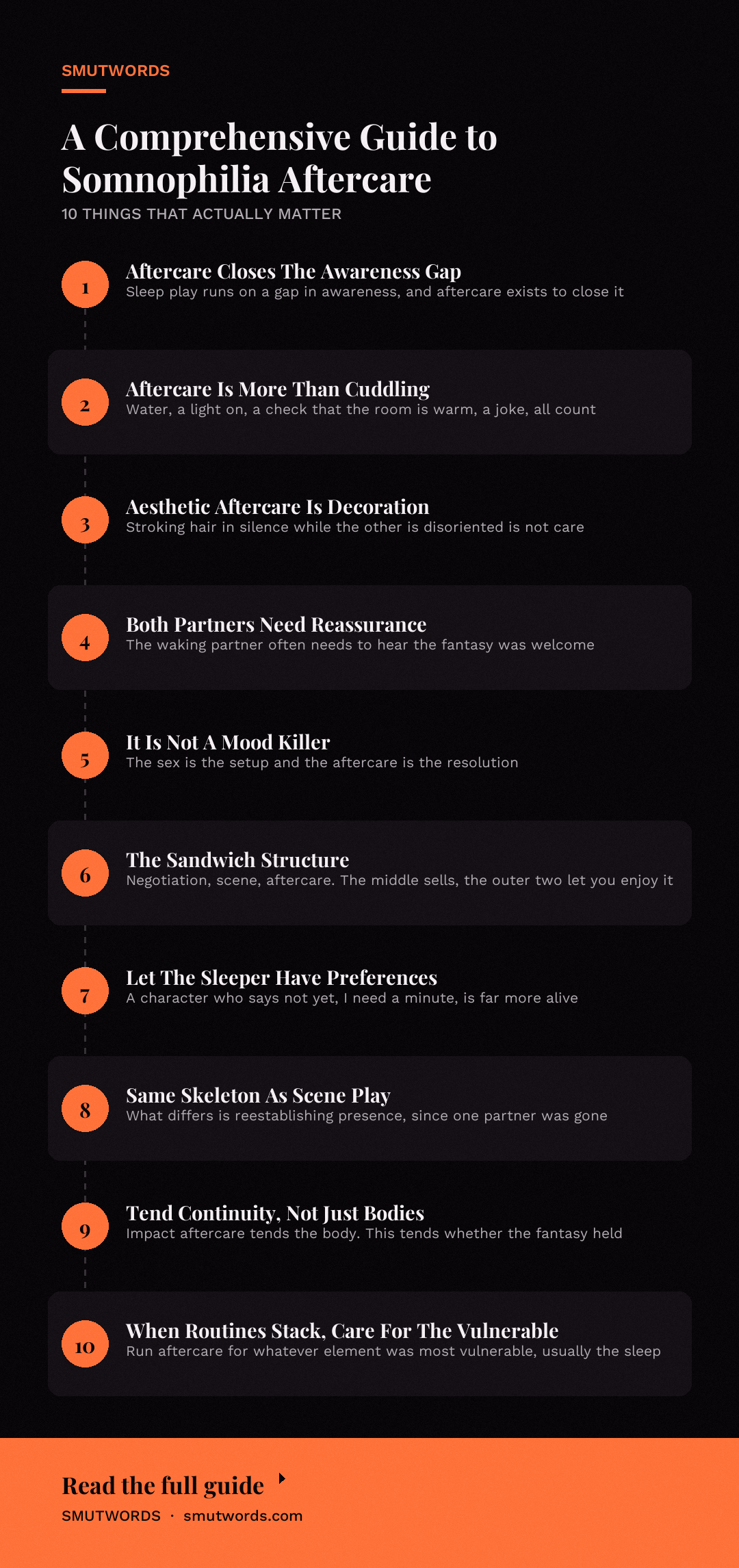
That last clause matters more than it sounds. A somnophilia scene is built on a temporary gap in awareness, and aftercare is specifically the process of closing that gap. The waking partner checks that the other person is genuinely present, not still floating in the headspace the scene created.
The sleeping partner gets to say what they felt and what they need. Reassurance goes both directions.
What counts as aftercare here is broader than people assume. It is not only cuddling. Any deliberate act that reestablishes contact, agency, and comfort after the scene counts: a hand on the sternum, a light turned on, a glass of water, a whispered "are you back with me," a check that the room is warm enough, a stupid joke to break the mood, a conversation about what worked.
What does not count is the fantasy version of aftercare that exists only to be aesthetic. A character who strokes hair and says nothing, while the other person is still disoriented and unspoken for, is not being cared for on the page. That is decoration. Real aftercare in fiction involves information moving between the two people.
A few common misconceptions worth clearing up:
- It is not a mood killer. In strong fiction, aftercare is where the emotional payoff of the scene actually happens. The sex is the setup; the aftercare is the resolution.
- It is not only for the sleeping partner. The waking partner often needs reassurance that the fantasy was welcome. This is especially true when the scene leaned hard into scene play dynamics or into a CNC framing.
- It is not the same as the negotiation that came before. Negotiation sets terms. Aftercare processes what happened. Both are necessary and neither substitutes for the other.
- It is not optional in a scene that used a real sleep state. If one partner was actually unconscious, the care afterward is the whole ethical spine of the thing.
In publishing, the term "somnophilia aftercare" is used loosely. Some readers mean the literal kink-practice routine. Others mean the narrative beat in a romance novel where a character wakes up in someone's bed and the emotional temperature of the relationship gets established. Both readings are valid, and this guide covers both, because the fictional version is what most readers are actually here for.
Where Somnophilia Aftercare Comes From
Sleep play as an erotic premise is old, but its recognizable form in English-language erotica is a twentieth-century thing. Early appearances leaned on the Gothic and the supernatural: vampires visiting sleepers, incubus and succubus figures, ghost lovers. The dream-visit framing let authors write the scene without ever having to answer the consent question, because the visitor was not fully real and the sleeper was not fully present.
As the genre moved toward contemporary settings and human characters, that dodge stopped working. A human partner who has sex with a sleeping person is a human partner who has sex with a sleeping person, and readers started wanting the story to acknowledge it. The aftercare beat grew out of that pressure. It is, in a real sense, a publishing convention that developed because readers kept asking what happened the morning after.
The 1990s and 2000s saw the rise of negotiated-kink romance, where writers began showing the conversation before and after a scene rather than only the scene itself. Fan fiction pushed this further. In slash and kink-focused fandom, tags for aftercare, "checking in," and "aftercare as a love language" became standard practice, and a lot of published authors in the 2010s and 2020s came directly out of that culture.
What changed most recently is the framing. Older wake-up scenes often treated the sleeping partner's arousal as proof that they wanted it, a retroactive justification. Modern versions tend to place the agreement before the scene and use the aftercare to confirm it, rather than treating the scene itself as the evidence. That is a meaningful shift, and it has made the trope far more popular with readers who want the fantasy without the unease.
The current publishing shape is a sandwich: negotiation, scene, aftercare. The middle part sells the book. The outer two parts are what let the reader actually enjoy it.
How It Shows Up in Erotica
On the page, somnophilia aftercare is usually short. One to four pages, often the closing beat of a chapter. Writers who handle it well treat it as a scene of its own with its own tension, not as an epilogue cough. Writers who handle it badly either skip it entirely or write it as pure syrup with no content.
Here's what a strong version tends to do, roughly in order:
- Returns the character to their own body. The sleeping partner wakes in stages. The writer tracks cold limbs, blurry vision, the disorientation of not knowing how long it's been. Physical detail does the work here.
- Establishes location and time. Where is the person, what hour is it, is the door locked, is anyone else around. Small orienting facts are enormous for reader comfort.
- Confirms consent in the present tense. Not a legal speech. A touch, a question, a hand gripped back. The point is that the waking character gets to answer.
- Addresses the waking partner's state. The person who did the touching may be shaky, over-aroused, guilty, or buzzing. Letting them be a person with their own aftermath is one of the truest markers of an author who understands the dynamic.
- Settles the physical scene. Water, temperature, clothing, whether it's time to sleep or time to leave. Mundane care reads as real care.
- Provides the emotional landing. One line of dialogue, usually, that names what the scene was between them. Not a speech. A line.
Common variations authors use:
- The CNC-adjacent wake-up. The sleeping partner was awake the whole time and chose to stay still. The aftercare handles the reveal, often with amusement on one side and sheepishness on the other.
- The long-married version. No negotiation shown on the page; the ritual has been in place for years, and the aftercare is domestic, almost wordless, and devastating because of it.
- The new-partner version. This is the one that has to do the most work. Both characters are figuring out what the other needs, and the aftercare is a live negotiation rather than a rehearsed script.
- The interrupted version. Something goes wrong. The sleeping partner surfaces wrong, or the waking partner misjudged, and the aftercare becomes repair rather than comfort. Harder to write, and it hits harder when it's written well.
- The fantasy framing. A dream sequence, a vampire or fae partner, an unconsciousness spell. The rules are looser but readers still want the reunion to feel chosen.
What separates a strong version from a flat one comes down to whether the writer lets the sleeping partner have preferences in the aftercare. A character who says no, not yet, I need a minute is far more alive than one who accepts everything offered. The same goes for the waking partner. A character who admits they need reassurance is doing more for the scene than a character who performs calm.
There's also a timing question. Some writers rush the aftercare because they think readers only came for the scene. The opposite is true for this trope specifically. Readers of somnophilia are usually readers who enjoy anticipation play as much as the act, and the wake-up ritual is the longest extended anticipation of all.
Enjoyed this? Get a free book.
Join the list and we will send a complete free story straight to your inbox, plus new releases every week after that. No credit card, no catch.
Slowing down after the act is a gift, not a penalty. It gives the reader permission to sit in the fantasy and then set it down gently.
Physical detail in aftercare should be specific. Not "he held her" but the press of his palm against her ribs, the smell of the sheets, the fact that her left arm is asleep and she has to shake it out. Specificity is what makes aftercare feel like care instead of a note the writer added because they'd heard they were supposed to.
One thing worth flagging for writers: a lot of somnophilia scenes in fiction lean on careful, deliberate touch as the mechanism, and the aftercare often uses the same slow hand-work. If you find yourself writing palms flat against skin, you may be circling something the cupping kink glossary entry describes directly. That overlap is not a problem, it's just worth knowing the name for what you're doing.
For writers working with Dom characters, the aftercare is also where domspace gets addressed. A waking partner who spent the scene holding the fantasy together may come down hard afterward, and a scene that shows them being cared for in turn is doing something real, not just balancing the ledger.
Somnophilia Aftercare vs Scene Play Aftercare
The honest answer is that somnophilia aftercare is a species of scene play aftercare, and in practice the two routines overlap almost entirely. Water, checking in, orientation, reassurance. Same skeleton.
What makes somnophilia its own thing is the specific gap in awareness at the center of the scene. In an impact play scene, or a scene built around mummification, both partners are conscious the whole time and usually have continuous feedback. In a sleep-play scene, one partner was gone, or was performing gone, and the aftercare has to explicitly reestablish presence as the first task.
That one difference changes the order of operations and the emotional weight of every beat that follows.
Compare with impact play aftercare specifically. Impact aftercare is largely about tending the body: marks, ice, salve, checking in about pain, managing the crash that follows high-adrenaline play.
Somnophilia aftercare is more about tending continuity. Was the sleeping partner still in it? Did anything slip past them? Is the fantasy still intact for both people?
The checking in matters more than the lotion.
One practical note: some somnophilia scenes are also impact scenes, also restraint scenes, also CNC scenes, and then you're layering aftercare routines on top of each other. The right move when that happens is to run the aftercare for whichever element was the most vulnerable. That's almost always the sleep state, because it's the part where the character wasn't able to tap out mid-scene.
Frequently Asked Questions
What is somnophilia aftercare in simple terms?
The checking in and physical care that happens after a scene where one partner was asleep or pretending to be. It covers waking them up gently, confirming they're okay, giving them water or a blanket or space, and making sure the return to ordinary awareness is unhurried. In fiction, it typically plays out as the closing beat of the chapter.
Is somnophilia aftercare the same as CNC aftercare?
They overlap heavily. CNC aftercare covers any scene with a consensual non-consent framing, and a lot of somnophilia scenes use that framing. The difference is that somnophilia aftercare has the extra job of confirming the sleeping partner's presence once they wake, which CNC scenes without a sleep component don't have to manage.
Why do readers care about aftercare so much in sleep-play romance?
Because the fantasy is only enjoyable if the reader trusts the person doing the touching. The aftercare is the proof. It converts the power imbalance of the scene into chosen tenderness, and that conversion is where the emotional payoff of the trope lives. Skip it and the scene reads unfinished or unsettling.
Does the waking partner need aftercare too?
Often, yes. The partner who carried the active role during a somnophilia or CNC-adjacent scene can drop hard afterward, especially if they were also holding a Dom persona. Reassurance that the scene was welcome, and that they didn't do anything wrong, is frequently the most necessary line of the whole book.
How do you write somnophilia aftercare without it feeling clinical?
Keep it physical and specific, and let both characters want things in it. Not a checklist. A character who reaches for a hand, or pushes a glass of water back across the sheets, or admits they're cold. Mundane detail reads as real care on the page, and real care is what makes the beat land.
Is a real sleep state safe to write about?
It's written about constantly and it can be written responsibly. The elements readers and reviewers look for are clear prior negotiation, an agreed way for the sleeping partner to signal that the scene should stop, and genuine checking in once they are fully awake. Fiction that shows those beats is modeling good practice for readers who might try something similar, and it makes the fantasy safer to enjoy.
Final Thoughts
Somnophilia aftercare is the quiet beat that turns a risky fantasy into a love story. It only takes a page or two, but it's the page readers remember, because it's where the sleeping character gets to have opinions and the waking character gets to be seen as something other than a force.
If you want to see the trope handled with real care, the SmutWords catalog has a strong pick for this exact dynamic at the bottom of this page. It's a good place to start if you've never read the subgenre before. For newer readers, two more useful primer pieces: our breakdown comparing why choose vs reverse harem for sorting out how the romantic structure of a book shapes its kink content, and our guide to the Yes/No/Maybe list if you're negotiating a sleep-play scene of your own and want a real framework to start from.







Loading comments…