
Forest spirit romance is a subgenre of paranormal and fantasy romance where one half of the pairing is a supernatural being bound to the natural world (a dryad, a woodland god, a moss-covered guardian, an ancient tree given a body and a mouth). The other half is a mortal or outsider who wanders into that being's territory. The spirit is old, rooted, and not entirely tame. The mortal is soft, breakable, and usually trespassing.
What follows is a slow, sensory, frequently filthy courtship in which the forest itself becomes a character, a chaperone, and occasionally a third participant. If you have ever finished a book and felt vaguely annoyed that the characters went back to an apartment, this is your genre.
The appeal sits in the collision. A being who has stood in the same grove for six hundred years meets someone who will die in sixty, and the resulting devotion is possessive, patient, and a little alarming. Readers come for the moss and moonlight and stay for the way a creature with no concept of human shame behaves once it decides you belong to it.
What Forest Spirit Romance Actually Means
The term covers a wide spread of supernatural partners who share one trait: their existence is tied to a specific natural place. A dryad bonded to a single oak. A forest god whose mood controls the weather in his valley. A guardian spirit who has protected the same woods since before the nearest town had a name.
Then there are the treants, the stag-headed wild things, the green men with bark for knuckles. All of them belong on this shelf.
The name borrows loosely from folklore (Greek dryads, Slavic leshy, Celtic woodland deities, Japanese kodama) but the romance genre's version is not mythology homework. Authors raid folklore for atmosphere and then invent whatever biology the plot needs. A forest spirit in romance can shift shape, heal wounds, speak to animals, grow flowers in the palm of a hand, or simply be a very tall person with vines in his hair and an unnerving amount of patience.
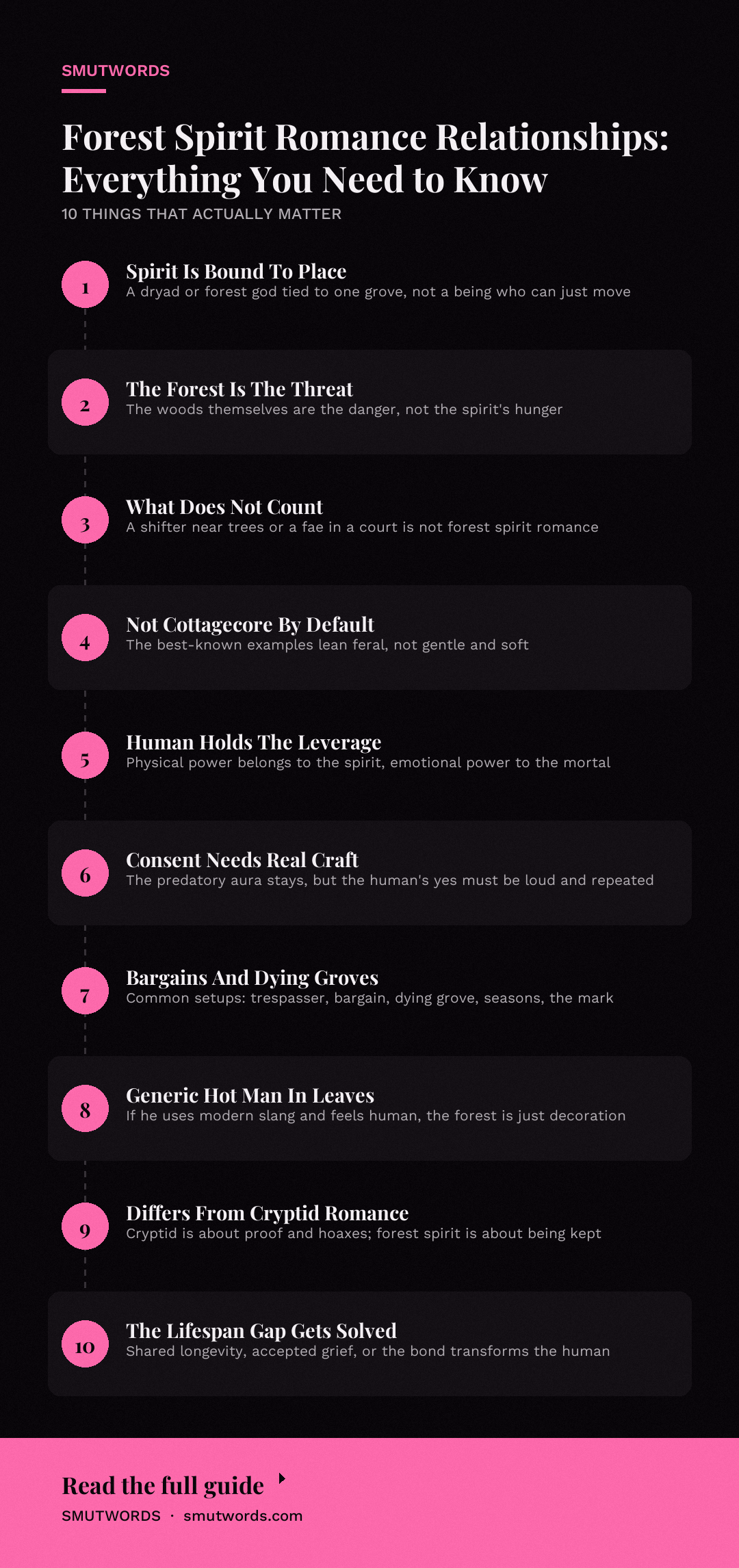
The setting is the threat
What distinguishes this dynamic from other supernatural pairings is that the setting itself becomes an active force. In a vampire romance, the vampire's hunger is the threat. In forest spirit romance, the threat is the forest. Wander off the path and the woods will keep you, and the spirit may or may not be the one deciding whether that counts as rescue or abduction.
The domain is not a backdrop. It is the spirit's body in a broader sense, and everything that happens inside it happens with the spirit's awareness.
What counts
- A mortal or outsider entering the spirit's territory and forming a romantic bond with a being tied to that land
- A spirit whose power, mood, or physical form is affected by the health of the forest or grove around him
- A relationship structured around the gap between an eternal, rooted being and a short-lived, mobile human
What does not count
- A generic shifter who happens to live near trees. If he can leave for a city apartment and nothing about him weakens, he's a wolf with a commute.
- A human love interest who is simply a gardener or a park ranger. Green thumb is not a species.
- A fae romance set in a forest court. The fae belong to courts, politics, and iron taboos, not to root systems. That's a separate dynamic with its own rules.
Common misconceptions
New readers often assume forest spirit romance is automatically gentle and cottagecore. It can be, but the genre's best-known examples lean feral. These are beings with no human social conditioning, no concept of embarrassment, and no interest in whether the neighbors hear anything.
The second misconception is that the mortal partner is passive. The physical power gap is usually enormous, but the emotional leverage frequently belongs to the human, who is the only person the spirit has ever wanted to keep. That tension is where the good books live.
Where Forest Spirit Romance Comes From
Romance publishing has been flirting with woodland lovers for decades, but the dynamic solidified as a recognizable niche in the 2010s, riding the same wave that pushed pack mates romance and monster romance into the mainstream. The explosion of self-published paranormal romance on Kindle Unlimited gave authors room to write increasingly specific creatures.
Once readers proved they would buy a book about a minotaur, a kraken (see kraken romance), or a dinosaur, forest spirits became an obvious next step. Trees are, after all, extremely available.
The roots run deeper than the marketing trend. Nineteenth-century Romantic literature was already eroticizing wild nature, and twentieth-century fantasy gave readers Galadriel's forest and the ents and a thousand stories about mortals who stumble into enchanted woods and come back changed. The romance genre simply finished the thought: changed how, exactly?
Three shifts are worth tracking. First, the move from spirit-as-antagonist to spirit-as-love-interest. Early fantasy treated the enchanted forest as a trap. Modern romance asks what happens when the trap is lonely and desperately wants you to stay.
Second, the shift in the mortal partner's agency. Older versions of this story had the human as a prize carried off by a force of nature. Contemporary versions give the human a job, a reason to be in the woods, and genuine choices to make about staying. The spirit's power is enormous; the human's yes has to be real for the book to function.
Third, the ecological turn. A growing number of authors tie the spirit's wellbeing to real conservation stakes: dying groves, logging companies, drought.
The romance gains a plot engine and the possessive devotion gains a justification. He is not clingy. His forest is literally on fire.
Today the dynamic overlaps heavily with shifter romance, monster romance, and fantasy romance, and readers move between those shelves without much loyalty. The forest spirit is one option in a broader menu of nonhuman love interests that also includes hybrid shifter romance and the many flavors of alien breeding trope. The specific fantasy of being kept by a place remains its own thing.
How It Shows Up in Erotica
On the page, this dynamic runs on contrast between texture and anatomy. Good forest spirit romance is written from the skin outward: bark under fingernails, cold stream water, the smell of crushed leaves, sun through a canopy landing in stripes across a naked back.
The spirit's body is usually the set piece, and authors give themselves permission to write lovers who are partly botanical and partly humanoid. That means the physical logistics are a creative playground.
Vines as restraint. Sap. Roots that surface at exactly the wrong moment. A chest that feels like the trunk of an old tree when you press your palm against it. None of this is subtle, and it is not supposed to be.
Common variations authors use
- The trespasser: the human enters the woods by accident (lost hiker, researcher, fleeing something) and the spirit decides they are not leaving until he understands why they came.
- The bargain: the human trades something to the forest (time, memories, a season) and the price is paid in intimacy rather than blood.
- The dying grove: the spirit is weakening with his land, and the human's presence revives him in ways that are both literal and extremely horizontal.
- The seasons: the spirit's temperament, body, and appetite change with the wheel of the year. Winter is cold and possessive. Spring is insatiable.
- The mark: mortals who lie with the forest spirit come back with something (a scent, a green ring around the iris, a fertility that terrifies the village) and have to live with the consequences.
What makes it work
The strongest versions keep three plates spinning at once: sensory immersion, real power imbalance, and ongoing consent. The imbalance should be genuinely felt. The human should be aware, more than once, that they are not in control of what the forest can do to them, and the book should make that awareness part of the arousal rather than pretending it doesn't exist.
Enjoyed this? Get a free book.
Join the list and we will send a complete free story straight to your inbox, plus new releases every week after that. No credit card, no catch.
Consent here requires more craft than in a standard contemporary, because the spirit's predatory aura is part of the fantasy. The workaround is not to soften the spirit. It is to give the human loud, repeated, unmistakable agency: asking, initiating, demanding, naming what they want while the spirit waits.
A forest spirit who pauses to check, with obvious effort, is more frightening and more attractive than one who never does. Readers who want help structuring that kind of negotiation on and off the page should look at this guide to the yes/no/maybe list; the same toolkit maps directly onto "what will I let the ancient thing do to me" conversations.
Physical scale matters too. Many forest spirits are written several heads taller than their partners, with hands that could close around a human ribcage. That is deliberate, and it shares DNA with the broader appeal of size difference romance. The smaller partner's vulnerability is the point, and so is the spirit's care in handling it.
What makes it flat
Books fail this dynamic in predictable ways. The most common is a spirit who reads as a generic hot man in a leaf crown: no nonhuman logic, no weird priorities, no moments of genuine alienation. If he understands jealousy and sarcasm and modern slang without effort, the forest is decoration.
The second failure is a mortal with no life to leave behind. The choice to stay in the woods only lands if there was something to walk away from. Give the human stakes and the ending hurts in the right way.
The third is skipped consent. When the spirit overwhelms the human with no check-ins, no negotiation, and no sign that the human's no would be respected, the fantasy collapses into something the reader can't safely enjoy. The possessive, almost feral devotion readers love only works when it is clearly chosen.
Finally, thin world-building kills immersion. If the forest has no rules, no boundaries, and no cost, the reader stops believing it could keep anyone. Every grove should have a perimeter, a price, and at least one thing the spirit cannot do.
Forest Spirit Romance vs Cryptid Romance
These two get confused constantly, partly because both involve a nonhuman love interest encountered in the wild. The difference is what the being is and where its power comes from.
A forest spirit is bound to a place. Take him out of his grove and something breaks, either in him or in the land. His devotion is expressed through territory, protection, and a claim that runs through root systems.
A creature in cryptid romance is a mystery first and a resident second: Bigfoot, Mothman, a lake monster, something that exists to be glimpsed and doubted. Cryptid romance leans into hoax culture, blurry photos, and the tension between the creature's elusiveness and his desire to be seen by exactly one person.
Forest spirit romance is not about proof. Everyone in the village knows the woods are alive. The question is whether the spirit will let you stay.
Frequently Asked Questions
Is forest spirit romance the same as dryad romance?
Dryad romance is the most common flavor, since a dryad is by definition a tree-bound spirit. The broader category also includes woodland gods, forest guardians, treants, and nature spirits who are not tied to a single tree. If you're searching for a specific book, dryad is a useful keyword; if you're browsing the shelf as a whole, forest spirit romance is the wider term.
Do these books always involve a mortal human partner?
Usually, because the human is the reader's way in and the source of the power imbalance. Some authors swap in a witch, a shifter (often a wolf, which creates fun friction with territorial shifter trope conventions), or another supernatural being. The dynamic still needs one partner who is soft, temporary, and out of their depth to keep the contrast alive.
How explicit do forest spirit romances get?
It varies widely. Some are slow-burn fantasy with a single closed-door scene, and plenty are full explicit with botanical anatomy on display. The sensory emphasis of the setting means even the tamer books tend to be lush and physically detailed. Check content notes if you want a specific heat level.
Why does the spirit always seem so possessive?
Because possession is the genre's central fantasy: being wanted by something ancient, powerful, and completely undivided in its attention. A forest spirit doesn't have a job, a phone, or a dating history. He has you, the woods, and centuries of patience. That single-minded focus is the entire appeal, and readers will forgive a lot of feral behavior in exchange for it.
Can a forest spirit romance have a happy ending?
Absolutely, and most do. Authors handle the lifespan gap in a few standard ways: the human gains a share of the spirit's longevity, the human chooses a mortal life and the spirit accepts the grief, or the bond itself becomes a kind of transformation. What matters is that the ending respects the cost of the pairing instead of waving it away.
Where should a new reader start in this niche?
Figure out which piece of the fantasy you want most. If it's the wild setting and the sensory writing, look for lush, descriptive authors. If it's the power imbalance and the danger, look for darker titles with clear content warnings. If it's slow tenderness with a nonhuman partner, look for the cottagecore end of the shelf.
Then check a ranked list from a trusted source rather than guessing from covers.
Final Thoughts
Forest spirit romance works because it takes the oldest fantasy in the genre (someone enormous and inhuman wants you specifically) and roots it in a place you can smell. The good ones make you believe the woods are watching. Better ones make you want them to keep watching.
If you're new to the dynamic, start with a book that takes its time in the trees. If you prefer your romances with more than one nonhuman option on the table, the why choose vs reverse harem breakdown will tell you which shelf to browse next.





Loading comments…