
The marriage bed trope is the erotic engine of a relationship already built. A married couple whose physical intimacy has stalled, broken, or turned into a battlefield has to find their way back to each other inside the vows they already made. No meet-cute, no will-they-won't-they. The rings are on. The mortgage is signed.
The question is whether two people who once couldn't keep their hands off each other can remember how, and whether wanting to is enough. Every touch arrives pre-loaded with history. Every reconciliation has to be earned in front of a reader who has watched the distance grow.
What the Marriage Bed Trope Actually Means
The name comes straight from the oldest euphemism in the language. "The marriage bed" has meant the sexual relationship of a married couple for centuries, and the phrase carries a specific weight: sex with obligation, history, and witness attached.
When a story centers the marriage bed, the bed itself becomes a character. Sometimes a graveyard. Sometimes a neutral zone. Sometimes a place two people circle like animals who don't trust the ground.
The trope is not simply "married couple has sex." That's a category of character, not a plot. The marriage bed trope requires a problem. The intimacy has stalled, fractured, or become a site of tension, and the narrative is about the repair. The conflict lives inside the relationship, not outside it.
What counts:
- A couple whose sex life has gone silent and the story tracks the thaw
- An arranged or political marriage where consummation is a negotiation, not a given
- Estranged spouses forced back into proximity who have to relearn each other's bodies
- A marriage surviving infidelity, where physical intimacy has to be rebuilt from wreckage
- Two people who love each other but have stopped touching, and both know why and won't say it
What doesn't count: a couple who starts the book happy and stays happy. A one-night stand that becomes a marriage. A marriage used only as backstory before the real couple meets. The marriage bed trope needs the marriage itself to be the problem and the point.
The most common misconception is that this trope is inherently sad or low-heat. Readers assume "marriage in trouble" means emotional literary fiction with the bedroom door closed.
In erotica the opposite is often true. The stalled marriage is an excuse to write longing at maximum volume. When two people who know exactly what the other's mouth feels like have to ask permission again, the charge is enormous.
Another misconception: the trope requires a villain. It doesn't. Sometimes the villain is a miscarriage, a grief neither partner processed, a decade of small refusals that added up to a wall. The best versions refuse to hand the reader an easy person to blame.
Where the Marriage Bed Trope Comes From
The marriage bed is older than the novel. Medieval and Renaissance literature treated the consummation of a noble marriage as a political event, and the wedding-night scenes in those texts are transactional, public, and tense. Shakespeare's problem comedies flirt with it constantly. Marriages contracted in act one have to be made real by act five, often with a bed trick standing in for the truth.
In the history of erotic publishing specifically, the marriage bed became a reliable frame in the eighteenth and nineteenth centuries, when a wedding night could justify explicit content that a seduction plot could not. A married couple having sex was respectable. The reader got the heat and the moral cover in the same package.
The twentieth century shifted the emphasis. Mid-century pulp and paperback originals used the "sexless marriage" as a launchpad for adultery plots, where the marriage bed's coldness justified everything that happened outside it. The wife who wouldn't, the husband who stopped seeing her, the neighbor who did. That version was usually a tragedy or a cautionary tale.
Contemporary romance flipped the script. The Marriage in Trouble category, which the marriage bed trope usually lives inside, treats the repair as the romance. The couple is the love story. The affair, if there is one, is a wound, not a solution.
Over the last two decades, the arranged-marriage and marriage-of-convenience subgenres exploded. Those books almost always include a consummation the couple has to negotiate rather than assume.
The genre has also gotten more honest about why marriages go quiet. Early versions blamed the wife's frigidity or the husband's wandering eye. Modern versions blame grief, postpartum depression, chronic illness, career resentment, the slow arithmetic of who does the emotional labor. The bed is cold because something upstream froze, and the story has to thaw the source.
How It Shows Up in Erotica
Craft-wise, the marriage bed trope gives an author a foundation most romance has to spend fifty thousand words constructing. The couple already has inside jokes, a shared bathroom routine, a fight they've had nine times.
The scene where they finally touch again lands because of what it isn't. Not the first time. The first time since.
The strongest versions use the physical space of the bed as a narrative device. The side of the bed one partner no longer sleeps on. The pillow that smells wrong. The moment someone rolls toward the middle and stops.
These are genre conventions, and readers who love this trope are reading specifically for them.
Common variations authors use:
- The arranged consummation: a contract marriage with a deadline, and the wedding night becomes a slow negotiation of consent, curiosity, and performance. Often overlaps with Hate to Love energy early on.
- The dry spell: a modern couple whose intimacy died of exhaustion and small grievances. The repair is quiet, dirty, and often starts in a kitchen or a car before it reaches the bed.
- The estrangement reboot: separated spouses forced together by a funeral, a house sale, a sick parent. Physical proximity does the work.
- The infidelity recovery: the hardest version. The bed has to be reclaimed after it was betrayed. This variant demands the most careful writing because the reader has to believe the hurt and the healing at the same time.
- The consummation in a fantasy or historical setting: political marriage, monster bridegroom, clan alliance. The power imbalance and the public stakes crank the tension. Readers who like this version often like Monster Breeding Romance for similar reasons: a marriage that has to be made real by a body that doesn't fully understand the terms yet.
- The bedroom deadlock: neither partner initiates because both are waiting. The entire scene is who moves first.
What separates a strong marriage bed book from a flat one comes down to three things. First, the reason the bed went cold has to be specific. "We grew apart" is not a reason. "I told her about my father's diagnosis and she said 'that's rough' and went back to her phone, and I never told her anything real again" is a reason.
The specificity is what makes the reconciliation feel earned.
Second, the couple has to actually want something from each other that isn't just sex. The best scenes are about a need under the need. He wants to be chosen without asking.
She wants to be seen as a person and not a function. The sex is how both of them say it without saying it.
Enjoyed this? Get a free book.
Join the list and we will send a complete free story straight to your inbox, plus new releases every week after that. No credit card, no catch.
Third, the writing has to trust the reader to hold two truths. The couple loves each other. The couple has also hurt each other badly and is not sure they can stop. Readers who love this trope have a high tolerance for emotional ambivalence and a low tolerance for a tidy fix.
For authors moving into this territory, one note: the marriage bed trope pairs beautifully with a physical setting that forces contact. The classic move is a remote house, a snowstorm, a hotel room with one bed.
This is why you see the trope overlap so often with the structure covered in the piece on cabin in the woods romance: external isolation creates the conditions for internal repair. If you're writing a couple back into each other's bodies, being far from the life that drove them apart does half the work for you.
Another note on heat level. The marriage bed trope reads hotter than a first-time hookup for many readers because consent has a different flavor when it's given inside a marriage. Not permission to touch someone new.
Permission to want someone you already have. That specific charge, the familiarity plus the vertigo, is what the trope is for.
Readers who gravitate here often also respond to shared fantasy dynamics between kinky couples, because the same negotiation of trust applies. A married couple has to name what they want out loud for the first time in years, and naming it out loud is the scene.
Handling the flashback matters more than most authors expect. The temptation is to show the couple's original courtship in warming detail so the reader knows what was lost. Overdone, that flattens the present.
The strongest books drop flashbacks in fragments, and only where the present can't carry the weight alone. One sentence about how he used to find her shoes in the hallway can do more than three pages of remembered sex.
Marriage Bed Trope vs Enemies to Lovers
These two get confused constantly, especially in romance rec threads, because both feature hostile banter and a long fuse. The difference is the history.
Enemies to Lovers starts with two people who have negative ground to cover. They don't know each other, or they know each other badly. The arc is building trust from zero.
The marriage bed trope starts with two people who already built trust and then lost it. The arc is restoring, not constructing. That's why the emotional register is different. Enemies-to-lovers reads like sparking.
Marriage bed reads like coaxing a fire back from coals. An author can run both in the same book, which is why so many arranged-marriage romances feel like a mashup, but the underlying engine is not the same.
Frequently Asked Questions
Is the marriage bed trope the same as Marriage in Trouble?
They overlap heavily, but they aren't identical. Marriage in Trouble is the broader category: any romance where the central relationship is an existing marriage under strain. The marriage bed trope is the version of that story where physical intimacy itself is the battleground, the site of the conflict, and the site of resolution.
You can have a Marriage in Trouble book with no sexual tension at all, like a couple fighting about money or a move. You can't have a marriage bed book without it.
Does the marriage bed trope always involve an arranged marriage?
No. Arranged marriage consummation is one variant, usually a historical or fantasy one, but the trope works perfectly in a contemporary setting with a couple who chose each other and then drifted. The dry spell, the postpartum recovery, the couple who stopped initiating because both were tired of being rejected: these are the modern versions and they're the fastest-growing slice of the category.
Why is this trope so popular right now?
Because it lets a reader have the heat of a new relationship with the emotional safety of an old one. There's no anxious "will he text back" energy. The marriage already exists.
What the reader gets instead is the shock of familiar bodies rediscovering each other, which hits a different and often deeper nerve than a first hookup. It's also a trope that rewards older protagonists, and the romance readership has been asking for those for years.
Can the marriage bed trope work without a happy ending?
In erotica and romance, almost never. The genre contract is that the couple ends the book together, and the marriage bed trope is built entirely around repair. A version that ends in divorce reads as literary fiction, not romance, and readers who search for this trope are specifically looking for the reconciliation. If you want an unhappy ending, the marriage itself probably isn't the right frame.
Is infidelity required for this trope?
No, and most readers prefer it without. Working through infidelity is one of the darkest variants, and it's a much harder sell than the dry spell or the estrangement.
Many readers find the cheating version emotionally exhausting in a way that undercuts the fantasy. The core appeal is repair, and the affair version has more wreckage to clear before the repair can start.
What's a common mistake authors make with this trope?
Making the reconciliation too fast. The couple fights in chapter three, has incredible sex in chapter four, and everything's fine by chapter five. Readers of this trope want the thaw to take time. They want at least one scene where one partner initiates and gets turned down, or where they almost touch and don't.
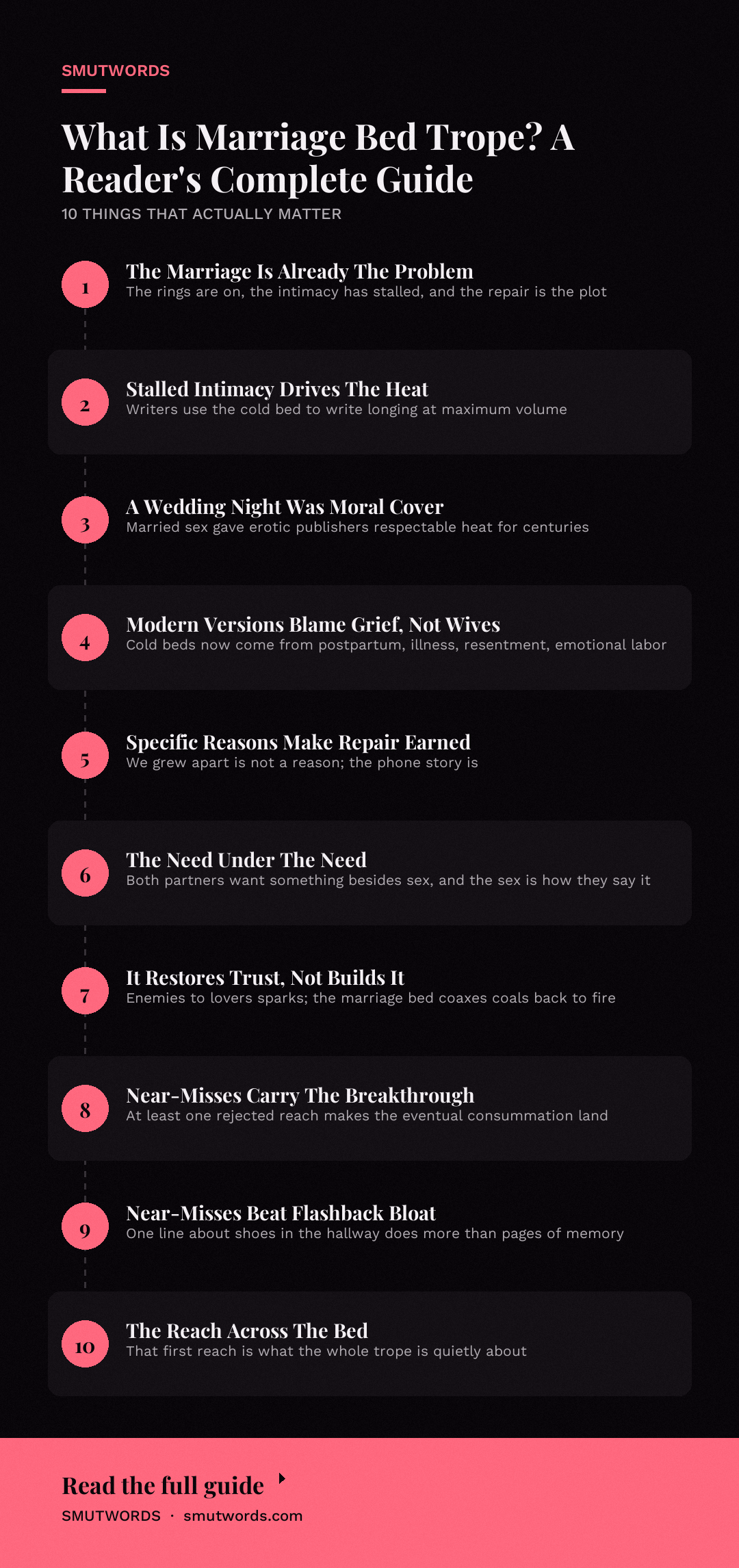
The near-misses are the point. Without them the eventual consummation reads like a plot beat instead of a breakthrough.
Final Thoughts
The marriage bed trope isn't for readers who want the thrill of a stranger. It's for readers who want the higher stakes of wanting someone who has already seen them at their worst and stayed anyway. If you're new to the trope, start with a strong arranged-marriage historical, the kind where the wedding night is a contract to be renegotiated line by line.
Pay attention to how the author handles the first time one of them reaches across the bed. That reach is what the whole trope is quietly about.








Loading comments…