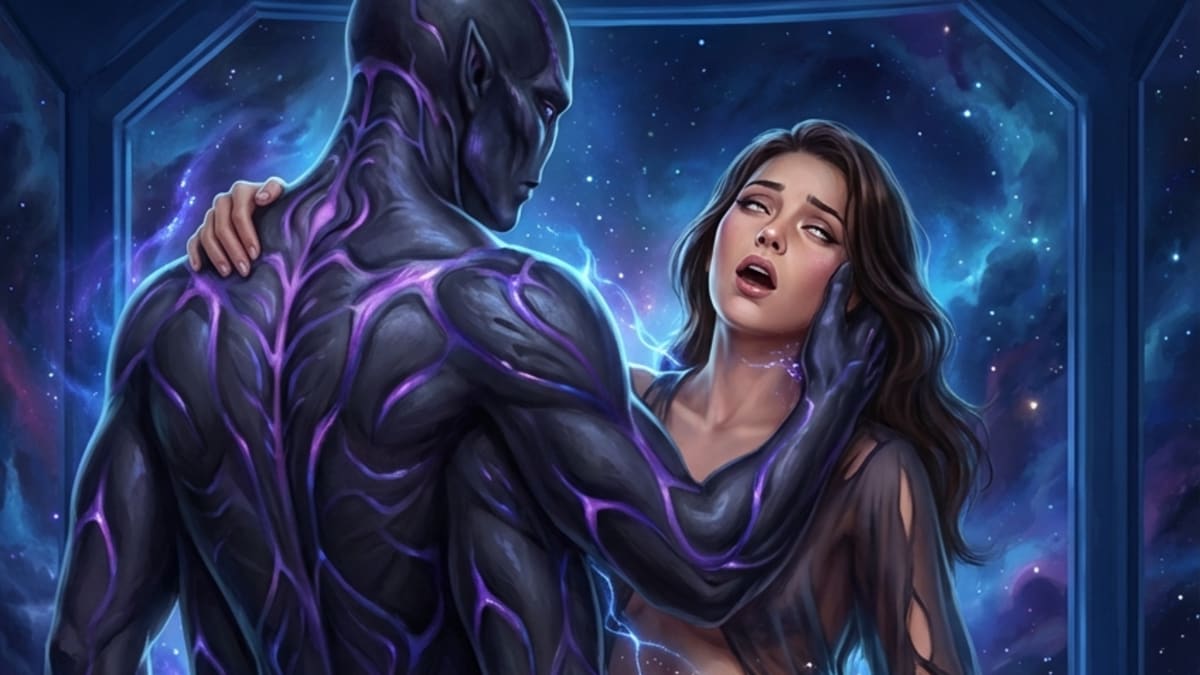
Fae romance books occupy a weird slice of the monster romance shelf. No claws, no tentacles, no hulking physiques that would fold a human in half like laundry. The fae love interest is usually gorgeous, well-dressed, and capable of speaking in full, grammatically correct sentences. That makes him worse, somehow. A minotaur will just tell you he wants to claim you, and then he does it, and there's a frankness to that which is almost relaxing. The fae will offer you a glass of wine, compliment your eyes, and by the time the night is over you've agreed to surrender your firstborn child and also your sense of self-respect, and you still aren't entirely sure how it happened.
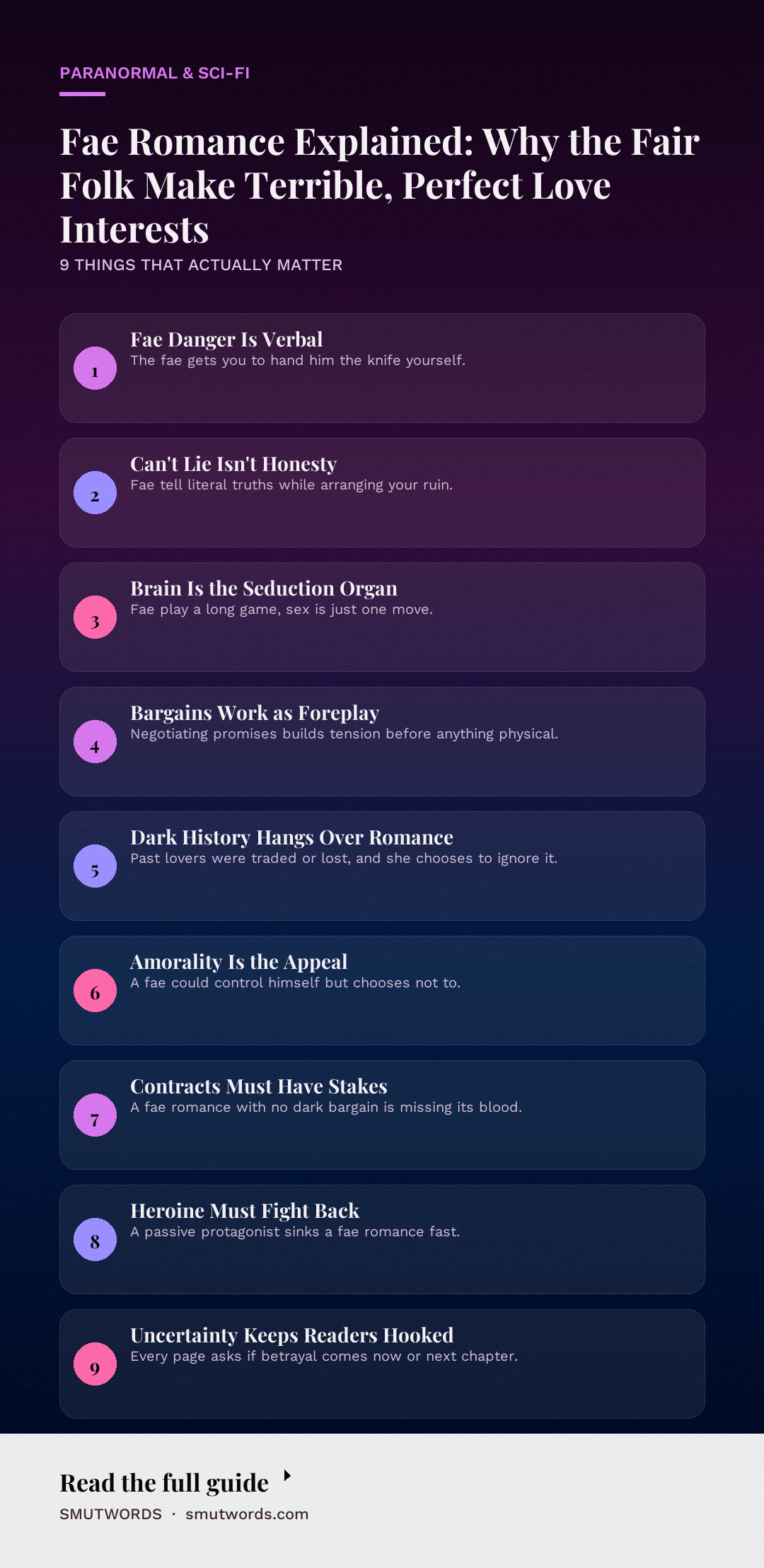
The appeal of the fae lover is not that he's safe. It's that the danger is verbal, social, and intimate in a way that being chased through a forest by an orc never quite is. The fae is the monster who gets you to hand him the knife yourself.
Why the "Can't Lie" Rule Makes Fae Better Liars
Here's the thing about the fae inability to lie. It's the single most romanticized piece of folklore in the entire genre, and it gets misunderstood constantly. The fae can't tell a direct falsehood. That's not the same as being honest. Not even close.
A fae can tell you that the two of you are destined to be together. He can say it with his hand over his heart and perfect sincerity, and it can be absolutely true. What he doesn't have to mention is that destiny also includes your gradual transformation into a decorative garden ornament once he gets bored of you, or that his definition of "together" involves the next five hundred years and very little input from you on the subject.
What readers actually want from fae romance books is that specific tension: someone who cannot lie to you but will absolutely manipulate you into a situation you never saw coming. The honesty is technical, literal, and weaponized. He'll tell you he's never going to hurt you, and he means it, and then he'll arrange a series of events that lead to you being hurt by someone else while he watches with a mildly apologetic expression. Technically correct. Terribly cruel. Perfectly in character.
This is what separates the fae from every other monster type. An alien wants to breed you because biology. A demon wants to corrupt you because damnation. A fae wants to own you because he finds you interesting, and his idea of courting is a year-long campaign of psychological warfare dressed up as polite conversation.
How Fae Romance Differs From Other Monster Love Interests
Put a fae next to the other standard monster boyfriend types and the contrast gets sharp fast.
- Orcs and minotaurs operate on honesty of the body. They want, they take, they claim, and the whole transaction happens out in the open. No verbal games.
- Demons and incubi are transactional about it. They want your soul, your virtue, or your sexual submission, and they're upfront that the deal has a price.
- Aliens and tentacle monsters are usually running on pure biological imperative. Their interest in you isn't personal; it's procreational.
- Fae are the only monster archetype where the primary organ of seduction is the brain. They're playing a long game, and the sex is just one move on the board.
The fae lover operates on contracts, loopholes, and the precise wording of every promise exchanged. He's the only monster who can ruin you without ever raising his voice, and that's the whole point. The reader isn't afraid he'll snap her spine in the throes of passion. She's afraid she'll wake up one morning and realize she signed away her autonomy in exchange for a really good kiss.
And then she does it anyway, because the kiss was really that good.
The Bargain as Foreplay
A properly written fae romance understands that the deal itself is the seduction. The exchange of promises between the fae and the human heroine functions as a kind of verbal foreplay, getting both parties worked up before a single piece of clothing comes off. He offers her three nights of pleasure in exchange for one kiss. She negotiates. He counters. The negotiation is charged in a way that's genuinely erotic, because the stakes are real and the tension is verbal.
The best fae romance books make the contracts genuinely clever. Not just "I'll protect you if you give me your name" but actual wordplay where the heroine has to think fast, catch his phrasing, and outmaneuver him within the bounds of his own rules. A heroine who matches the fae's energy, who gives as good as she gets verbally, is the absolute ideal pairing. She's the one who has a real chance of walking away with her soul intact, which only makes the fae want her more.
This is where the trope gets into genuinely interesting territory. The fae who meets his match, who finds a human clever enough to duel with him in contracts, is inevitably undone by it. He falls for her precisely because she's the one creature who can play his game. That fall is the redemption arc, such as it is. He doesn't become a good person. He just becomes a person who is good to her, which for the purposes of the romance is exactly the same thing.
The Fae Lover and Everyone He's Already Traded Away
A true fae romance needs the dark history. Fae live for centuries, and your immortal love interest has loved before. A hundred times before. Those prior loves went badly, possibly because he traded them to a rival court for political advantage or let one of them age into dust while he was away on a hunting trip. He doesn't bring this up voluntarily.
The modern fae romance handles this gracefully by having the heroine be the one who forces the confrontation. She asks about the portrait in the west wing. She notices that the servant's eyes are too blank, too loyal, too much like someone who's had all their will siphoned out of them. Good fae romance books let the heroine be suspicious enough to ask the hard questions, and they let the fae be old enough to have genuinely regretful answers.
What the genre does extremely well is taking the old fairy tale bargain, where a human pays a terrible price for a fae favor, and romanticizing it into a relationship built on mutual need. The heroine needs something. The fae wants her. The price is her, to some degree. And somewhere in that transaction, against all odds, real affection develops. The history of everyone who came before her, everyone who got traded or lost or locked away, hangs over the relationship as a threat she has to consciously choose to ignore.
Enjoyed this? Get a free book.
Join the list and we will send a complete free story straight to your inbox, plus new releases every week after that. No credit card, no catch.
That choice, by the way, is part of the fantasy. She's not naive enough to believe he won't do it to her. She's just willing to take the risk.
The Inevitable Amoral Center
Fae romance books force the reader into a morally interesting position. You're rooting for a relationship with someone who genuinely cannot be trusted, who would sell you to a rival court if the terms were right, who has an entirely different relationship with concepts like consent and ownership than any human does. The hero is a colonizer of souls, essentially, and you're supposed to want the heroine to keep him.
That's the fun of it. There's a distinct pleasure in the forbidden that other monster romance doesn't quite hit, because the fae's amorality is so much more articulate than a brute's instinct. An orc who can't control himself is forgivable; he's an animal. A fae who absolutely could control himself but chooses not to is a different kind of creature entirely. He knows exactly what he's doing when he mends the tear in her dress, and he knows exactly what that gesture costs her emotionally.
The heroine who goes into a fae romance with clear eyes, who knows the risks and takes them anyway, is the core appeal. She's not being deceived, necessarily. She's being seduced, and the seduction includes the full, unvarnished warning of what she's getting into. The fae tells her the rules. He can't lie, after all. She just doesn't fully understand what the rules mean until it's too late to back out.
When Fae Romance Works vs. When It Falters
Not every fae romance lands the landing. The trope is easy to get wrong, and a poorly written fae love interest sinks the whole book faster than almost any other monster type.
A fae works when:
- He's genuinely dangerous verbally, not just sternly handsome with pointed ears.
- The heroine is smart enough to keep up with him in a negotiation.
- The contracts and bargains have actual stakes and clever wordplay.
- His amorality is present, not sanitized into "he's actually a nice guy who just can't lie."
- The love feels earned through the verbal sparring, not declared out of nowhere.
A fae falls flat when:
- He's just a human man with a glamour and a generic desire to protect the heroine.
- The can't-lie rule gets forgotten halfway through because the author needed a dramatic reveal.
- The heroine is passive, just waiting to be rescued or claimed with no pushback.
- There's no actual price paid. A fae romance with no dark bargain is like a vampire romance with no blood. Something's missing.
The type of romance that plays with verbal tension and dark bargains isn't exclusive to the fae, either. A different kind of chaotic negotiation runs through demon and incubus romance books, where the devil's bargain is the entire point of the seduction. The fae version just happens to be dressed in courtly manners and silk.
Why We Keep Going Back to the Fair Folk
The phrase fae romance books gets searched for a lot, and it's not hard to see why. The fae lover is the fantasy of being wanted by someone who is out of your league in every conceivable way, someone whose attention is a privilege and whose desire is a compliment. He's ancient, powerful, beautiful, and utterly devoted to you specifically, even though he's seen empires rise and fall and he's loved a thousand other women who are now bones.
Maybe the appeal is the risk. The fae is the one monster you can't rely on to protect you from himself. You can read an orc romance knowing the hero would tear the world apart for his mate. You can read a kraken romance knowing the deep has no judgment. You can't read a fae romance with any certainty at all. Every page is a question about whether he's going to betray her next chapter or the one after that.
That uncertainty, the delicious dread of never knowing if you're reading a love story or a horror story in disguise, is the whole game. The fae lover keeps you off balance the way he keeps the heroine off balance, and some readers never want to be on solid ground again.
And if the fae's absolute commitment to claiming a mortal for his own gives you a taste for possessive, all-consuming romance where the "hero" is the most dangerous part of the story, the reverse side of that fantasy lives in stories like Taken by the Celestial King, where the cosmic scale of the desire is the point, or Officer's Orders: Breed Her, where the command and the claiming are woven into the same thread.
Final Thoughts
The fae romance hero is the monster who will ruin you with his manners, and that's precisely why he's worth reading about. He offers the fantasy of being so thoroughly known and desired that even his manipulations feel like devotion. Start with a fae romance that actually commits to the cruelty and the contracts, one where the heroine fights back and the negotiation is half the fun. Let him lie to you by telling nothing but the truth, and enjoy the fall.





Loading comments…