
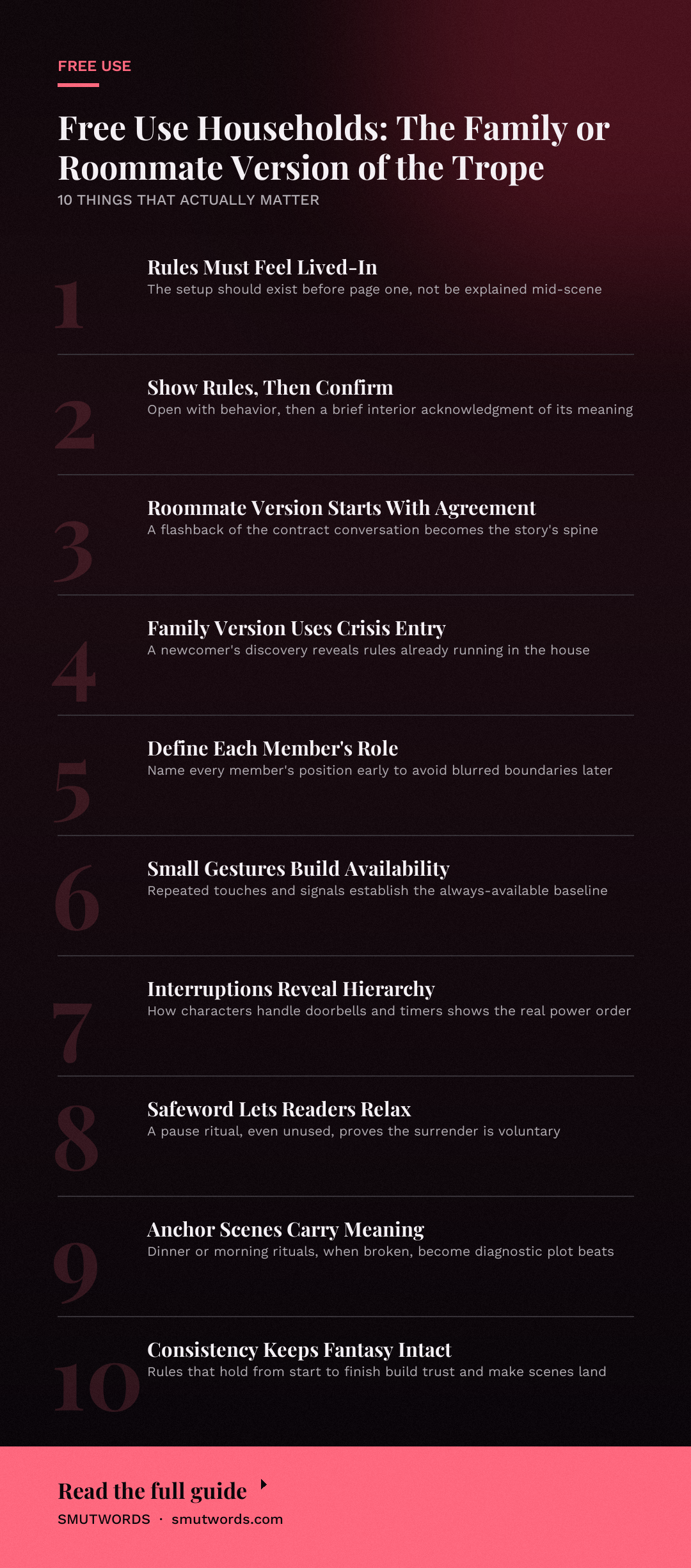
The first thing a good free use household story does is make you believe the rules existed before page one. Not as a prologue dump, and not as a character stopping mid-scene to explain the whole system to a newcomer for the third time. The rules need to feel lived-in, like the house has been running this way for months, and everyone who lives there has already stopped noticing the strange parts. That lived-in quality is the whole appeal of free use household fiction. The fantasy isn't the first time someone gets grabbed in the kitchen. It's the morning after, when nobody makes a big deal out of it, because this is just how Tuesday works in this house.
Authors who nail the premise do their world-building in the first chapter, sometimes in the first few pages. They establish what counts as "available," who counts as "household," and what happens when someone needs a pause. The rest of the book then runs on that foundation without constantly re-explaining it. When the setup is that quiet and that consistent, readers stop looking for the seams. When it isn't, you get a story where the rules change every time the plot needs them to, and the whole thing falls apart.
So what does the opening act of a good free use household actually look like? Let's talk about the specific moves authors use to set the stage.
The Household Contract: How Authors Establish the Rules Early
The best free use household fiction opens with a concrete scene that demonstrates the rules in action, not a monologue that explains them. There's a difference between showing a woman walking into the living room and kneeling beside her husband's chair without being asked, and having the narrator tell us she does that every evening at seven. The first lands because we see the behavior. The second lands because we trust the narrator. Most strong openers use both, but they sequence it: a scene first, then a brief interior acknowledgment of what the scene means.
Take the roommate version, where two friends sign a lease with an attached addendum that nobody at the leasing office ever sees. The rules here are usually narrower than the family version. Maybe the deal only covers evenings. Maybe it only covers one specific room. The best roommate-set stories start with the agreement itself, often as a flashback to the conversation where one of them brings it up over takeout and the other says yes a little too fast. That agreement becomes the spine of the book. Every later scene checks back against it, and the tension comes from watching the characters push at the edges of what they originally consented to.
The family version, or the found-family version, usually needs a different entry point. If the characters already live together, there's no "moving in" moment to hang the premise on. So the story often opens with a point of crisis that reveals the existing arrangement, like a new step-sibling discovering what happens after midnight in the downstairs den, or a college student coming home for the summer and finding her childhood bedroom assigned a new purpose.
The free use setup predates the protagonist's arrival, which lets the author reveal the rules across several scenes instead of all at once.
Whatever the household shape, readers need a few specific questions answered by the end of the first act. Is this arrangement daily or occasional? Does it cover all sexual acts, or only certain ones?
Are the household members exclusive to each other, or does the arrangement extend to guests? What happens when someone is sick, exhausted, or genuinely not in the mood? The answers can be different in every book. The requirement is that the answers exist, and that they stay consistent once they're established.
For a deeper look at how the broader fantasy operates across different settings, the overview of free use erotica does a good job of mapping the shared assumptions most of these stories run on. A lot of the household stories borrow from that larger playbook, then shrink it down to fit inside four walls.
Who Counts as Part of the Household?
Boundary-setting starts with population. A free use household story needs a clear answer to who has access to whom, because that answer determines every scene that follows.
The family version tends toward a small, intimate group: a father and his adult daughter, a brother and sister, sometimes a parent and the live-in tutor or nanny who's been folded into the arrangement. The roommate version runs the opposite direction, often including guests and visitors as the story progresses. The roommate story starts with two people and a lease, then expands the guest list when the plot needs fresh energy or a specific act one roommate doesn't provide.
Authors who handle this well give each household member a role that maps to their place in the arrangement. You can tell who the primary free use partner is within the first few pages, because they're the one whose gaze the protagonist keeps meeting across the room. The secondary members get defined by their specialties or their timing, like the roommate who only participates on weekends, or the housemate whose role is limited to certain kinds of scenes.
A good test for whether the population is working: can you name every household member's role after the first three chapters? If you can't, the author has likely blurred the lines in a way that will start causing problems later. Every member of a free use household needs a defined position, even if that position is "the one person who isn't part of the arrangement and doesn't know about it." That outsider is often the most important character in the first act, because their discovery of the rules becomes the mechanism for showing us everything.
Sometimes the household needs a disruptor, and paired with a forced proximity setup, that dynamic can get especially interesting. A character trapped in the house by weather, injury, or circumstance has to negotiate the existing free use system from the inside, and the negotiation reveals all the unwritten rules the regular members take for granted.
Establishing the "Always Available" Baseline
The core promise of free use is availability without a request. In household fiction, that baseline gets established through small, repeated gestures that happen without verbal negotiation. A hand sliding up a thigh at the dinner table. A collar left on the nightstand that the protagonist puts on every morning before breakfast. A specific seat at a specific table that means something, and everyone in the house knows what it means.
The most effective versions of this do two things at once. They show the behavior, which establishes the rule, and they show the protagonist's internal reaction to it, which establishes the emotional texture. If the protagonist is new to the arrangement, their heart rate spikes. If they've been in it for years, the response is quieter, more settled, maybe even bored until a particular partner does something that breaks their rhythm.
Both versions work. The bored version is harder to pull off, because it risks reading as flat, but when an author manages it, the eventual scene that finally cracks the protagonist's composure lands twice as hard.
One recurring trick in strong free use household fiction is the rules for interruptions. A free use household is still a household, and real life intrudes. The phone rings. The doorbell buzzes. The lasagna timer goes off in the middle of something important. How the characters handle those interruptions tells the reader more about the household's hierarchy than any explicit rule dump could. If the protagonist stops what they're doing to answer the door wearing only an apron, that's one message. If they pause until whoever is at the door leaves, then resume exactly where they stopped, that's another.
There's a structural overlap between this kind of story and the best free use books in general because so much of the genre depends on the same foundation: a reader who needs to trust that the consent model works before they can enjoy what happens on top of it. Household stories just have an extra layer, because the characters live inside the arrangement rather than visiting it.
The Right to Say No: How Households Keep the Fantasy Ethical
Every well-built free use household has a safeword, or an equivalent, even if the word is never spoken during the book's present timeline. The smartest authors establish this early, sometimes in a single throwaway line, then make sure the structure honors it. If the protagonist never actually uses the safeword, that's fine. Its existence is what lets the reader relax into the scenes that don't involve it.
Enjoyed this? Get a free book.
Join the list and we will send a complete free story straight to your inbox, plus new releases every week after that. No credit card, no catch.
What does that look like on the page? Often it's a gesture rather than a phrase. A specific chair where no one will touch you. A hand signal that means "not tonight." A kitchen mug placed on a certain counter that tells everyone in the house to give you space. These rituals do double duty: they establish the ethical boundaries that make the fantasy acceptable, and they add texture to the world, giving the household a vocabulary that no one outside it would understand.
The absence of this mechanism is usually what separates a compelling free use household story from a troubling one. When a character has no exit, the reader stops being able to enjoy the moments of surrender, because there's no evidence the surrender is voluntary. The genre at its best is about a protagonist who consents to having their autonomy suspended, and the suspension only works if the consent is credible.
The free use versus gangbang distinction rests on this too, because a gangbang scene preserves the right to refuse specific participants in a way that a hard free use scene deliberately suspends.
For household fiction specifically, the right to say no is what keeps the family version from tipping over into something the reader can't root for. When the characters share blood or a history that predates the arrangement, the story needs an extra beat of reassurance that nobody is being coerced by obligation. The strongest stories write that reassurance into the world-building: the agreement was made in writing, or it was renegotiated on a specific date, or it expires at the end of the lease and gets explicitly renewed.
Scenes That Organize the Household
Free use households tend to run on a rhythm of recurring scenes that let the author re-establish the rules without having to restate them. Dinner is the obvious one. Morning routines are another. Movie night, where the lights stay low and the couch works overtime, serves a similar function in roommate stories.
These recurring scenes act as anchors. The reader learns that dinner always ends with the protagonist being pulled into her father's lap, and that the ritual matters as much as the sex itself. When a story deviates from its own ritual, that deviation carries weight. If the protagonist comes home and dinner isn't on the table, and no one reaches for her, she notices, and so do we. The absence of the expected free use behavior becomes a plot beat in its own right.
Authors who do this well also use recurring scenes to show the evolution of the household. Maybe a new partner joins, and the rituals shift to accommodate them. Maybe the protagonist, who used to kneel at her husband's feet every evening, stops doing it for a week, and the change is the signal that something in the relationship has broken. The ritual becomes a diagnostic tool, letting the author show emotional states through physical behavior instead of dialogue.
The public versions of this fantasy operate on similar logic, but scale the household rules up to a larger space. A free use airport lounge or a free use casino takes the same core premise, runs everyone through the same rules, and wraps it in a built environment that enforces its own structure. The domestic setting is more intimate, which is its asset. The public setting can hide the characters in a crowd; the household can't.
Verbal and Nonverbal Cues Writers Use to Reinforce the Rules
Good free use household fiction builds a shared vocabulary between the characters, and the best authors make that vocabulary feel private and specific. A phrase that would sound baffling outside the house carries enormous weight inside it. A specific tone of voice, a particular knock on a bedroom door, a way of folding a napkin that everyone understands as an invitation.
Nonverbal cues do most of the heavy lifting in the strongest stories, because they show the household's familiarity without requiring exposition. A character tilts their head a certain way, and the protagonist knows to follow them upstairs. A hand rests on the small of the back for a half-second too long, and the scene shifts into a different register. These micro-behaviors accumulate into a sense of lived reality that a thousand words of explanation couldn't match.
The verbal cues matter too, and they tend to be shorter than readers expect. Households that have been running for a while don't need to say much. "Come." "Now." A name spoken in a specific register. The most effective dialogue in these scenes is often the sparsest, because the household has evolved past the need for elaboration. When a character does use more words, it registers as unusual, and the reader learns to pay attention when the pattern breaks.
This is where a matched dynamic, like the tutor/student setup in a household that includes a live-in educator, can add an interesting layer of complexity. The student is used to following their tutor's instructions in one context. The free use arrangement shifts that authority entirely. The tension between the two rule sets gives the author room to explore what happens when roles clash.
Consistency Is the Whole Game
The single biggest failure point in free use household fiction is inconsistency. A book that starts with strict rules about who can access whom and when, then casually breaks those rules in chapter eight because the plot needs a different scene, loses the reader's trust. The genre depends on the rules holding. When they don't, the fantasy collapses into a mess of convenience rather than a coherent world.
Authors who write within the rules on purpose, finding creative scene setups inside the boundaries they've established, produce work that holds up. The constraint is the point. Watching an author work a scene into an established household structure is part of the pleasure of this subgenre, the same way a locked-room mystery is satisfying because of its limits, not despite them.
The best household stories also keep the rules visible enough that the reader feels the characters choosing to stay inside them. Every scene in a free use household contains a moment where the protagonist could leave, could say no, could break the arrangement, and chooses not to. Those moments of choice are what keep the fantasy from feeling like a cage. A protagonist who stays because they want to be there is the only kind of protagonist this genre can sustain.
If you're looking for where to start reading with an eye for how the best authors build these worlds, the county fair free use fantasy makes for a useful comparison point: it plays out in a semi-public environment with rules as tightly drawn as any household, but the setting changes what those rules mean.
Watching how different authors handle the same structural problem, fitting a free use dynamic into a specific environment, teaches you more about the craft than any book on writing.
What Makes a Household Free Use Story Work
- A clearly defined member roster, established in the first act, with every character's role mapped out
- Rules that get demonstrated through behavior before they're explained through dialogue, if they're explained at all
- A recognizable safeword or pause ritual that lets the reader relax, even if it's never used on page
- Recurring anchor scenes that re-establish the household's rhythm without restating the premise
- A consistent internal logic that holds from chapter one to the final page, even when the scenes get darker
Final Thoughts
The best free use household fiction makes you believe in the architecture before it shows you what happens inside it. Pick up a story that opens with a rules conversation or a ritual scene, and watch how the author pays that setup off across the rest of the book. Reading the vampire coven free use book alongside a domestic roommate story gives you a useful side-by-side lesson in how far the world-building can stretch while the core premise holds steady.
Start with a roommate story if you want the cleanest version of the setup, where the agreement happens on a specific date and the rules are still fresh enough for everyone to remember them.
Then move to a family story where the arrangement has history, and see how a more experienced author layers in the complication of characters who knew each other before the rules existed. That second one is harder to write, and when it works, it's the version this subgenre exists for.







Loading comments…