
The absolute best hotwife romance novels understand that the spiciness doesn't live in the bedroom. It lives in the negotiation. The whispered conversations over dinner, the text messages setting the parameters, the hand on a knee under the table while a stranger chats them up at the bar. The explicit scenes hit harder because a set of rules was established first, and you know exactly what those rules are being broken.
The agreement is the turn-on in the best hotwife rules romance. It separates a story about a couple exploring a fantasy from a story about a couple falling apart. When the boundaries are clear, the tension comes from watching characters decide whether to bend them, and what that bending costs. When the rules are vague, the story just reads as infidelity with extra steps, and that's a far less interesting read.
What Makes Negotiated Hotwife Rules So Effective
A well-written rule negotiation scene does double duty. It tells you what the characters want, and it tells you how they communicate. The husband who writes out a list of ten detailed clauses has a very different relationship than the one who can barely say the word "bull" out loud. The wife who negotiates hard for one specific exception is revealing something about her desires that a hundred pages of internal monologue never could.
Negotiation scenes in hotwife and cuckold fiction work because they're a form of intimacy that mirrors the physical kind. Two people have to be brutally honest with each other, they have to risk rejection, and they have to trust that the person across from them can hear the full truth and still want them afterward. That vulnerability is exactly the same muscle that good sex scenes exercise.
The most common rules in these stories fall into recognizable categories. They get repeated across different books because they carry genuine emotional weight, not because authors lack imagination.
- The first-kiss rule: She can flirt, but no physical contact yet. The counting-down of every brush and glance before that first sanctioned kiss stretches the anticipation further than any scene without a rule could.
- The one-night-only rule: A single encounter with no follow-up, designed to keep the fantasy from turning into something resembling a relationship. The emotional risk becomes whether the chemistry will actually stay contained.
- The veto-power rule: One of them can call it off at any moment, no questions asked. Who holds the veto, and whether they ever use it, tells you everything about the power dynamic.
- The home-field rule: Everything happens in a familiar setting, a hotel nearby, or nowhere at all. The geography of the rule is often a secret third character in the story.
- The reporting-back clause: She owes him every detail afterward, or he watches, or she refuses to tell him and makes him wonder. This rule alone divides hotwife fiction from pure cuckold material.
- The emotional line: Love stays at home. It's the hardest rule to actually keep, which is why so many stories are built on its failure.
The authors who land these scenes know that the rule is a gift one character gives the other. It says, I want this, and I want you to know exactly what wanting this looks like. Compare that to the alternative reading where a character just disappears for a weekend and comes back with no explanation. The erotic charge is entirely different.
Negotiation as Foreplay in Hotwife Romance
The best writers treat the negotiation as a scene with its own arc. It has rising tension, a breaking point, and a release. Two characters who love each other have to say things out loud that most couples never voice, and the relief of having said them often turns into physical need. A well-placed clause about what he wants to hear her say when she comes can end the conversation and begin the foreplay in a single paragraph.
Consider the logistics in He Chose Her Outfit: A Public Temptation Game Between Husband and Wife. The entire premise is built on a rule so specific it becomes a game. He picks what she wears, and then they both have to live with what that choice invites.
The outfit is the negotiation made visible, a statement of intent that everyone at the bar can read. The rules aren't a preamble to the action here; they are the action.
That kind of specificity is what separates a read you remember from a read you forget by the next page. A rule that says "you can flirt" is a plot hole disguised as permission.
A rule that says "you can let him buy you a drink, but you order it from the bar yourself, and you don't touch his hand when the change comes back" is a scene. The second one gives the reader something to track and anticipate, and it makes every violation a moment of genuine drama.
When authors get fuzzy on the rules, the stakes collapse. If nobody knows what counts as crossing a line, then nothing counts as crossing a line, and the reader loses the sense of watching something forbidden happen within a frame.
Common Rules Broken in Hotwife Novels
Every good hotwife story needs a fracture point. The rules exist to create a structure that can be tested, and the most memorable moments in the genre come from a character deciding that the structure matters less than what they want right now.
The "no emotional attachment" rule is the one that cracks most often. It's the most fragile because it depends on a degree of self-awareness that real people rarely have in the moment. A wife who promised a marriage isn't at risk doesn't realize the risk until their husband is watching and the bull says something that makes her laugh genuinely, not just politely.
The look that passes between them across a dinner table that isn't theirs. That's the moment the rule breaks, and everything after it is damage control or surrender. Marked by the Bull takes this exact fracture and pushes it all the way to its physical conclusion, exploring what happens when the emotional line isn't just crossed but deliberately obliterated.
The "no repeats" rule is another favorite target. One night is manageable as a concept. The second night requires admitting that the first night wasn't just a fantasy checkbox, and that admission is often harder than the act itself. Following a wife home from a one-time encounter becomes a different story entirely.
The "I need to know everything" rule breaks in the opposite direction. He thought he wanted details, and he gets them, and the specifics hollow him out in a way he didn't anticipate. His wife, relieved at his demand for honesty, gives him more than he can handle. The rule doesn't just break; it detonates, and the fallout is the rest of the book.
The "no sleeping over" rule sounds practical, but the overnight is where the fantasy becomes a relationship. The morning-after intimacy of coffee and conversation is materially different from sex. Several strong stories in this space build their entire second act around that single rule being broken. The woman who stays for breakfast because it felt wrong to leave is making a much bigger decision than she thinks she is.
Rules That Work Too Well
Less often discussed but equally effective is the rule that gets followed so perfectly it becomes a new problem. The wife sticks to every boundary her husband set, and her total compliance starts to feel like mockery.
She doesn't cross a single line. She comes home exactly when she said she would. He asked for total control, and she gave it to him so completely that he feels like a spectator at his own life rather than a participant.
That inversion is a genuinely sophisticated move for a writer to pull. The conflict isn't betrayal; it's the absence of it. The husband realizes that the fantasy required some friction, some evidence that his wife wanted this rather than simply permitting it. A wife who follows every rule perfectly is obeying, not desiring, and the difference between those two things becomes the story's true subject.
When the Couple Writes the Rules Mid-Scene
Some of the best rule negotiation in hotwife romance happens with a hand on a thigh or a mouth against an ear. The characters are already past the point of no return, and they're improvising the boundaries as they go. This is riskier narrative territory because the author has to convince you that two aroused characters can still think clearly enough to set parameters, and that the parameters they set will matter when the heat is all the way on.
The key detail in these scenes is that the rules change as the scene progresses. They evolve based on what's actually happening, not on what was planned. The rule about not kissing gets quietly dropped when the moment calls for it, and the husband notices. The rule about texting updates gets abandoned because the wife genuinely forgot her phone in her purse and that forgetfulness tells the husband more than any literal report could.
Stop and think about the difference between a pre-negotiated scene and an emergent one. The pre-negotiated scene is about trust built ahead of time.
The emergent scene is about trust demonstrated under pressure. Both work. The best novels know when each one is called for, and they don't confuse the two.
If a couple has a strong set of rules and then breaks one of them in the heat of the moment, that's emergent negotiation. A live amendment to a contract both parties care about. If an entire encounter happens with no rules at all, that's not hotwife fiction; it's just cheating with a narrative patina.
Enjoyed this? Get a free book.
Join the list and we will send a complete free story straight to your inbox, plus new releases every week after that. No credit card, no catch.
The Third Man's Relationship to the Rules
The bull is not a rule-breaker by default. In well-constructed stories, the bull is often the most scrupulous observer of the couple's boundaries. He is the one who asks what the husband likes to hear, who confirms whether a specific act is sanctioned, who double-checks that this is still okay when the wife is clearly lost in the moment. That careful attention is part of what makes him attractive.
A man who respects the rules enough to ask about them signals that he's not just taking what he wants; he's participating in a dynamic that matters to all three of them. This is a crucial distinction from ordinary cheating narratives.
The bull who follows the rules is playing a role within a story the couple wrote. The bull who ignores them is writing his own story, and that's usually the moment the hotwife story curdles into something darker or pivots into outright cuckold territory. Both directions can be compelling, but they are not the same. The Complete Guide to Hotwife covers this difference in detail, and it's worth reading if you want to understand the tonal gap between a bull who respects a boundary and one who tests it.
The bull's own preferences matter here too. A bull who wants things the couple's rules forbid creates a different kind of tension. The husband has to decide whether to loosen a rule to keep the encounter alive, and his wife has to decide whether she's willing to ask for that. The negotiation triangle, wife, husband, bull, each holding a thread of the agreement, is where the genre gets its most interesting wrinkles.
The Wife's Rules for Her Husband
Most of the focus lands on what the wife is allowed to do, but the best novels make the husband subject to rules too. She may require him to stay outside the room. She may permit him to watch but not to speak. She may demand that he tell her afterward exactly what he felt, holding him to the same standard of uncomfortable honesty that he's asking of her.
The reciprocity matters. A set of rules that all constrain one person and none constrain the other reads as domination rather than partnership, which may be the intended kink but lands differently if the book doesn't acknowledge what it's doing. When she grants herself the same permission she's asking him to give, and when she accepts a few constraints of her own, the negotiation feels like a real exchange rather than a one-sided demand.
The husband who has rules to follow becomes a more interesting character. He's not just a passive recipient of her stories. He's choosing his own path through a maze he helped build, deciding how much discomfort he's willing to endure for the pleasure of the view.
How the Stakes Escalate with Each Rule
Good hotwife rules romance sets early rules that are easy to keep. The escalation comes when a character proposes a rule that is just barely within their own comfort zone, and the reader knows it. Watching someone voluntarily choose a risk is more compelling than watching them get swept along by events, because choice suggests agency, and agency makes the consequences land harder.
A couple who starts with "you can kiss him if he asks" and then, two chapters later, agrees to "you can spend Saturday night at his place but you have to be home before noon" has shown growth.
The rule evolution across a novel is a barometer for how much the relationship has changed. If the rules are identical on page five and page two hundred, the author has kept the training wheels on the whole ride, and the book suffers for it.
The physically explicit side of the negotiation carries real weight too. Rules about where he can finish, whether protection is mandatory, whether she can use the word "daddy" in front of the bull, these details feel small, but they are the granular matter of a couple's actual sex life. Writers who skip them leave the negotiation abstract, and an abstract negotiation is a boring scene.
This also drives why the best picks in the genre put the negotiation on the page rather than in a summary. The handshake agreement with no specifics gives the reader nothing to hold onto. The six-page conversation about whether he gets to reclaim her in the parking lot afterward gives the reader a date to anticipate and a standard against which to measure everything that happens between then and now.
Rules as a Lens for Every Kind of Couple
Different couples write different rules, and the genre accommodates them all. A younger wife negotiating her first open experience against her husband's nerves reads one way.
A seasoned couple trading their sixteenth revision of the standing agreement reads another. Age-gap dynamics tilt the rules toward whatever the older partner needs in terms of reassurance or control. Stories like She Likes Them Young: A Cougar MILF Hotwife Age-Gap Fantasy explore what a confident, experienced wife requires from a younger partner or a younger bull, and the rules she sets reflect that confidence.
The couple next door reads differently from the couple who met at a swingers' club. The couple who use a specific hotel every time, like in Weekend at the Bull's, is imposing a rule of place that creates its own ritual. Each new setting is a new set of rules waiting to happen, because different spaces make different acts feel permissible or forbidden.
The rules that don't get said out loud matter just as much as the ones that do. A wife who never explicitly forbids her husband from touching her the morning after an encounter is communicating something through silence. An author who points that out is giving the reader a richer text to interpret.
Reading the Negotiation Beyond the Hotwife Genre
The negotiation dynamic doesn't stop being interesting when you close a hotwife book. It carries over into how you read any story where one partner grants the other a sphere of sexual freedom, even in stories that never use the words hotwife or cuckold. The same structural tension, the rule, the temptation, the breach, is at work in stories with entirely different surface plots.
A story about a couple who pick up a third for a single night is the same engine, as is the broader world of polyamorous fiction. Every time a story gives lovers a set of rules and then tests them, it's drawing on the same well that hotwife rules romance draws from. Knowing the trope makes you a sharper reader of its cousins. If you're new to the broader category, the Smutwords glossary has solid definitions on the adjacent tropes.
Even a kink as far afield as a monster romance runs on rules of negotiation between partners, the agreement that makes the impossible dynamic workable. The same pattern shows up in the office romances, the billionaires, and the motorcycle clubs. Every good dynamic runs on an unspoken or explicit contract. The hotwife genre just has the decency to make that contract the whole point.
How to Spot Rules Written for the Reader Rather Than the Character
Some hotwife novels include rules that are transparently just excuses for the author to deliver a specific filthy scene. The rule exists only to justify the content that follows. Nothing is wrong with a scene that exists to be filthy, but calling it a rule doesn't make it a rule. It makes it a fig leaf.
A well-constructed rule in a story does at least one of three things. It reveals character.
It raises the stakes. It makes the eventual violation hurt or heal in proportion to its importance. If a rule does none of those things, it's stage dressing, and the scene would probably work just as well without pretending to follow a rule.
The best authors hide this scaffolding well. A rule delivered casually, mid-conversation, in an offhand way that signals how much thought actually went into it, is doing character work even while it sets up the plot. When a wife says, "You're allowed to kiss him, but you're not allowed to kiss her," the reader sits up, because the wife just revealed which part of the encounter she actually fears.
Final Thoughts
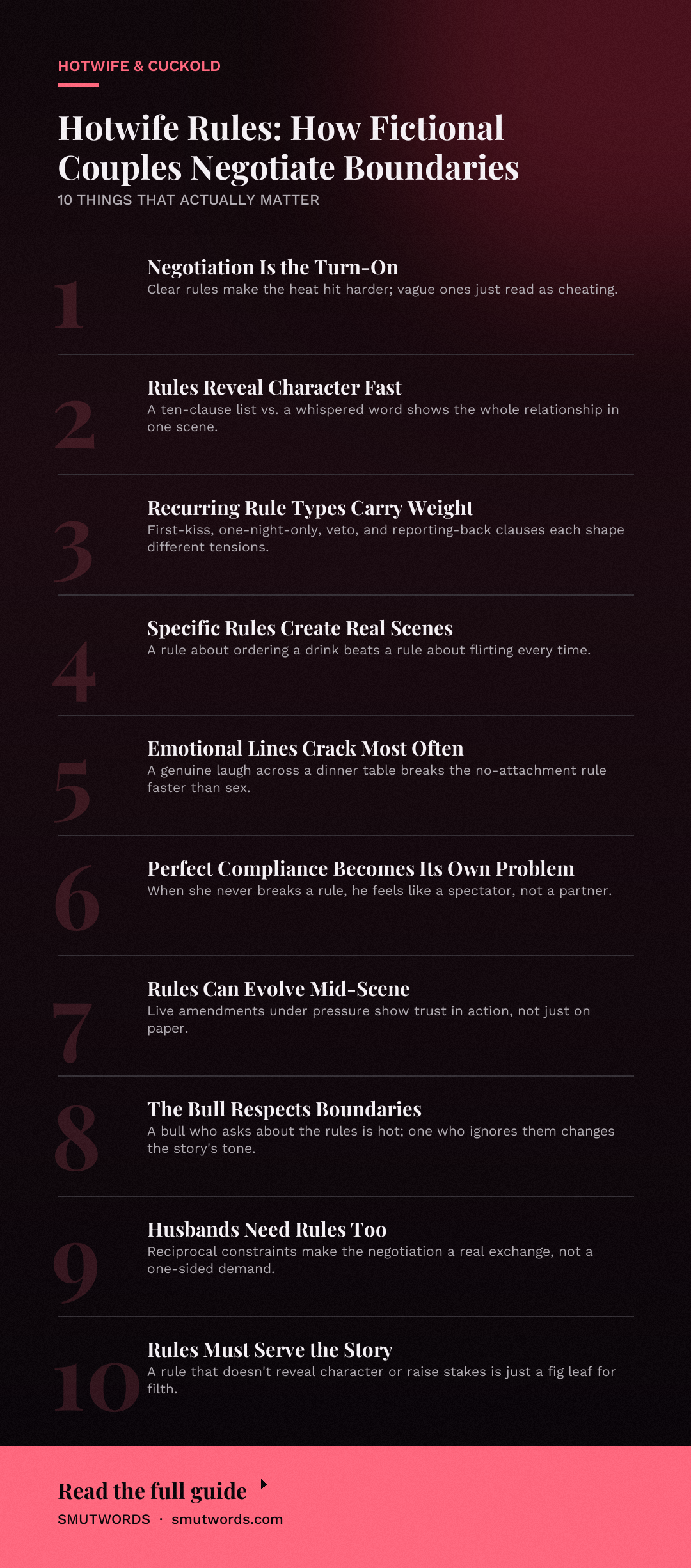
The negotiation is the sex. Everything after it is just details. Find a book that takes the rule-setting seriously, and you will find a book that understands what makes the hotwife fantasy connect. Watch a couple earn each other's trust through clauses and amendments and carefully chosen words, and you'll feel the release when they finally act on it.
Read He Chose Her Outfit for a master class in a single rule driving an entire story. The outfit is not the story. The story is everything the outfit means between the two people who chose it. Get that right, and you don't need to write a single explicit scene to be writing a book that knows exactly what it is about.






Loading comments…