
Enemies to lovers is the romance trope where two people who genuinely cannot stand each other at the start end up in bed together and then in love. Professional rivals, opposing agents, literal captor and captive: the setup varies, the endpoint doesn't.
The enemies to lovers smut book is its own beast. The conflict is the foreplay, the insults are the dirty talk, and by page fifty the reader is already scanning ahead for the first kiss. What separates a great one from a flat one is whether the hatred feels real enough to make the surrender feel like something.
The trope powers a huge slice of the erotic romance market, and for good reason. Antagonism gives a scene structure: someone has the upper hand, someone is furious about it, and the moment that power flips, the reader feels it in their chest. This guide covers what the label actually means, where the tradition comes from, how skilled authors build a scene around it, and where it goes wrong.
What Enemies to Lovers Actually Means
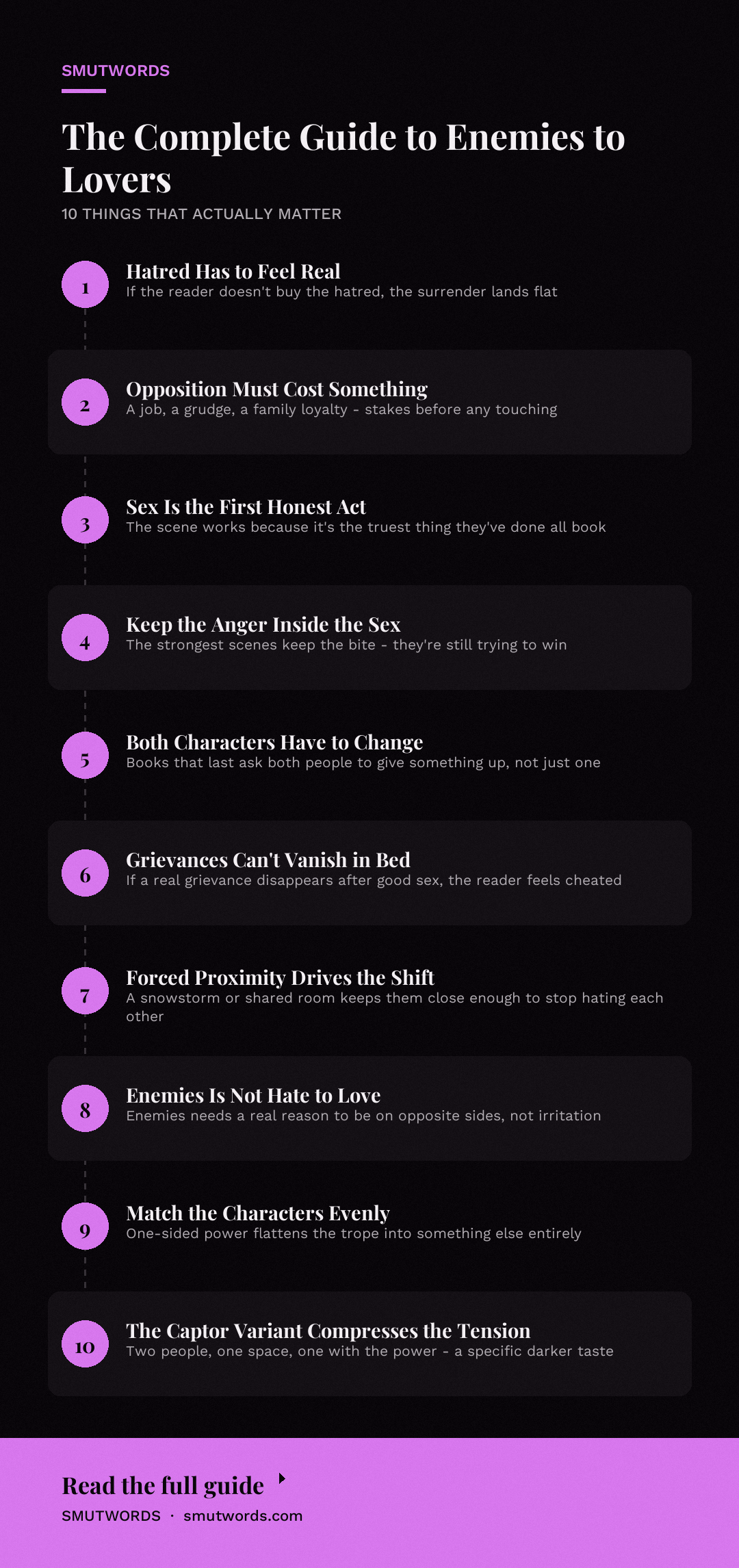
At its core, the trope requires two characters with a real, mutual, active opposition before any romantic or sexual development begins. That opposition has to cost something: a job, a mission, a family loyalty, a grudge that dates back years. Rivals who trade witty barbs and secretly respect each other count. Two people who dislike each other mildly and are forced to share a cabin for a weekend are closer to forced proximity with a side of friction.
The name itself describes the emotional trajectory. It says nothing about kink. The word "enemies" gets used loosely, and in practice the trope runs a spectrum from professional competition (two chefs fighting for one restaurant's top spot) all the way to genuine moral opposition (a detective and the criminal she's hunting). The stronger the original opposition, the bigger the payoff when it collapses into desire.
What doesn't count: hate to love where the "hate" is really attraction dressed up as irritation from chapter one. That's a related but distinct trope, and the hate to love entry covers how they differ. Enemies to lovers needs something concrete at stake before the characters ever touch each other.
Readers also tend to assume enemies to lovers means the bedroom scenes will be rough or degrading. Sometimes they are, sometimes they aren't. The trope is about the emotional arc, and the sex can be tender, filthy, competitive, or all three in the same book.
Where Enemies to Lovers Comes From
The adversarial romance is older than the modern genre labels. Shakespeare ran Beatrice and Benedick through it in Much Ado About Nothing. The gothic novel spent the entire eighteenth and nineteenth centuries pairing terrified heroines with brooding men who may or may not be villains.
The Brontës built an entire tradition on it: Wuthering Heights is enemies to lovers with a body count, and Jane Eyre runs Rochester and Jane through suspicion, deception, and a near-ruin before anyone gets a happy ending.
In twentieth-century category romance, the trope hardened into a formula: the alpha male boss or rival rancher who clashes with the spirited heroine until the final chapter. Harlequin built a publishing empire on it, and by the 1980s the bickering couple was the default engine of the entire genre. Heat level varied. Structure didn't: conflict, forced proximity, first kiss that both parties regret, eventual surrender.
Erotic romance took that structure and pushed the explicitness way up through the 2000s and 2010s. Digital publishing helped; authors could write longer, filthier books without a print page limit. The captor variant gained a large audience in that window, and so did the workplace rivalry variant, likely because both let authors escalate the power imbalance and the sex on the same page.
More recently the trope has absorbed a wider range of adversarial settings: rival bands in rockstar romance, competing agents in the intelligence-thriller corner of the genre, rival motorcycle chapters in motorcycle club romance. The core mechanic hasn't changed. Only the settings have multiplied.
How It Shows Up in Erotica
The craft of an enemies to lovers scene is mostly about the anger. If the reader doesn't believe the hatred in the first act, the surrender in the third act lands flat. Authors who do it well let the characters be genuinely cruel to each other in small, specific ways: a deliberate social humiliation, a cutting remark about a dead parent, a professional sabotage that costs real money.
The sex works because it's the first honest thing either of them has done all book.
The best versions of the trope follow a rough beat structure that most readers recognize even if they can't name it:
- The inciting clash. Something forces the two characters into the same orbit: a shared job, a contested inheritance, a mutual enemy. It has to put them in physical proximity regularly or the tension has nowhere to build.
- Escalating sabotage. They go after each other, and the reader gets to enjoy the small victories on both sides. This stretch has to be genuinely fun, because it's the section that hooks readers.
- The forced proximity pitch. A snowstorm, a shared hotel room, a mission gone sideways. The two are now alone and can't avoid each other, and the insults turn into something else. This is almost always where the first kiss or first sexual contact lives.
- The consummation. The scene where the opposition collapses into want. The best versions keep the anger alive inside the sex: they're still fighting, they're just doing it naked now.
- The backlash. Something reminds both characters why they were enemies in the first place. One of them takes a step back. The reader is briefly devastated, which is the whole point.
- The surrender. They choose each other over the original cause, and the choice has to cost them something concrete for it to matter.
The variants that show up in erotic romance are largely variations on that spine. The captor/captive version compresses the forced proximity to a single location and raises the stakes by making one character the literal jailer of the other. The workplace rivalry version keeps the conflict professional, which slows the physical escalation but makes the professional stakes more personal. The rival-siblings-or-friends version layers a family or social cost on top.
What makes a strong enemies to lovers smut book rather than a flat one usually comes down to a few specific craft choices. The first is whether the two characters are evenly matched. A book where one character has all the power and the other has none tends to flatten into a different trope, often stalker romance or a darker power-imbalance fantasy, where the original opposition becomes something else entirely.
Enjoyed this? Get a free book.
Join the list and we will send a complete free story straight to your inbox, plus new releases every week after that. No credit card, no catch.
The second is whether the sex scene lives up to the buildup. A lot of books spend three hundred pages on mutual loathing and then write a tender first time that reads like a completely different book. The strongest scenes keep the bite: they're still trying to win, and the sex is another round in a fight neither of them planned to lose.
The third is whether the original opposition resolves in a way the reader can actually believe. If one character had a legitimate grievance and it disappears the moment the other one is good in bed, the reader feels cheated. The strongest books let both characters hold onto something of their original position, even after they've chosen each other.
Certain darker variants overlap with other kinks. Books that build the payoff around one character crying during sex and the other getting off on it are closer to dacryphilia than to classic enemies to lovers, and the strongest authors know the difference and lean into it. Books that escalate the rivalry into revenge acts, where one character seduces the other specifically to destroy them, belong closer to revenge romance, and often borrow its late-reveal structure.
One more divider between the books that last and the ones that flatten: whether both characters change. Plenty of enemies to lovers stories only ask one character to soften, while the other stays exactly as they were and is simply "deserving" of love. The books that stay with readers are the ones where both people have to give something up to make room for each other.
Enemies to Lovers vs Hate to Love
These two get used interchangeably, and they aren't quite the same. Hate to love is the broader label: two people who dislike each other intensely at the start and end up together. Enemies to lovers is a subset, and it requires "enemies" to mean something more specific.
If the two characters have a real-world reason to be on opposite sides (opposing legal teams, rival governments, feuding families), it's enemies to lovers. If they simply irritate each other and the irritation is clearly attraction in disguise, it's hate to love, a lighter, quicker version of the same emotional arc. Enemies to lovers runs longer and requires more setup.
The two can overlap heavily, and many books are technically both. The distinction matters mostly when you're searching for a specific flavor: if you want a book where the two characters have a real reason to destroy each other first, that's the enemies version, and the stakes are usually higher.
Frequently Asked Questions
Is enemies to lovers always dark romance?
No. The trope lives across the whole heat and darkness spectrum, from lighthearted rom-coms to fully dark captor stories. What connects them is the adversarial opening, not the intensity of the sex or the moral shading of the characters.
What's the difference between rivals to lovers and enemies to lovers?
"Rivals to lovers" is a softer variant. Rivals usually share a goal or a profession and respect each other's competence even while competing. Enemies implies a deeper opposition, often a moral one, where one character has genuinely hurt or could genuinely hurt the other.
Do I need to read enemies to lovers book series in order?
For a series where each book follows a different couple, no. Most are written to stand alone, with previous characters appearing as side figures. Series that run the same couple across multiple books should be read in order, since the trope arc spans the whole run.
Why do the enemies always end up in forced proximity?
Because the trope requires the two characters to spend enough time together to develop something other than hatred. Forced proximity is the easiest way to keep them in the same room for long enough that the reader believes the shift from anger to attraction.
Is it still enemies to lovers if one character was never really an enemy?
If one character's opposition was a misunderstanding revealed early on, the book is closer to a second-chance or miscommunication trope. Enemies to lovers requires both characters to genuinely believe they're on opposite sides for most of the book.
What's the appeal of the captor variant specifically?
It compresses the forced proximity to its maximum: two people in one space, one with all the physical power. Readers drawn to the darker end of the trope often want the tension of a power imbalance that eventually flips into something neither character planned. It's a specific taste within the broader trope, and the strongest versions take the ethics seriously rather than glossing them.
Final Thoughts
The best enemies to lovers books are the ones where the hatred in the first act is specific, cruel, and completely earned, and the surrender in the last act costs both characters something real. If you've never read one, start with a book that takes the adversarial setup seriously rather than using it as window dressing.
The childhood friends to lovers entry is worth reading afterward. It's the exact opposite mechanic, and reading the two back to back makes the structure of each much clearer.






Loading comments…