
A stocking fetish is a persistent sexual focus on stockings, thigh-highs, hold-ups, or pantyhose, where the garment itself sits at the center of arousal rather than serving as background decoration. The turn-on lives in specific details: the texture of nylon against skin, the reinforced seam running up the back of a calf, the tight band compressing a thigh, the slow ritual of rolling fabric up a leg.
In stocking fetish erotica, the stockings are a character in the scene. They get described, touched, removed, and admired with the same attention most books give to a lover's face.
That specificity matters, because a stocking fetish is not the same thing as finding a woman in lingerie attractive. Plenty of readers enjoy a hero peeling off a pair of sheer black hold-ups without the garment carrying any real charge. For a true stocking fetishist, the stockings hold their own erotic weight. They are the point.
What Stocking Fetish Actually Means
The term covers a wide family of garments and a wide family of turn-ons. At the broadest, stocking fetish (sometimes called a thigh-high obsession or pantyhose fetish) describes sexual interest in any hosiery worn on the legs: sheer stockings, opaque tights, pantyhose, thigh-highs held up by elastic or a garter belt, fishnets, and the whole extended catalog in between. What unifies them is the fact of leg covering.
Within that family, different readers fixate on different details. Some are texture people. The feel of nylon, the friction of a seam, the smooth slide of a hand along a calf in pantyhose.
Others are visual: the framing effect of a stocking on the shape of a leg, the contrast of dark fabric and pale skin, the glimpse of bare thigh between the top of a hold-up and the hem of a skirt. Still others care most about the ritual, the deliberate act of putting stockings on or taking them off.
The word "stocking" itself is old and practical. It referred to a close-fitting leg covering long before it carried any erotic charge, and the textile history runs back centuries. Nylon, the material most associated with the modern fetish, only arrived in the late 1930s, and the reaction to it was immediate.
What people mean today by a stocking fetish is mostly a twentieth-century and twenty-first-century phenomenon, tied to the rise of mass-produced hosiery and the visual language of pin-up art, film, and advertising.
Several things do not count as a stocking fetish on their own. A general appreciation for a well-dressed lover, a taste for formal wear, or an interest in bondage in which stockings happen to be part of the outfit all fall short.
The stocking has to be doing real erotic work. The difference is whether the scene would lose something essential if the stockings vanished. If the answer is no, you are looking at a costume, not a fetish.
A common misconception holds that a stocking fetish is simply a foot fetish with extra fabric. It is not. A foot fetish centers on the foot itself, bare or not. With a stocking fetish, the foot may never come into it.
The garment and the leg take the focus, and many stocking fetishists have no particular interest in feet at all.
Another misconception: that this is a purely male fixation and a purely visual one. In practice the interest shows up across genders, and for plenty of people the charge is tactile or imaginative as much as visual. Stockings feel like something. That tactile dimension is half the draw.
Where Stocking Fetish Comes From
Stockings have been erotic objects for a very long time, but the specific modern fetish is tightly bound to nylon. When DuPont introduced nylon stockings in 1939, they sold out fast, and the wartime rationing that followed made them scarce and coveted. That scarcity is part of why stockings took on the charged, luxury-adjacent status they still carry in erotica.
The pin-up era of the 1940s and 1950s did the rest. Illustrators and photographers built an entire visual grammar around the stocking seam, the garter, and the flash of bare thigh, and the aesthetic crossed straight into the paperback covers and men's magazines that fed the mid-century erotic imagination. By the 1960s and 1970s, pantyhose had largely replaced stockings for ordinary wear, but the fetish object survived in lingerie culture and grew a devoted following of its own.
In erotica and romance publishing specifically, the stocking has always been a reliable tool because it is so easy to describe well. It gives an author concrete sensory detail to work with. Victorians handling stockings, noir heroines pulling them on, contemporary heroines undressing after the office: the garment reads as legible in almost any setting.
The big shift in recent decades is a move toward the woman's own point of view. Older material often framed stockings as items a woman wore for a man's consumption. Contemporary stocking fetish erotica increasingly writes the pleasure of putting them on, the private ritual, the self-directed anticipation of dressing.
The garment became a source of pleasure for the wearer too, not just a visual gift. That reframe is one of the liveliest developments in the genre and worth paying attention to as a reader.
How It Shows Up in Erotica
A strong stocking scene is built from the garment's mechanics. The stockings get put on. They get described in muscular, specific detail. The moment they come off, or the moment they stay on, becomes an event.
The best authors treat the stocking like a character with a costume change, giving it an entrance, a presence, and a departure.
Notice the range of variation within that structure. Authors work this fetish differently, and the variation is one of the pleasures of the subgenre.
- Pantyhose fetish: focuses on tights and full-coverage hose, often on the smooth, continuous line from waist to toe, with texture and containment doing the work.
- Thigh-high obsession: emphasizes the band and the bare strip of thigh above it, where the garment ends and skin begins.
- Seam fetish: fixates on worn or reinforced back seams and fishnets, on line and geometry, on the way the seam traces the shape of a leg.
- Garter belt attraction: centers the hardware, the hooks and straps and the process of attaching stockings, which gives a scene built-in stage business.
- Stocking removal ritual: makes a slow, deliberate undressing the centerpiece, sometimes tender, sometimes teasing, sometimes a reveal in itself.
Where a scene sets its attention tells you what kind of sex scene it is. A book that lingers on the snap of a garter is writing a piece of power play into the costume. One that spends a paragraph on a hand smoothing a thigh through nylon is writing touch and heat. One that documents a woman dressing alone, choosing her stockings and rolling them up in the drowsy morning light, is writing anticipation.
Enjoyed this? Get a free book.
Join the list and we will send a complete free story straight to your inbox, plus new releases every week after that. No credit card, no catch.
These overlaps are where stocking fetish clearly lives. Its tactile, garment-focused quality puts it in the same family as leather fetish, which locates arousal in the material of a jacket or a pair of gloves. Its fixation on a single charged body part connects to breast fetish. If you like the idea of a specific garment reshaping the body's silhouette into something sexual, inflation fetish explores a related kind of body-focused fantasy, though from a very different direction.
The glove is the closest cousin of all. If a scene or a book keeps returning to the line of a stocking, the glove does the same for the hand, and the mechanics of covering, compressing, and removing a limb translate almost perfectly. For a full treatment of that mirror image, read Understanding Glove Fetish: A Full Breakdown.
What makes a stocking scene feel strong versus flat comes down to specificity and agency. A flat version makes stockings a static prop: she was wearing stockings, and now they are on the floor.
A strong version gives the gesture weight. Someone chooses the stockings. Someone notices them. The garment changes the way a hand moves or the way a character stands, and the author treats that change as worth writing down.
There is also a rule about pacing. Because the fetish is tactile, good authors slow the scene down when the stockings are involved. A quick undressing plays as wardrobe logistics. A lingering one plays as sex.
That pacing instinct is the same one that makes other touch-driven kinks work, and if you read Spanking Kink Explained: Why People Like It and How to Start, you will notice the same slow, deliberate, touch-forward craft at play.
Authors also handle the garment's paradox well: stockings are both covering and revealing. They hide the leg while announcing it. That "dressed but available" quality gives writers an entire tension to play with, and the best scenes lean hard on it. The stockings are still on while everything else about the encounter has stopped being polite, and the contrast does real erotic labor.
Readability matters here too. Stockings give a scene a built-in tactile vocabulary, and the books that know this stay concrete. You feel the nylon, the tug, the cool air on bare skin when the fabric moves. A scene that describes the texture and the friction, rather than just announcing the stockings, is doing the fetish right.
Finally, stocking fetish pairs naturally with an insta-love or high-anticipation dynamic, where two people's mutual attention sharpens fast and every garment detail reads as charged. If that pace appeals to you, Why Readers Can't Stop Reading Insta-Love (Even When They Say They Hate It) is a good companion read on why fast-burn tension holds a reader.
Stocking Fetish vs Foot Fetish
The comparison readers make most often is with the foot. The two are genuinely different, and the confusion is common enough to be worth clearing up. A stocking fetish centers on hosiery and the leg. A foot fetish centers on the foot itself, often bare, and the garment angle is secondary or absent. The overlap happens in the foot's vicinity, since a stockinged foot is still a foot, but the point of focus differs.
Practical test: does the garment do the work, or does the body part? If the stocking itself is what catches the eye, its texture, its seam, its hold, then you are reading a stocking fetish scene. If the scene lingers on toes or arches with the hosiery as incidental, you are reading a scene written for foot interest. The two can share a page, but each carries its own charge.
Stocking fetish also draws comparisons to the glove fetish, since both turn a limb into a fetish object through fabric. The difference is location. Stockings live on the legs and often carry a broader costume and ritual vibe. Gloves live on the hands and can read as practical or formal depending on the setting.
If you like stockings for the way a garment reshapes a body's presence, the glove breakdown is the natural next stop.
Frequently Asked Questions
Is a stocking fetish the same as a pantyhose fetish?
They overlap heavily but are not identical. Pantyhose fetish is usually treated as a subset of the broader stocking fetish, one that emphasizes full-coverage hose and the smooth continuous line from waist to toe. Someone can have a strong interest in thigh-highs and no particular interest in pantyhose, and vice versa.
Why do people find stockings sexy?
Stockings frame the leg, create contrast between fabric and skin, and signal a deliberate state of dressing, which reads as dressing for desire. They also feel like something, and that tactile dimension gives the visual a physical charge. Psychologically they work as both covering and revealing at once.
Is a stocking fetish common?
It is one of the most commonly described garment fetishes in erotica and romance, partly because stockings are so easy to work into almost any setting. Exact population numbers are impossible to pin down, but the trope is popular enough in fiction that readers will encounter it often without seeking it out.
Can you have a stocking fetish without a foot fetish?
Yes, and this is common. Many people with a stocking fetish have no particular interest in bare feet, because the garment itself and the shape of the leg are the focus. The foot may barely enter the picture at all.
What is a stocking removal ritual?
It is a scene pattern in which slowly and deliberately taking off a pair of stockings becomes the centerpiece of the encounter, often written with attention to the roll of the fabric, the drag of nylon, and the reveal of bare skin. It is less about the ending state and more about the pace and attention of the undressing.
How do I write a good stocking fetish scene?
Stay specific and slow down. Name the material, the seam, the grip of the band. Give the stocking a reason to matter to the character, whether the choice to wear it, the noticing of it, or the act of removing it. A scene that treats the garment as a prop will read flat; one that treats it as charged will not.
Final Thoughts
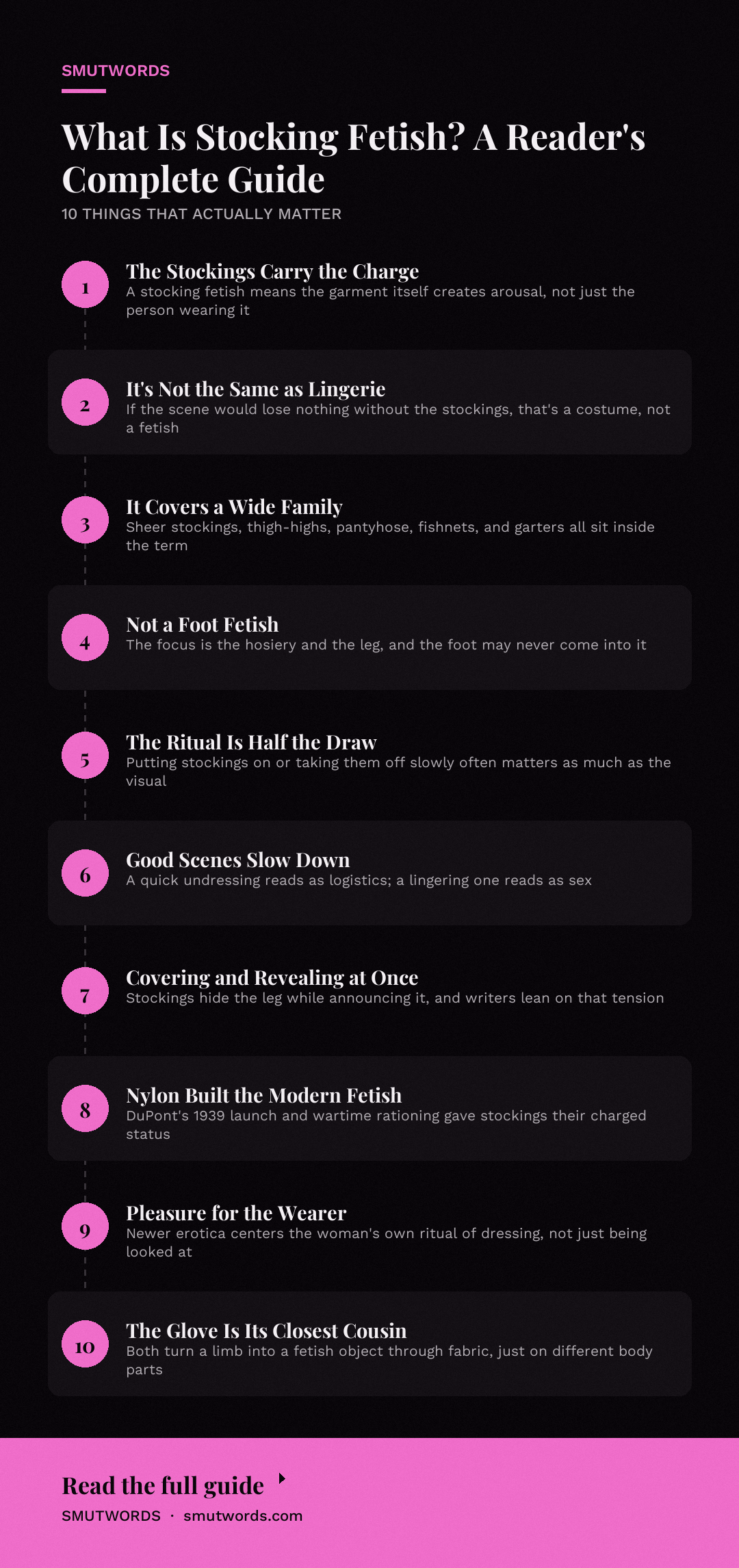
Stocking fetish works best when the garment gets real attention on the page, texture and seam and the deliberate ritual of dressing. The books that get this right slow down and let the fabric carry weight, and the ones that treat stockings as set decoration leave the charge on the table. If you want a scene that takes the fabric seriously, start with a book that writes the stocking as a character in the room.







Loading comments…