
Breath play JOI is a masturbation scene, usually delivered as audio or a written script, where the person giving jerk-off instructions also controls the listener's breathing. They count holds, meter out pauses, and tell you when to let go. The air restriction runs inside the verbal guidance, timed to the strokes, so the whole thing becomes one continuous act of following orders.
The appeal sits in total surrender: a function you never think about, your breathing, gets handed to someone else and synced to their commands. It is one of the highest-risk things you can do with a partner or a recording, and the good versions treat that seriously even while they get filthy with it.
What Breath Play JOI Actually Means
The acronym is straightforward: JOI stands for jerk off instructions. It names a format where someone talks you through masturbation, step by step, often with counting, pacing, edging, and a payoff they schedule for you. Breath play is the layer where that same voice governs your air.
Combine them and you get a scene where breath becomes another dial the director turns. "Breathe in on four. Hold it while you stroke. Don't let go until I say." The choking or holding isn't a separate event bolted onto the instructions; it's the rhythm the instructions run on.
The vocabulary around this is messy, and worth sorting out. You'll see it called breath play, choking, choking games, hypoxia play, air play, and voice-guided breath control. Erotic asphyxiation is the clinical-adjacent term for the broader category of breath restriction for arousal.
JOI is the format. Put them together and you have a scene whose engine is verbal control over both air and orgasm at once.
What counts as breath play JOI and what doesn't:
- Counts: An audio or script where holds, timed pauses, or choking commands are woven into stroke instructions and pacing.
- Counts: A written scene where the dominant character counts breaths aloud and ties each count to a command to touch or stop.
- Counts: A voice note where someone walks you through edging and mixes in "hold your breath now" as part of the cadence.
- Doesn't count: A plain JOI with no attention to breathing at all. That's just instructions.
- Doesn't count: Breath play in a scene with no masturbation directive and no verbal guidance. That's the broader kink, not this format.
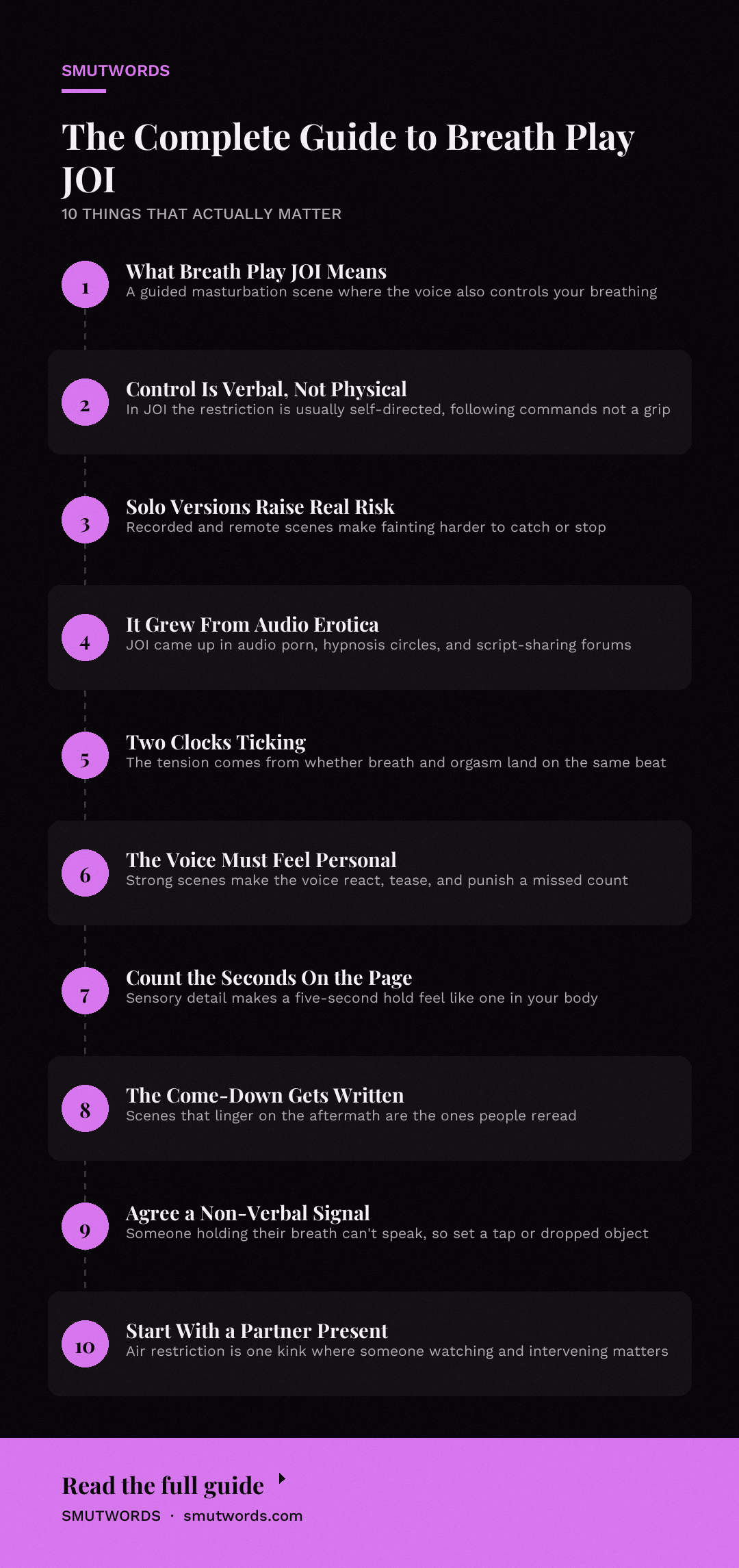
One common misconception: people assume the breath control has to mean hands on a throat. In JOI it usually doesn't. The restriction is often self-directed, following the voice, which is exactly why the format can be done solo with a recording. The control is verbal, not physical, and the surrender is to the instruction rather than to a grip.
Another misconception is that this is a light, low-stakes add-on. It isn't. Anything that restricts air carries real physical risk, and the format's solo, remote, and audio-only versions make that risk harder to manage. We'll get into the safety specifics below, because they matter more here than in almost any other kink we cover.
Where Breath Play JOI Comes From
The honest history here is short and mostly recent, so let's not pad it with ancient speculation. Breath restriction as an erotic practice has a long, informal, and often dangerous history in the real world. The specific thing we're talking about, breath play folded into voice-guided jerk-off instructions, is a child of internet erotica.
JOI as a format grew up in audio porn communities, erotic hypnosis circles, and written script-sharing forums. The recorded voice became a delivery mechanism: someone could guide a stranger through a scene without being in the room. That format made verbal control the whole point, and once a voice is directing your strokes, directing your breathing is a natural next dial to turn.
Breath play entered through a few doors at once. Erotic hypnosis scripts already used breathing as an induction tool, counting breaths to deepen trance. Choking and asphyxiation had a long, uneasy presence in kink writing. And edging culture gave authors a model for deferred release that breath restriction could amplify.
The genre shift worth naming is this: breath play JOI moved from niche audio into mainstream written erotica as the "dark romance" wave pulled choking, breathless tension, and verbal control into the center of popular books. What used to sit in a corner of script archives now shows up in published romance with a dominant voice counting breaths on the page.
The portrayal has shifted with it. Early audio leaned on the shock of the command. Contemporary written versions tend to spend more words on the psychological build, the trust, the slow loss of control, and the come-down afterward.
That's an improvement in craft and, arguably, in how responsibly the kink gets portrayed, though plenty of published versions still skim the safety work. That's a fair thing to notice as a reader.
How It Shows Up in Erotica
On the page, breath play JOI lives or dies on voice and timing. The dominant character is running a scene with their words alone, so the prose has to make that voice feel like it has a hand on your throat without ever touching you. The strongest versions treat the counting and the pauses as the action.
A scene typically moves through a recognizable arc. The voice establishes control. It lays down instructions and breath commands together. It escalates the restriction in step with the arousal.
Then it denies release, and grants it, and the air and the orgasm arrive together or in a deliberate, cruel sequence. The best authors understand that the breath and the orgasm are two clocks ticking, and the tension comes from whether they land on the same beat.
Here's what separates a scene that works from one that falls flat. The flat version announces commands. "Hold your breath. Now stroke." It reads like a list of instructions with no heat in it.
The strong version makes the voice a character: it notices, it teases, it threatens to stop, it punishes a missed count. The control feels personal because the voice reacts.
Enjoyed this? Get a free book.
Join the list and we will send a complete free story straight to your inbox, plus new releases every week after that. No credit card, no catch.
Common variations authors reach for:
- The countdown hold. Breathe in on the count, hold through a set number, release on command, and the stroke pace is tied to the count. Simple, reliable, easy to escalate.
- Denial stacking. Breath restriction layered onto edging, so both the air and the orgasm are withheld at once. This is the version that produces the suffocating, edge-of-control feeling the format is known for.
- The recorded voice. A scene framed around a tape, a voicemail, or a one-way transmission, which lets the author play with the listener's isolation and the absence of real-time feedback.
- Interactive real-time. A partner directing in the room or over a call, which raises the stakes because they can respond and adjust.
- The punishment frame. A missed count earns a consequence, which lets authors stretch the scene and add structure.
The recorded-voice variation is worth dwelling on because it shapes what authors can do. When the instructions come from a recording, nobody in the room can see whether the listener is following, which is exactly the danger and the fantasy. The strong written versions either lean into that helplessness deliberately or build in a check-in that keeps the scene honest. Weak versions ignore the problem entirely and treat a recording as if it can supervise.
Craft-wise, the format rewards sensory specificity. Count the seconds. Name the way the air goes thin.
Let the voice go quiet right before a hold so the reader feels the silence. The best passages restrict the reader's own sense of time, so a five-second hold on the page feels like a five-second hold in your body.
The overlap with other practices gives authors more texture. Breath restriction pairs naturally with the denial rhythm of a milking table scene in the way both put release on someone else's schedule, and it can sit alongside the sensory removal of mummification, where the whole body is already at someone's mercy. Writers who understand the shared logic of surrendered control write richer scenes across all of them.
One thing the format has in common with a lot of intense kink writing: the scene is only half the job. The come-down matters. A breath play scene that ends the second the orgasm lands leaves the reader with the adrenaline and nothing to do with it.
The versions that linger on the aftermath, the shaking, the held hand, the slow return of normal breathing, are the ones people reread. That's the same reason aftercare shows up in the best intense scenes across the genre, and authors who skip it produce something that feels unfinished. For a related read on how intensity and release get paced, the spanking kink breakdown covers much of the same ground.
Breath Play JOI vs Impact Play Aftercare
These get compared because both are high-intensity practices with serious physical stakes, but they name different things. Breath play JOI is a format: a guided masturbation scene built around breath control. Impact play aftercare names the recovery work that follows a scene involving hitting or striking.
The confusion comes from the overlap in the aftermath. A breath play scene needs its own recovery work, and readers who know the impact-play vocabulary sometimes reach for it to describe what breath play scenes are missing. They're related concerns, not the same term. If you're reading a breath play scene and thinking "where's the come-down," you're noticing a gap that impact-play writing has a well-developed vocabulary for.
The other comparison worth flagging: breath play JOI is not the same as genital torture play, even though both involve intense sensation and control. One works through air and voice, the other through direct, often painful stimulation. The intensity is similar; the mechanism is nothing alike.
Frequently Asked Questions
Is breath play JOI safe?
Any restriction of air carries real risk, including fainting, and the format's solo and recorded versions make it harder to manage. Do not do it alone with a recording if you're new to it. Practice with a trusted partner who can see you and stop the scene, and treat the risk as genuinely serious.
What does JOI stand for?
Jerk off instructions. It names a format where someone talks you through masturbation step by step, often with counting, pacing, and scheduled release. Breath play JOI adds breath control to that structure.
Do you need a partner for breath play JOI?
Not always, but the safest versions involve one. Recordings and written scripts let people do it solo, but air restriction is one of the few kinks where having someone present who can watch and intervene is important. If you're exploring it, start with a partner in the room.
What's the difference between breath play and choking?
Choking usually refers to physical pressure on the throat. Breath play is the broader category of restricting air, which includes timed holds, breath-counting, and self-directed pauses. In JOI, the control is almost always verbal rather than a hand on the neck.
How do you negotiate breath play before a scene?
Agree on limits, a safeword or a physical signal, and a clear stop rule before anything starts. Because a person being choked or holding their breath cannot speak, you need a non-verbal signal like a tap or a dropped object. The person directing the scene should know the signal and watch for it. This is basic bondage safety logic applied to air.
Why do people find breath restriction arousing?
The surrender of a basic involuntary function to someone else, plus the physical intensity of restricted air, produces a heightened edge-of-control state. Combined with edging and delayed orgasm, it creates a layered tension that fans describe as hitting harder than either element alone. The appeal is the total loss of control, which is also why the safety work matters.
Final Thoughts
Breath play JOI works when the voice on the page feels like it owns your air and your orgasm at the same time, and it falls apart when the scene treats restriction as a cheap shock. Read the version that does the safety work on the page as well as the filth. If you want a scene that handles surrendered breathing and verbal control with real care, start with a book that treats the come-down as seriously as the count.
If you're still working out what draws you to a scene before you commit to one, the piece on why readers can't stop reading insta-love is a useful companion on the pull of intensity you didn't plan for.








Loading comments…