
How to Write Erotica That Feels Real and Reads Hot
Writing erotica seems easy. You write two people, they get naked, they do things, everyone finishes, the end. Then you sit down to do it and find out the fastest way to make a reader close the tab is to give them exactly that: a mechanical checklist of body parts colliding with zero emotional stakes.
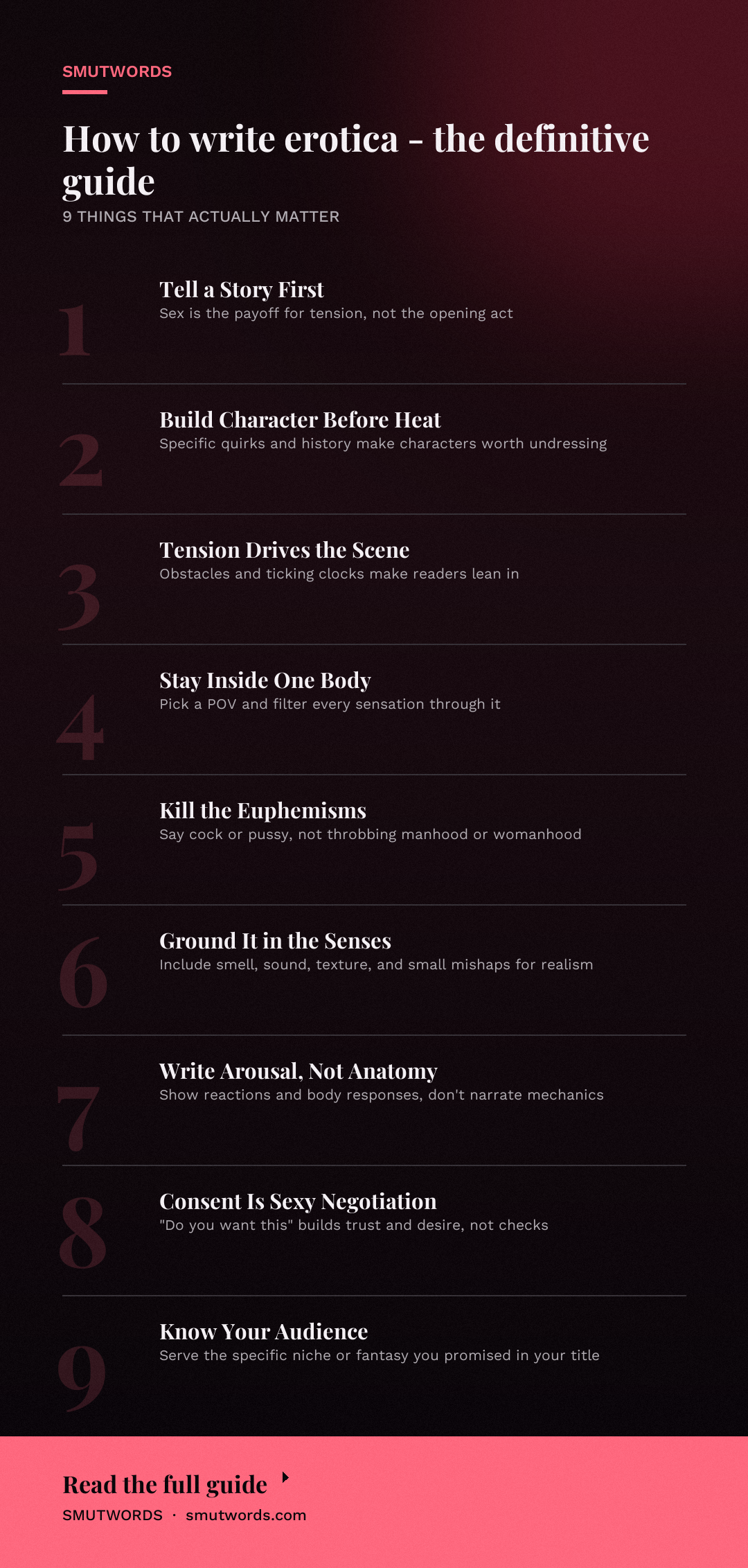
Good erotica is a story first. The sex is the payoff for tension built over pages rather than a desperation move when you didn't know where to start. The craft principles are the same as any genre, with one extra layer: you're asking the reader to get physically involved. That's a higher bar than making them curious or sad. They have to feel it in their body.
Here's what separates the work that lands from the work that reads like a plumbing diagram.
What is erotica, actually?
Before you write a word, know what genre you're in. Erotica and erotic romance get shoved into the same shelf, but they're different animals. Erotic romance promises a love story with a happy ending, with the sex serving the relationship arc. Erotica makes no such promise. The sex can be anonymous, transactional, dark, or selfish. The only real requirement is that the erotic content is the point, not an ornament.
There's a spectrum of heat levels within erotica. You can write a romance with explicit sex, or pure kink stories that exist to explore one specific fantasy. Knowing where your piece sits matters for marketing, and it matters for your own sanity. A tender love story that keeps veering into hardcore scenes will frustrate readers who came for one thing and got another.
Character comes before chemistry
Nobody cares about two generic attractive people having generic sex. That's the fastest way to make a reader skip ahead, and skipping ahead in erotica kills the whole project.
Your characters need to be specific before they're sexy. What does she do for work? Does he have a bad knee that aches before rain? Is she embarrassed by her laugh? Does he lie about his reading habits? These details do double duty. They make the characters feel like people you might know, and they give you material for the sex scene itself. A character's job, history, and hang-ups should shape how they fuck. The accountant who spends her days controlling every variable might crave being pinned down. The guy who's never been chosen first might have a praise kink that would make you blush.
Think about what each character wants from the encounter beyond orgasm. Attention. Validation. Power. Surrender. Revenge against an ex. The "why" drives the scene harder than any physical action. When you know what's at stake emotionally, every touch, every whispered line, every pause carries weight.
This is also where a lot of amateur erotica trips over its own feet. The characters meet and within two paragraphs they're tearing each other's clothes off. That works in a very short piece, but it kills the tension that makes sex scenes worth reading. The build matters more than the act. A story that spends fifteen pages on longing glances, accidental touches, and near-misses before the first kiss will get a hotter payoff than one that opens mid-thrust.
Take a look at how Late Night Delivery: A Married Woman's Hotwife Stranger Fantasy handles this. A woman waits for a delivery, and the story builds the entire encounter around the anticipation of a knock she knows is coming. The mundane act of waiting becomes foreplay. That's the trick: make the space between before and the moment itself work for you.
Build tension before you build heat
Sexual tension is the engine of erotica. It's the difference between a scene that makes you flip pages and one that makes you flip away.
Tension lives in the gap between what the characters want and what they can have right now. Maybe they're coworkers who shouldn't cross that line. Maybe they're strangers on a train with one stop to go. Maybe they're exes who hate each other and can't stop circling. The obstacle doesn't have to be dramatic. A locked door, a dying phone battery, a roommate due home in an hour. All these create a ticking clock that makes the reader lean in.
Dialogue does heavy lifting here. Two people who are dying to fuck each other but are still talking, negotiating, testing boundaries. That's the good stuff. The verbal sparring before the physical contact is often hotter than the contact itself. It's where the power dynamics get established and the characters reveal what they actually want beneath their small talk.
Foreplay isn't just physical. It's the emotional shift when one character realizes they've stopped pretending they don't want this. The moment the mask drops is a hit of tension all on its own.
Write the scene from inside one body
Whose point of view are you writing from? Pick one and stay there. Head-hopping between two lovers in the same scene destroys intensity because it keeps pulling the reader out of a single physical experience.
First person works well for erotica because it puts the reader directly inside the character's skin, but tight third person can be just as effective. What matters is consistency. The reader should feel the scene from the inside, not watch it from a camera mounted in the corner of the ceiling.
Deep POV means filtering everything through your viewpoint character's perception. You don't describe what's happening objectively; you describe what they notice, what they feel, what they're thinking in the moment. The taste of his skin. The scratch of stubble she didn't expect. The way his breathing changes when she does the thing he didn't know he wanted. These details only work if you're locked into one person's senses.
Avoid the classic rookie mistakes
Every genre has its clichés, and erotica has some real groaners. Here are the ones that will get your story rejected or your book refunded:
- "Throbbing manhood" and its cousins. "Member," "manhood," "rod," "engorged shaft." This language reads as a parody of erotica. Say cock, say dick, say penis if you want clinical. Anything beats "his throbbing member."
- "Her womanhood" and its relatives. "Center of her womanhood," "her mound," "her wetness." Vague euphemism kills the specific physicality that makes a scene work. Pussy, cunt, clit. Use the word that fits the tone of your scene, but use a real word.
- Pounding like a jackhammer. Comparisons to tools and machinery strip the humanity out of the scene. Sex involves bodies that sweat, make weird noises, and occasionally bump into furniture. Let it be messy.
- "She lay back, spent." Orgasm should not be the end of the story. What happens after? Who says what? Does one of them leave? Does one of them say the wrong thing and ruin it? The aftermath tells the reader who these people are to each other.
- Anatomically impossible positions. Keep track of limbs. If you described her lying on her back and then she's suddenly straddling him three sentences later with no transition, your reader will notice. They'll also notice if she has three hands.
Use sensory details that ground the reader
Erotica is a physical genre, so you need physical detail. But "physical" doesn't mean "genitals." It means the whole body in the whole room.
What does the air smell like? Is there a fan rattling in the window? Are the bedsprings loud enough to be heard through the wall? Is the light from the streetlamp cutting across the bed in a way that turns her face half to shadow? These details put the reader in the room, and once they're in the room, they're in the scene.
Texture matters. Rough denim against bare thighs. The cool slide of a satin sheet. A hair tie snapping. Temperature matters too. Cold air on warm skin. A mouth that's too hot. A hand that's cold from holding a glass of ice water.
Sound is underused in a lot of erotica. Moans are the obvious one, but what about the creak of a floorboard, the rustle of clothing hitting the floor, the startling noise of a dog barking a block away that makes one of them laugh in the middle of it? The small mishaps are what make a scene feel real. Two people who are perfect at sex without a single awkward moment is a fantasy, and not the good kind.
The language of desire is not the language of a medical textbook
Here's a rule that covers a lot of ground: write the arousal, not just the action.
You don't have to narrate every thrust. You have to convey what the thrusting feels like from inside the viewpoint character. If she's the POV character and you write "he pushed into her," that's a fact. It's not an experience. To make it an experience, you need her reaction: the stretch she wasn't expecting, the way her breath catches, the thought that flashes through her mind about how long she'd been waiting for this.
Enjoyed this? Get a free book.
Join the list and we will send a complete free story straight to your inbox, plus new releases every week after that. No credit card, no catch.
The same goes for the internal experience of arousal. Instead of "she was turned on," show it. Her hands shaking as she unbuttons his shirt. The way she can't stop pressing her thighs together. The pulse in her throat that feels like a drum. Show the body responding rather than announcing that the body is responding.
The rhythm of your prose can mimic the rhythm of the scene. Short, clipped sentences during frantic moments. Longer, winding sentences during slow tease. Letting the language match the physicality is a cheap trick, but it works. Just don't make it mechanical. Vary the sentence lengths the way a person's actual thoughts would vary.
Consent is part of the fantasy, not an interruption
This is a big one that a lot of writing advice gets weird about. Consent in erotica doesn't have to look like a contract signing. It looks like dialogue that negotiates desire. "Do you want this?" "Tell me what you like." "Say the word and I'll stop." These lines, done right, are sexy. They're not a bureaucratic checkbox; they're an exchange of trust and desire.
The way consent plays out depends heavily on the power dynamic of the scene. In a scene with a dominant/submissive dynamic, the negotiation might happen before the scene properly starts, or it might be woven into the order-giving that already excites both characters. In a scene between equals, it might be as simple as a look and a whispered "yeah?" before the clothes come off.
Consent doesn't have to remove all tension. The reader still has to believe the characters want each other. Consent gives them permission to want each other, and that permission can be its own kind of turn-on.
Know what you're writing and who you're writing it for
The audience for a sweet, low-heat story about a married couple reconnecting is different from the audience for a hardcore free-use fantasy. Not better or worse, just different. Knowing which one you're serving tells you how explicit to be, how fast to escalate, and what kind of language is appropriate.
If you're writing into a niche, serve the niche. If you're writing free-use or hotwife scenarios, the reader wants to see the specific dynamic they came for. The characters might vary, but the core fantasy needs to land. Look at how Free Use Nurse: A Hospital Free-Use Fantasy sets its premise: the title tells you exactly what you're getting. The story then has to deliver on that promise while still building characters the reader gives a damn about.
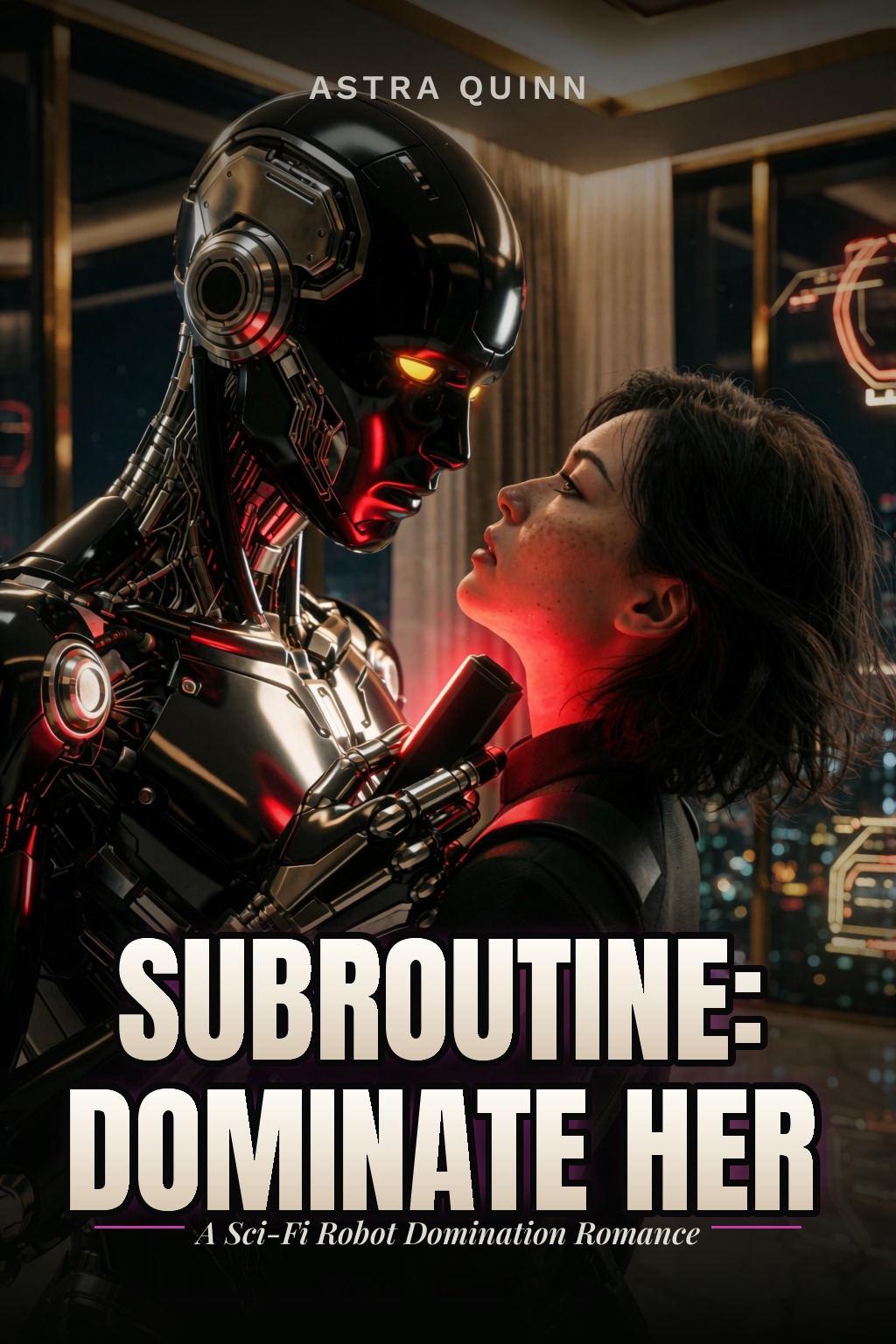
The same goes for a book like Officer's Orders: Breed Her. The title promises a specific power dynamic and a specific kink. If that's not your thing, fine, it's not aimed at you. If it is your thing, you want the story to lean into it without apologizing. Wishy-washy erotica that keeps trying to be acceptable to everyone ends up working for no one.
Pacing: let desire cook, then let it burn
The structure of a good sex scene is not a straight line from A to B to orgasm. It's a series of peaks and valleys. A build, a near-miss, a retreat, a sharper build, a sudden moment of intimacy that changes everything, then the release.
That zigzag is what makes a scene feel real. Real sex isn't a monotonic climb. It has stops and starts, moments of laughter, moments of intensity so sharp it feels like crying. Let your scenes have that texture.
A common mistake is ending the scene at the orgasm. If you've done your job, the reader cares about what happens next. Does one of them bolt? Do they order pizza? Does someone say "I love you" and immediately regret it? The quiet after the storm is where character truth lives.
Revise with fresh eyes and a clear head
First drafts of sex scenes are often either too clinical or too purple. That's fine. You're not going to write the perfect scene in one pass.
When you revise, read it out loud. If you stumble over a sentence, the reader will too. Check your metaphors. If you're comparing a lover to a "school of porpoises in an ocean of love," pause and ask yourself if you've turned anyone on or just confused them. If you wouldn't say it in bed, don't write it on the page.
Think about what the scene is doing for the story. Does it advance the characters' emotional arc? Does it reveal something one of them has been hiding? If you can delete the scene and the story still makes sense, the scene isn't earning its place. That doesn't mean every sex scene needs a plot twist. It means the scene should leave the characters changed in some way, even if it's just a shift in how they see each other.
As a test, read your scene and then describe it to a friend without nervous laughter. If you can't say "and then she asks him to stop because she's too sensitive and he laughs and kisses her forehead instead" without feeling embarrassed, you're too far inside your own head. The best erotica isn't embarrassed about the awkward, tender, ridiculous physicality of sex.
The "do I actually enjoy writing this" test
Here's a strange but reliable metric: if you're not at least a little turned on while you're writing the scene, the reader probably won't be either. Arousal shows up on the page as interest. It's what makes you slow down and linger over a detail instead of rushing to the checklist. If you're bored writing the scene, that boredom will leak through.
That doesn't mean you have to be horny on demand. It means you should write about the things that genuinely interest you. If ropes and knots make you feel something, write rope bondage scenes. If the idea of a bossy billionaire makes you roll your eyes, write something else. Your genuine interest is a compass that won't steer you wrong.
Writers who chase trends they don't care about produce hollow work. Writers who chase their own desires, no matter how niche, produce work with heat in it. The biggest compliment an erotica reader can pay is "I finished this book in one sitting and needed a cold shower." That doesn't happen if the author was just going through the motions.
Where to go from here
If you're stuck for a starting point, try a writing exercise. Write a sex scene set in a location nobody would call romantic: a laundromat, a DMV waiting room, the back of a taxi in traffic. The constraint will force you to be specific. Then write a version where one character has a secret they're trying to keep, and the sex is about discovery. Then write a version where the characters hate each other but can't keep their hands off each other. Run those exercises and you'll have something with actual dynamics instead of a generic encounter.
Reading widely within the genre also helps. Seeing what other writers do well, and what they fumble, sharpens your instincts. The hotwife niche has some strong examples of building tension around a taboo, like The Man Next Door: A Hotwife Neighbor Sharing Fantasy, which plays the slow-burn neighbor fantasy for all its worth. And Marked by the Bull shows how a specific fantasy premise can carry an entire narrative without feeling repetitive.
Final Thoughts
Writing erotica is writing. The sex scenes are the obvious bit, but the craft lives in the details around them: characters with histories, dialogue that reveals more than it hides, prose that puts the reader in a body instead of just watching one. Nobody finishes a story about two interchangeable attractive people fucking on a generic bed. They finish stories about a woman who's been lying to her husband finding out what it feels like to tell the truth, or a man who's never been in control in his life discovering he craves giving it away.
Start with something that circles around the thing your characters want, then take your time getting them into the room. When they're finally in it, let them be awkward and hungry and greedy and scared. That's the stuff that gets under a reader's skin. It's also the stuff you'll actually enjoy writing, which turns out to be the one rule nobody states outright: write the scene you wish you'd found in someone else's book. The reader who's looking for exactly that will find you.






Loading comments…