Monster romance is a romance subgenre where one partner is a non-human creature with monstrous traits. It can be orcs, minotaurs, tentacled beings, eldritch horrors, whatever your shelf can hold. The other partner is a human (or humanoid) character who falls for them anyway.
The appeal sits in the contrast: the lover's body, desires, and instincts are radically foreign, but the emotional connection reads as profound and unconditional. The relationship is the entire point of the book, not a side plot to some horror. In plain terms, monster romance asks what happens when the thing under the bed is the one you want to keep there.
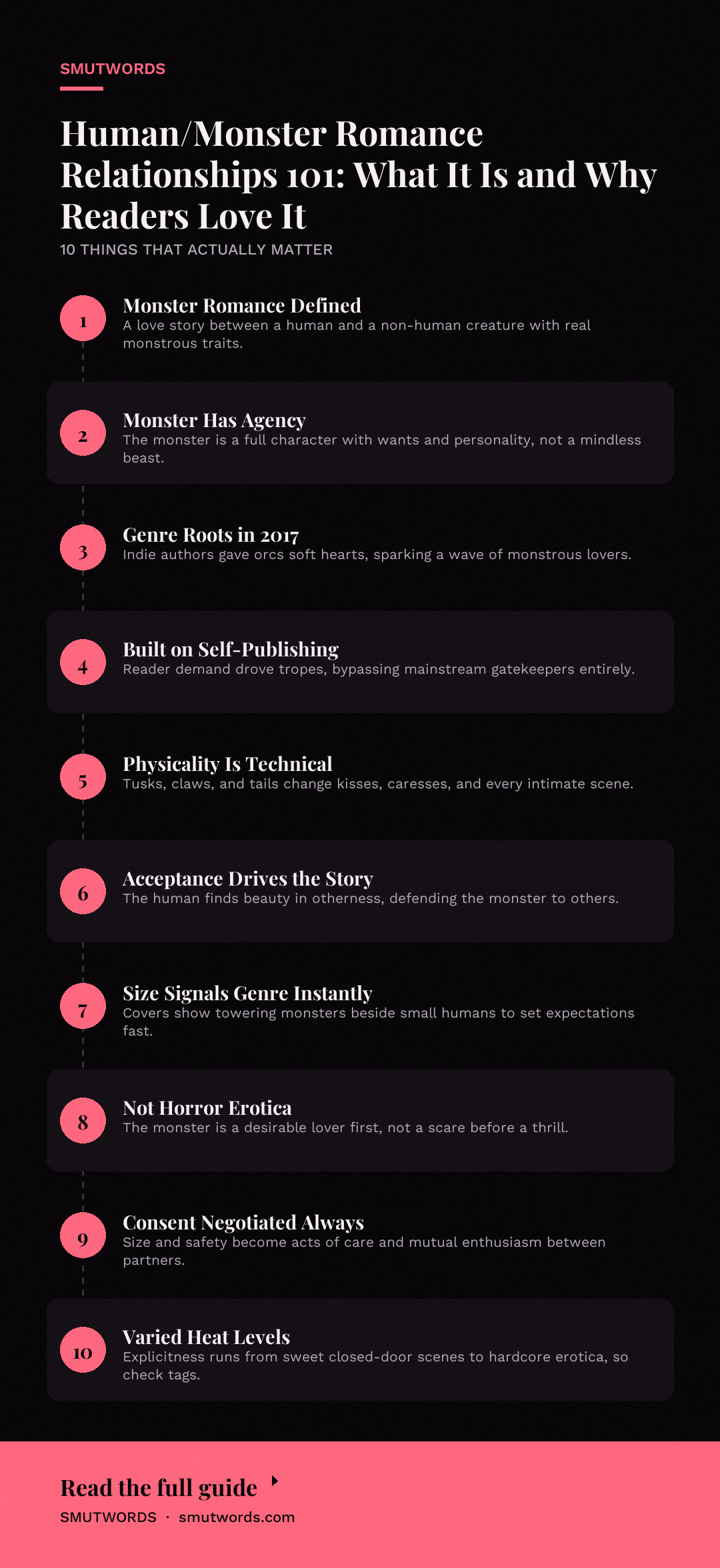
What Monster Romance Actually Means
The term "monster romance" covers a broad literary category where a central love story occurs between a human and a being that is explicitly not human. Not a human with a few cosmetic tweaks, either. The monster usually has anatomy, instincts, or a culture that are alien to the human experience: a snout with tusks, a prehensile tail, venomous fangs, multiple limbs, or a massive difference in scale.
The key is that the "monster" is a legitimate character with agency, wants, and a personality. Not a mindless beast.
The genre's definition has a wide umbrella. Orc romance, cryptid romance, and alien romance (when aliens are monstrous) all fall under it, as do dinosaur romance and giant romance titles. A fae who is merely tall, beautiful, and pointed-eared rarely qualifies; a fae who shifts into a monstrous form or has an inhuman appetite for flesh might. The line between monster and paranormal love interest often comes down to how much the book leans into the creature's non-humanity.
Common misconceptions abound. Monster romance is not the same as horror erotica, despite some overlap in tone. Horror romance usually aims to scare before it aims to arouse.
Monster romance treats the monster as a desirable lover first. It is also not inherently non-consensual or dark, though darker titles exist alongside sweet ones. The genre is a spectrum, not a single flavor.
Readers should also know that "human" in the genre's title is flexible. The human partner just needs to be the ordinary, baseline point of view. A fantasy heroine from a medieval world can be a monster's love interest every bit as much as a modern office worker. The important part is the perceived gap between the two lovers, not the legal species of the protagonist.
Where Monster Romance Comes From
The roots of monster romance reach deep into mythology, but its recognizable modern shape as a romance genre is surprisingly recent. For a long time, romance fiction kept love interests humanoid and conventionally attractive. The popularity of shapeshifters like werewolves offered a safe middle ground: a man who is beautiful but has a beast inside.
That archetype began to shift in the 2010s when indie publishing discovered a hungry audience for love interests who were monstrous on the outside as well as the inside. The breakout moment is widely attributed to writers who gave orcs the full romance novel treatment.
Around 2017 and 2018, indie authors began publishing stories where orc males were soft-hearted, courting, and devoted lovers despite their tusks and bulk. These books rode a wave of readers who found the hypermasculine, non-human love interest refreshing compared to the clean-shaven billionaire or the brooding vampire. The trend spread to minotaurs, trolls, goblins, and more obscure mythological creatures.
Publishing history matters here. The genre was built on self-publishing and small digital-first presses long before traditional houses caught on. This means its tropes evolved through reader demand.
Communities on social media and forums fed writers suggestions for monster lovers, and entire subcategories like dinosaur romance owe their existence to niche reader requests that proved commercially viable. The genre effectively bypassed mainstream gatekeepers and spoke directly to an audience that wanted something other than human men.
The shift toward explicit acceptance of the monster as a romantic ideal also mirrors broader changes in how romance handles consent, safety, and power imbalances. Earlier portrayals of monsters in romance or erotica often coded them as villains or threats that the heroine tamed or escaped.
Modern monster romance books still enjoy tension, but the monster is more often a protector and provider who seeks enthusiastic partnership. That evolution matters: the genre's current definition relies on the monster being a viable, loving partner.
How It Shows Up in Erotica
The craft of monster romance erotica hinges on two things: the monster's physicality and the author's ability to sell the reader on that body as erotic. A good monster romance scene is a technical exercise in describing anatomy without losing heat.
Tusks need to be accounted for in a kiss. Claws change how a caress works. A tail can be a subtle instrument of restraint or pleasure.
A well-written monster has a full sensory profile: smell, texture, size, sound, and taste all get used. Strong monster romance books also deliver on the emotional craft of intimacy between two very different beings.
The human character does not just tolerate the monster's otherness; she (the genre skews heavily toward straight female readers, though LGBTQ+ monster romance exists) actively finds beauty and value in the differences. This often manifests as the heroine defending the monster to other humans or learning cultural customs that are alien to her own. The acceptance arc is a major engine for the story's emotional payoff.
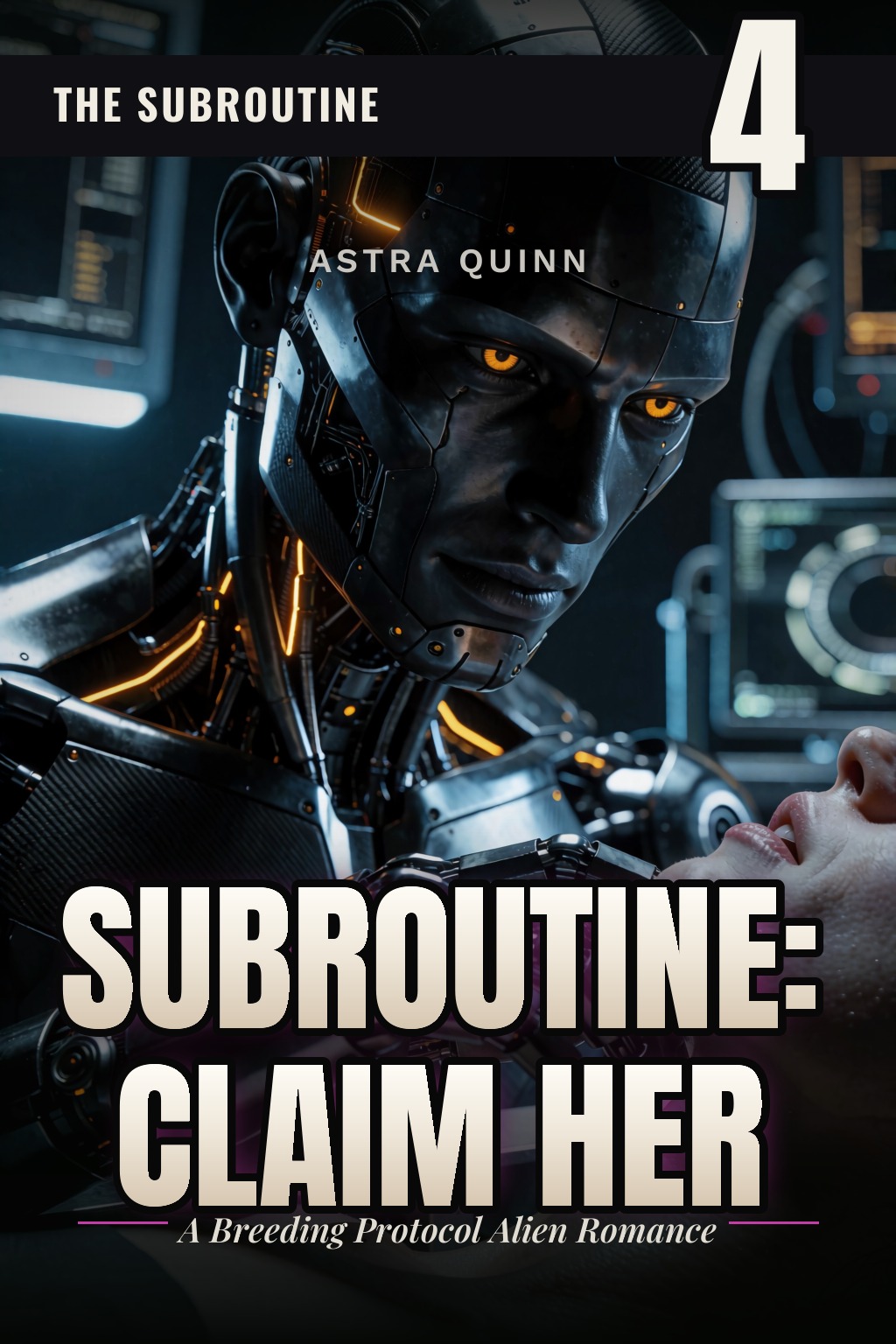
Authors also play with the visual grammar of the romance cover. Where a traditional cover shows a clingy dress and a bare male chest, monster romance covers are doing heavy lifting with scale. An orc towering over a human woman signals the genre instantly.
The size difference between partners is often a core part of the fantasy: readers who enjoy size difference romance will frequently find those same dynamics amplified in monster books, where the small, soft human partner is physically overwhelmed by a creature three times their mass.
Enjoyed this? Get a free book.
Join the list and we will send a complete free story straight to your inbox, plus new releases every week after that. No credit card, no catch.
Different monstrous types create distinct sub-eras of the genre:
- Orc romance: Emphasis on rejected or undervalued heroes, tenderness against a brutish exterior, and community-oriented courtship.
- Cryptid romance: Mothmen, Bigfoot, and lake monsters become love interests, often leaning into curiosity and rural isolation.
- Elven monster variants: Some elf romance entries blur the line when elves are written as cold, alien, and inhuman, though most remain beautiful and humanoid.
- Dinosaur romance: A niche that treats prehistoric creatures as viable lovers, usually through some exotic setup or portal premise.
- Tentacle and eldritch romance: Focus on the truly alien, with non-human anatomy that requires creativity and consent to build a satisfying scene.
What separates a strong monster romance from a flat one is characterization. A monster whose only trait is being huge and horny is boring. The genre's best works give the creature a society, a set of customs, a distinctive voice, and emotional complexity that makes their monstrous body feel like an expression of a real self rather than a costume.
The monster must surprise the reader: an orc who embroiders, a minotaur who reads poetry, a tentacled being who is shy about its feelings. Conversely, the erotic scenes fail when the author writes the monster as a human with prosthetics.
If the non-human anatomy never affects the mechanics of the sex scene, the book cheats. The physical and emotional components must work together. The monster's body introduces real stakes: the human must negotiate size, safety, and comfort, all of which can be rendered as acts of care and mutual enthusiasm rather than fear.
Monster Romance vs Cryptid Romance
The comparison between monster romance and cryptid romance is a real point of confusion because the categories overlap heavily. A cryptid is a creature of uncertain existence, like Bigfoot, the Mothman, or the Loch Ness Monster.
Cryptid romance pairs a human protagonist with one of these real-world mythological creatures, often in a contemporary setting where the cryptid is hiding from human society. Monster romance is the wider category: it includes cryptids but also wholly fictional creatures from fantasy worlds, space, or alternate realities.
Functionally, cryptid romance reads as a modern American folk tale. The horror of the unknown creature is tempered by a desire for connection, but the contemporary setting anchors it in a world that looks like our own. That contrast gives cryptid stories a different texture.
A standard monster romance set in an orc kingdom can build the world around the monster. A cryptid romance must smuggle its creature into a recognizable suburban or forested landscape.
If a reader is deciding between the two, the choice comes down to setting preference. The familiar world with a hidden creature often produces enemies-to-lovers and secret-identity dynamics. A full fantasy world with monsters everywhere allows for slower romance worldbuilding. Most readers who enjoy one will enjoy the other.
For more detail on the specific folkloric branch, a dedicated reading of the cryptid romance glossary entry is worthwhile.
Frequently Asked Questions
Is monster romance the same as monster erotica?
No. Monster erotica is a subset that foregrounds explicit sexual content, often with short, plotless stories. Monster romance always includes a developed relationship and typically reaches a happily-ever-after ending. A book can contain both, but the terms describe different levels of romantic and narrative focus.
Why are orcs so popular in monster romance?
Orcs became the genre's flagship monster because the standard orc archetype (large, gruff, physically powerful) creates a maximum visual and cultural contrast with a small human partner. Authors also gave them a soft side: supportive social structures, adoration of their partner, and protective instincts, making them feel like a safe fantasy despite the intimidating appearance.
Does monster romance always include explicit sex?
Many titles are very explicit, but the heat level ranges from sweet and closed-door moments to hardcore erotica. The genre label refers to the romantic subject matter, not a guaranteed spice level. Checking content tags and reader reviews is the only reliable way to know how graphic a given book gets.
Is it normal for the human to have all the power in the relationship?
Power dynamics vary widely. Some books play with the monster as a protector and the human as a sheltered partner, while others reverse expectations entirely. The human often has social power (beauty, civilization) while the monster has physical power (strength, wildness). The balance between the two is part of the narrative tension.
Can men or non-binary readers enjoy monster romance?
There are books written for all audiences under this umbrella, though the market broadly targets heterosexual women. Readers of any gender who enjoy romance structures will find appeal in the themes of acceptance, otherness, and primal attraction. The best approach is to look for titles whose blurbs match the kind of pairing and point of view they want.
What is the difference between alien romance and monster romance?
Alien romance is usually understood to include humanoid, attractive extraterrestrials with a familiar human frame, while monster romance leans into non-human anatomy and aesthetics. However, alien species that are visibly monstrous very often sit in the monster category as well. The line is about presentation, not strict taxonomy. If you want a curated list of titles that dance along that line, the best paranormal and sci-fi books list has plenty of both flavors.
Final Thoughts
Monster romance insists that love can be found in the most foreign of bodies. The best books make that idea feel both wildly exciting and genuinely tender. It speaks to a craving for connection that does not depend on conventional attractiveness, a fantasy where the monstrous partner sees the human as the rare and precious one.
If you want a curated starting point for the trope and its wider supernatural family, the best hotwife & cuckold books list might seem like an odd detour, but it actually shares a thematic cousin: the thrill of wanting something outside the expected script. For those drawn to the risk and taboo aspects of loving the unknown, the best taboo and forbidden books collection is a natural companion read.
For the related tension of different scales and frames, the SmutWords catalog entry on size difference romance is the natural next stop. Pick up a book with tusks on the cover and let the monster do the rest.




Loading comments…