Imprinting is the trope where one character's body, magic, or animal instinct selects another person as their one and only mate, permanently, whether either of them signed up for it or not. In shifter romance and paranormal erotica, imprinting overrides courtship, consent negotiations, and sometimes common sense: the bond snaps into place, and both parties are bound to it for life.
The appeal is total certainty. Somebody out there is not just attracted to you, not just choosing you, but chemically incapable of wanting anyone else. The imprinting trope is that fantasy at maximum volume, and it has become one of the load-bearing structures of the entire paranormal romance genre.
What Imprinting Actually Means
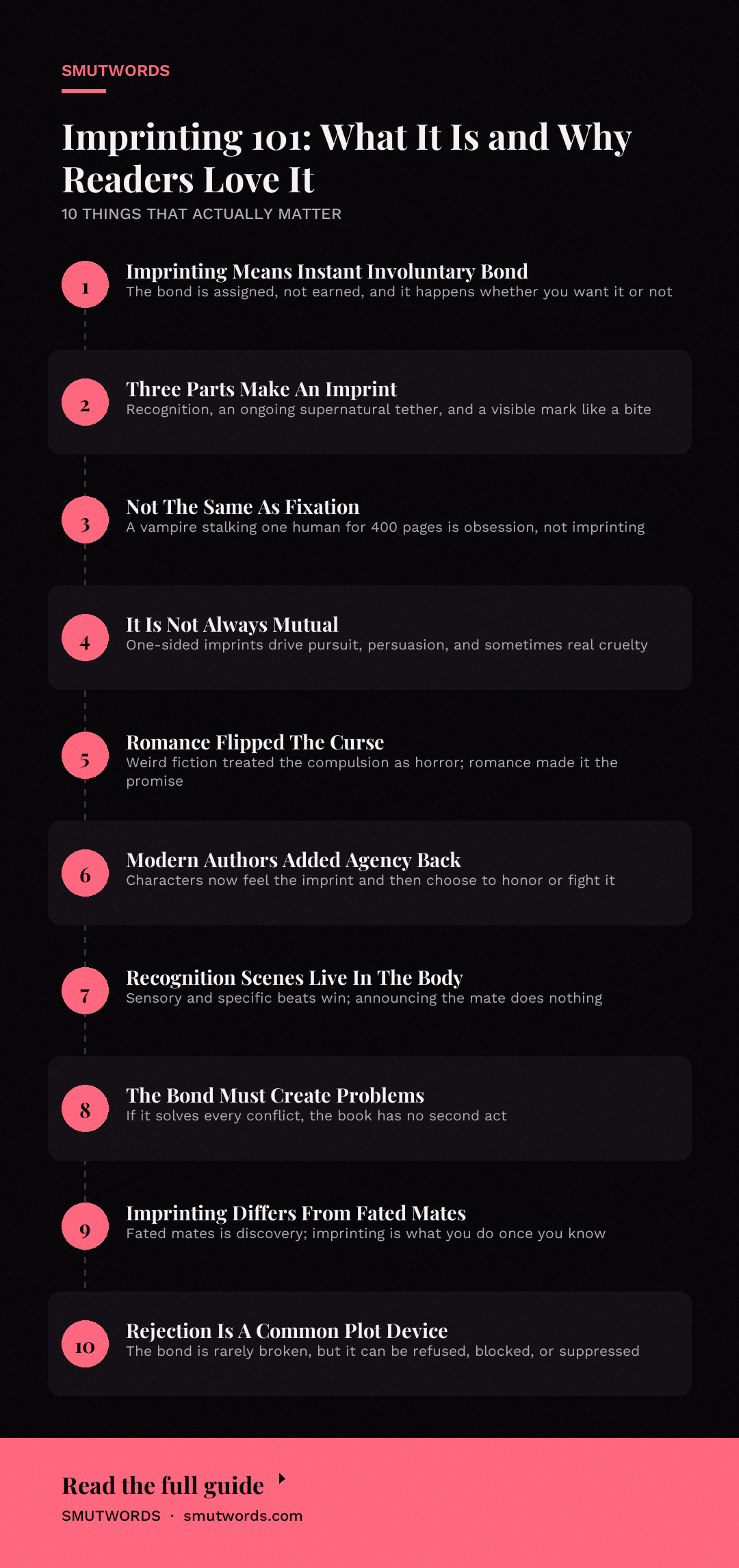
The short definition gets you in the door: a character marks another as their destined partner, creating an instant and unbreakable bond. The expanded version is messier and more interesting.
Imprinting usually involves three components working together. There is the recognition, the moment one character's senses lock onto the other and something fundamental rearranges itself. There is the bond itself, an ongoing supernatural tether that lets the pair feel each other's emotions, track each other across distances, or suffer physical pain when separated. And there is the marking, often a bite or a brand or a scar, that makes the bond visible to the rest of the supernatural world.
What does not count is important, because the term gets used loosely. A vampire who becomes obsessed with one human and stalks her for four hundred pages has not imprinted. That is fixation, a different trope with a different emotional engine.
A fated mate pairing where both characters discover their connection gradually, over months, through getting to know each other, is adjacent but distinct. Imprinting specifically implies immediacy and involuntariness. The bond is not earned. It is assigned.
That involuntariness is the whole point, and it is also the source of every good conflict the trope generates. Nobody applies for an imprint. It happens to you, often at the worst possible moment, often to the last person you would have picked.
Common misconceptions worth clearing up:
- Imprinting is not the same as love. The bond creates compulsion and connection. Love is what the characters have to build on top of it, or in spite of it. The best books in this space never let the imprint substitute for the actual relationship.
- Imprinting is not always mutual at first. Plenty of books run on a one-sided imprint, where one character is bound and the other has to be convinced, seduced, or worn down.
- It is not confined to wolves. Dragons, bears, big cats, demons, fae, and cyborgs all imprint in various series. The mechanism travels.
- The bond does not automatically mean happily ever after. An imprint to a villain, an imprint between enemies, an imprint that arrives while one party is already married: the trope is most useful when it makes life harder first.
Terminology varies by author and by series. You will see it called a mate bond, fated mates, biological destiny, a soulbond, or claiming mark depending on whether the emphasis lands on instinct, fate, or the physical act of marking. The terms overlap but are not identical, and readers who have been in the genre long enough develop firm preferences about which term signals which flavor of story.
Where Imprinting Comes From
The honest history here is a publishing history, because imprinting as a named trope is roughly thirty years old and its lineage runs through genre fiction rather than folklore.
Animal-mate bonds existed in fantasy and science fiction long before the romance genre claimed them. Early twentieth-century weird fiction and mid-century pulp occasionally gestured at a supernatural compulsion between two characters, usually as horror. The compulsion was a curse. It was something to escape.
Romance flipped that. Through the 1980s and into the 1990s, paranormal romance as a shelf category solidified, and authors writing vampires and werewolves needed a mechanism that could deliver the genre's core promise, which is a guaranteed emotional payoff, inside a world where human courtship rules did not apply.
The mate bond solved a structural problem. It gave supernatural characters a reason to be monogamous, intense, and permanent in a way that felt native to their natures rather than imposed by the plot.
The word "imprint" itself entered wide romance usage through the werewolf and shifter wave of the late 1990s and 2000s. Series that put pack structures, alpha hierarchies, and animal instinct at the center of the story needed vocabulary for what happened when instinct chose. Imprint, bond, and mark became the genre's shared shorthand, and readers began searching for books by those words specifically.
Two shifts have reshaped the trope since.
The first was the consent conversation. As romance readers became more vocal about what they wanted from the genre, the "bond overrides free will" premise started getting interrogated from inside the books rather than just enjoyed.
Modern authors increasingly write characters who feel the imprint and then choose to honor it, or who fight it and win the right to build something separate. The compulsion is still there. The agency got added back.
The second shift was diversification of the bond's mechanics. Early imprinting was almost exclusively a wolf thing, tied to pack hierarchy. Now the bond shows up in dragon romances with hoard-based mate recognition, in fae books where the bond is a magical contract, in sci-fi and cyberpunk romance where it is a neural link or a compatibility algorithm, and in monster romance where it is closer to biological destiny than to any animal behavior.
What has stayed constant across three decades is the core promise: the bond is real, it is permanent, and it removes the possibility of rejection. That promise is why the trope keeps working no matter how many times it gets rebuilt.
How It Shows Up in Erotica
On the page, imprinting is a pacing engine and a heat engine at the same time, and understanding how the two interact is the difference between writing a scene that lands and writing one that reads like a summary of a better book.
The recognition scene is where everything is won or lost. It usually happens early, sometimes in the first chapter, and it is almost always written from inside one character's body: a scent that hits like a wall, a spike of possessiveness that has no rational source, a physical reaction the character cannot explain and cannot stop.
Strong versions keep the recognition sensory and specific. Weak versions announce it. "He realized she was his mate" is a sentence that does nothing. The same beat written through the body, through a mouth going dry or a growl that escapes before he can swallow it, does all the work.
After recognition comes the resistance phase, which is where the erotic tension actually lives. The characters know. The reader knows. The bond is already in place.
So the story has to generate friction from something else: a rival, an oath, a war, a class divide, a secret.
Enjoyed this? Get a free book.
Join the list and we will send a complete free story straight to your inbox, plus new releases every week after that. No credit card, no catch.
Erotica in this space tends to use the imprint as a pressure source that makes every physical encounter feel inevitable and forbidden at the same time. The characters are not deciding whether to want each other. They are deciding how long they can stand not to act on it.
The claiming itself is the genre's signature set piece, and it is where imprinting and heat converge most directly. A claiming scene typically involves a bite, a mark, or a ritual, physical pain braided with pleasure, and a shift in the bond's intensity that both characters feel immediately. Authors vary wildly in how explicit the marking gets and how much they lean into the pain.
The mark is also a plot device. Once it exists, other supernatural characters can see it, which means it functions as a public declaration and a source of external conflict.
Common variations you will run into:
- Mutual imprint. Both characters recognize simultaneously. Cleanest version, least conflict, so it usually needs an external threat to carry the plot.
- One-sided imprint. One is bound, the other is not. Generates pursuit, persuasion, and sometimes genuine cruelty from the bound character who cannot help themselves.
- Rejected imprint. One character refuses the bond outright, and the other has to survive the rejection, which is often written as physical agony. This variant exploded in popularity and now supports entire subgenres.
- Imprint to an enemy. The bond lands on someone from the opposing side of a war or feud, forcing proximity on two people who would otherwise kill each other. This pairs naturally with enemies to lovers structures.
- Imprint interrupted. The bond forms and is then severed, blocked, or hidden, usually by magic or by a villain, and the story becomes about restoring or resisting it.
- Delayed recognition. The characters have known each other for years and the imprint ignites late, which lets an author graft the trope onto a marriage in trouble plot or a long-running friendship.
What separates a strong imprinting book from a flat one comes down to one question: does the bond create problems or solve them?
Flat versions use the imprint as a shortcut. The characters are fated, therefore they end up together, therefore the story is over. Those books have no second act and readers feel it.
Strong versions use the bond as an accelerant on top of a conflict that would exist anyway. The couple has real reasons to stay apart, and the imprint makes staying apart unbearable. That is the version that generates heat, because every scene between them is charged with something neither can switch off.
The other marker of quality is whether the author lets the bond have costs. An imprint that only ever feels good is a wish-fulfillment device with a short shelf life. An imprint that makes a character lose sleep, lose control, lose a friendship, or lose a shot at something they wanted is a story.
Worth noting: the trope plays well with others across the genre. You can drop an imprint into a soldier romance where the bond forms mid-deployment, into a lumberjack romance where the shifter has deliberately isolated himself in the woods, or into a redemption arc romance where the imprinted mate is the one person the hero's past should disqualify him from having. The bond is a multiplier on whatever emotional structure is already there.
Imprinting vs Fated Mates
These two get used interchangeably and they should not be, because the distinction changes how a story works.
Fated mates is the umbrella. It covers any setup where destiny, magic, or biology has designated two characters for each other, whether or not the pairing is immediately obvious and whether or not there is a physical mark. Imprinting is a specific, more aggressive version of the same idea: the bond is instant, and in most books it is accompanied by a claim that other characters can see.
The practical difference is timing and visibility. A fated mates story can run for three hundred pages before the characters figure out what they are to each other. An imprinting story usually tells you in chapter two.
Fated mates tends to be about discovery. Imprinting is about what you do once you already know.
Readers searching for one will often accept the other, so the terms bleed together in tagging and recommendation lists. But if you are writing, the choice matters. Imprinting forces you to build the conflict around an already-known bond. Fated mates lets you build the conflict around the reveal itself.
Frequently Asked Questions
Is imprinting the same as a mate bond?
Close, but not identical. A mate bond is the ongoing supernatural connection between two characters. Imprinting is the event or instinct that creates it. Many authors use the terms interchangeably, and in casual reader conversation they function as synonyms, but the distinction is useful when you are trying to describe what a specific book does.
Can an imprint be broken or rejected?
In most series, no. The permanence is the point, and authors protect it because breaking it would remove the trope's core promise. That said, rejection is a common plot device: one character refuses the bond and both parties suffer for it, often physically. The bond is rarely destroyed, but it can be suppressed, blocked by magic, or left unacknowledged for years.
Why do readers find imprinting so appealing?
It answers a fear that runs underneath a lot of romance reading: that the person you want might not want you back, or might stop. An imprinted pair cannot reject each other and cannot drift apart. The fantasy is being wanted with a certainty that does not exist in real life.
Does imprinting only happen in werewolf and shifter books?
No, though that is where it started and where it remains most common. Dragons, fae, demons, vampires, and in some cases aliens or augmented humans all imprint in various series. The mechanism adapts to whatever the author needs, from a magical contract to a neural compatibility match.
Is imprinting problematic because it overrides consent?
It is a real tension in the trope, and modern authors handle it in different ways. Some lean fully into the loss of control and treat it as the fantasy. Others write characters who feel the imprint and then deliberately choose to accept or reject it, which restores agency without removing the bond. Neither approach is wrong; they simply produce different books.
What should I look for in a good imprinting romance?
Look for a bond that costs the characters something. If the imprint smooths every problem away, the book will feel thin. The strongest versions in the genre use the bond to make an existing conflict more acute, not to resolve it, and they keep the physical recognition scenes grounded in the body rather than in summary.
Final Thoughts
Imprinting endures because it delivers something romance readers genuinely want and rarely get to have without friction: certainty. The bond removes doubt, and doubt is the most exhausting thing about falling for someone. The books that last in this trope are the ones that take that certainty seriously and then ask what it costs.
If you want to see the trope at its most effective, start with a rejected-imprint story where the refusal lands in the first act and the rest of the book has to earn its way back. That structure forces the author to write the bond as a live wire rather than a foregone conclusion, and it shows you exactly what the trope can do when it is handled with real stakes.







Loading comments…