
Kraken romance is having a moment, and the moment keeps getting deeper. What started as a niche corner of monster erotica, mostly jokes about tentacles and ships, has quietly become one of the most reliably weird and emotionally sincere subgenres in the whole alien romance racket.
A kraken isn't a scaled-up human with green skin. The appeal is precisely that it isn't. The appeal is a creature built for a different ocean entirely, one that loves with everything it has because it has never once been allowed to.
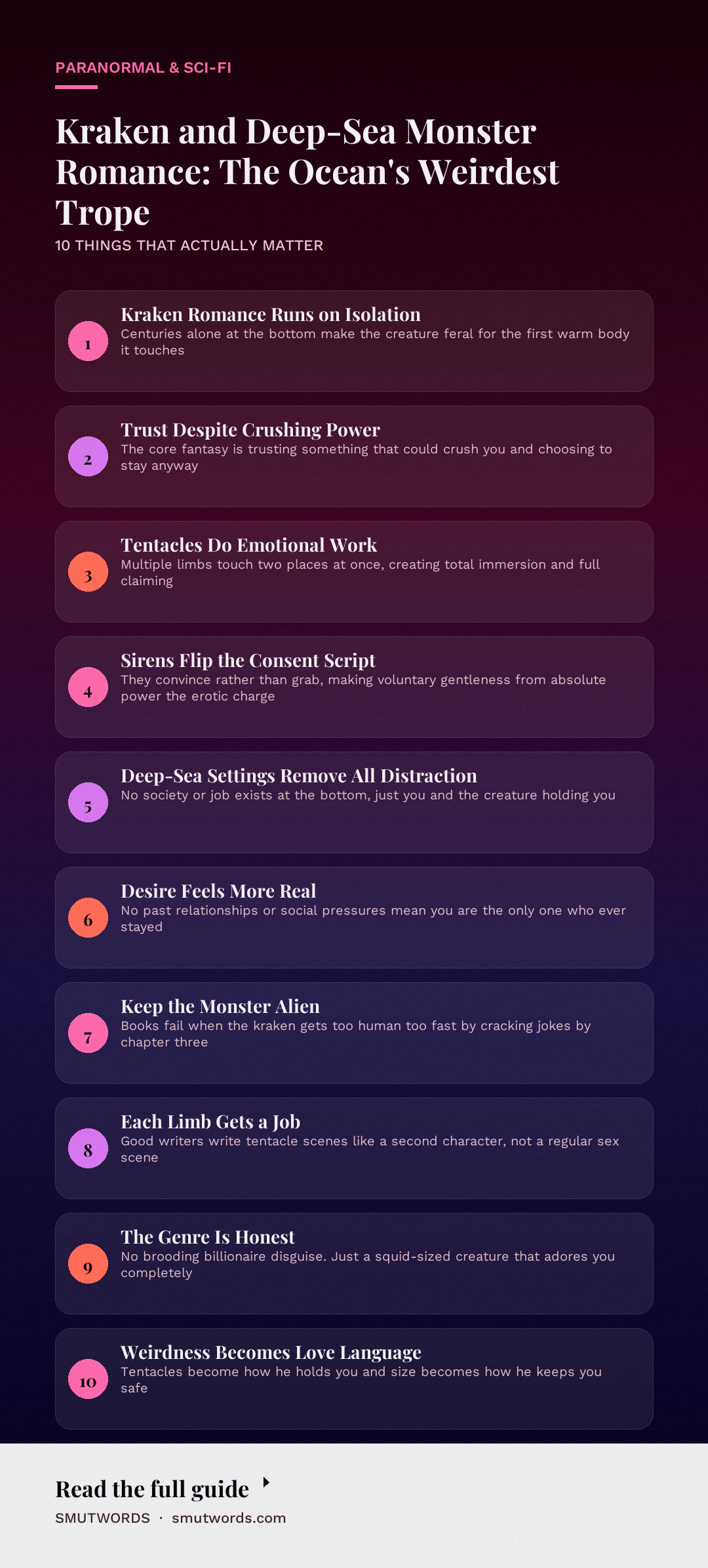
The whole deep-sea corner of monster romance, from krakens to sirens to things that live so far down they don't have names, runs on the same engine: isolation.
These are love interests who have spent centuries alone at the bottom of the sea, and they are absolutely feral about the first warm body that touches them. That setup does more narrative work than any handsome-face-with-scars design ever could. It gives the author permission to make the love interest genuinely strange, genuinely dangerous, and genuinely desperate all at once.
What Makes a Kraken Different From Other Monster Love Interests
Most monster romance love interests are humanoid with a twist. Maybe horns, maybe a tail, maybe claws, but the basic architecture reads like a person. A kraken is not that.
A kraken is a mass of muscle and limbs and ancient intelligence that has no reason to look like anything a human would recognize. When a kraken wants something, it doesn't try to reason with you in a way you'd find comfortable. It wraps around what it wants and holds on.
This is where the fantasy actually lives. The core of kraken romance is being held by something that could crush you and choosing to trust it anyway. The size difference isn't a suggestion.
The power imbalance isn't a negotiation point; it's the whole proposition. You are smaller, softer, more breakable, and the creature holding you knows it and is being careful anyway. That carefulness reads as devotion in a way a human partner's care never quite can, because a human partner doesn't have to try that hard.
The tentacles themselves matter, but not the way most people assume. Yes, there's a practical appeal, and anyone who has read a good tentacle scene knows the logistics are part of the draw.
But the tentacles also do emotional work. They can touch two places at once. They can hold you still while another limb strokes your face. They can trace your spine while another coils around your ankle. For a subgenre obsessed with being fully claimed, that multi-limbed attention is the closest thing to total immersion a scene can offer.
If you want the mechanics of why tentacles hit the way they do, the history and the craft are covered properly in our piece on tentacle erotica, where the trope came from and why it still works. The short version is that tentacles bypass all the usual human-body expectations and give the author a blank canvas for whatever the scene needs.
The Deep-Sea Monster Romance Family Tree
Krakens don't exist alone in this niche. They share the ocean floor with a whole cast of creatures that all pitch the same basic fantasy with different lighting.
Sirens and mermaids flip the script in an important way. A siren is the predator who lures you in on purpose, who sings and waits and watches you come to her. She may or may not care about you after she catches you, and that ambiguity is half the appeal.
She is also usually humanoid above the waist, which makes her a different category of monster entirely. The uncanny part of a siren isn't her shape. It's her voice and her patience.
Full-on sea serpents and leviathans occupy the extreme end. These are creatures the size of small buildings, and the romance tends to be more about being protected by something enormous than about intimate logistics.
The scenes are often more atmospheric, more about the constant presence of something vast and watchful below the boat than about specific acts. Some readers want the bedroom scenes; some just want the sense of being owned by the ocean itself.
And then there are the ones with no mythic precedent at all, the invented deep-sea aliens who just happen to live underwater. Those tend to play like terrestrial alien romances with wet hair, and they often lean harder on the science fiction side of the worldbuilding.
The fated mate bond usually shows up here, and honestly, it lands beautifully when the creature in question has been swimming alone for four hundred years. Our explainer on fated mates and why alien romance runs on instant bonds covers exactly why this pairing works so well.
Why the Isolation Fantasy Works So Hard
Strip away the tentacles and the scales and the gills, and every deep-sea romance is about the same thing: someone who has been starved of contact finally getting it. This is the touch-starved monster trope in its most literal possible form.
A werewolf has a pack. A vampire has a coven. A kraken has the abyssal plain. There is no one down there. There has never been anyone down there.
So when the human shows up, the response is not measured. It's not a slow burn with a will-they-won't-they arc. It's an immediate, overwhelming, borderline panicked attachment. The creature does not know how to flirt.
It knows how to hold on and not let go, and it applies that single skill with total commitment.
That dynamic does something specific to the reader. It makes the monster's desire feel more real than a human love interest's, because the monster has no other options, no social pressures, no past relationships to compare you to.
You are not one candidate among many. You are the only person who has ever seen this creature and not run. That is the fantasy. Being wanted like that, with full knowledge that you could leave and there's a real chance they'd simply dissolve back into the dark, is the emotional payload the whole niche is built to deliver.
The books that fumble this are the ones that make the monster too human too fast. If the kraken starts cracking jokes and asking about your day by chapter three, the spell is gone.
The best versions let the creature stay alien in its devotion, expressing love through behavior rather than language, through the way it rearranges its entire existence around protecting one small soft thing.
What a Good Deep-Sea Monster Romance Scene Actually Does
The mechanics of a kraken or siren scene matter less than the atmosphere, but the mechanics still need to land. A good author treats the non-human body as an opportunity, not an obstacle.
For krakens specifically, the limbs create a choreography problem. You can't write a tentacle scene like a regular sex scene, with two bodies moving against each other in expected ways. Every tentacle has to be accounted for, or the scene falls apart.
The best writers use the limbs like a second character, giving each one a job. One holds you against the creature's chest. One traces its way up your thigh. One wraps around your wrist, just firm enough to remind you that you're not going anywhere.
Free StoryEnjoyed this? Get a free book.
Join the list and we will send a complete free story straight to your inbox, plus new releases every week after that. No credit card, no catch.
That distributed attention is the whole point. It's not one partner touching you. It's being surrounded, held, and worked over from every angle at once.
Sirens work the opposite way. Their power is in voice and suggestion, so the scenes tend to be slower, more psychological. The siren doesn't need to hold you down. She sings, and you stay.
The tension in a siren scene is consent, normally, the question of whether you're there because you want to be or because her voice has rewritten your wiring. The good versions leave that question unresolved and make you not care.
If you want to see writers who actually understand this kind of escalation from first contact to full claim, the tentacle breeding subgenre is where the craft is most visible.
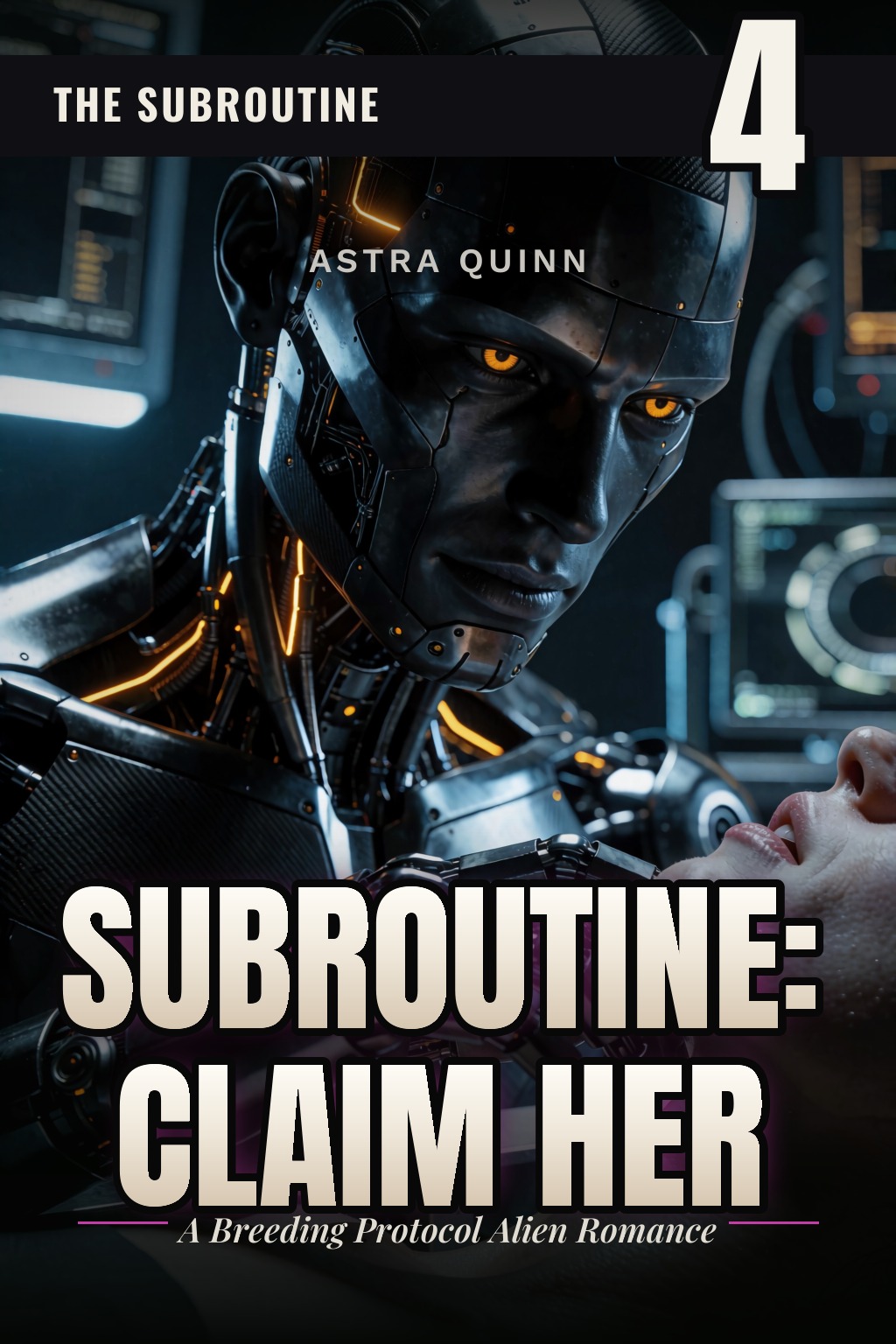
The Breeding Spiral: Captured in the Tentacle Alien Incubation Chamber and Star Sower: A Captive in the Tentacle Alien Breeding Chamber both run the full arc of a creature that has no idea what to do with you except everything at once. They lean into the incubation element, which is its own whole thing, and they don't waste time making the tentacles shy about their purpose.
Sirens and the Consent Question
Sirens deserve their own paragraph because they handle consent differently than every other deep-sea love interest. A kraken grabs you. A siren convinces you.
There's a version of that which is pure horror, and then there's the romance version, where the siren genuinely wants you and the song is just her way of speaking honestly. The difference is whether the author treats the mind-control element as a cheat or as part of the creature's fundamental nature.
The best siren romances play it as a trust exercise. She could make you do anything. She can also choose not to.
The erotic charge comes from the fact that she doesn't need your consent, and she cares about it anyway. That's a different flavor of monster-light than the kraken's desperate grip, but it scratches the same itch: being valued by something that has absolute power and refuses to abuse it.
This connects directly to the wider captor to protector arc that runs through so much monster romance. The creature starts in a position of total power and ends up choosing gentleness. It's a fantasy about being dangerous to someone and having them love you anyway, just from the other side of the equation.
The Appeal of the Uncharted Depths
There's also something to be said for the setting itself. Deep-sea romance isn't just about the creature; it's about the place.
The bottom of the ocean is the last genuinely unmapped frontier on Earth, and that gives authors a blank canvas. There are no rules down there. There's no society, no job, no family expectations, none of the stuff that makes a normal romance complicated.
When you're in a kraken's lair at the bottom of the Mariana Trench, the only thing that exists is you and the creature holding you.
That's a fantasy of total removal from everyday life, and it hits especially hard for readers who are drowning in responsibilities. A deep-sea monster romance isn't about leaving your husband or quitting your job. It's about sinking, voluntarily, into a space where nothing can reach you except the one thing that wants you.
The depth also lets authors crank the strangeness. Bioluminescence, pressure that would kill you, creatures that evolved in darkness so complete that eyes are useless.
The best books lean into that sensory difference. They describe the glow, the weight of the water, the way sound moves differently. When the setting is this alien, the love interest doesn't have to work as hard to feel otherworldly. He just lives there.
Why This Genre Has Legs
The kraken romance category gets dismissed as a punchline, and that's a mistake. This is one of the most emotionally consistent subgenres in monster romance.
The setup is always the same: creature alone for eons, human falls in, creature latches on with everything it has. That's a formula that works, and it works because it's honest about what it's selling. There's no pretending the creature is secretly a brooding billionaire. He's a squid the size of a fishing boat, and he adores you, and that's the entire appeal.
The books that do it best commit fully to the weirdness. They don't apologize for the tentacles or the scales or the fact that the love interest has no face to smile with.
They make the creature's alienness work for the romance instead of against it. The physical difference becomes the language of affection. The tentacles are how he holds you. The sheer size is how he keeps you safe. The inability to speak your language is why he learns to show you instead of tell you.
That's also why the genre pairs so naturally with the breeding instinct stories that run through the alien romance catalog.
There's a deep compatibility between a creature that wants to claim you completely and a plot that involves that claim having a purpose. Titles like Officer's Orders: Breed Her and Worship The Womb both understand that the creature's devotion works best when it has a direction, a reason to build a future around you instead of just a need to grip you in the dark.
Where to Start With Monster Romance
If the idea of a kraken love interest has never crossed your radar, the best entry point is usually the monster romance guide that lays out every creature type and what each one brings to the table. Once you know what you're looking for, you can skip straight to the subgenre that matches your specific flavor of weird.
For readers who want the purest version of the deep-sea fantasy, start with something that never pretends the creature is human. The whole point is the otherness.
A kraken romance should feel like falling into water you can't see the bottom of, then finding out the bottom was waiting for you the whole time.
Final Thoughts
The deep-sea monster romance niche is weird, specific, and completely unapologetic, and that's exactly why it works. When a creature the size of a cargo ship wraps itself around you and decides you're its whole world, the fantasy isn't about the tentacles or the size.
It's about being wanted that completely, with no hesitation and no alternative. If you've never tried one, start with Star Sower. It understands the assignment: a creature that has never been touched, suddenly given something to care for, and the wreckage and tenderness that follow in equal measure.





Loading comments…