Monster romance is the subgenre of erotica and romance where the love interest is genuinely, visibly non-human, and that non-humanity is the point rather than an obstacle to be cured. The creature in question can be a vampire, a shifter with a bestial side, an alien with a second set of parts, a gargoyle come to life, or a cryptid pulled from folklore.
What makes a story monster romance rather than simply paranormal is that the creature stays monstrous through the narrative. Their claws, fangs, scales, or stranger anatomy are never fully erased, and the fantasy centers on being desired, claimed, and loved by something that could hurt you but chooses not to.
What Monster Romance Actually Means
Monster romance is a romance or erotica novel where at least one member of the central pairing is a non-human creature whose physical or behavioral differences from a human man or woman are a core part of the attraction. The creature is a love interest, not a villain.
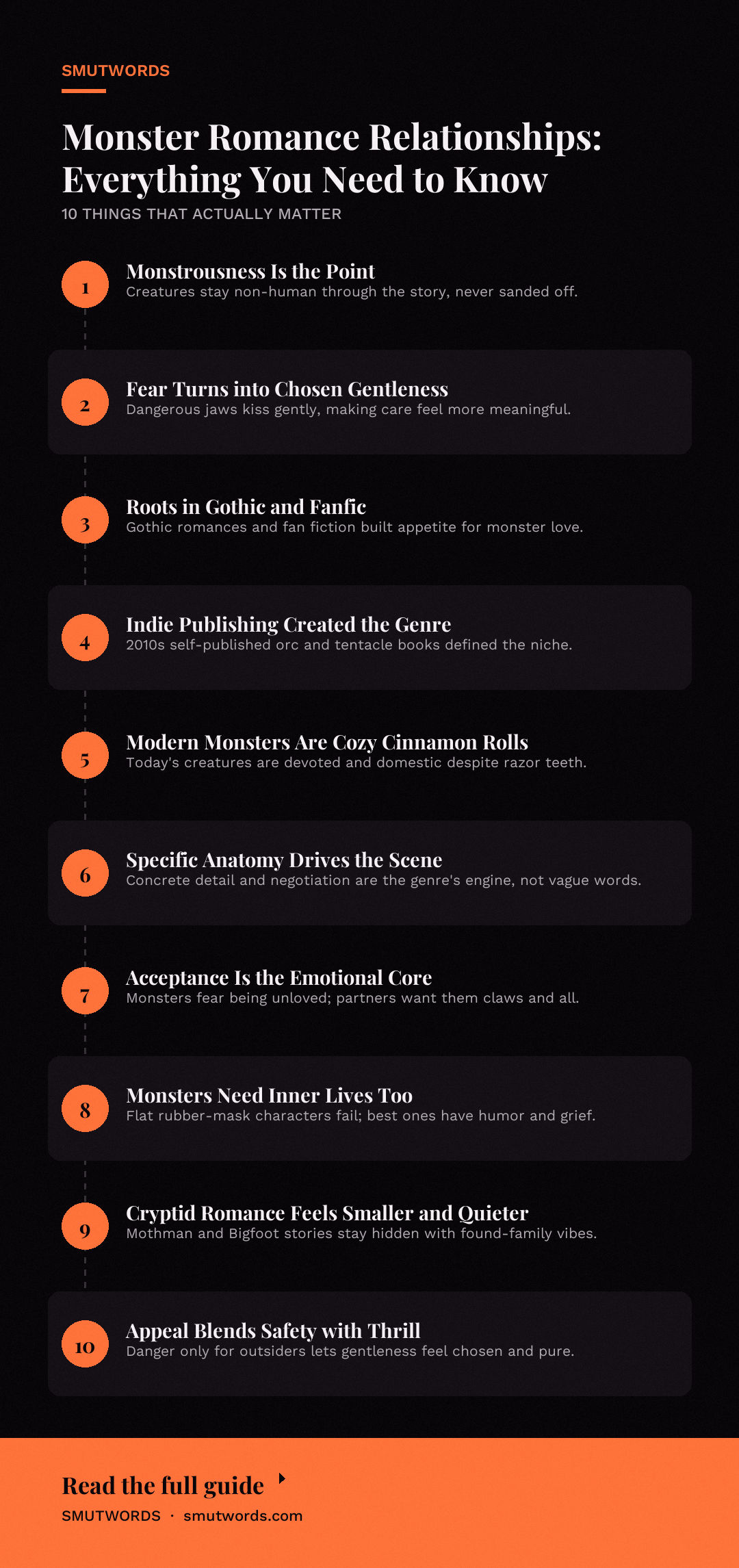
The story treats their monstrousness as a feature: dangerous jaws that kiss gently, a tail that offers pleasure, alien pheromones that spark a mate bond, or a massive frame that makes every touch feel overwhelming. The term sits under the broader umbrella of paranormal and sci-fi romance, but it carries a specific flavor.
A vampire in a standard paranormal romance might be a wealthy, brooding man who happens to drink blood and avoid sunlight. In a monster romance, that same vampire still has fangs that extend when he's aroused and a possessive streak literal enough that he marks his partner. The difference is one of emphasis. Monster romance refuses to sand off the sharp edges for the sake of conventional hero appeal.
Not everything with a supernatural creature counts. A fae lord who is beautiful, elegant, and passes for human in every way except for pointed ears is usually fae romance, not monster romance. The line blurs, but the general rule is that the creature must read as frightening, alien, or physically intimidating to anyone outside the relationship.
Size plays a part here. A seven-foot orc with tusks and green skin is a monster. A five-foot-eleven vampire who looks like a runway model is not, no matter how bloodthirsty he gets in the sack.
Common misconceptions abound. Monster romance is not horror erotica, though it borrows some of horror's imagery. The tone is almost always hopeful and romantic. The creature is never the villain of their own story, and the dark elements serve the fantasy of being wanted by something fierce.
It also is not exclusively about women with human men. The genre includes monstrous women, non-binary creatures, and pairings of every configuration, though the dominant market share is still a human woman with a male monster.
Where Monster Romance Comes From
The recognizable version of monster romance is a modern publishing phenomenon, but its roots stretch back decades. The gothic romances of the 1960s and 1970s, particularly the wave of novels from publishers like Ace and Lancer, featured heroines menaced by and eventually wed to brooding, often inhuman figures.
Daphne du Maurier's "Rebecca" and its imitators established the template of a woman entering a strange household ruled by a man with secrets. Those secrets were sometimes literal monsterdom. The real acceleration happened alongside the paranormal romance boom of the late 1990s and 2000s.
Vampire and shifter romances dominated bookstore shelves, and readers who wanted the intensity but found the human-shaped heroes too tame started looking for more. Fan fiction played a massive role in building the appetite. The internet gave readers space to write and share stories about characters who were genuinely alien or monstrous, and authors noticed the demand.
The explicit marketing term "monster romance" emerged in earnest in the indie publishing revolution of the 2010s. Self-published authors on Amazon and Smashwords could test niche concepts without a publisher's approval, and one of the most successful niches turned out to be orc romances, minotaur romances, and tentacle stories.
The 2016 release of "The Company of Fiends" and other early indie work helped establish the genre's recognizable tropes. By 2020, monster romance was a self-aware, self-referencing genre with its own conventions, cover aesthetics, and reader communities.
The genre has shifted meaningfully over its short formal history. Early entries tended to be grimdark, with the monster as a true threat the heroine had to survive before earning his softer side. Modern monster romance has swung hard toward cozy and protective dynamics.
The monsters of today's market are often cinnamon rolls wrapped in razor teeth: fiercely devoted, surprisingly domestic, and desperate for the affection they believe their appearance denies them. The fear has become a spice rather than the main course.
How It Shows Up in Erotica
Monster romance on the page lives or dies by physical description and the power dynamic it creates. A strong scene establishes the creature's body in concrete, sensory detail before any sexual contact happens. The reader needs to feel the weight of a massive hand, the scrape of scales, the heat radiating off a body that runs hotter than human.
This is not the place for vague adjectives. Specificity is the genre's engine. Anatomy is the most discussed craft element. Monsters get different equipment, and how the author handles that determines whether the book works or reads as absurdist comedy.
A minotaur with a barbed, knotting cock requires the heroine to acknowledge the danger, prepare for it, and be cared for through the process. The best authors make this negotiation part of the romantic arc: the monster's restraint in taking his pleasure slowly, the heroine's trust in letting something physically overwhelming close to her.
The recurring variants give a sense of the genre's range. Common approaches include:
- Alien romance, where the creature is from another planet with a distinct biology, often featuring unusual appendages or breeding instincts.
- Omegaverse, which overlaps heavily with pack dynamics and shifter tropes, focusing on biological hierarchy and mate bonds.
- Tentacle romance, often centered on a single entity with many limbs, exploring loss of control and multiple points of stimulation.
- Shifter romance, where the hero or heroine shifts between human and animal forms, with the animal half treated as genuinely present.
- Gargoyle romance, usually placing a stone guardian cursed to wake for one destined partner.
- Orc romance, frequently flipping the orc from violent fantasy villain to gentle, devoted suitor.
The modern indie market has also opened space for cryptid romance, which pulls from American folklore and internet-age legends like Mothman, and for giant romance, where the size difference is so extreme that the human partner fits in the palm of their lover's hand.
Enjoyed this? Get a free book.
Join the list and we will send a complete free story straight to your inbox, plus new releases every week after that. No credit card, no catch.
Anatomy aside, the emotional core matters more than the physical details. Every strong monster romance runs on acceptance. The monster believes they are too ugly, too dangerous, too alien to be loved. The heroine or hero sees past the surface and wants them anyway.
They want the creature not in spite of the claws and fangs but because those features make the care they show more meaningful. When a creature with the strength to crush bone uses that hand to brush hair from a face, the gesture lands harder than it would from any human partner.
Flat versions of the genre fail when the author forgets the monster is a character. If the creature is just a human man in a rubber mask with no personality beyond growling and being horny, the story collapses. The best monsters have interiority: a sense of humor about their own situation, a grief about their isolation, a specific way of moving through a world not built for them.
They want things beyond the heroine's body, and their desire for her is richer because it connects to those larger hungers. The best monster romance also makes the world around the couple feel real, however briefly. Whether set in a fantasy valley, a post-apocalyptic wasteland, or contemporary Earth where creatures hide in the shadows, the setting ought to justify why this creature and this human would cross paths at all.
A forced proximity scenario, like a mate bond triggered by scent or catching a wandering heroine in the forest, works because it removes the question of why they are together and focuses attention on how they handle the inevitability.
Monster Romance vs Cryptid Romance
The point of confusion between cryptid romance and monster romance is real because cryptid is a subset of the broader monster category. Cryptid romance deals specifically with creatures from folklore and alleged sightings: Mothman, the Jersey Devil, Bigfoot, Nessie.
These stories often carry a found-family or small-town feel, with the creature hidden from the wider world and the romance unfolding in secrecy. That setting quality distinguishes them from high fantasy monsters like orcs or dragons, who usually exist in worlds where their kind is known.
The practical difference matters for reader expectations. If you want a sweeping epic with battle scenes and a fully integrated monstrous society, standard monster romance delivers. If you want a quiet story about a woman in a rural town discovering that the creature the locals whisper about is real and lonely, cryptid romance is the more accurate search.
Frequently Asked Questions
What counts as monster romance?
Any erotic romance where a central love interest is non-human in body or nature and stays that way through the story. Vampires, shifters, aliens, orcs, gargoyles, tentacles, and cryptids all qualify. The creature must read as intimidating or alien to outsiders, and their monstrousness must be an active part of the attraction and conflict.
Is monster romance the same as paranormal romance?
No, though the genres overlap. Paranormal romance includes vampires, werewolves, and fae who are often human-passing and socially integrated. Monster romance keeps the creature visibly and behaviorally other.
A story about a vampire CEO who only drinks synthetic blood is paranormal. That same vampire with glowing red eyes and a territorial mate claim is moving into monster territory. If you want a broader survey of adjacent titles, the paranormal and sci-fi roundup has plenty of crossover picks.
Are the monsters in these books always male?
No. The market skews heavily toward male monsters with human women, but the genre includes female monsters, monster-monster pairings, and non-binary creatures. Monstrous women often play with predator imagery and reversed power dynamics. The underlying themes of acceptance and dangerous devotion apply across configurations.
Why do people like reading about monsters having sex?
The appeal combines safety with thrill. The monster is dangerous to everyone in the world except their partner, which makes their gentleness feel chosen and meaningful. The physical differences also remove comparisons to real human partners, letting readers explore exaggerated size, stamina, and anatomy without the baggage of real-world expectations. For many readers, it is the purest form of fantasy, since no human man can compete with a creature built for your pleasure.
Is monster romance just a fetish or does it have real stories?
Like any subgenre, quality spans a spectrum. Some books are essentially masturbatory scene sequences with a thin plot holding them together, and they serve readers who want exactly that. The genre also produces rich, emotionally complex novels exploring loneliness, disability, body image, and belonging. The best monster romances work as complete love stories, with the erotic scenes earning their place through character development rather than replacing it.
Where should a new reader start with monster romance?
Start with your specific interest. If you like werewolves and pack structures, look for shifter romances with prominent pack dynamics. If alien biology intrigues you, alien romance has the largest catalog. Orc romance is the current gateway drug for many readers because those books reliably deliver the protective, tender dynamic that defines the genre's modern tone.
Readers coming from other kink-adjacent niches often find the overlap with hotwife and cuckold books surprising, since both genres play heavily with jealousy, possession, and the thrill of the forbidden. Pick one creature and one well-reviewed book, then branch out from there.
Final Thoughts
Monster romance works because it asks a simple question and answers it beautifully: what would it feel like to be wanted completely, without reservation, by something that should terrify you? The genre's best books answer with total devotion, and readers keep coming back for that specific rush.
If you are ready to start reading, look for the currently popular orc or alien titles in the genre's best-of lists, including the paranormal and sci-fi roundup that features monster romance front and center. One book is all it takes to understand why so many readers trade in their human heroes for something with fangs.
For readers who want the darker, more taboo-adjacent side of the genre, the taboo and forbidden books list has entries that push the boundaries of what a monster can be.





Loading comments…