
Opposites attract is the romance trope where two people with clashing personalities, values, or lifestyles end up wanting each other anyway. The neat one-line version undersells it. In practice, opposites attract is a friction engine: a structure authors use to generate conflict, chemistry, and character change all from the same source.
It is one of the oldest and most reliable setups in the genre, and it is also one of the easiest to do badly. This guide covers what the term actually means, where it came from, how working authors build scenes around it, and what separates a pairing that crackles from one that just bickers for three hundred pages.
What Opposites Attract Actually Means
The phrase itself is folk wisdom older than the novel: the idea that complementary differences create a stronger bond than similarity. Romance publishing adopted it as a category label somewhere along the way, and it stuck because it describes a mechanical truth about storytelling. Two similar people have little to negotiate. Two opposed people have everything to negotiate.
What counts as opposites attract is broader than most readers assume. The opposition can live at almost any layer of character:
- Personality: the grumpy/sunshine axis, where one lead is closed and sharp and the other is open and warm.
- Values: ambition versus contentment, faith versus skepticism, family loyalty versus self-invention.
- Lifestyle: city versus country, wealth versus scraping by, chaos versus routine.
- Power and status: the prince and the nobody, the boss and the temp, the celebrity and the civilian. Prince/princess romance runs almost entirely on this axis.
- Moral register: the character who plays by the rules paired with the one who does not. Revenge romance leans on this version constantly.
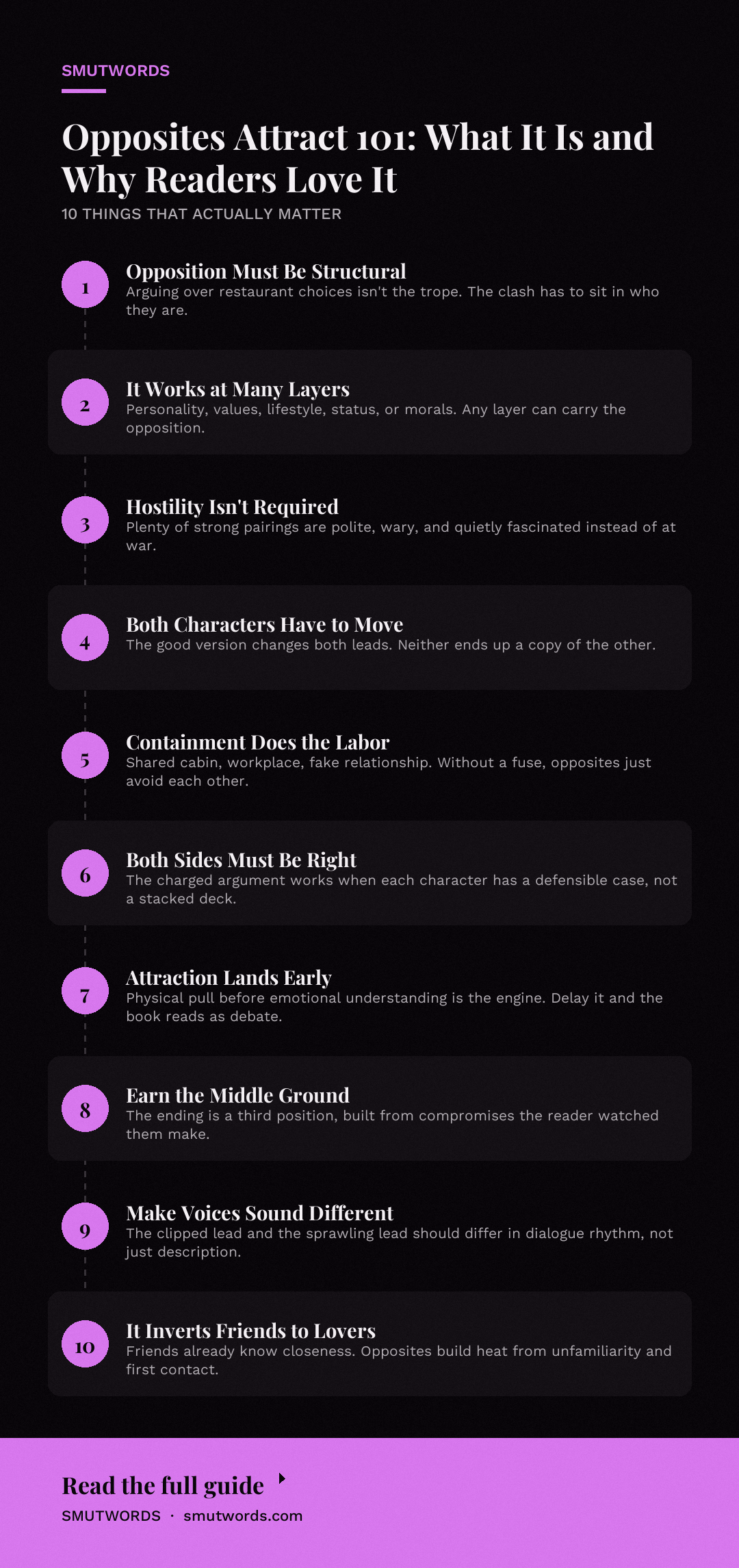
What does not count is mere disagreement. A couple who argues about restaurant choices is not an opposites attract pairing. The opposition has to be structural, meaning it sits in who the characters are and how they have decided to live, and it has to be the thing standing between them.
The most common misconception is that opposites attract requires hostility. It does not. Plenty of strong pairings in this trope are polite, wary, and quietly fascinated.
The other misconception is that the trope demands a full reversal by the final page, with one lead entirely remade into the other's image. That reading produces flat books. The good version moves both characters, and neither one ends up a copy of the other.
Where Opposites Attract Comes From
As a phrase, opposites attract has been floating around in English since at least the eighteenth century, applied to magnets, marriages, and everything between. As a romance publishing phenomenon, its history is shorter and easier to trace.
Category romance built the trope into its bones in the twentieth century. The mid-century pulp and category eras ran on covers that promised a clash: the rugged man, the refined woman, sparks implied by posture alone. The pairing was often framed as a problem the heroine had to solve, usually by taming or being tamed. That framing has aged poorly, and the genre knows it.
The real shift came with the rise of dual point of view. Once readers could sit inside both heads, the trope changed shape. The opposition stopped being a hurdle one character cleared and became a negotiation between two people with legitimate worldviews. Contemporary romance in the 2000s and 2010s pushed this further, and the internet named the sub-variants: grumpy/sunshine, bad boy/good girl, and the rest.
Indie publishing accelerated the naming. Tropes became marketing tags, readers searched by them, and opposites attract split into a dozen searchable flavors. That is the honest publishing history: a folk saying became a category convention, the convention became a tag, and the tag now shapes what gets written.
How It Shows Up in Erotica
On the page, opposites attract does specific structural work, and the best authors know exactly which levers to pull.
The forced-proximity fuse
Two opposed characters need a reason to stay in the room together. Working authors almost always bolt the trope to a containment device: a shared cabin, a workplace, a fake relationship, a blind date romance setup gone sideways. The containment is doing the labor. Without it, the opposition just means the characters avoid each other.
The charged disagreement
The signature scene in this trope is the argument that turns into something else. It works when both characters are genuinely right about something. She is not wrong that he is reckless. He is not wrong that she is frozen.
The heat comes from two defensible positions colliding, and the sex that follows reads as an extension of the fight rather than a pause in it. The flat version of that scene stacks the deck: one character obviously correct, the other merely stubborn. Readers feel the difference immediately.
Common variants authors use
- Grumpy/sunshine: one lead armored and withholding, the other open and relentless. The trap is writing the sunshine character as a therapist rather than a person.
- Bad boy/good girl: rule-follower meets rule-breaker. Strongest when the good girl's rules are her own rebellion and the bad boy's chaos is a wound, not a costume.
- City mouse/country mouse: fast versus slow, ambition versus rootedness. This variant gives you physical setting as a second character.
- Ice queen/player: two people fluent in control, one cold and one charming. The chemistry lives in who blinks first.
- Workaholic/free spirit: time itself becomes the contested ground. One lead schedules, the other drifts.
These variants cross-pollinate freely. A rockstar romance pairs the free-spirit performer with a structured, ground-level lead almost by default. A soldier romance runs the discipline-versus-spontaneity version. A marriage in trouble story can use the same engine on two people who already chose each other and are discovering how opposite they turned out to be.
Enjoyed this? Get a free book.
Join the list and we will send a complete free story straight to your inbox, plus new releases every week after that. No credit card, no catch.
What makes a strong version work
Strong opposites attract books do three things that flat ones skip. First, they make the opposition symmetric: both leads get a real case, and both get a real flaw. Second, they put the attraction on the page early and let it confuse the characters.
Physical pull that arrives before emotional understanding is the trope's engine. Delay it, and the book reads as a debate.
Third, they earn the middle ground. The ending of a good opposites attract story is not surrender. It is a third position neither character held at the start, arrived at through specific compromises the reader watched them make. If you cannot name what each lead gave up, the author skipped the work.
One more craft note: the opposition should be visible in dialogue rhythm, not just stated. The clipped lead and the sprawling lead should sound different on the page. When both characters narrate in the same voice, the trope collapses into a summary of itself.
Opposites Attract vs Childhood Friends to Lovers
These two get compared constantly, and the comparison is worth making because they are structural inversions of each other. Childhood friends to lovers builds heat from shared history and the terror of ruining it. Opposites attract builds heat from unfamiliarity and the friction of first contact.
The practical difference shows up in the pacing of intimacy. The friends already know how to be close; the story is about changing the shape of that closeness. The opposites are strangers to each other's operating system, and every scene of understanding is a small discovery. Both tropes can appear in the same book, but the engine running the middle act has to be one or the other, or the book stalls between them.
Frequently Asked Questions
What does opposites attract mean in romance?
It describes a pairing where the two leads hold genuinely different personalities, values, or lifestyles, and that difference creates both the main conflict and the main chemistry. The trope requires the opposition to be structural rather than cosmetic, and it usually requires both characters to change before the relationship can work.
What are the most popular opposites attract sub-tropes?
Grumpy/sunshine is the most searched by a wide margin, followed by bad boy/good girl, city mouse/country mouse, ice queen/player, and workaholic/free spirit. Most published books blend at least two of these, and publishers tag them accordingly.
Why do readers love opposites attract so much?
Because the friction is built in. Every scene has a reason for tension, and the payoffs feel earned because the reader watched two incompatible people choose each other anyway. The trope also delivers visible character growth without needing a separate plot device to force it.
What is the difference between opposites attract and enemies to lovers?
Enemies to lovers runs on animosity and usually a shared history of conflict. Opposites attract runs on incompatibility without necessarily any hostility at all. A grumpy/sunshine pairing often involves two people who like each other immediately and simply cannot figure out how to fit.
Can opposites attract work without a forced proximity setup?
Yes, but it is harder. Without a reason to stay in the same space, opposed characters tend to exit the scene. Authors who skip the containment device usually substitute a shared obligation, like a job or a family crisis, that functions the same way.
What makes a bad opposites attract book?
One-sided arguments where a single character is obviously correct, an opposition that turns out to be skin-deep, and a final act where one lead simply capitulates. Readers notice when only one person did the growing, and they say so in reviews.
Final Thoughts
The trope lives or dies on symmetry. Two real cases, two real flaws, and a middle ground neither character could have reached alone.
When a book gets that balance right, the friction reads as chemistry on every page. The ending feels like something two people built together instead of something one person surrendered. Want a version that pits a private, guarded creative against an open, public-facing lead? Start with a ghostwriter romance and watch how the compromise lands at the end.





Loading comments…