Rivals to lovers is the trope where two characters locked in direct competition, whether for a promotion, a grant, a crown, or a championship, find their professional animosity curdling into something far more personal and intimate. It is not about misunderstanding or petty dislike. It is about two people who genuinely want the same thing, who see each other as the primary obstacle to getting it, and who slowly realize that the person who infuriates them most is also the only one who truly understands them.
The appeal is in the friction, the verbal sparring, and the slow, earned shift from contempt to respect to desire.
What Rivals to Lovers Actually Means
The core of rivals to lovers is a mutual, acknowledged competition. Both characters are chasing the same prize, and they take each other seriously as threats. This distinguishes it from simple dislike, where one character might be an obstacle without either party truly competing.
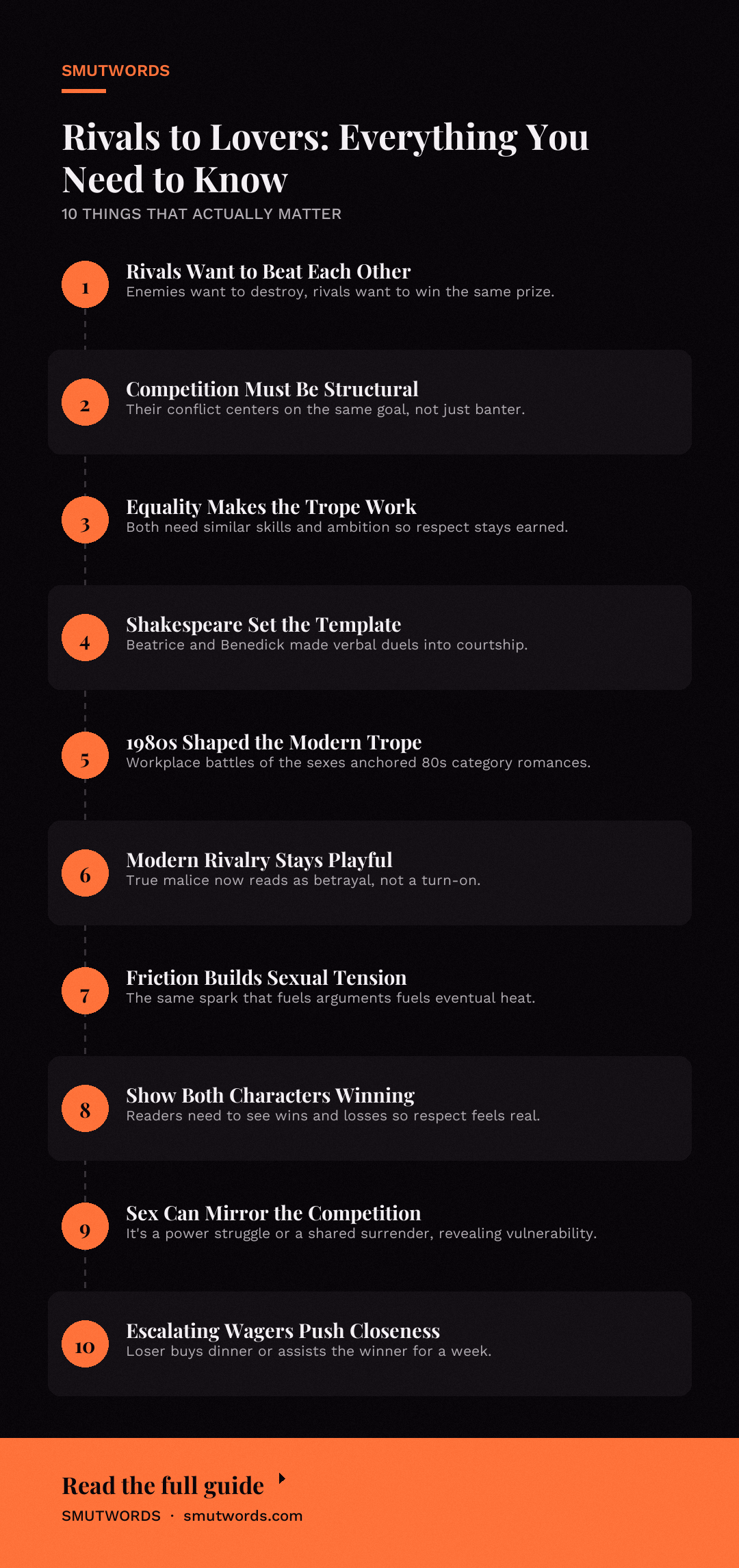
In a rivals story, the stakes are structural. They both want the corner office, the same book deal, the final spot on the team. Their conflict is not incidental, it is the entire basis of their working relationship.
This trope rests on the assumption of equality. A boss and an employee vying for the same promotion is a rivalry, but a boss and an employee in a power dynamic is something else entirely, closer to a grumpy hero soft for her setup or a workplace romance with a different imbalance.
For the trope to work, both parties need to be on roughly the same level, each possessing skills the other respects even as they hate to admit it. They are mirrors of each other in ambition and capability, which is why their attraction feels so inevitable when it finally breaks through.
A common misconception is that rivals to lovers is just enemies to lovers with a different job title. The distinction matters. Enemies usually want to destroy each other or at least see the other punished. Rivals want to beat each other.
There is a professional or personal respect embedded in the rivalry that is missing from true enmity. A rival may scheme to win the account, but they generally do not scheme to ruin the other person's life. Their conflict operates within rules, whether those are the rules of the boardroom, the courtroom, or the arena.
What does not count as rivals to lovers: two people who compete for the affection of a third party. That is a love triangle, not a rivalry. Two people who work at the same company but in completely different departments who happen to bicker is also not a rivalry, that is just banter.
The competition must be structurally central to why they are in each other's orbit.
Where Rivals to Lovers Comes From
The DNA of rivals to lovers runs deep in romance fiction, arguably back to the very origins of the genre. The Shakespearean model of Beatrice and Benedick in Much Ado About Nothing established the template of two sharp-tongued opponents whose verbal duels are a form of courtship.
But the recognizable genre trope, as modern readers know it, solidified in the romance novel boom of the 1980s and 1990s, when category romances from Harlequin and Silhouette leaned heavily into workplace and professional settings.
During that era, the rivalry was often framed as a battle of the sexes. A female protagonist would be fighting for recognition against a male counterpart who dismissed her, only to be forced to acknowledge both her competence and his own growing attraction. The structure served a specific feminist fantasy of the time: the heroine proving she belonged in the boardroom while also finding a partner who could meet her as an equal.
The trope has evolved considerably since then. Contemporary rivals to lovers stories are less concerned with proving a point about gender equality and more interested in the psychological dynamics of two ambitious people who accidentally find their match.
The setting has also expanded. While workplace and academic rivals remain the most common framing, the logic of rivalry now applies to chefs, artists, athletes, and even royals, as seen in many a prince/princess romance where two heirs to neighboring kingdoms compete for trade dominance.
The most notable shift in the last decade is the emphasis on consent and clarity. Older versions of this trope often leaned into acts of sabotage or petty cruelty that bordered on bullying. Modern readers expect the rivalry to stay playful and professional.
The characters can be sharp with each other, but true moments of malice or intended humiliation are now more likely to be treated as a betrayal that ends the rivalry, not a precursor to love. The underlying fantasy shifted from taming a hostile rival to meeting a worthy opponent who makes you better.
How It Shows Up in Erotica
In erotic fiction, the rivals to lovers structure is a gift because it provides a built-in engine for sexual tension before a single scene becomes explicit. The friction that fuels their arguments is the same friction that will fuel their eventual heat.
A strong erotic version of this trope spends its early pages building the competitive stakes so that when the release comes, it feels like the climax of a match, not just a physical encounter.
The most common setup is the workplace rivalry. Two lawyers fighting over a partnership, two chefs competing for a Michelin star, two journalists chasing the same exclusive story. The erotic charge comes from their proximity and their shared intensity.
The late nights in the office, the huddle over a shared document, the moment their hands brush reaching for the same file. These scenes operate on a forced proximity logic even when they are not technically trapped in a cabin. Their competition forces them into situations where ignoring each other becomes impossible.
Academic rivals is a strong variant that thrives in erotic romance. Two doctoral candidates competing for the same fellowship or the same advisor's approval. They circle each other in library stacks, trade barbs over seminar tables, and spend long nights in research labs where the tension between them has nowhere to go.
Enjoyed this? Get a free book.
Join the list and we will send a complete free story straight to your inbox, plus new releases every week after that. No credit card, no catch.
The intellectual sparring acts as foreplay, each exchange a bid to impress the other while pretending not to care. The reader gets a slow burn where every insult carries an undertone of I am thinking about you more than I should be.
What separates a flat execution from a strong one is the specificity of the competition. If the characters are rivals in name only, with the author telling us they are competitive but never showing the actual stakes, the eventual romance feels unearned.
A strong version gives us scenes where each character wins a round. We need to see both of them succeed and fail, so their mutual respect has a basis. We need to feel the sting of one losing the account to the other and the reluctant admiration that follows the loss.
The sexual dynamic in rivals to lovers erotica often mirrors the competition. The sex itself can be competitive, a power struggle where each is trying to make the other surrender first. It can also be a surrender, the one space where they stop fighting and admit they want each other.
Both approaches work, but the best stories use the sex to reveal vulnerability. The character who is ruthless in the boardroom might be unexpectedly tender in bed, or the one who plays it cool might beg. That reveal is where the trope earns its keep.
Playful baiting and public challenges are another common variation. Rivals who bet on outcomes with increasingly personal stakes. The loser has to buy dinner. The loser has to be the winner's assistant for a week. These escalating wagers are a time-honored way to push rivals into closer, more compromising situations.
The erotic charge comes from the negotiation itself, the frisson of making demands of each other that have nothing to do with the original competition.
Frequently Asked Questions
What is the difference between rivals to lovers and enemies to lovers?
Rivals want to beat each other in a specific competition. Enemies want to hurt or destroy each other. Rivals share a mutual respect that is usually hidden beneath the animosity, while enemies often have genuine reasons for hating each other.
A rivalry has rules and a shared arena. Enmity operates without limits.
Can rivals to lovers work in a short story?
Yes, but it needs to be lean. The author must establish the competitive dynamic quickly and give each character at least one clear victory over the other before the romantic shift.
A short story can work if the rivalry is vivid and specific. The reader needs to believe these two are evenly matched and that their attraction grows out of that balance.
What makes a good rivals to lovers couple?
They need to be evenly matched in skill and ambition. If one is clearly superior, the dynamic becomes patronizing rather than exciting. They also need complementary weaknesses.
One might struggle with asking for help while the other struggles with trust. Their rivalry should expose those vulnerabilities over time, which creates the intimacy that leads to love.
Is rivals to lovers always a slow burn?
Often, but it does not have to be. The rivalry can combust quickly if the physical attraction is immediate and the emotional recognition takes longer.
The more common pattern is a slow burn because the competitive shell takes time to crack. But a short, intense rivalry that turns physical fast can work if the emotional payoff lands before the story ends.
Can rivals to lovers be combined with other tropes?
Rivals to lovers combines naturally with forced proximity, since competitors often end up working closely together in high-stakes settings. It also pairs well with hate to love, which is a broader umbrella.
Workplace rivals and academic rivals are the two most common structural pairings.
What is the difference between workplace rivals and workplace enemies?
Workplace rivals compete for the same promotion, account, or recognition within the rules of their organization. Workplace enemies sabotage each other, undermine each other's work, or actively try to get the other fired.
A rivalry can sour into enmity if one character goes too far, which is often a turning point in the story rather than the baseline.
Final Thoughts
The rivals to lovers trope works because competition is one of the most reliable engines for intimacy. Two people who measure themselves against each other are already paying close attention to every detail of the other's life, which is half the foundation of attraction.
If you want the gold standard of this dynamic, pick up a romance between two chefs competing for the same restaurant space or two attorneys fighting over a single partnership. The more evenly matched they are, the sweeter the surrender.







Loading comments…