
Search "taboo erotica" and you get a wall of lists: "100 Taboo Stories to Read Tonight," "Total Taboo," clickbait with a blurry cover and a warning label. Most of those lists don't bother to explain what taboo actually means beyond "this content might get a site in trouble." That's a shame, because the definition is doing all the interesting work. Not every forbidden story is the same kind of forbidden. An affair and a sci-fi ritual are both taboo, and they don't touch the same nerve at all.
This is the distinction that most write-ups miss: taboo erotica spans a spectrum of risk, and the risk itself is what makes the fantasy work. A cheating story and a monster story run on completely different mechanics. If you know which kind of risk you're actually craving, you stop wasting time on stories that never get under your skin.
What makes something taboo instead of just kinky
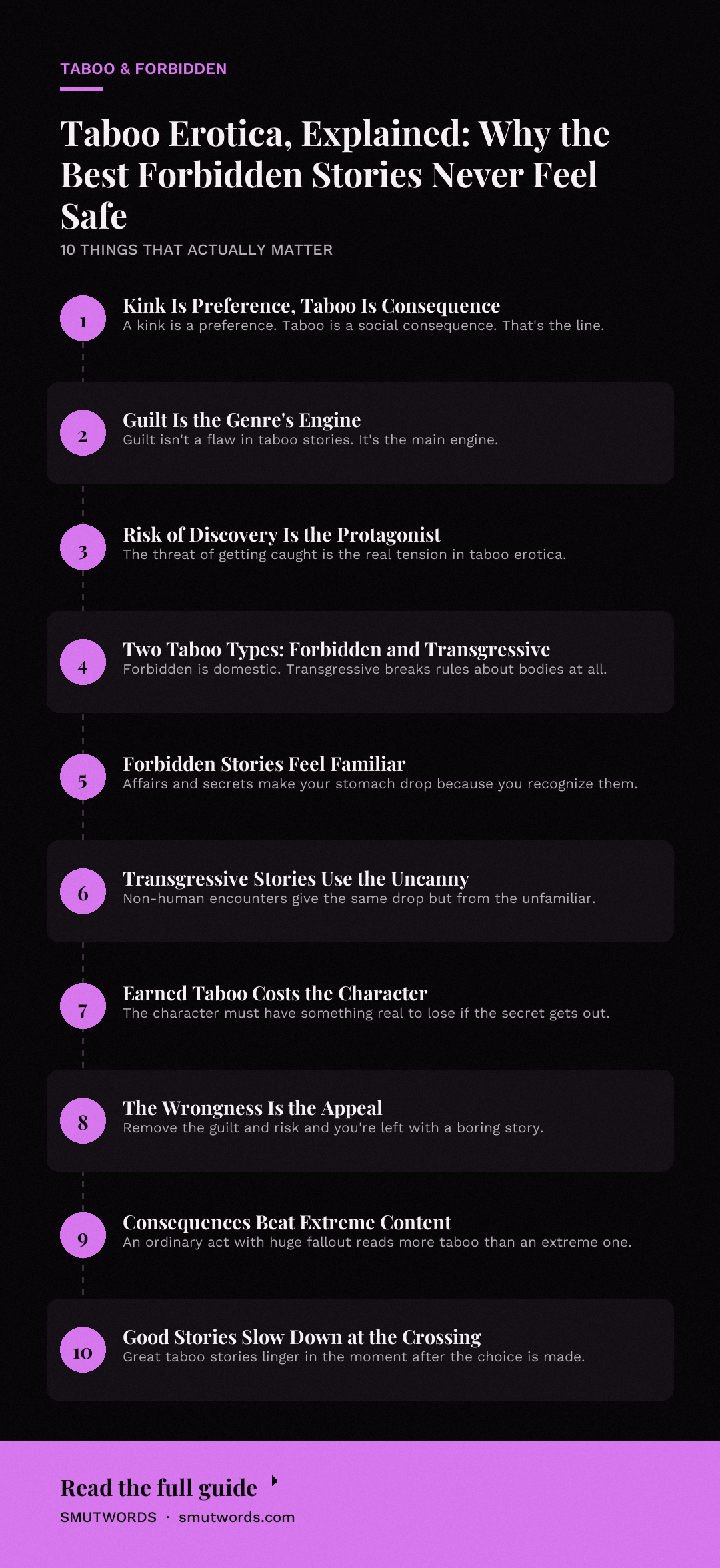
A kink is a preference. Taboo is a social consequence. That's the line that actually separates the two. Spanking is a kink: nobody loses their job over a latex glove fetish, and the story's tension comes from the act itself. Taboo erotica does something different. It puts a character in a position where getting caught, or even just admitting what they did, would cost them something real: a marriage, a reputation, a place in their community. The charge comes less from the sensory experience and more from the knowledge that there's no safe way to talk about this afterward.
That's why guilt shows up so often in taboo stories, and why it's not a flaw in the writing. Guilt is the genre's main engine. A story that skips the guilt is usually a story that's skipped the risk too. The "wrongness" has to be present in the character's own head, not just in the reader's knowledge of what society would think, or the story loses its spine.
Risk of discovery is the real protagonist
Take a story about a married woman texting her husband's colleague. The sex is important, sure, but the structural tension comes from the phone. The risk of discovery is the real protagonist: a message sent to the wrong contact by accident, a husband reaching for the wrong screen, the six-second delay between hitting send and knowing the recipient is alone with their phone. The charge doesn't come from the physical act. It comes from the fact that she could be caught at any moment, and that she keeps going anyway.
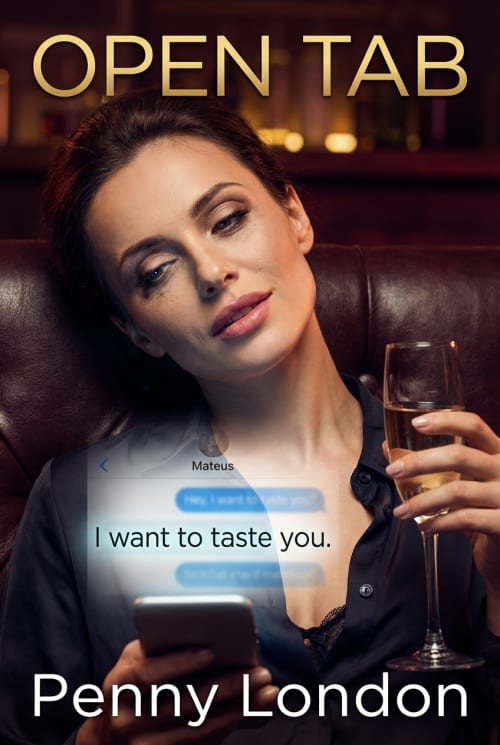
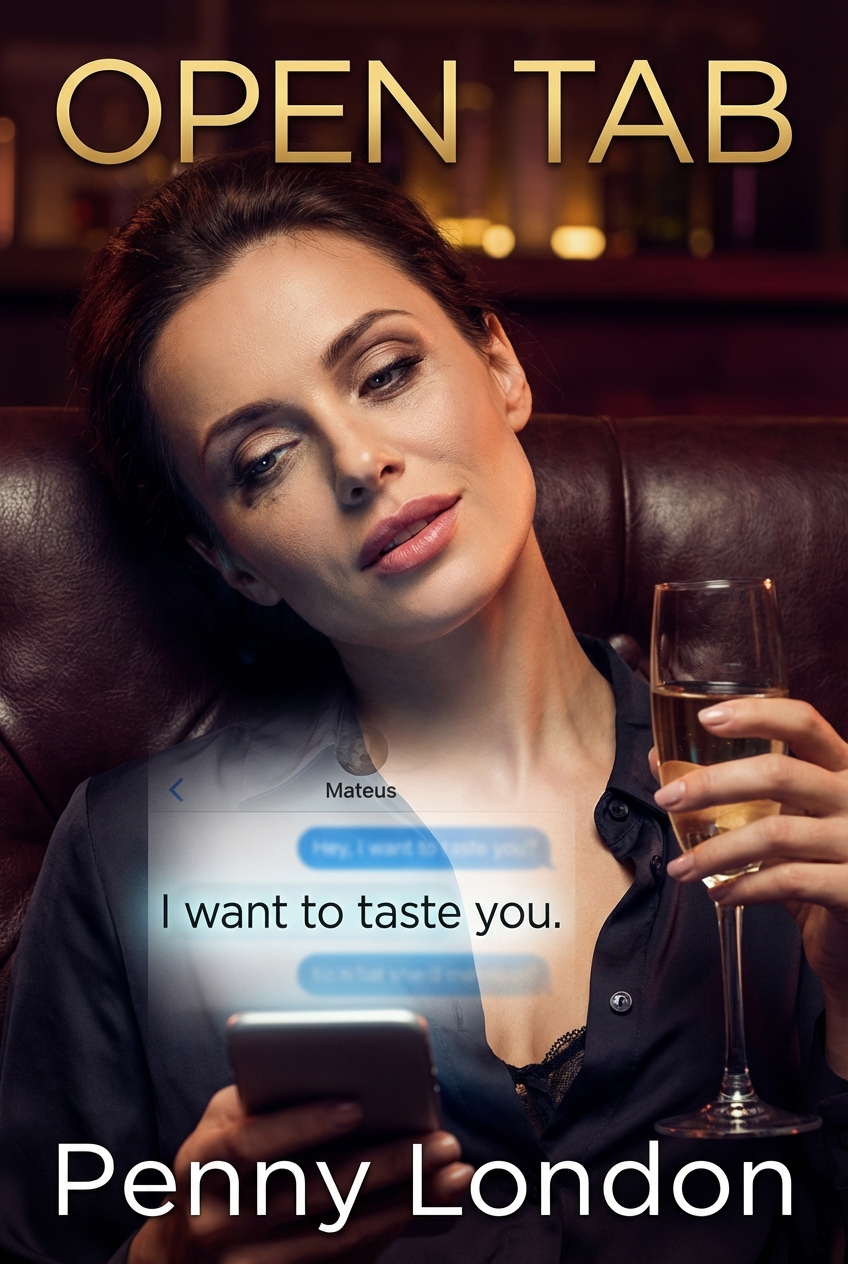
Open Tab tracks that exact risk: a marriage cracked open by a secret sexting affair that starts small and grows teeth.
This is where taboo erotica separates itself from standard romance or even standard erotica. Most genres want the tension to resolve safely. Taboo stories keep the tension alive by refusing to let the secret fully settle. Even the happy endings in this genre tend to keep the risk humming somewhere in the background, because the thing that made the story exciting in the first place hasn't disappeared. It's just been folded into the relationship.
The two kinds of taboo: forbidden vs. transgressive
Here's the split that matters, and it's the one almost nobody names out loud:
Taboo because forbidden. The social consequence is the whole engine. An affair. Secrecy. Doing something in a marriage that violates a promise. The characters know exactly what the rules are, and they break them anyway. This is the most grounded version of the genre, and it's the one that feels closest to real life, which is precisely why it lands so hard for so many readers. The stakes are domestic: a ring, a wedding photo, a shared mortgage. Open Tab and She Left Her Panties There both live in this territory, and both are stronger for staying there.
Taboo because transgressive. The content itself is something a culture would raise an eyebrow at even without a marriage involved. Beastiality-adjacent stories, sci-fi ritual content, encounters with beings that aren't human at all. The characters aren't breaking a promise to a spouse; they're breaking a rule about what bodies are allowed to do together at all. Zoo After Dark runs this way: a woman drawn back to the city zoo after hours, where an unnamed hunger takes over. And The Implantation Parade pushes the same logic into ceremonial sci-fi territory, where the chosen woman becomes the living centerpiece of a forbidden fertility rite.
The difference matters because the two kinds of taboo produce completely different reading experiences. The forbidden kind makes your stomach drop with recognition: you can imagine the text thread, the hotel hallway, the half-open door. The transgressive kind gives you that same drop, but it comes from the uncanny instead of the familiar. Both are taboo erotica. Neither is a substitute for the other.
What separates earned taboo from plain shock value
Shock value is cheap. Any writer can put a forbidden act on the page and call it a day. What separates a taboo story that earns its tension from one that's just rattling the cage is whether the risk actually costs the character something.
A few things tend to separate the two:
- The taboo has consequences inside the story itself, past whatever the reader feels about it. The character must have something to lose if the secret gets out.
- The character wants the thing despite knowing exactly what it costs. Indifference doesn't enter into it. A protagonist who doesn't care about the social consequence isn't in a taboo story; they're just in a kinky one.
- The story slows down around the moment of crossing. It doesn't flash a taboo image and move on. It sits in the seconds after the choice, in the character's body and in the reader's chest.
- The forbidden thing feels genuinely compelling on its own merits, past the simple thrill of breaking a rule. The reader has to be able to see why the character would risk everything for this.
Stories that fumble the fourth point are the ones that read as stunt fiction. They pick the most shocking content they can find and assume that's enough. But nobody's actually convinced by a character who risks their whole life for something that reads as generic. The risk only works when the reward is specific enough to justify it.
Enjoyed this? Get a free book.
Join the list and we will send a complete free story straight to your inbox, plus new releases every week after that. No credit card, no catch.
Why the "wrongness" is part of the appeal
Readers who are new to taboo erotica often ask why the guilt and risk are there at all. Wouldn't the story be better if the affair were fine, if the marriage were open, if the ritual were legal? No, and this is the single biggest misunderstanding about the genre. The guilt is the appeal. The risk is the appeal. A forbidden story with the forbidden removed is just a comfortable, boring story.
Think about it in terms of the body's response. A story about a woman who's completely free to be with anyone she wants produces a very different kind of arousal than a story about a woman who has to hide a text thread from her husband. The second one carries a spike of adrenaline that the first one never gets close to. That spike is the genre's signature note. Remove it and you've removed the reason the genre exists.
She Left Her Panties There understands this instinctively. The title alone is a risk made physical: the panties are evidence. They're a confession that could be found at any time. The entire story runs on the question of whether they get discovered, and by whom, and what happens to the character's marriage when they are.
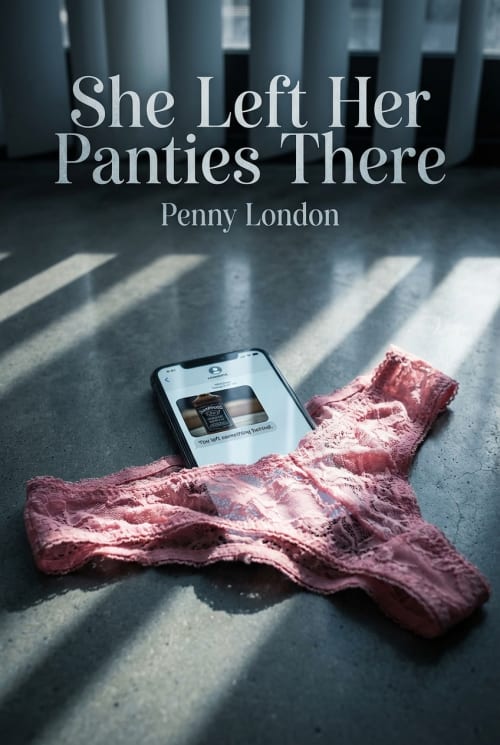
She Left Her Panties There turns a single piece of evidence into the whole engine of the story.
FAQ: What readers actually ask about taboo erotica
Is it normal to be turned on by taboo content I'd never act on in real life? Yes, and it's more common than you'd think. The gap between fantasy and reality is exactly what makes fiction useful. Taboo erotica offers a safe container for exploring impulses that would be destructive or impossible in real life: an affair, a transgressive ritual, a hunger you can't name. The story lets you feel the risk without paying the price. That's the entire point of the genre, and it's not something to be ashamed of. If anything, the reader who can enjoy a taboo fantasy and still keep their real-life boundaries intact is doing exactly what the genre was built for.
Does the story have to end in disaster for it to count as taboo? No, and honestly, the opposite is usually more satisfying. A story that ends in a ruined marriage is just a tragedy with sex scenes. The better taboo stories let the secret survive, or let the characters find a way to live with what they've done. The tension doesn't have to resolve into punishment. It can resolve into a new equilibrium, one where the characters carry the secret together and the risk stays alive underneath everything else. Open Tab is a good example of this: the affair grows teeth, but the story is more interested in what the secret does to the marriage than in punishing the character for wanting it.
Which is better: the forbidden kind or the transgressive kind? They're not competing. They're two different moods. If you want a story that makes your stomach drop because it feels recognizable, the forbidden kind is where you should look: affairs, secrets, the risk of discovery in your own kitchen. If you want the same drop from the uncanny instead, the transgressive kind is your lane: rituals, non-human encounters, ancient hungers that don't care about your modern social rules. Zoo After Dark and The Implantation Parade are both strong entry points for the transgressive side. The forbidden side lives in She Left Her Panties There and Open Tab.
Why do so many taboo stories involve marriages? Because marriage is the most legible promise a society can make about sex. It's a vow with a legal document attached. Breaking it carries immediate, understandable consequences: trust, jealousy, the possibility of losing the life you built. That makes it the perfect scaffolding for a taboo story, because the risk is instantly legible to any reader. You don't need to explain why an affair is risky. Everyone already knows.
Does the content matter more than the consequences? Usually the other way around. A story about a completely ordinary act that carries a huge consequence (a text message that could end a marriage) often reads more taboo than a story about an extreme act with no consequence at all. The consequence is doing the heavy lifting. If a character can do something shocking and face zero fallout, the story's just an act list. The taboo lives in the cost.
How to tell a good taboo story from a bad one
There's a reliable test, and it's simpler than you'd think. Ask what the character has to lose. If the answer is "nothing," the story is just decorative dressing. A good taboo story gives a character something real: a marriage, a reputation, a place in a community, a sense of self that she'd lose if the truth came out. The story then spends its time making the reader understand what that thing is worth, so that when the character risks it, the reader feels the drop.
The other test is whether the story slows down around the crossing. A good taboo story never jump-cuts past it; it zooms in slow on the exact moment a character decides to do the thing they shouldn't do, then lingers in the moment after, when they have to live with having done it. Stories that rush past that moment are just using taboo as a garnish. Stories that live there are the ones you'll still be thinking about the next morning.
Final Thoughts
If you're curious about the forbidden side of taboo erotica, start with She Left Her Panties There. It's the cleanest example of the risk-of-discovery engine on the site, free to read start to finish, and it earns every page of its tension. If the transgressive side is what you're hunting for, go straight to The Implantation Parade for a ritual that shouldn't exist and a woman who walks into it anyway. The wrongness is the point. The only question is which wrongness you came looking for.





Loading comments…